
Wireless-resource-dispatching method during multi-cell cooperation in relay-aided communication system
A technology of wireless resource scheduling and multi-cell cooperation, applied in wireless communication, electrical components, etc., can solve the problems of interference uncertainty, unpredictable channel state, difficult link adaptive wireless resource management, etc. Effect
Patent Information
- Authority / Receiving Office
- CN · China
- Patent Type
- Patents(China)
- Current Assignee / Owner
- Publication Date
- 2015-04-15
- Estimated Expiration
- Not applicable · inactive patent
Smart Images
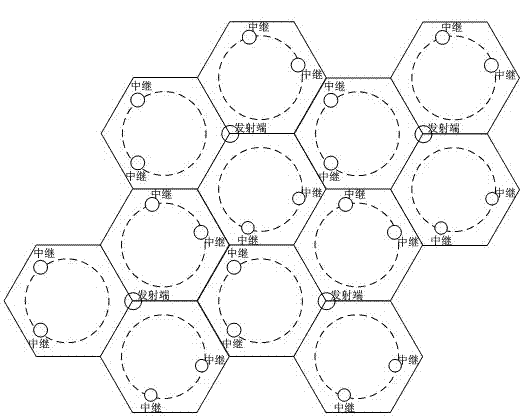
Figure 1 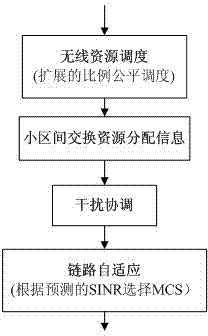
Figure 2 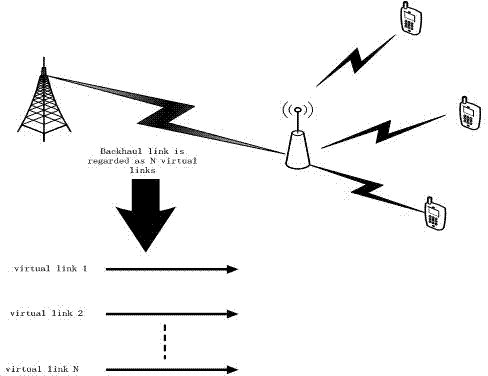
Figure 3
Abstract
Description
technical field
[0001] The present invention relates to the field of wireless communication, in particular to a wireless resource scheduling method in consideration of multi-cell coordination in a relay-assisted communication system. Background technique
[0002] Early research on dynamic resource scheduling was mainly limited to single-cell systems, where each transmitter independently processed the signals of all mobile receivers in its serving cell; mobile receiver signals from other cells were used as interference signals, resulting in multi-cell systems Interference-limited features, especially for mobile receivers at the cell edge. How to better schedule multi-cell mobile receivers, so that the scheduled mobile receivers can use system resources more reasonably, so as to effectively weaken the adverse effects of inter-cell interference, is the key problem to be solved by multi-cell dynamic resource scheduling.
[0003] We usually use channel state-based wireless sched...
Examples
Embodiment Construction
[0032] The present invention will be further described below in conjunction with the accompanying drawings.
[0033] The relay-assisted and multi-cell cooperative communication system in the wireless resource scheduling method includes a cooperative cluster of M cells, and one cell includes L relay stations and N mobile receiving ends. The relay-assisted and multi-cell In a cell in the cooperative communication system, only one mobile receiving end is scheduled on the same time-frequency resource for each transmission; where M is an integer greater than 1, and L and N are integers greater than or equal to 1; the wireless resource scheduling The method includes the following steps:
[0034]1) The mobile receiving end receives the downlink reference signal, and calculates the received power value of the reference signal from each transmitting end accordingly, and then determines the serving node and the main interference node of the mobile receiving end, and calculates the servi...