
Image super-resolution method based on improved non-local constraints and local self-similarity
A self-similar, non-local technology, applied in the field of image processing, it can solve the problems of blurred edges of high-resolution images, prone to errors, poor visual effects, etc., and achieve the effect of more image details and sharpening image edges.
Patent Information
- Authority / Receiving Office
- CN · China
- Patent Type
- Patents(China)
- Current Assignee / Owner
- Publication Date
- 2016-04-13
Smart Images
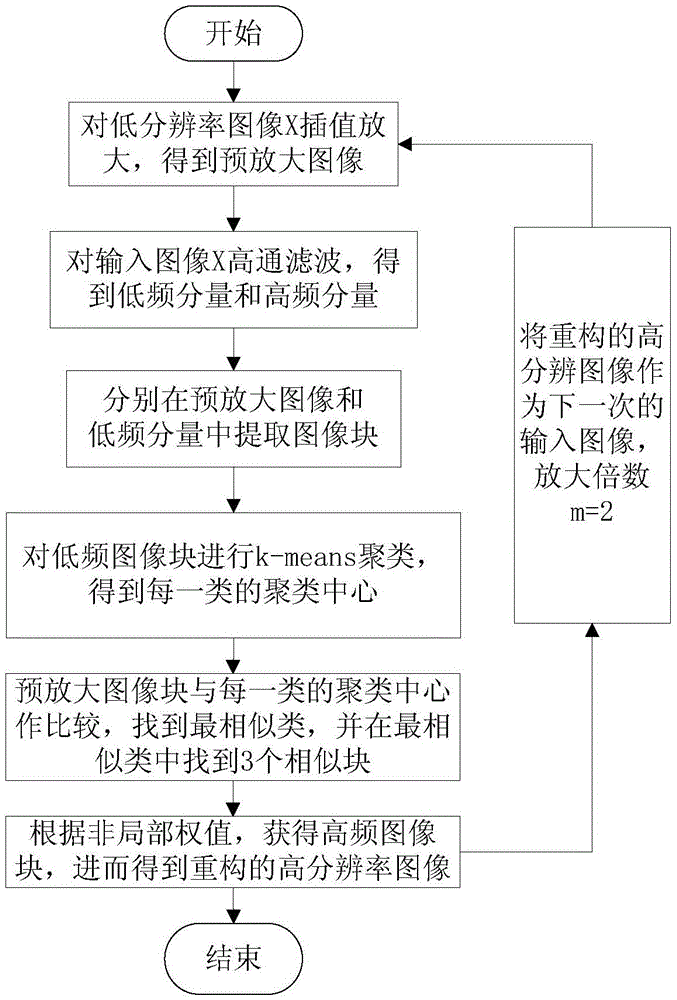
Figure 1 
Figure 2 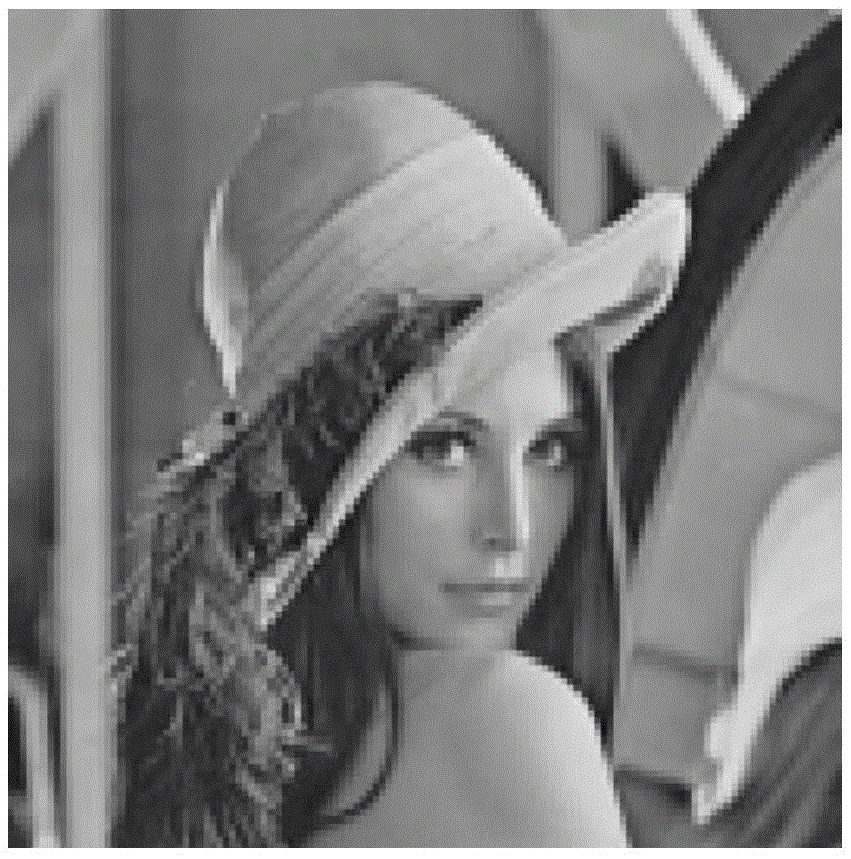
Figure 3
Abstract
Description
technical field
[0001] The invention belongs to the technical field of image processing, and specifically relates to an image resolution method, which can be used to super-resolve an input low-resolution image to obtain a high-resolution image. Background technique
[0002] Image super-resolution technology is a discipline that improves image clarity and suppresses noise through various technical means in order to obtain more accurate image information. It is an important and challenging research content in image processing. For the image super-resolution problem, researchers have proposed many methods.
[0003] In 2008, Yang et al. proposed an image super-resolution reconstruction method based on example learning, see J. Yang, J. Wright, T. Huang, and Y. Ma, "Image super-resolution ass parse representation of raw image patches", inProc.IEEEConf.Comput.Vis. PatternRecognit., 2008, pp.1-8. The basic idea of this method is to randomly select some blocks from some high-reso...
Examples
Embodiment Construction
[0030] refer to figure 1 , the implementation steps of the present invention are as follows:
[0031] Step 1, input a low-resolution image X, and interpolate and enlarge it.
[0032] Enter as image 3 For the low-resolution image X shown, set the magnification factor λ=1.25, perform bicubic interpolation and amplification on the low-resolution image X, and obtain the pre-amplified image Y o
[0033] Step 2, filter the low-resolution image X.
[0034] Use a Gaussian high-pass filter to filter the input low-resolution image X and decompose it into high-frequency components X h and the low frequency component X o .
[0035] Step 3, using the high frequency component X h , low frequency component X o and the prescaled image Y o , perform super-resolution reconstruction on the input low-resolution image X.
[0036] 3a) In the low frequency component X o Extract low frequency image blocks from X o j ,j=1,...,M, M is the number of low-frequency image blocks, in the pre-a...