
Image restoring method based on three dictionary block matching
A block matching and dictionary technology, which is applied in the field of restoration of blurred images, can solve the problem of not being able to restore high-frequency details of images well, and achieve the effect of multi-image details and sharpening of image edges.
Patent Information
- Authority / Receiving Office
- CN · China
- Patent Type
- Patents(China)
- Current Assignee / Owner
- Publication Date
- 2013-01-23
Smart Images
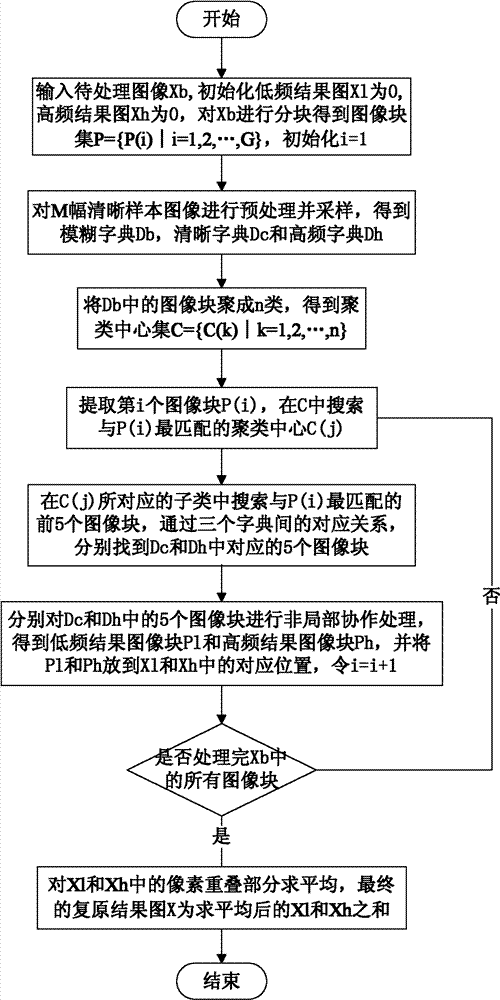
Figure 1 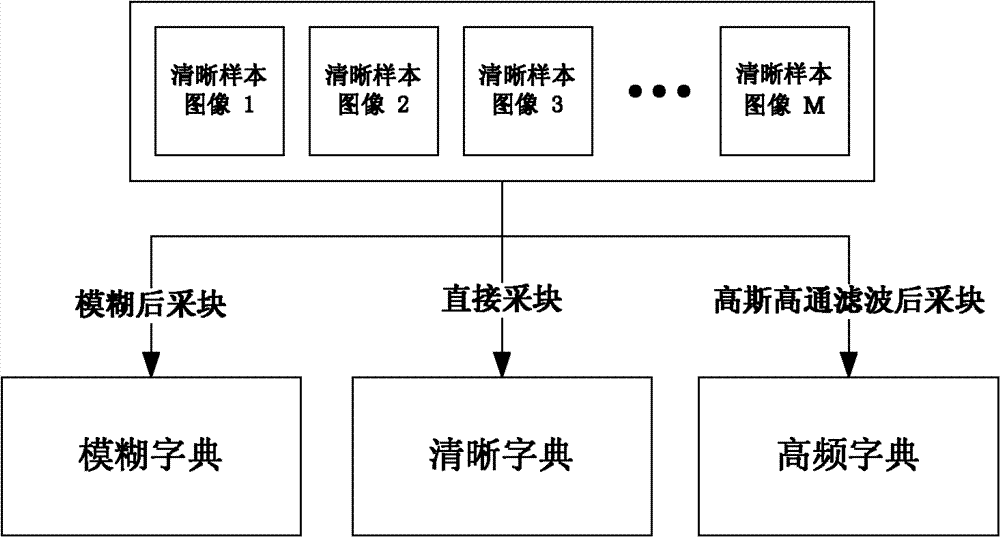
Figure 2 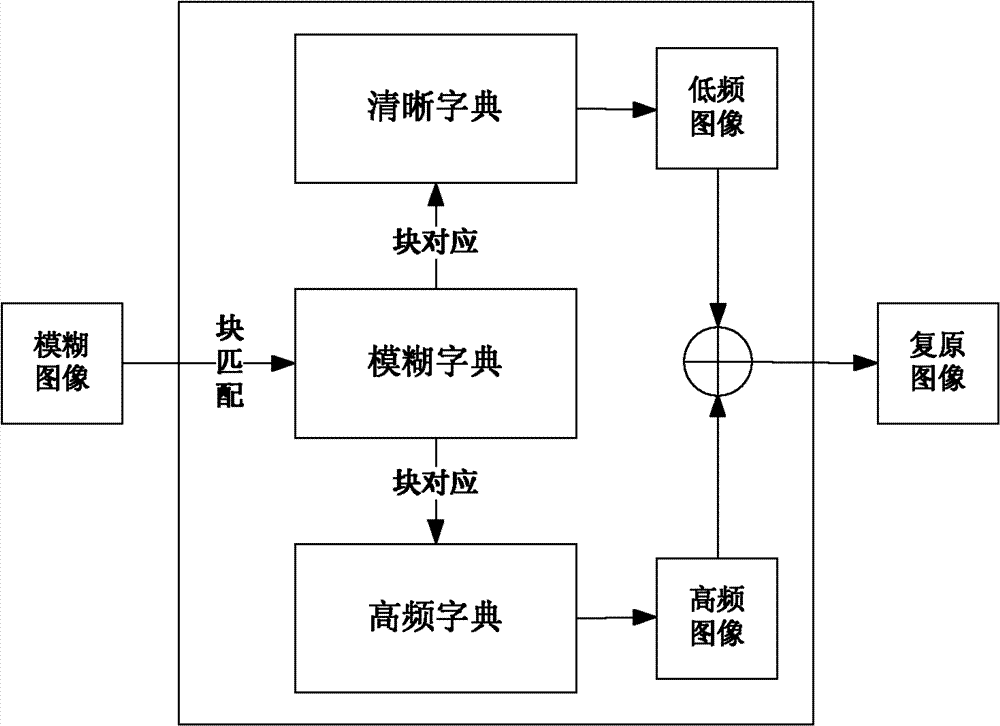
Figure 3
Abstract
Description
technical field
[0001] The invention belongs to the technical field of image processing, in particular to a method for restoring blurred images, which can be used for restoring blurred images of various known blur types. Background technique
[0002] Image restoration refers to the removal or mitigation of image quality degradation in the process of acquiring digital images. It is an important and challenging research content in image processing. For the image restoration problem, researchers have proposed many methods.
[0003] Traditional restoration methods include inverse filtering, Wiener filtering, Kalman filtering and generalized inverse singular value decomposition, etc. These methods have been widely used in image restoration, but these methods require blurred images to have a high signal-to-noise ratio , methods such as inverse filtering are only suitable for images with high SNR, which limits the practical application of traditional restoration methods. Another ...
Examples
Embodiment Construction
[0032] refer to figure 1 , the specific implementation steps of the invention are as follows:
[0033] Step 1, input a blurred image X to be processed b , initialize the blurred image X b The low frequency result graph of X lis an empty matrix, i.e. X l = 0, initialize the blurred image X b The high-frequency result graph of X h is an empty matrix, i.e. X h =0, the low-frequency result map X l The matrix size and high frequency result plot of X h The size of the matrix is the same as the blurred image X to be processed b are the same size.
[0034] Step 2, the blurred image X to be processed b Carry out a block with a size of 5×5, and overlap 4 pixels between adjacent blocks during the block process to obtain a set of image blocks P={P(i)|i=1, 2,...,G}, and initialize i= 1.
[0035] Step 3, assuming that the number of clear sample images used to construct the dictionary M=5, the fuzzy dictionary D b , clear dictionary D c and high frequency dictionary D h The ...