
Video super-resolution method based on key frame and non-local constraints
A non-local, super-resolution technology, applied in image analysis, image data processing, instruments, etc., can solve the problems of limited high-frequency information, high requirements, and degraded visual quality, and achieve sharpened image edges and multiple image details. Effect
Patent Information
- Authority / Receiving Office
- CN · China
- Patent Type
- Patents(China)
- Current Assignee / Owner
- Publication Date
- 2016-05-25
Smart Images
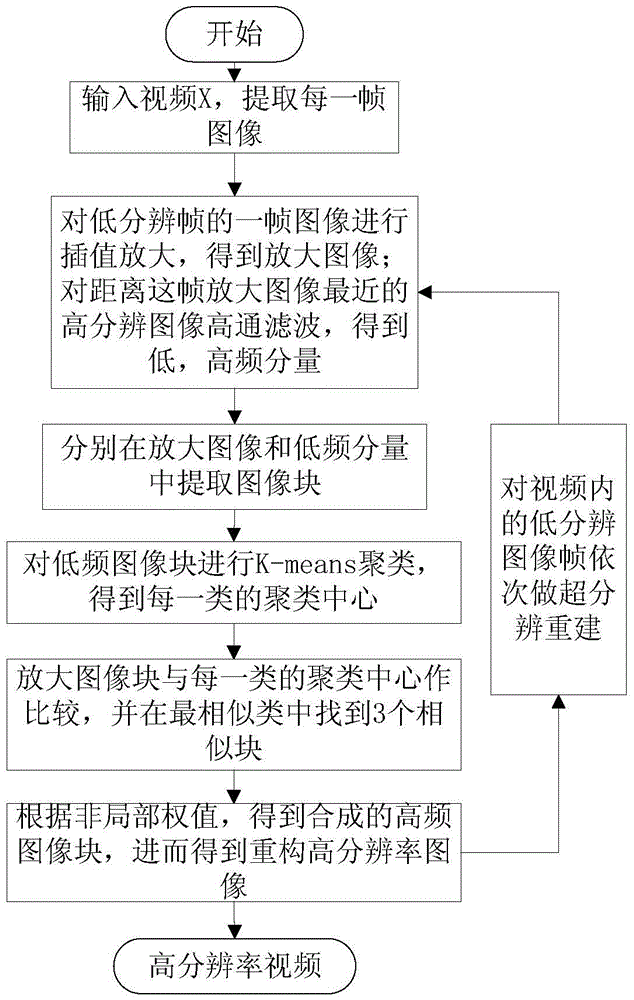
Figure 1 
Figure 2 
Figure 3
Abstract
Description
technical field
[0001] The invention belongs to the technical field of video image processing, in particular to a method for super-resolution of low-resolution video, which can be used to enhance or restore video images. Background technique
[0002] Video super-resolution technology is a discipline that improves video clarity and suppresses noise through various technical means in order to obtain more accurate video information. It is an important and challenging research content in video image processing. For the video super-resolution problem, researchers have proposed many methods.
[0003] In 2008, Brandie et al. proposed an effective video super-resolution method. When transmitting compressed video, several frames of original uncompressed images are transmitted as key frames, and these key frames are used as a database, because there is a difference with non-key frames. great similarity. Therefore, when non-key frames are paired in these key frames, the pairing erro...
Examples
Embodiment Construction
[0036] refer to figure 1 , the implementation steps of the present invention are as follows:
[0037] Step 1, input video X, and extract each frame of image in it.
[0038] Input video X, which includes high-resolution images and low-resolution images, and the image distribution relationship is: the first and last two frames are high-resolution images, starting from the first frame of high-resolution images, every eight frames of low-resolution images are A frame of high-resolution images until the end frame;
[0039] Extract each frame of video X to get high-resolution image frame X h ,h=1,...,M, and the low-resolution image frame X t ,t=1,...,N, and define these high-resolution images as key frames, and define these low-resolution images as non-key frames, where M is the number of frames of high-resolution images in the video, and N is the low-resolution images in the video. The number of frames of the resolution image.
[0040] Step 2, using the subdivisional relations...