
Statistics channel computing method based on asymmetric spatial structure and non-uniform scatterers
A technology of spatial structure and spatial statistics, applied in the direction of space transmit diversity, baseband system components, diversity/multi-antenna system, etc., can solve the problems of asymmetric distribution environment, lack of physical concept statistical channel simulation model, etc.
Patent Information
- Authority / Receiving Office
- CN · China
- Current Assignee / Owner
- Publication Date
- 2014-04-09
Smart Images
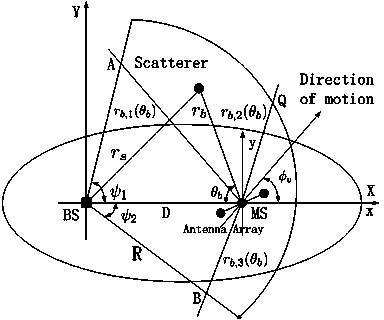
Figure 1 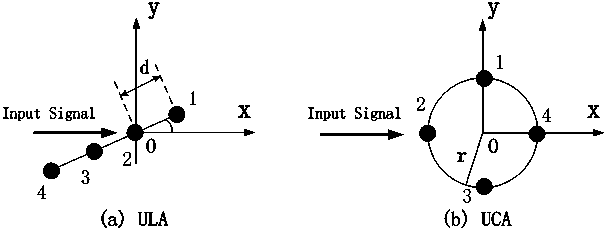
Figure 2 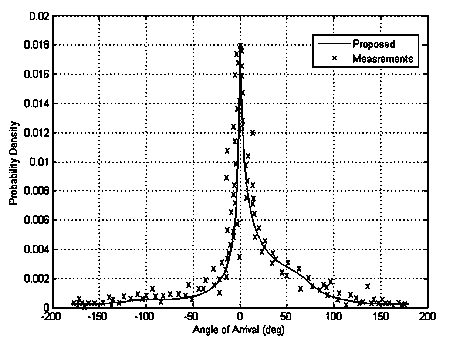
Figure 3
Abstract
Description
technical field
[0001] The invention belongs to the technical field of multi-antenna MIMO channel modeling, and in particular relates to a statistical channel calculation method based on an asymmetrical space structure and distributed with non-uniform scatterers. Background technique
[0002] Mobile communication is a technology that uses wireless channels for information transmission. The wireless channel is easily affected by various noises, interference and other channel factors, and the system is subject to great uncertainty due to the user's movement and channel dynamics, which seriously affects the communication efficiency and quality. Therefore, the wireless channel must become a A reliable high-speed communication medium has severe challenges, and the research on wireless channels has been concerned and valued by researchers for many years. Establishing a wireless channel model that accurately describes channel multipath effects is also an important basis for analyz...
Examples
Embodiment Construction
[0072] The technical solutions provided by the present invention will be described in detail below in conjunction with specific examples. It should be understood that the following specific embodiments are only used to illustrate the present invention and are not intended to limit the scope of the present invention.
[0073] To realize the statistical channel calculation method based on the asymmetric spatial structure / non-uniform scatterer distribution proposed by the present invention, first
[0074] To establish an asymmetric spatial statistical channel model: assume that a directional antenna is set in a cell base station (BS: base station), and the cell is subdivided into several sector cells under the coverage of the antenna. In the channel model, the distance between the mobile station (MS: mobile station) and the base station (BS: base station) is D, and all scatterers are distributed in the fan-shaped scattering area R with the BS as the coverage cell, such as figure ...