
A large and small leg device with knee joint parameter measurement suitable for exoskeleton auxiliary support robot
An auxiliary support and parameter measurement technology, applied in the field of service robots, can solve the problems of soldiers being exhausted and difficult to persist in independent combat for a long time, and achieve the effect of flexible movement, novel structure and reliable use
Patent Information
- Authority / Receiving Office
- CN · China
- Patent Type
- Patents(China)
- Current Assignee / Owner
- Publication Date
- 2017-10-27
- Estimated Expiration
- Not applicable · inactive patent
Smart Images
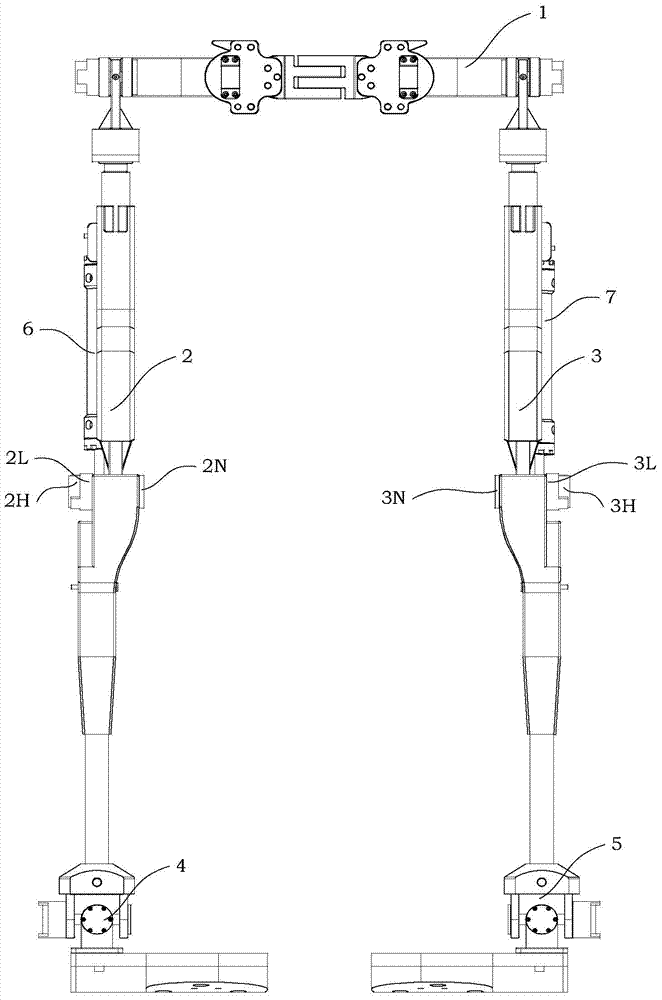
Figure 1 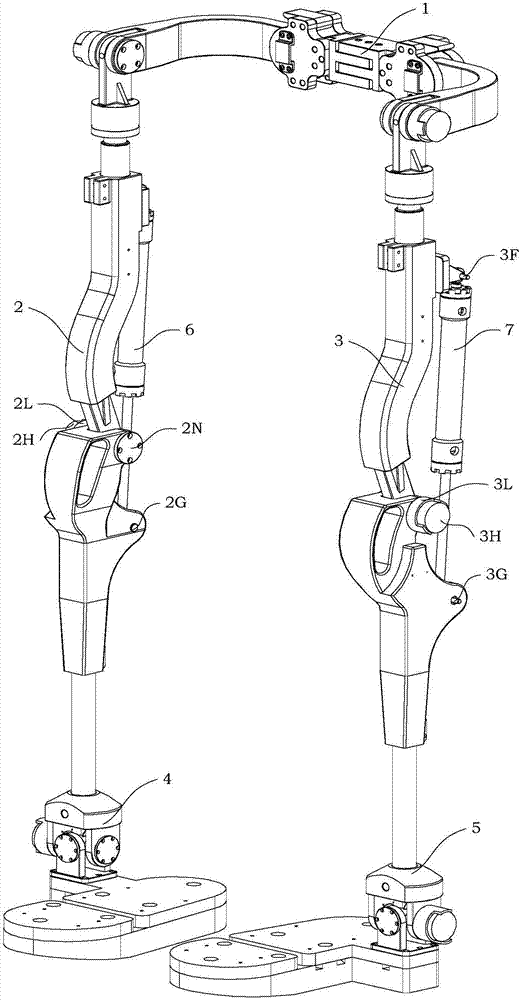
Figure 2 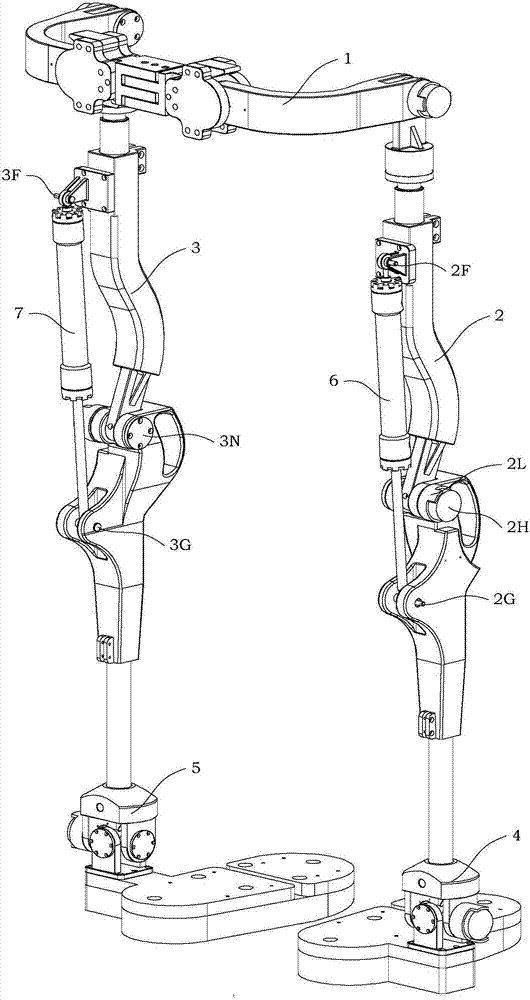
Figure 3
Abstract
Description
technical field
[0001] The design of the invention belongs to the field of service robots, and relates to the auxiliary support and rehabilitation training for human lower limbs by a lower limb exoskeleton robot. Background technique
[0002] The human legs provide a load-bearing and transportation platform, especially in environments that are not suitable for wheeled transportation, and the biped shows strong mobility. Weight bearing is one of the most common problems faced by human beings.
[0003] For soldiers, firefighters and disaster relief personnel, the payload accounts for a large part of their overall weight, and it is both inevitable and their responsibility to carry these loads. Carrying a heavy load is not only tiring, but also potentially mentally and physically damaging. In order to alleviate this burden, lower limb auxiliary support exoskeleton mechanical equipment came into being.
[0004] In the military, many advanced equipment have improved the soldier...
Examples
Embodiment Construction
[0044] The present invention will be further described in detail below in conjunction with the accompanying drawings.
[0045] The present invention is an exoskeleton auxiliary support robot with joint parameter measurement, and the exoskeleton auxiliary support robot includes a waist device 1, a large and small leg device and a foot device. The large and small leg devices include a left leg assembly 2 and a right leg assembly 3; a left hydraulic cylinder 6 is installed on the left leg assembly 2, and a right hydraulic cylinder 7 is installed on the right leg assembly 3. The foot device includes a left foot assembly 4 and a right foot assembly 5 . The exoskeleton auxiliary supporting robot of the present invention is designed for simulating the characteristics of the waist, legs and feet of the human body.
[0046]In the present invention, the waist device 1 is designed with left and right hip joints. The left knee joint is designed in the left leg assembly 2, and the right ...