
A Facial Expression Recognition Method Based on Two-step Dimensionality Reduction and Parallel Feature Fusion
A facial expression recognition and feature fusion technology, applied in the field of facial expression recognition, can solve the problem of dimensional disaster, affecting the solution of dimensionality reduction projection axis, deepening matrix singularity, etc., to achieve the effect of improving the recognition rate
Patent Information
- Authority / Receiving Office
- CN · China
- Patent Type
- Patents(China)
- Current Assignee / Owner
- Publication Date
- 2017-10-17
Smart Images
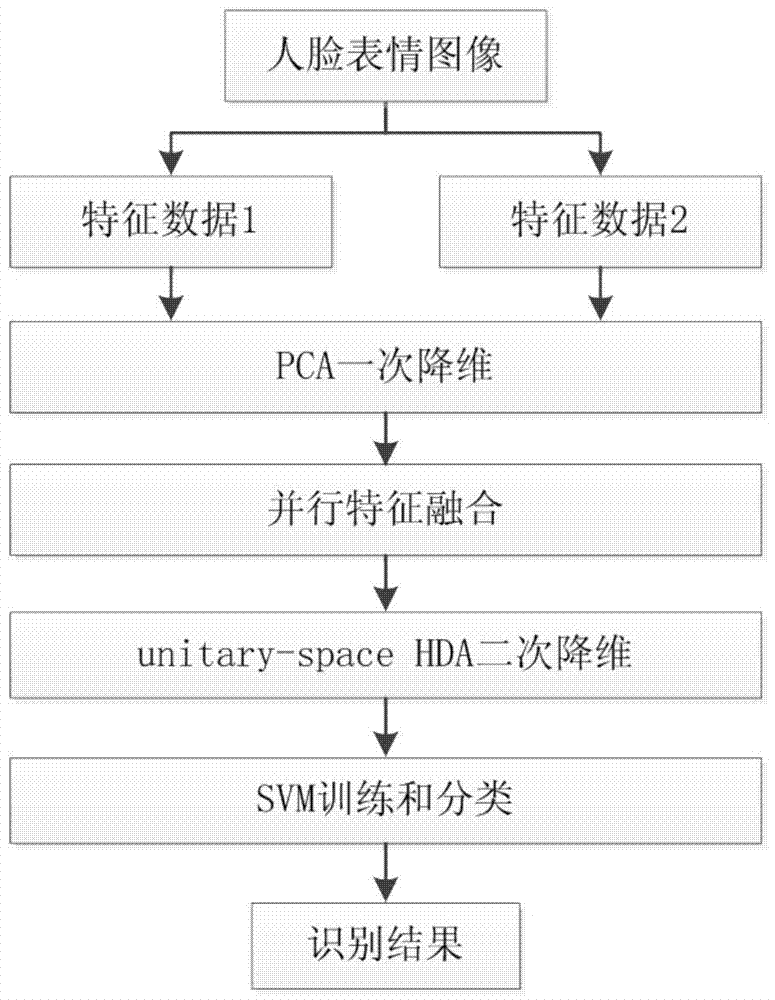
Figure 1 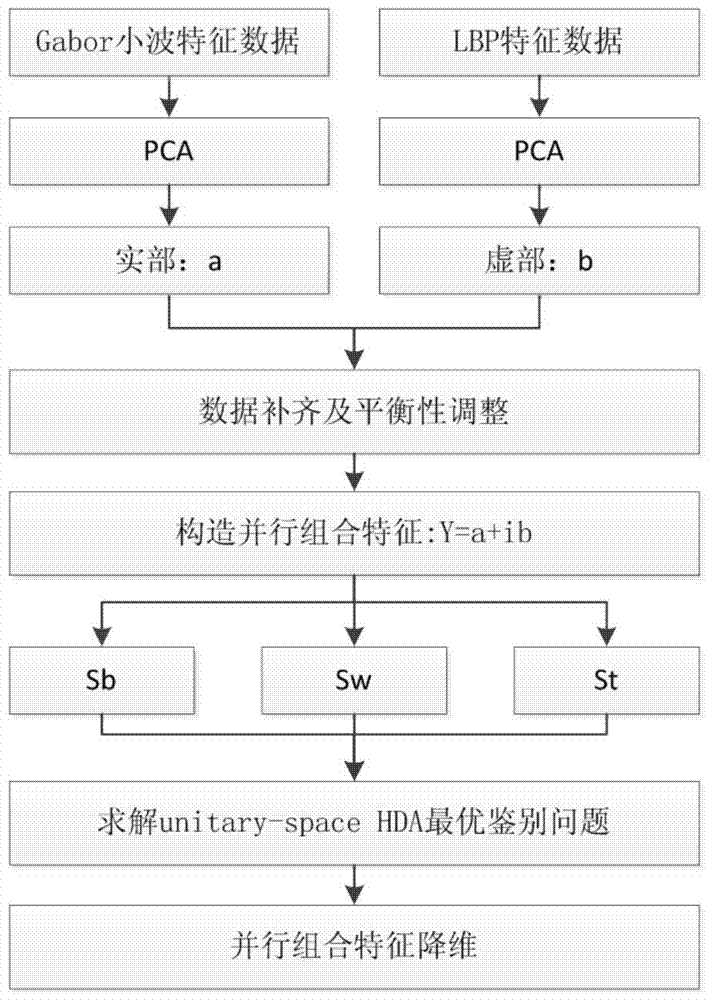
Figure 2 
Figure 3
Abstract
Description
technical field
[0001] The invention relates to the field of facial expression recognition in pattern recognition, in particular to a facial expression recognition method based on two-step dimensionality reduction and parallel feature fusion. Background technique
[0002] Facial expression recognition technology, also known as automatic facial expression recognition technology, refers to the use of program algorithms to enable machines to automatically recognize different types of facial expressions, that is, through training and learning data, it has the ability to understand and recognize faces The ability to express. Psychologists believe that emotional expression = 7% language + 38% voice + 55% facial expression. It can be seen that facial expression can well reflect a person's emotional expression. It can be said that facial expressions are the most important carrier of human emotions and the external manifestation of human inner world. As an important part of artific...
Examples
Embodiment Construction
[0024] The specific implementation of the present invention will be further described in detail below in conjunction with the accompanying drawings.
[0025] The basic idea of this method is as follows: firstly, image preprocessing is performed on the facial expression image and multi-feature extraction is performed by using two feature extraction methods; then, the real and imaginary parts of the complex vector are respectively specified by using the parallel feature fusion mechanism to form Combine features in parallel. Considering that the parallel combination of features usually has a problem of high dimensionality, the above-mentioned problem is solved by adopting two-step dimensionality reduction. (1) The first step of dimensionality reduction: first, PCA is used to perform dimensionality reduction on the two types of feature data in the real number field, and the dimensionality reduction and the number of principal components are determined by the contribution rate of...