

A mixture for inducing resistance to bacterial wilt in eucalyptus
A mixture and a technology for bacterial wilt disease, which is applied in the field of forest disease prevention and control for forest protection, can solve problems such as unreported prevention and control technology of eucalyptus bacterial wilt disease, and achieve the effect of improving resistance
Patent Information
- Authority / Receiving Office
- CN · China
- Patent Type
- Patents(China)
- Current Assignee / Owner
- Publication Date
- 2017-09-29
- Estimated Expiration
- Not applicable · inactive patent
Smart Images
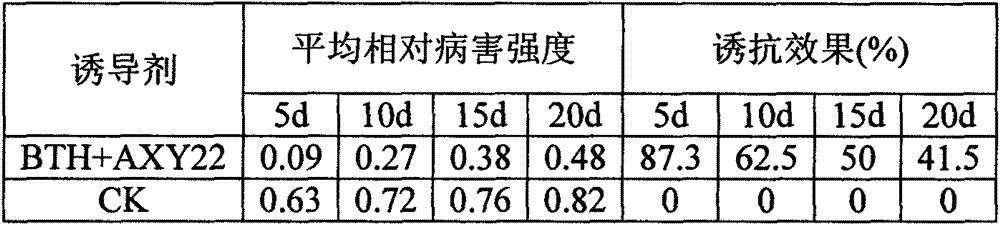
Figure 1
Abstract
Description
[0001] The present invention is completed under the support of the national science and technology plan project of the "Twelfth Five-Year Plan" in rural areas "Southern short-cycle industrial timber forest disease and insect pest control technology" (2012BAD19B0802); Guangdong Forestry Science and Technology Innovation Project (2010KJCX015-01). technical field
[0002] The invention relates to an inducer for controlling eucalyptus bacterial wilt and belongs to the technical field of forest disease prevention and control in forest protection. Background technique
[0003] Eucalyptus bacterial wilt is a systemic vascular disease caused by Ralstonia solanacearum (Smith) Yabuuchi et al. It has been reported in some countries in Brazil, Australia, Uganda, Congo and South Africa, China It was first found on young trees such as meranti (E.saliero Sm.) and giant eucalyptus (E.grandis Hillex Maid.) in Guangxi, and its main hosts are E. grandis×E.urophyIla, Eucalyptus eucalyptus (E.urop...
Examples
Embodiment 1
[0009] Use potato juice medium to inoculate non-pathogenic Ralstonia solanacearum strain (AXY22), after fully cultivating, prepare to the required concentration, and fully mix with benzothiadiazole (BTH) at a volume ratio of 1:1 , add 0.05% Tween 20, spray eucalyptus seedlings, use 0.05% Tween 20 aqueous solution as a control, spray once every 7 days, after 3 times of induction, challenge inoculation of bacterial wilt, wait for 5d, 10d, 15d and 15d after inoculation Investigate the relative disease intensity of the control and treated seedlings on the 20th day, and calculate the induction effect of each treatment. The control effect of eucalyptus induced by inducers on bacterial wilt is shown in Table 1. The data in the table are the average value of three parallels, and the relative standard deviation is less than 10%.
[0010] Table 1
[0011]
[0012] Pot experiments showed that the induction effect reached 87% 5 days after challenge inoculation, and 42% remained after ...