
Robot motion generation method based on physics engine
A technology of physics engine and robot, applied in the field of robot action generation based on physics engine, can solve the problems of low efficiency and achieve the effect of improving efficiency and no cumulative error
Patent Information
- Authority / Receiving Office
- CN · China
- Patent Type
- Patents(China)
- Current Assignee / Owner
- Publication Date
- 2019-04-26
Smart Images
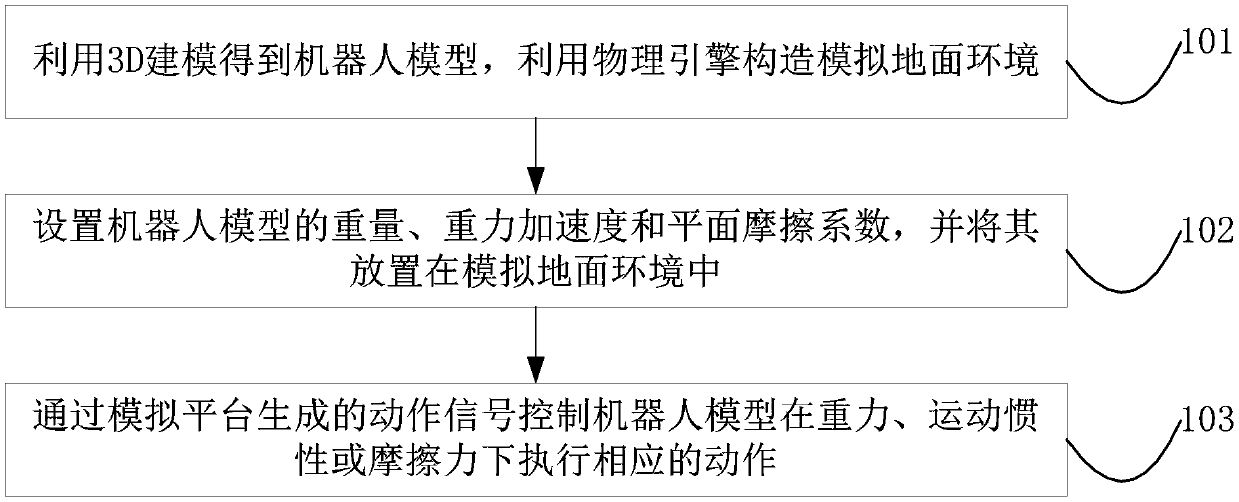
Figure 1 
Figure 2
Abstract
Description
technical field
[0001] The invention relates to the field of robots, in particular to a method for generating robot actions based on a physics engine. Background technique
[0002] Existing debugging of robot actions is mainly to use manual or program to generate action sets, and then burn the action sets into the robot and conduct real machine tests to get the actual operation results. The specific operation requires manual one-to-one on the robot actions Carry out real tests, but after a long period of extensive testing, robot joints and structural parts may need to be adjusted or replaced due to severe wear, otherwise errors will accumulate and affect test results. In order to avoid the impact of error accumulation on test results, it is necessary Adjust or replace the joints and structural parts of the robot in time.
[0003] To sum up, the existing debugging technology for robot motion has the following disadvantages: (1) The efficiency is low; (2) In order to avoid th...
Examples
Embodiment Construction
[0017] The present invention will be described in detail below in conjunction with the accompanying drawings and specific embodiments.
[0018] Embodiments of the present invention provide a method for generating robot actions based on a physics engine, such as figure 1 shown, including the following steps:
[0019] Step 101, use 3D modeling to obtain a robot model, and use a physics engine (such as Havok and PhysX) to construct a simulated ground environment.
[0020] Step 102, setting the weight, acceleration of gravity and plane friction coefficient of the robot model, and placing it in the simulated ground environment.
[0021] Step 103, control the robot model to perform corresponding actions under gravity, motion inertia or friction through the action signal generated by the simulation platform.
[0022] Multiple robot models are placed in the same simulated ground environment. The aforementioned robot models include, but are not limited to: hexapod walking robots, ro...