
Multiscale deep reinforcement machine learning for n-dimensional segmentation in medical imaging
A technology of machine learning and machine learning models, applied in the field of multi-scale deep reinforcement machine learning for N-dimensional segmentation in medical imaging
Patent Information
- Authority / Receiving Office
- CN · China
- Patent Type
- Patents(China)
- Current Assignee / Owner
- Publication Date
- 2019-11-19
Smart Images
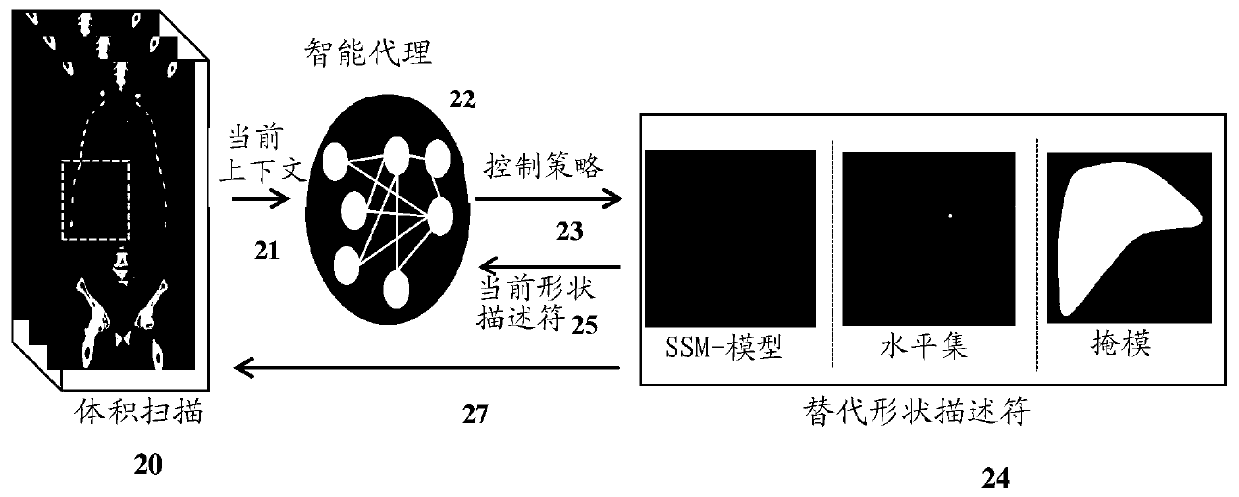
Figure 1 
Figure 2 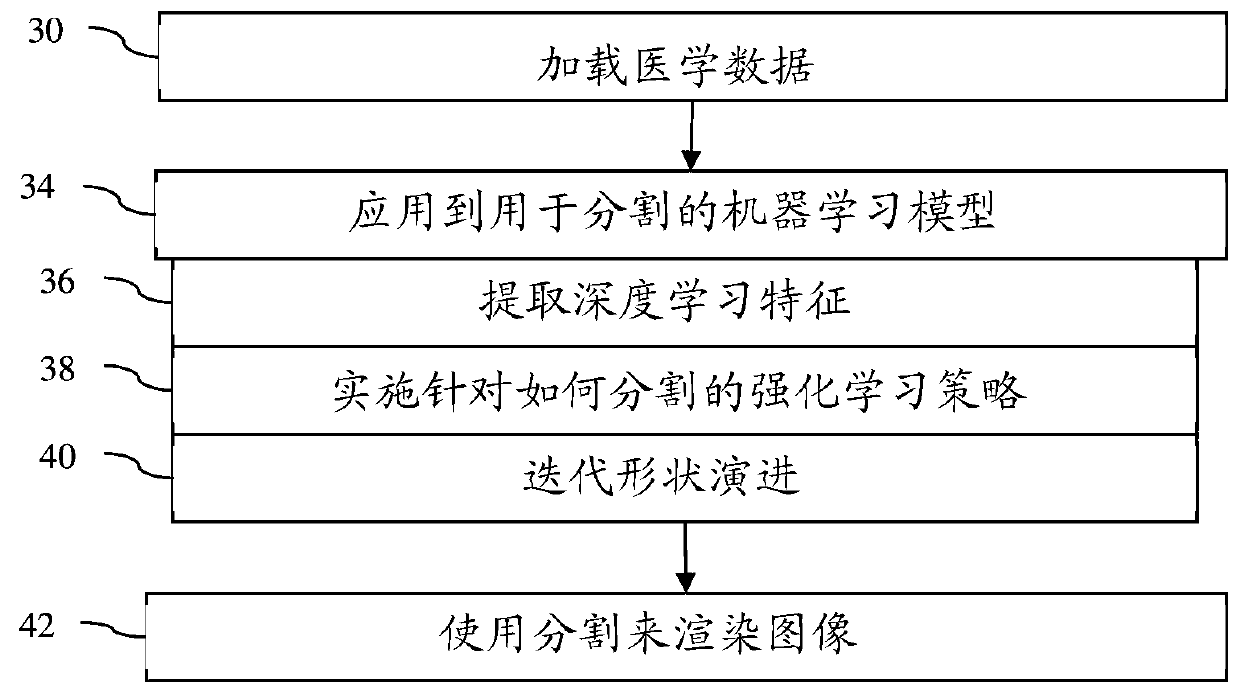
Figure 3
Abstract
Description
[0001] related application
[0002] This patent document claims the benefit of the filing date of Provisional US Patent Application Serial No. 62 / 500,604, filed May 3, 2017, under 35 U.S.C. § 119(e), which is hereby incorporated by reference. Background technique
[0003] This embodiment relates to segmentation in medical imaging. Accurate and fast segmentation of anatomical structures is a fundamental task in medical image analysis enabling real-time guidance, quantification, and processing for diagnostic and interventional procedures. Previous solutions for 3D segmentation are based on machine learning-driven active shape models, forward propagation theory, Markov random field methods, or deep image-to-image regression models.
[0004] Active shape models and forward-propagation theoretical solutions propose a parametric surface model that is deformed to fit the boundaries of the target object. Machine learning techniques utilize image databases to learn complex parametric...
Examples
Embodiment Construction
[0014] Multiscale deep reinforcement learning generates multiscale deep reinforcement models for N-dimensional (e.g. 3D) segmentation of objects, where N is an integer greater than 1. In this context, segmentation is formulated as learning an image-driven policy for shape evolution that converges to object boundaries. This segmentation is treated as a reinforcement learning problem, and scale-space theory is used to achieve robust and efficient multi-scale shape estimation. The learning challenge of end-to-end regression systems can be addressed by learning an iterative strategy to find segmentations.
[0015] Although trained as a full segmentation method, the trained policy can be used instead or also for shape refinement as a post-processing step. Any segmentation method provides an initial segmentation. Assuming the original segmentation is used as the initial segmentation in a multi-scale deep reinforcement machine learning model, a machine learning strategy is used to ...