
Traditional Chinese medicine composition for treating lung cancer with pleural effusion and preparation and applications thereof
A technology for pleural effusion and composition, which is applied in the directions of drug combination, medical preparations containing active ingredients, blood diseases, etc., can solve problems such as unreported, and achieve the effects of avoiding invasive treatment, definite curative effect and low cost
Patent Information
- Authority / Receiving Office
- CN · China
- Current Assignee / Owner
- Publication Date
- 2019-04-12
- Estimated Expiration
- Not applicable · inactive patent
Smart Images
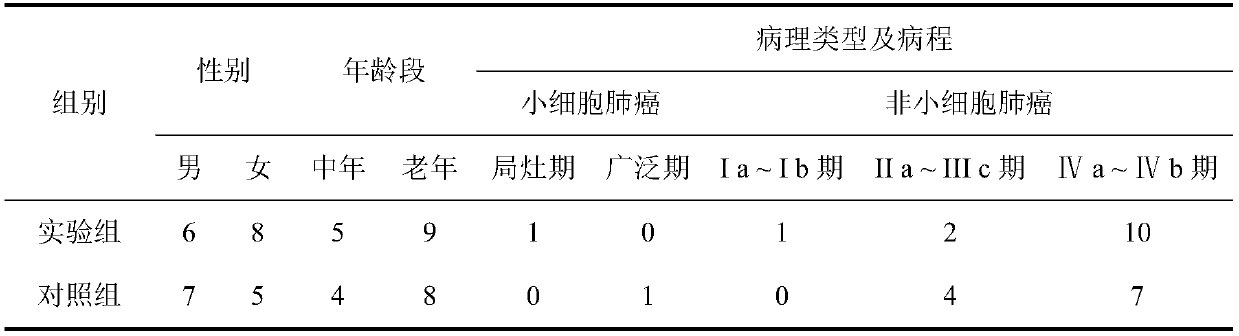
Figure 1 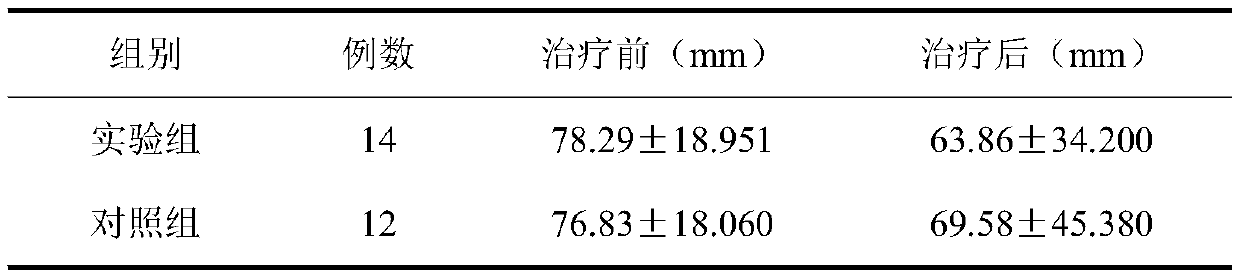
Figure 2 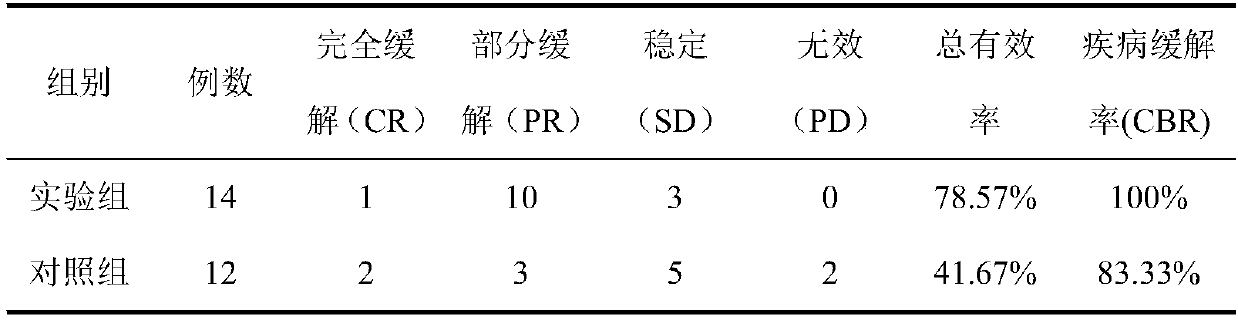
Figure 3
Abstract
Description
technical field
[0001] The invention belongs to the field of traditional Chinese medicine preparations, and in particular relates to a traditional Chinese medicine composition for treating lung cancer complicated with pleural effusion and its preparation and application. Background technique
[0002] Pleural effusion is the most common late complication of primary pleural tumors or tumor metastasis to the pleura. It is more common in lung cancer and breast cancer. Among them, malignant pleural effusion has clinical characteristics such as rapid growth, large volume, and bloody majority. It affects the quality of life of patients and the prognosis is poor. Its pathogenesis has changed from a single factor to a combination of multiple factors. When any cause causes an imbalance in the secretion and absorption of fluid in the pleural cavity, pleural effusion will occur. The traditional view is that the obstruction of lymphatic drainage by tumor tissue affects the absorption of...
Examples
Embodiment 1
[0032] Embodiment 1 treats the preparation of the Chinese medicine composition of lung cancer combined pleural effusion (1)
[0033] 1) According to the proportion, 16 parts of leather nitrate, 4 parts of raw rhubarb, and 1 part of Kansui were respectively pulverized into powders with a fineness of 100-500 mesh;
[0034] 2) Mix the above-mentioned powders evenly and pack them separately.
Embodiment 2
[0035] Embodiment 2 The preparation of the Chinese medicine composition (two) for the treatment of lung cancer combined with pleural effusion
[0036] 1) According to the proportion, 13 parts of leather nitrate, 2 parts of raw rhubarb, and 1 part of Kansui were respectively pulverized into powders with a fineness of 100-500 mesh;
[0037] 2) Mix the above-mentioned powders evenly and pack them separately.
Embodiment 3
[0038] Embodiment 3 The preparation of the traditional Chinese medicine composition (three) for the treatment of lung cancer combined with pleural effusion
[0039] 1) According to the proportion, 19 parts of leather nitrate, 6 parts of raw rhubarb, and 1 part of Kansui were respectively pulverized into powders with a fineness of 100-500 mesh;
[0040] 2) Mix the above-mentioned powders evenly and pack them separately.