
Wireless communication system, access point, terminal, and communication method
A technology of a wireless communication system and a communication method, applied in the field of wireless communication systems, capable of solving problems such as reducing the throughput of an access point AP2 and a terminal STA2-1
Patent Information
- Authority / Receiving Office
- CN · China
- Patent Type
- Applications(China)
- Current Assignee / Owner
- Publication Date
- 2019-08-27
Smart Images
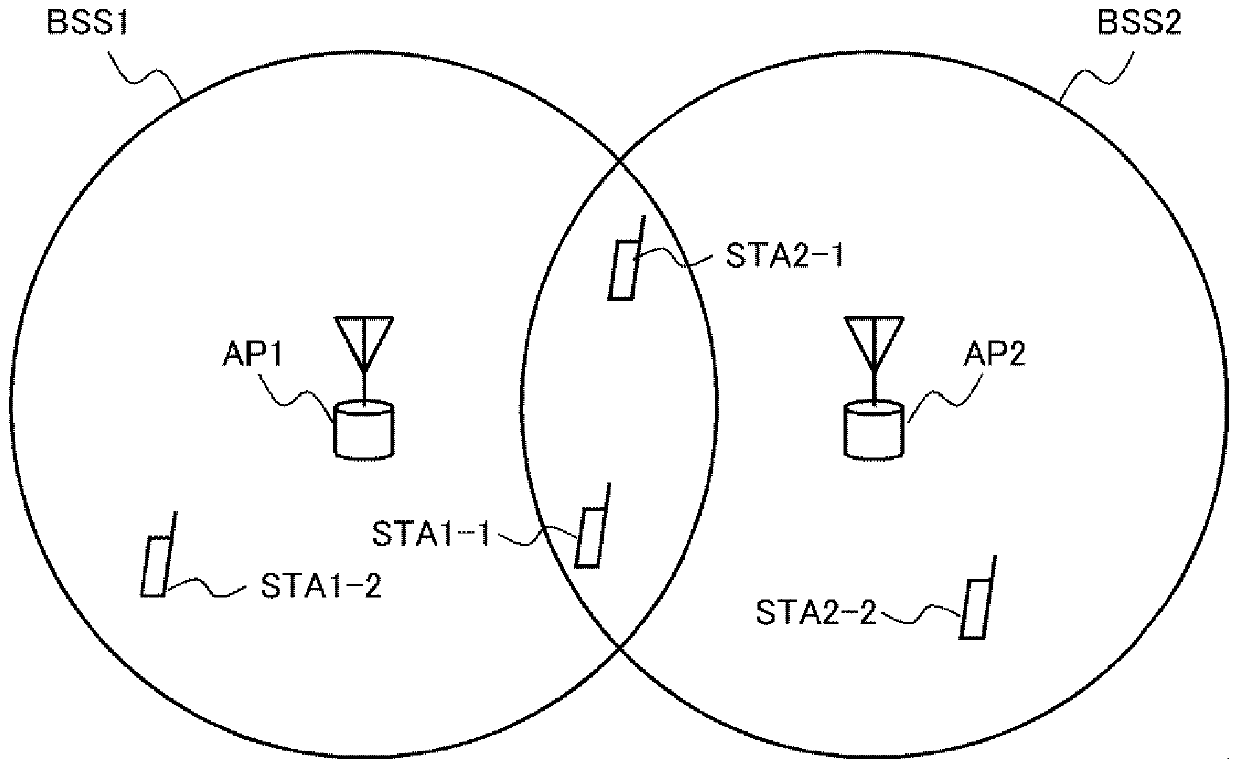
Figure 1 
Figure 2 
Figure 3
Abstract
Description
technical field
[0001] The present disclosure relates to a wireless communication system, an access point, a terminal and a communication method. Background technique
[0002] In the wireless Local Area Network (LAN) (local area network) standard Institute of Electrical and Electronics Engineers (Institute of Electrical and Electronics Engineers) (IEEE) 802.11, the task group TGax has been studying the next generation communication system IEEE 802.11ax (HEW: High Efficiency Wireless LAN (Efficient Wireless LAN) (WLAN)). Regarding component technology, it is expected that IEEE 802.11ax will adopt a new modulation / demodulation system (1024 Quadrature Amplitude Modulation (QAM)), support uplink Multi User Multi-Input Multi-Output (multi-user multiple input multiple output) (MU-MIMO), the introduction of Orthogonal Frequency-Division Multiple Access (Orthogonal Frequency Division Multiple Access) (OFDMA), etc.
[0003] Incidentally, for a predetermined Basic Service Set (BSS),...
Examples
example 1
[0149] First, refer to Image 6 Operation example 1 is described.
[0150] The access point AP1 belonging to BSS 1 recognizes the number of terminals STA1 not compatible with IEEE 802.11ax belonging to BSS 1 . It is assumed here that the access point AP1 has determined that the number of terminals STA1 incompatible with IEEE 802.11ax has become equal to or greater than a predetermined threshold (step S501 ).
[0151] Then, the access point AP1 turns off the setting of its own SR based on OBSS_PD (step S502). Furthermore, the access point AP1 sends signaling instructing them to turn off the setting of the OBSS_PD-based SR to all terminals STA1 belonging to the BSS 1 and compatible with IEEE 802.11ax (step S503 ). The access point AP1 includes this signaling in, for example, an HE operation element or a capability element of a radio frame such as a beacon frame and transmits it.
[0152] The terminal STA1 compatible with IEEE 802.11ax turns off its own setting of OBSS_PD-base...
example 2
[0158] Next, refer to Figure 7 Operation example 2 is described. It is assumed here that the terminal STA1 belonging only to BSS 1 is an explanation of the terminals STA1-1 and STA1-2 compatible with IEEE802.11ax (see figure 1 ).
[0159] Assume that IEEE 802.11ax-compatible terminal STA1-1 belonging to BSS 1 has detected a beacon frame or the like transmitted from access point AP2 belonging to BSS 2 serving as an OBSS (step S601). Also, assume that a beacon frame or the like includes an instruction to turn off the setting of SR based on OBSS_PD.
[0160] Then, similarly, the terminal STA1-1 compatible with IEEE 802.11ax turns off the setting of its own SR based on OBSS_PD (step S602). Furthermore, the terminal STA1-1 compatible with IEEE 802.11ax sends signaling (first signaling) to the access point AP1 belonging to the BSS 1, which informs the access point AP1 of the setting of its own SR based on OBSS_PD ( Step S603). The terminal STA1-1 compatible with IEEE 802.11ax ...
example 3
[0174] Next, refer to Figure 8 Operation example 3 is described. A description is given here assuming that terminal STA1 belonging only to BSS 1 is IEEE802.11ax-compatible terminals STA1-1 and STA1-2 (see figure 1 ).
[0175] Assume that terminal STA1-1 compatible with IEEE 802.11ax belonging to BSS 1 has detected a PPDU frame or the like transmitted from access point AP2 belonging to BSS 2 serving as OBSS (step S701).
[0176] Then, the IEEE 802.11ax-compatible terminal STA1-1 turns on its own setting of OBSS_PD-based SR (step S702). Furthermore, the terminal STA1-1 compatible with IEEE 802.11ax sends signaling (first signaling) to the access point AP1 belonging to the BSS 1, which informs the access point AP1 of the setting of its own SR based on OBSS_PD ( Step S703). The terminal STA1-1 compatible with IEEE 802.11ax includes this signaling in, for example, an HE operation element or a capability element of a radio frame such as a management frame and transmits it.
[...