
Two-dimensional Inverse-Free Sparse Bayesian Learning for Fast Sparse Reconstruction
A sparse Bayesian, sparse reconstruction technology, applied in the field of signal processing, can solve the problem of low efficiency of two-dimensional signal operation
Patent Information
- Authority / Receiving Office
- CN · China
- Patent Type
- Patents(China)
- Current Assignee / Owner
- Publication Date
- 2021-04-23
Smart Images
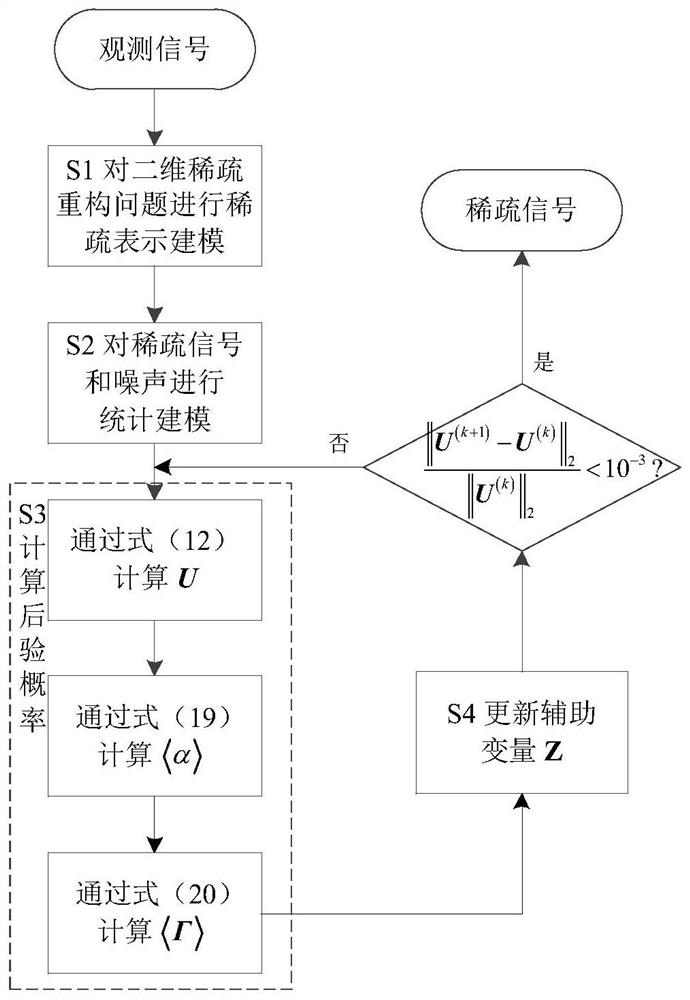
Figure 1 
Figure 2 
Figure 3
Abstract
Description
technical field
[0001] The invention belongs to the field of signal processing, in particular to a two-dimensional inverse-free sparse Bayesian learning (2Dimentional Inverse-Free Sparse Bayesian Learning, 2D-IFSBL) fast sparse reconstruction method. Background technique
[0002] Sparse reconstruction is the core of compressed sensing technology, which can accurately reconstruct sparse signals from incomplete observation data. After continuous development, sparse reconstruction technology has been widely used in medical image processing, computer vision, radar imaging and other fields. Classical sparse reconstruction algorithms include l1 regularization, Basis Pursuit (BP), Orthogonal Matching Pursuit (OMP), Sparse Bayesian Learning (SBL), etc. Among them, the SBL method is to solve the sparse reconstruction problem under the framework of statistical theory, and to model and solve the statistical priori and posteriori of the observed signal, sparse signal and noise signal, ...
Examples
Embodiment Construction
[0065] The present invention will be further described below in conjunction with accompanying drawing:
[0066] figure 1 It is the general processing flow of the present invention.
[0067] A two-dimensional inverse-free sparse Bayesian learning fast sparse reconstruction method described in the present invention comprises the following four steps:
[0068] S1: Sparse representation modeling for two-dimensional sparse reconstruction problems;
[0069] S2: Perform statistical modeling on vectorized sparse signal x and vectorized noise n;
[0070] S3: Solve the posterior probability of the vectorized sparse signal x, the reciprocal of the vectorized variance γ and the reciprocal of the noise variance α;
[0071] S4: Updating the matrix form Z of the auxiliary variables.
[0072] Using simulation data to conduct experiments, compare the method of the present invention with the IFSBL method (Duan H, Yang L, Fang J, and Li H. Fast Inverse-Free Sparse Bayesian Learning via Relax...