
Network terminal port scanning method and network terminal port scanning system
A network terminal and port scanning technology, applied in the field of information security, can solve problems such as long scanning time and unfavorable security vulnerability discovery, and achieve the effect of reducing scanning time, improving scanning efficiency, and fast and efficient discovery.
Patent Information
- Authority / Receiving Office
- CN · China
- Current Assignee / Owner
- Publication Date
- 2021-06-25
Smart Images
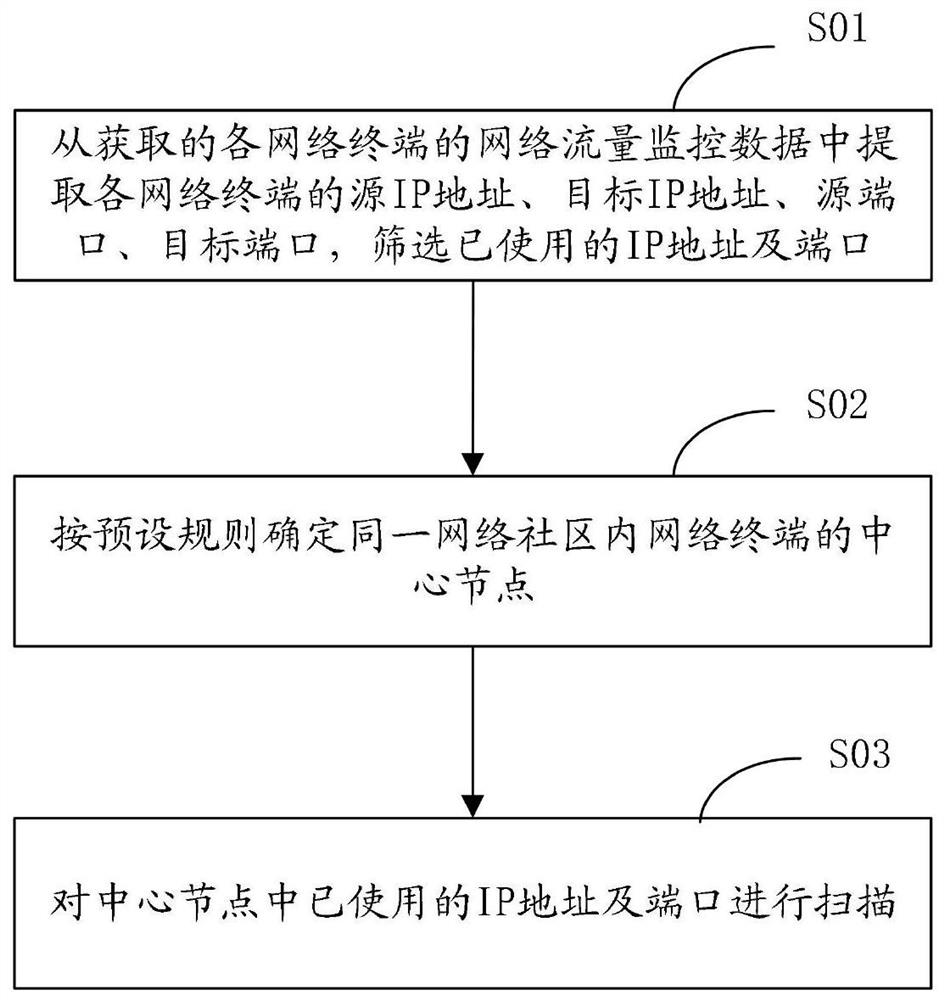
Figure 1 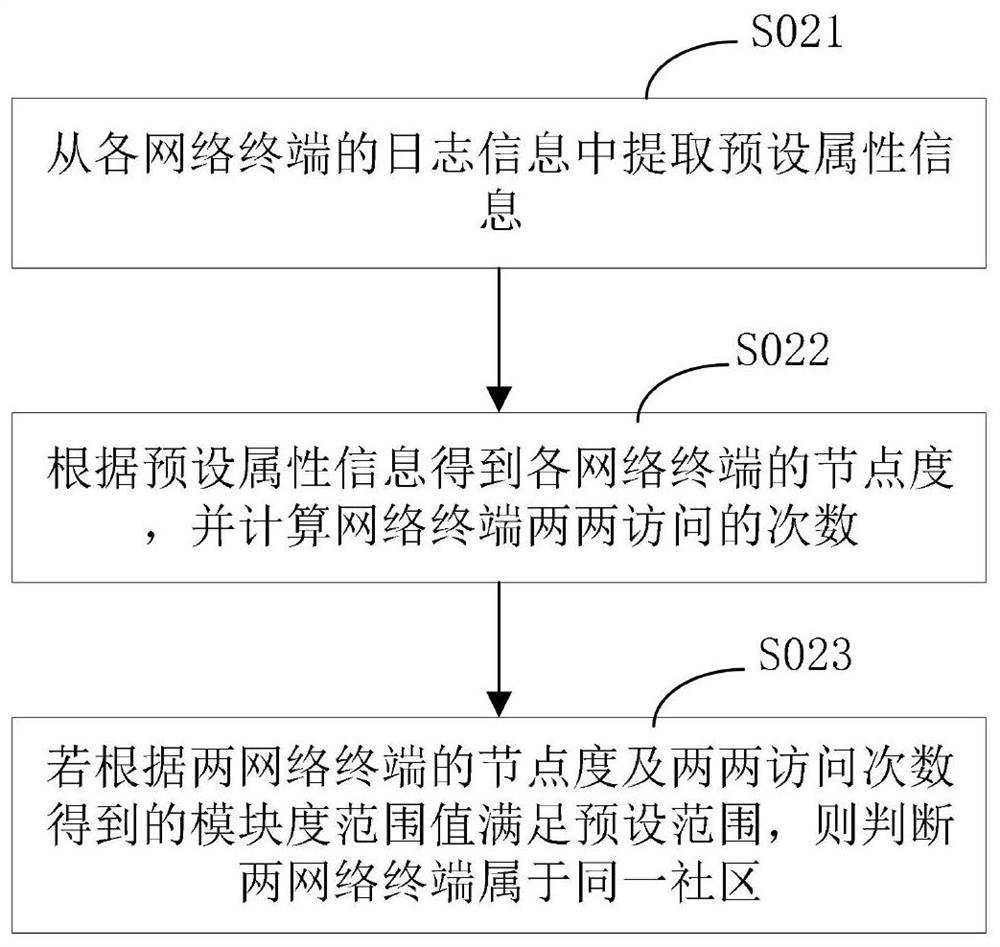
Figure 2 
Figure 3
Abstract
Description
technical field
[0001] The invention relates to the technical field of information security, in particular to a network terminal port scanning method and a network terminal port scanning system. Background technique
[0002] Whether the network terminal port is opened or not represents whether the service is running or not. By scanning whether the service of the port is opened, it is prepared for the subsequent network security warning. The existing port scanning technology scans each port of the terminal to determine whether the service (such as http service, ftp service, ssh service, telnet service, rdp service, etc.) is enabled.
[0003] But there are some problems with the existing port scanning technology. For example, you can only use polling to scan unknown IP address segments and ports; or use software to perform full scans to find IP addresses and ports that are already in use, and then perform detailed scans on these IP addresses and ports. Since the ports of an ...
Examples
Embodiment 1
[0041] In some embodiments, a network terminal port scanning method, such as figure 1 shown, including the following steps:
[0042] S01. Extract the source IP address, target IP address, source port, and target port of each network terminal from the acquired network traffic monitoring data of each network terminal, and filter used IP addresses and ports.
[0043] In this embodiment, the network terminal may be a server or a client, and may be a PC or a mobile terminal device. These network terminals are mainly managed by a network terminal management device, using hardware probes, traffic mirroring analyzers or SNMP (Simple Network Management Protocol)-based traffic analyzers to monitor network traffic data. Specifically, the hardware probe is serially connected to the link that needs to capture the flow, and the flow data is obtained by shunting the digital signal on the link. Traffic mirroring analysis is to mirror the traffic of a certain link of the network terminal to ...
Embodiment 2
[0068] In order to further optimize the network terminal port scanning method and improve scanning efficiency, in some embodiments, a network terminal port scanning method, such as Figure 4 shown, including the following steps:
[0069] S01a. Obtain the source IP address, target IP address, source port, and target port of each network terminal, and filter the used IP addresses and ports.
[0070] S02a. Determine the central node of the network terminal in the same network community according to preset rules.
[0071] For the specific content of steps S01a and S02a, reference may be made to Embodiment 1, which will not be repeated here.
[0072] S03a, looking for a first-degree node of the central node.
[0073] For a network community, in addition to the central node, it also includes edge nodes. The edge nodes can at least include first-degree nodes, second-degree nodes, and third-degree nodes. The first-degree nodes are network terminals that have a direct access relation...
Embodiment 3
[0106] The embodiment of the invention also discloses a network terminal port scanning system, which combines Figure 8 As shown, at least include screening module 11, priority determination module 12, scanning module 13, wherein:
[0107] The screening module 11 is used to extract the source IP address, target IP address, source port, and target port of each network terminal from the obtained network traffic monitoring data of each network terminal, and filter the used IP addresses and ports.
[0108] The screening module 11 can obtain network traffic data monitored by a hardware probe, a traffic mirroring analyzer, or a traffic analyzer based on SNMP (Simple Network Management Protocol). A traffic log information file is generated according to the detected network traffic data, and the traffic log information generally includes at least a source IP address, a destination IP address, a source port, a destination port, and the like.
[0109] The priority determination module ...