

Remote fault diagnosis system based on project scheme simulation software architecture design
A fault diagnosis system, architecture design technology, applied in database management system, design optimization/simulation, calculation, etc., to save time, improve economic benefits, and reduce the number of communications
Patent Information
- Authority / Receiving Office
- CN · China
- Patent Type
- Applications(China)
- Current Assignee / Owner
- Publication Date
- 2022-03-04
Smart Images
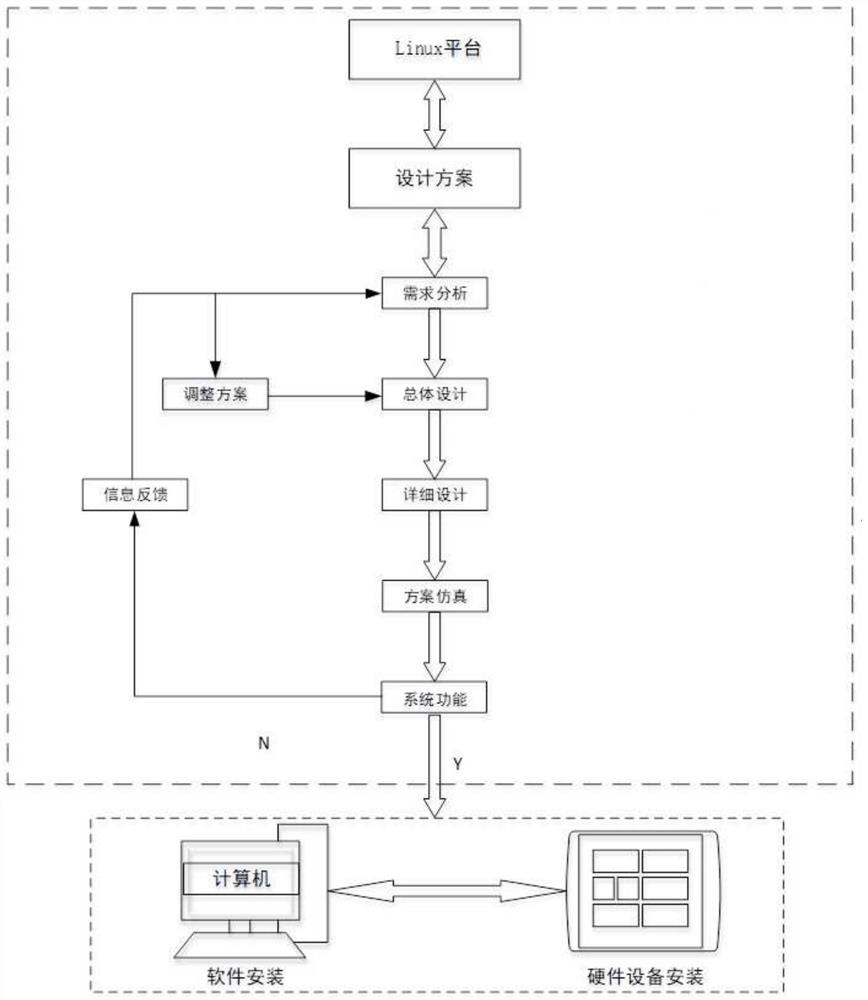
Figure 1 
Figure 2
Abstract
Description
technical field
[0001] The invention relates to the field of simulation software architecture design and remote fault diagnosis, in particular to a remote fault diagnosis system based on project scheme simulation software architecture design. Background technique
[0002] At present, to construct a new project (engineering or system), it is first necessary to carry out the scheme design, the main contents include design requirement analysis, system function analysis, technical means analysis, implementation progress analysis and acceptance method analysis, etc. Traditional design schemes are based on experience summarization, use empirical formulas, charts, and design manuals formed by mechanics and mathematics as design basis, and are characterized by static passive analysis, approximate calculation, empirical design, and manual labor, and repeated communication and rectification with users .
[0003] Secondly, after the project is delivered, in order to ensure the normal ...
Examples
Embodiment 1
[0062] Embodiment 1: the simulation framework of the present invention is based on the design scheme developed by the Linux platform, mainly comprising: a demand analysis module, an overall design module, a detailed design module, a scheme simulation module, a system function module and an information feedback module. The analysis data obtained by the demand analysis module is implemented into the overall design; the overall layout of the overall design module is implemented through the detailed design module; whether the detailed design module meets user needs is checked through the scheme simulation module; The result data of the scheme simulation is displayed through the system function module; after the system function is inspected by the user and relevant personnel, the data is transmitted to the demand analysis module through the information feedback module, and the scheme is rectified.
[0063] This simulation architecture can realize the separation of functional softwar...
Embodiment 2
[0073] Embodiment 2: with reference to attached figure 1 As shown, the simulation of the design scheme developed based on the Linux platform includes: a demand analysis module, an overall design module, a detailed design module, a scheme simulation module, a system function module and an information feedback module.