
Low-shrinkage anti-cracking concrete
A low-shrinkage, anti-concrete technology, which is applied in the field of building materials, can solve problems that affect the mechanical properties of concrete and cannot achieve curing effects, and achieve the effects of reducing shrinkage, dense pore structure, and speeding up
Patent Information
- Authority / Receiving Office
- CN · China
- Patent Type
- Applications(China)
- Current Assignee / Owner
- Publication Date
- 2022-04-15
Smart Images

Figure 1 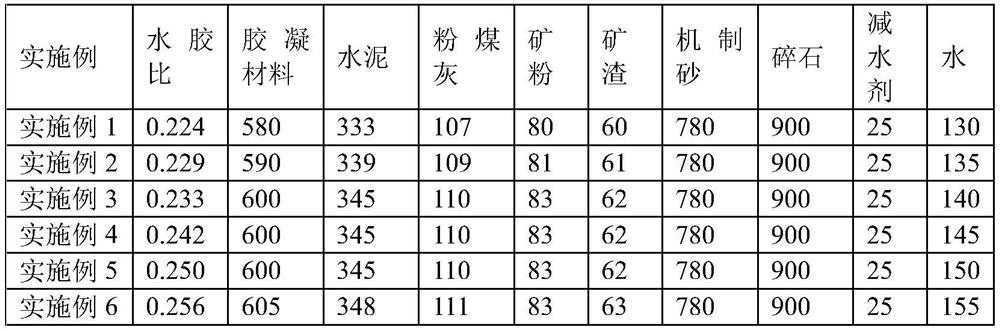
Figure 2 
Figure 3
Abstract
Description
technical field
[0001] The invention relates to the field of building materials, in particular to a low-shrinkage and anti-cracking concrete. Background technique
[0002] The shrinkage and cracking of concrete has become a common problem in the modern concrete industry, seriously affecting the normal use and service life of construction engineering structures.
[0003] The main reason for the shrinkage and cracking of concrete is that the evaporation rate of water inside and outside the concrete is different during the hardening process. Larger surface drying shrinkage deformation is restrained by the concrete interior, resulting in larger tensile stress, which leads to the generation of cracks. At present, the most common measures to solve the problem of shrinkage and cracking of concrete are to add superabsorbent resin to concrete, or to sprinkle water or spray on the concrete surface during concrete curing; although adding superabsorbent resin can solve the problem of c...
Examples
Embodiment 1
[0033] A low-shrinkage anti-cracking concrete, 580kg of cementitious material, 780kg of machine-made sand, 900kg of gravel, 25kg of water reducing agent, and 130kg of water;
[0034] Wherein the cementitious material includes cement, fly ash, slag and slag, wherein the weight ratio of cement: fly ash: slag: slag is 5:1.6:1.2:0.9;
[0035] The water absorption rate of the crushed stone is 2%, the needle flake particle content is 4%, and the crushing index value is 4-5%.
Embodiment 2-7
[0037] A low-shrinkage anti-cracking concrete, the difference from Example 1 is that the water-binder ratio is changed, and the rest is unchanged, and the specific content is shown in Table 1.
[0038] Table 1 Concrete ratio table of Examples 1-7, unit: kg
[0039]
[0040]
Embodiment 8
[0042] A kind of low-shrinkage anti-cracking concrete, the difference with embodiment 5 is that the weight ratio of cement, fly ash, slag and slag is 5:1.7:1.4:1, all the other are the same as embodiment 5, specific proportioning Refer to Table 2.