
Acid absorbing agent for preparing cinchona alkaloids ligand
A technology for cinchona alkaloids and ligands, which is applied in the field of acid binding agents, can solve the problems of difficulty in accurate quantification, danger, easy combustion, etc., and achieves the effects of avoiding the column chromatography process, easy operation and safe use.
Patent Information
- Authority / Receiving Office
- CN · China
- Patent Type
- Applications(China)
- Current Assignee / Owner
- Publication Date
- 2006-02-15
- Estimated Expiration
- Not applicable · inactive patent
Smart Images
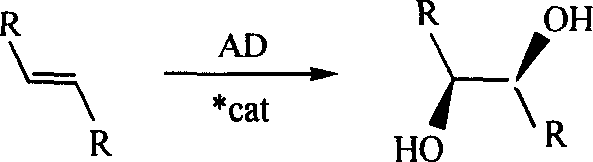
Figure 1 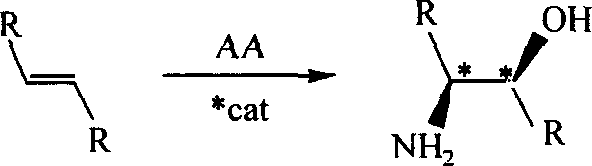
Figure 2 
Figure 3
Abstract
Description
technical field
[0001] The invention relates to an acid-binding agent in the synthesis process of preparing chiral cinchona alkaloid ligands. This type of ligands can be effectively used in asymmetric dihydroxylation and aminohydroxylation reactions of olefins. Background technique
[0002] Chirality is one of the characteristics of nature and the basis of all life. Life phenomena depend on the existence and recognition of chirality. All animals, plants and the human body have precise chiral recognition capabilities for drugs. The configurations of chiral drugs are different, and their physiological activities and toxicity are also different. L-dopa is a good medicine for treating Parkinson's disease, but D-dopa has serious side effects. (S)-naproxen is 35 times more potent than the (R)-isomer. Therefore, how to obtain chiral compounds has become a severe challenge for chemists. Although optically pure compounds can be obtained through classic racemate resolution and chi...
Examples
Embodiment 1
[0030] Example 1: Synthesis of Ligand 1
[0031] Add 0.295g (0.0015mol) 1,4-dichloro-2,3-naphthyridine, 0.975g (0.003mol) dihydroquinine, 0.63g (0.015mol) CaH 2 , 4.5mL DMF, N 2 Protected, reacted at 90°C, the reaction solution was a light yellow turbid solution, the reaction process was monitored by TLC until the raw materials disappeared, and the reaction time was 1 h in total. Add 10mL ethyl acetate and 5mL water and stir, separate the water layer, extract with ethyl acetate (15mL×3), combine the organic phases, anhydrous MgSO 4 dry. After filtering and concentrating under reduced pressure to leave about 3 mL of liquid, white needle-like crystals precipitated out, dried, and washed with a little anhydrous ether to obtain white crystals, with a yield of 95%. m.p.133~135℃. 1 HNMR (CDCl 3 , internal standard TMS): δ8.65(d, J=4.6Hz, 2H), 8.33(m, 2H), 7.98(d, J=9.2Hz, 2H), 7.96(m, 2H), 7.56(d, 2H), 7.44(d, J=4.7Hz, 2H), 7.36(d, 1H), 7.35(d, 1H), 7.01(d, 2H), 3.9(s, 6H), 3....
Embodiment 2
[0032] Embodiment 2: the synthesis of ligand 2
[0033] In a 100mL three-necked flask, add 0.295g (0.0015mol) 1,4-dichloro-2,3-naphthyridine, 0.975g (0.003mol) dihydroquinidine, 0.63g (0.015mol) CaH 2 , 4.5mL N, N-dimethylformamide (DMF), N 2 Protected, reacted at 90°C, the reaction solution was a light yellow turbid solution, the reaction process was monitored by TLC until the raw materials disappeared, and the reaction time was 5 hours in total. Add 10mL ethyl acetate and 5mL water and stir, separate the water layer, extract with ethyl acetate (15mL×3), combine the organic phases, anhydrous MgSO 4 dry. After filtering and concentrating under reduced pressure to leave about 3 mL of liquid, white needle-like crystals precipitated out, dried, and washed with a little anhydrous ether to obtain white crystals with a yield of 78%. m.p.176-178°C. 1 H NMR (CDCl 3 , internal standard TMS): δ8.65(d, J=5.3Hz, 2H), 8.33(m, 2H), 7.98(d, J=9.2Hz, 2H), 7.94(m, 2H), 7.58(d, 2H), 7.43(...
Embodiment 3
[0034] Embodiment 3: the synthesis of ligand 3
[0035] Add 0.295g (0.0015mol) 1,4-dichloro-2,3-naphthalene, 0.97g (0.003mol) quinine, 0.63g (0.015mol) CaH to a 100mL three-necked flask 2 , 4.5mL DMF, N 2Protected, reacted at 90°C, the reaction solution was a light yellow turbid solution, the reaction process was monitored by TLC until the raw materials disappeared, and the reaction time was 6 hours in total. Add 10mL ethyl acetate and 5mL water and stir, separate the water layer, extract with ethyl acetate (15mL×3), combine the organic phases, anhydrous MgSO 4 dry. After filtering and concentrating under reduced pressure to leave about 3 mL of liquid, white needle-like crystals precipitated out, dried, and washed with a little anhydrous ether to obtain white crystals, with a yield of 95%. m.p.160~161℃. 1 H NMR (CDCl 3 , internal standard TMS): δ8.65 (d, J=5.3Hz, 2H, Ar-H), 8.33 (m, 2H, Ar-H), 7.98 (d, J=9.2Hz, 2H, Ar-H) , 7.96(m, 2H, Ar-H), 7.58(s, 2H, Ar-H), 7.44(d, J=...