

Fracturing fluid composition and method of using same in geological formations
a technology of fluid composition and geological formation, applied in the field of fracturing fluid, to achieve the effect of increasing the viscosity of the fluid composition, facilitating and ensuring the formation of geological formations
Patent Information
- Authority / Receiving Office
- US · United States
- Patent Type
- Patents(United States)
- Current Assignee / Owner
- Publication Date
- 2019-03-19
- Estimated Expiration
- Not applicable · inactive patent
Smart Images
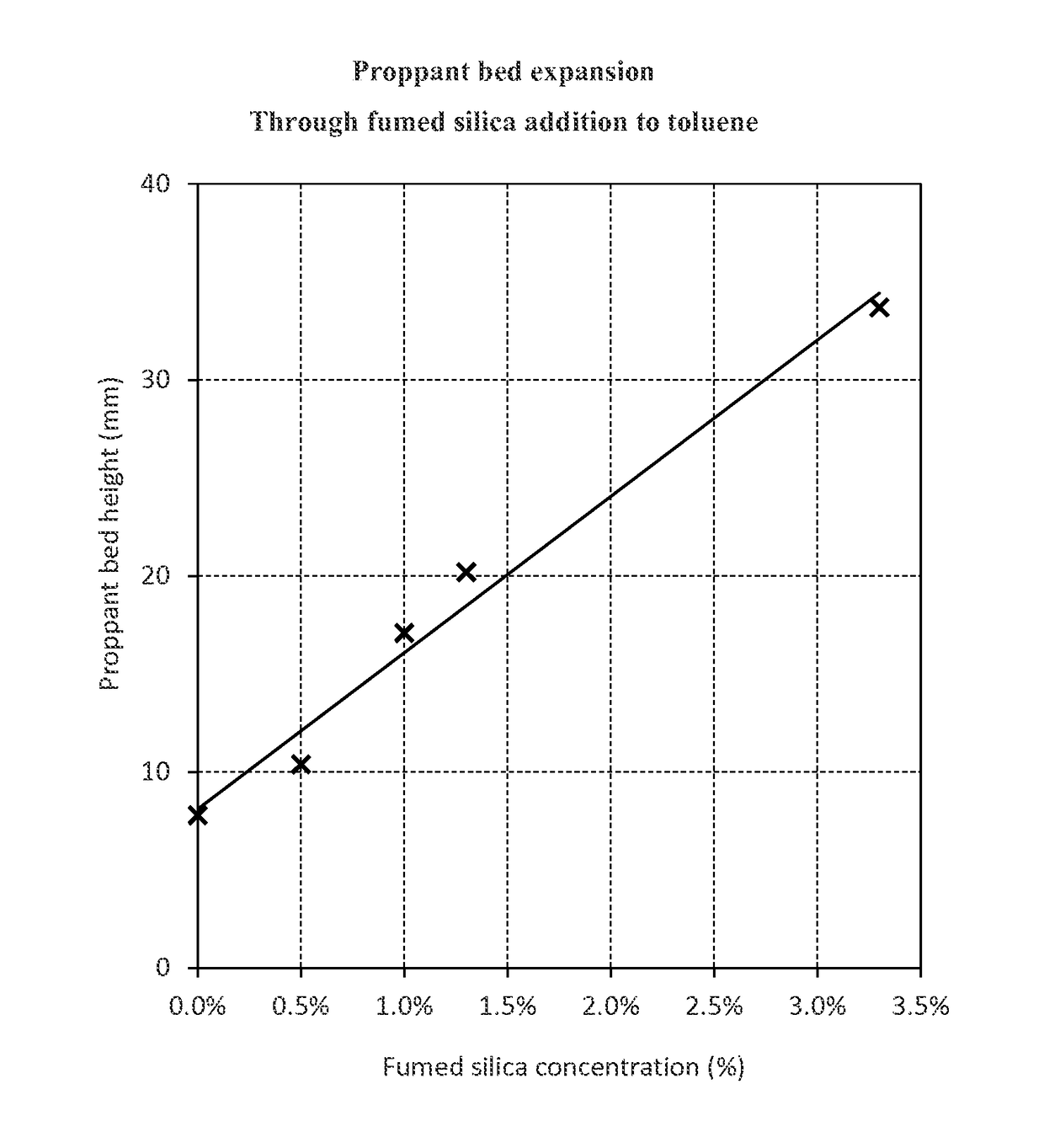
Figure 1
Abstract
Description
[0001] The present application claims priority from U.S. Provisional Application Ser. No. 61 / 837,963, filed Jun. 21, 2013, which is incorporated by reference herein in its entirety.FIELD OF INVENTION
[0002] The present invention relates to a fracturing fluid and optionally an associated proppant composition wherein fumed silica increases the viscosity of liquid carbon dioxide that is delivered into a well-bore for the fracture treatment of oil and gas reservoirs.BACKGROUND OF THE INVENTION
[0003] The use of carbon dioxide for production of oil and gas from hydrocarbon containing reservoirs is well known. Utilization of liquid carbon dioxide (LCO2) in fracture treatment of oil and gas formations has certain advantages in water sensitive and low pressure formations. First, the use of LCO2 enables a significant reduction in water volume utilized, which minimizes formation damage caused by the water and second, it promotes water flow-back (i.e., retrieval of water introduced, or produced, in...
Examples
example
[0026]This example illustrates the effect of an uncoated fumed silica having a mean primary particle size of approximately 10 nm and surface area of approximately 200 m2 / g when added to toluene at various concentrations in the range of 0.5 to 3.3 weight percent of the silica in toluene. Four samples were prepared. In each case, approximately 270 g of total fluid mixture was prepared by placing pure toluene in ajar that was 95 mm wide to a depth of approximately 50 mm, and then adding the corresponding amount of uncoated fumed silica (i.e., 0.5, 1.25, 1.5, and 3.3 weight percent) to the toluene with continuous mild stirring of the fluid mixture. A Caframo model BDC6015 stirrer unit was employed with a 48 mm diameter dispersion blade, rotating at a 200 rpm. Once all of the fumed silica had been added, the stirring speed was increased to 4,000 rpm and the speed was held for 15 minutes in order to completely disperse the fumed silica in the toluene. After 15 minutes, the mixture was wei...