

Integrally suppressed handgun
a suppressed and handgun technology, applied in the field of firearms, can solve the problems of uncharacteristic in dimensions and appearance of a more conventional pistol, affecting the balance, aiming, and the design of the suppressed pistol may be difficult to disassemble for maintenance and cleaning of the silencer and/or firearm components, and achieve the effect of facilitating aiming and holstering, and reducing the size of the pistol
Patent Information
- Authority / Receiving Office
- US · United States
- Patent Type
- Patents(United States)
- Current Assignee / Owner
- Publication Date
- 2019-12-31
Smart Images
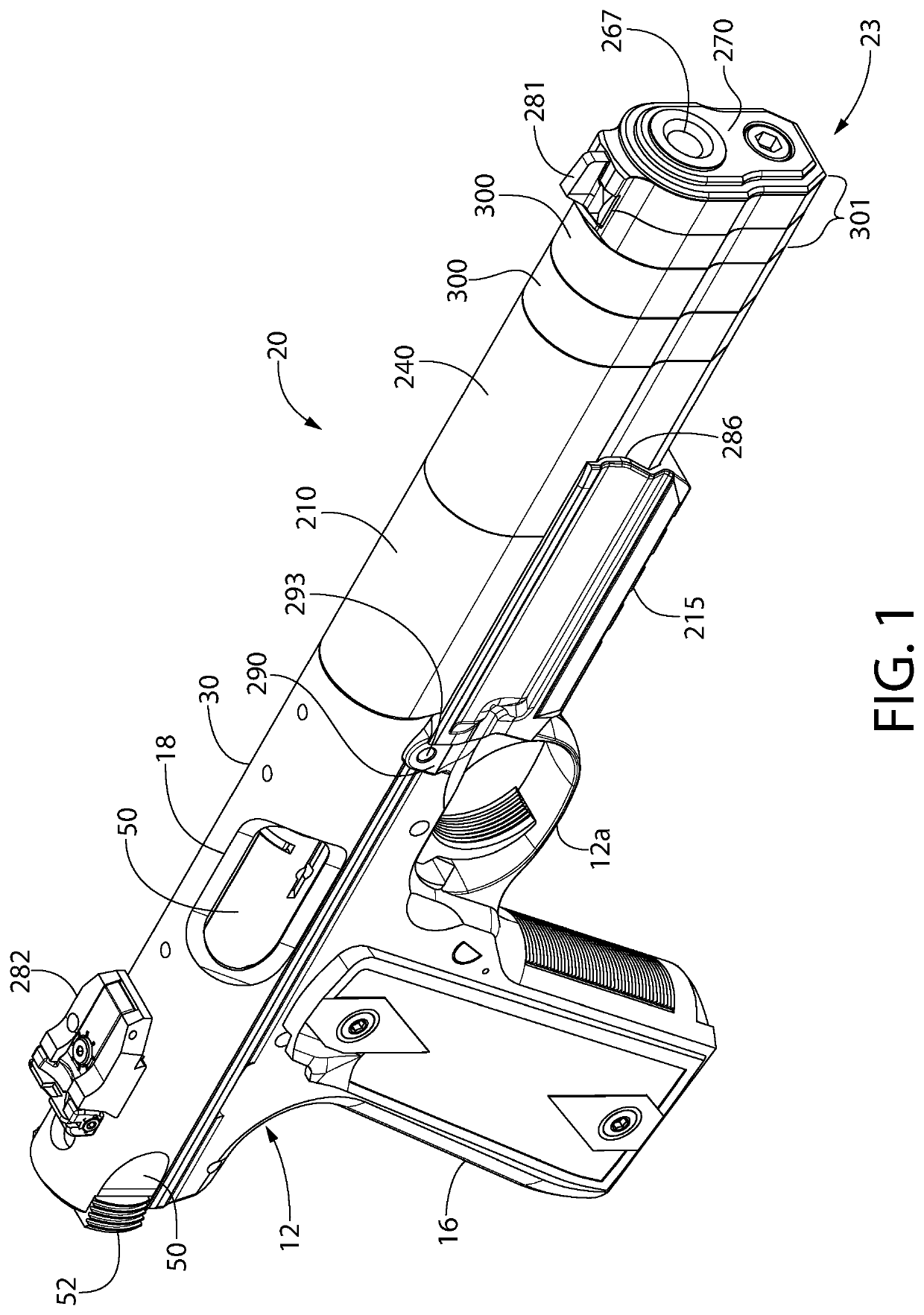
Figure 1 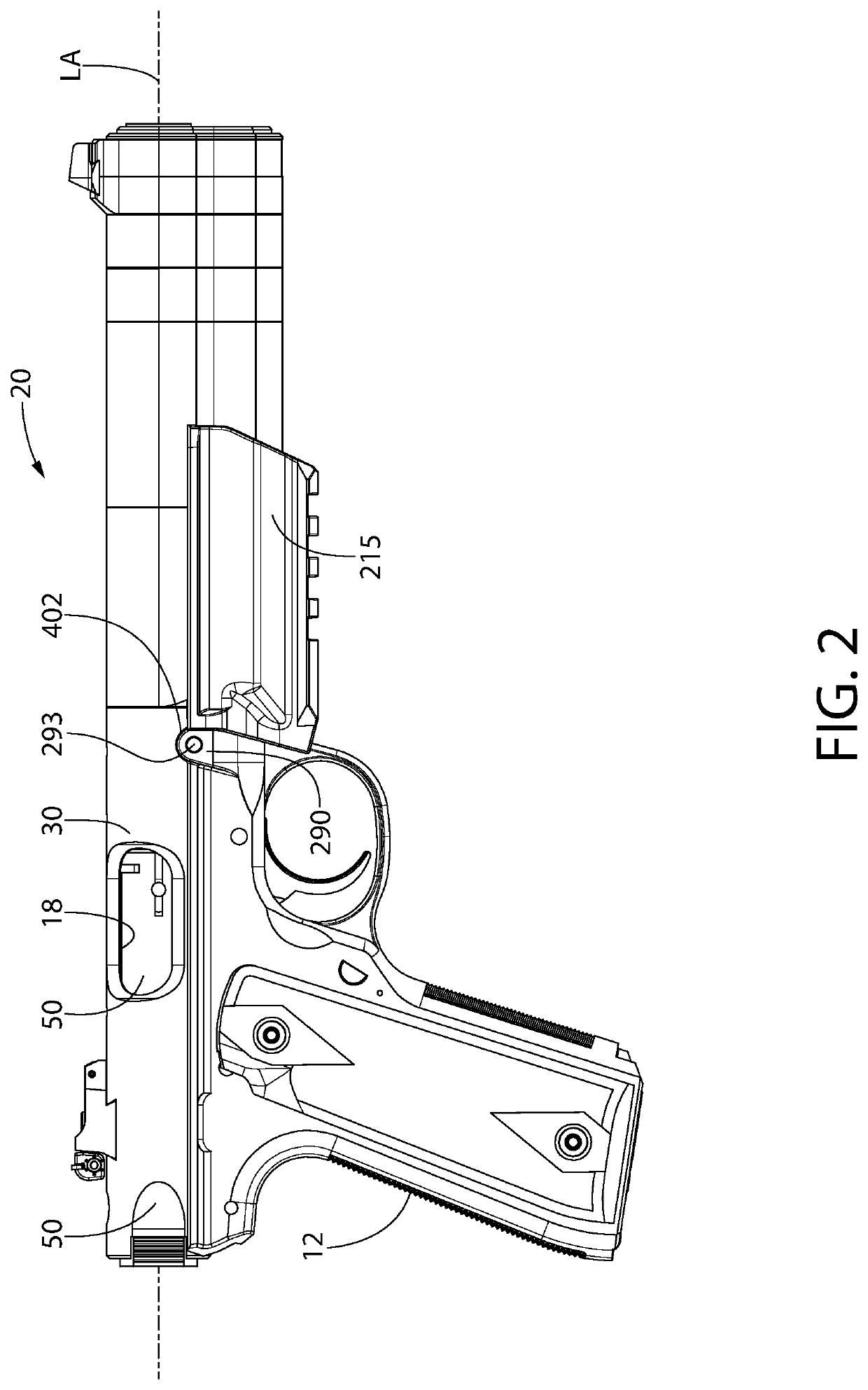
Figure 2 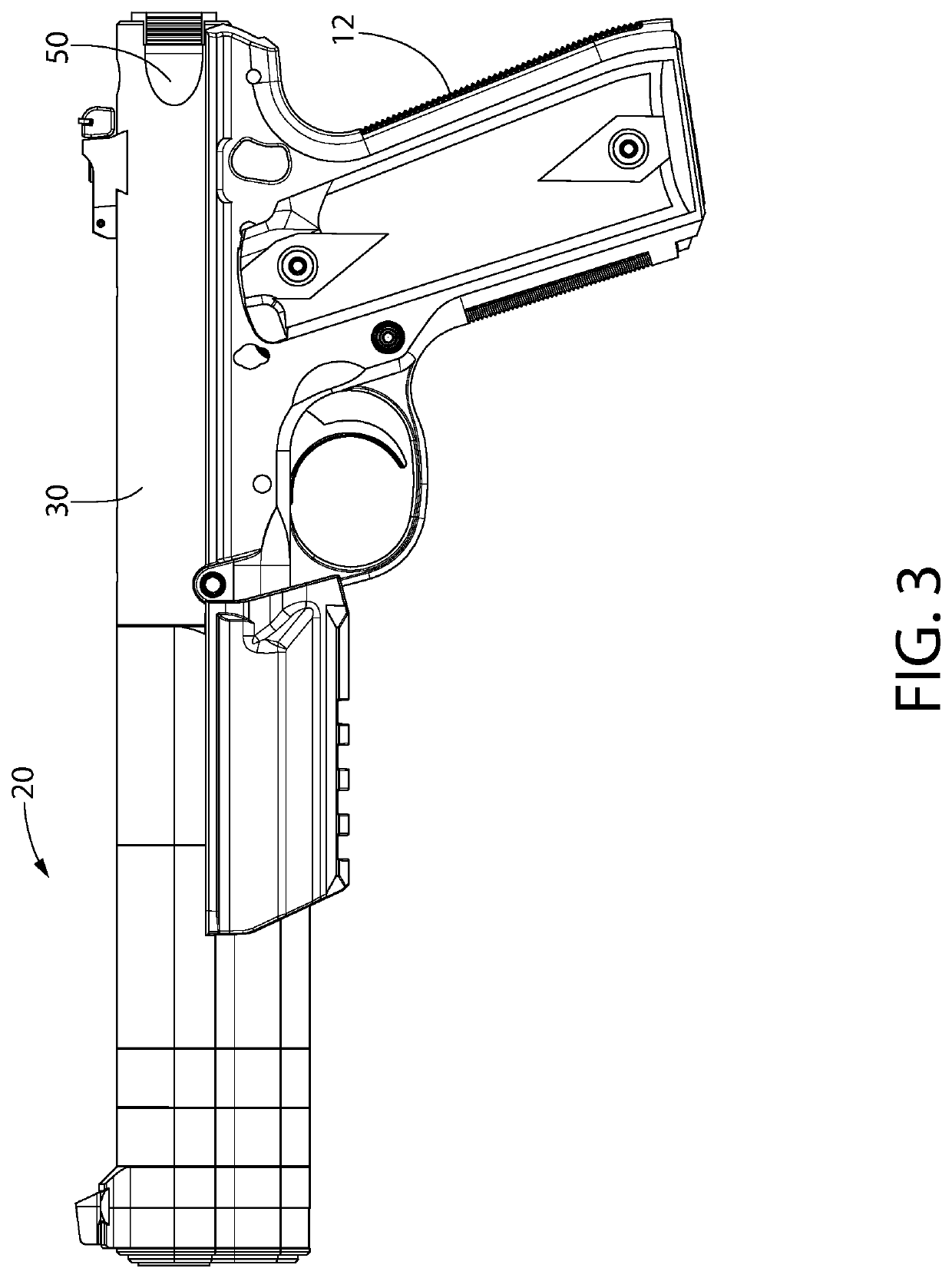
Figure 3
Abstract
Description
CROSS-REFERENCE TO RELATED APPLICATIONS
[0001] The present application claims the benefit of U.S. Provisional Application No. 62 / 626,450 filed Feb. 5, 2018; the entirety of which is incorporated herein by reference.BACKGROUND OF THE DISCLOSURE
[0002] The present disclosure generally relates to firearms, and more particularly to firearms in the form of handguns with integral silencers or suppressors that reduce muzzle noise or blast produced by discharging the firearm.
[0003] Silencers or suppressors generally comprise multiple combustion gas expansion chambers in which the high pressure gas is allowed to partially expand prior to leaving the firearm. The projectile such as a bullet is propelled through the barrel of the firearm and silencer by the combustion gas. In an unsuppressed discharge firearm, the rapid expansion and depressurization of the high pressure gas at the muzzle end of the barrel produces a loud sound referred to as muzzle blast or noise. The partial pre-expansion of gas ...
Examples
Embodiment Construction
[0063]The features and benefits of the invention are illustrated and described herein by reference to exemplary (i.e. “example”) embodiments. This description of exemplary embodiments is intended to be read in connection with the accompanying drawings, which are to be considered part of the entire written description. In the description of embodiments disclosed herein, any reference to direction or orientation is merely intended for convenience of description and is not intended in any way to limit the scope of the present invention. Relative terms such as “lower,”“upper,”“horizontal,”“vertical,”, “above,”“below,”“up,”“down,”“top” and “bottom” as well as derivative thereof (e.g., “horizontally,”“downwardly,”“upwardly,” etc.) should be construed to refer to the orientation as then described or as shown in the drawing under discussion. These relative terms are for convenience of description only and do not require that the apparatus be constructed or operated in a particular orientati...