
Method for gold deposition
a deposition method and gold technology, applied in the field of gold deposition, can solve the problems of limited signal-to-noise ratio, silver deposition may occur, and the deposition is not completely complete, so as to reduce the deposition rate, increase the deposition rate, and reduce the gold deposition rate
Patent Information
- Authority / Receiving Office
- US · United States
- Patent Type
- Applications(United States)
- Current Assignee / Owner
- Publication Date
- 2004-02-19
- Estimated Expiration
- Not applicable · inactive patent
Smart Images
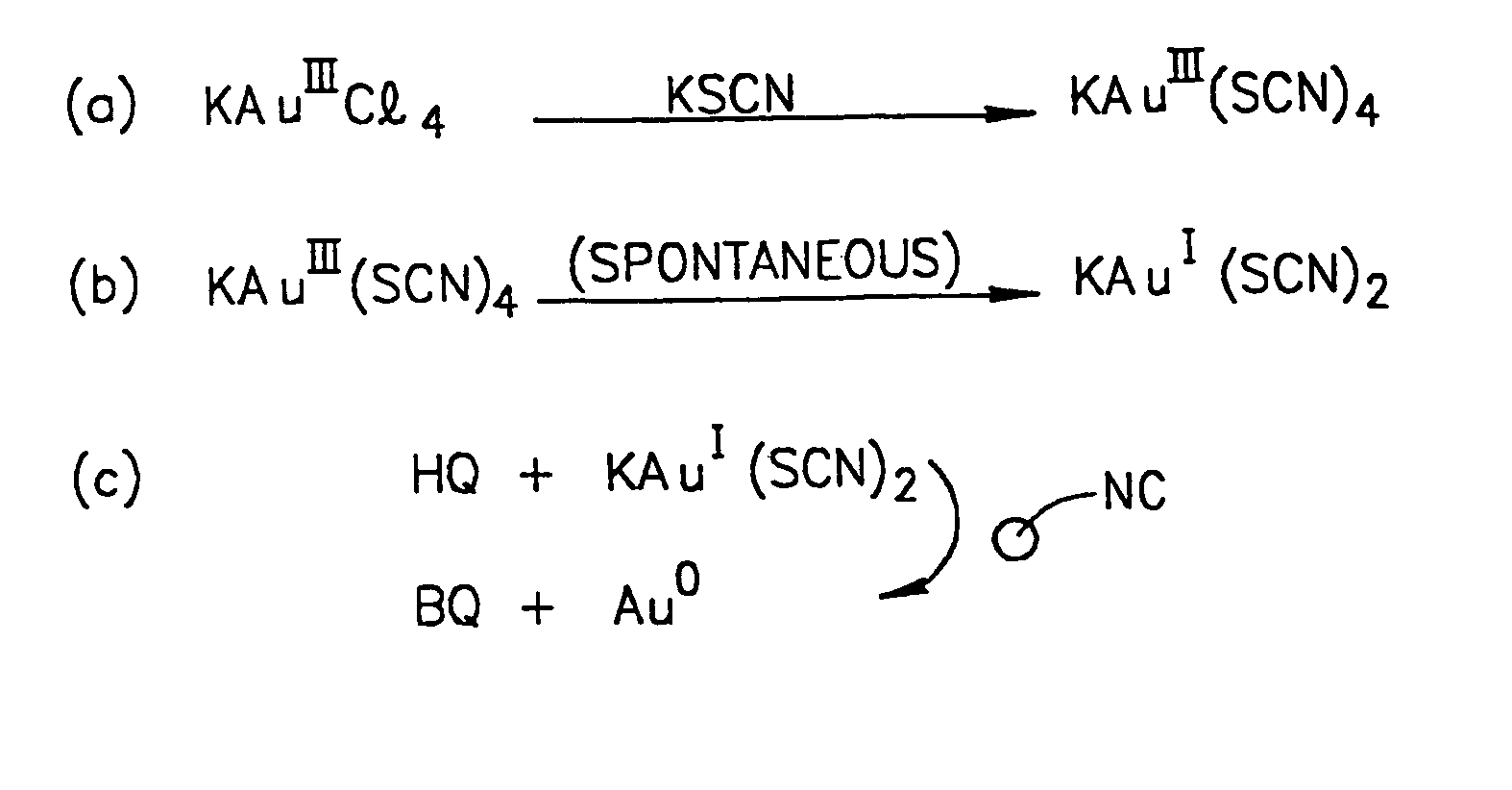
Figure 1 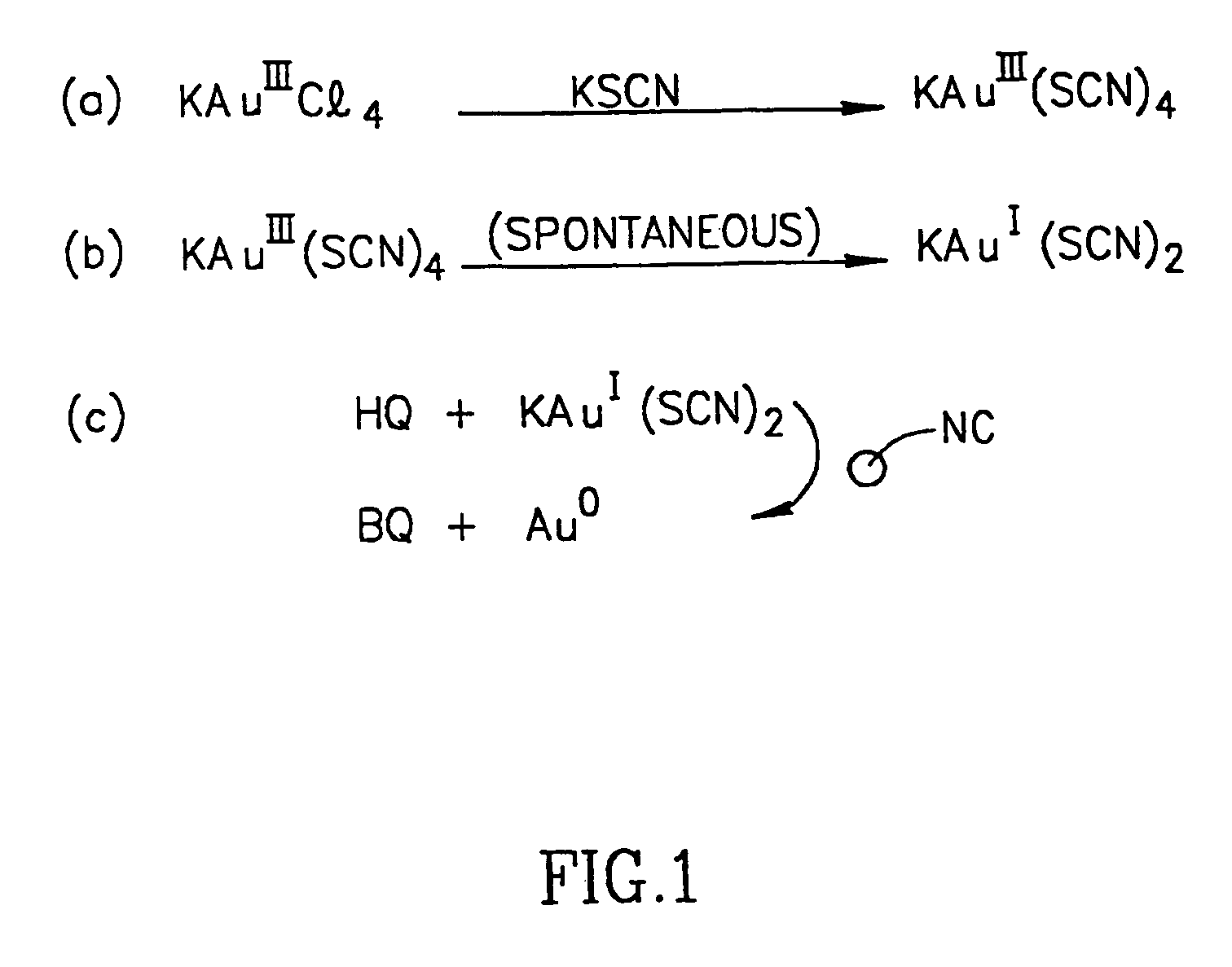
Figure 2 
Figure 3
Abstract
Description
[0001] The invention relates to chemical deposition of gold metal on substrates.
[0002] There are various techniques and uses in which metal substances are deposited on substrates. In various such methods, the metal to be deposited is provided in a form of a soluble complex or molecule, e.g. in an aqueous solution. Under appropriate conditions the complex or molecule is reduced and deposits the metal onto the substrate.
[0003] At times, in order to ensure deposition of metal from solution onto a substrate, it is preferable to first provide nucleation centers on the substrate. Such nucleation centers may, for example, be a variety of metal complexes, clusters or small metal particles, deposited on or attached to the surface.
[0004] Examples of techniques involving metal deposition are a variety of image formation or latent image contrast-enhancement techniques for photography, optical microscopy or electron microscopy. Another example of laboratory techniques where metal complexes are d...
Examples
Embodiment Construction
[0057] Preparation of a Treatment Composition and General Gold Deposition Scheme
[0058] A treatment composition in accordance with the preferred embodiment of the invention comprises a gold-containing complex-Au.sup.1SCN.sup.-. In order to prepare such a treatment composition at a first stage a solution comprising KAu.sup.IIICl.sub.4 and KSCN is prepared, typically by mixing two stock solutions, one comprising the gold containing complex and the other the KSCN. For example, such a solution may be formed by mixing equal volumes of a first solution comprising about 0.5 M KSCN and a second solution comprising about 0.05 M KAumCl.sub.4. Such mixing results in the formation of the complex KAu.sup.III(SCN).sub.4 (See Scheme (a) in FIG. 1). This complex precipitates but spontaneously forms the complex KAu.sup.I(SCN).sub.2. Typically, after the KAu.sub.III(SCN).sub.4 is precipitated, it is washed and resuspended in water or buffer and allowed to undergo the spontaneous reaction (SPONT.) note...