
Moving mechanism with high bandwidth response and low force transmissibility
a moving mechanism and bandwidth response technology, applied in the field of semiconductor processing equipment, can solve the problems of image projection of photolithography machine, inability to move, and inability to accurately reflect the image, etc., and achieve the effect of increasing the mass of the overall stage device, small counter mass, and high precision
Patent Information
- Authority / Receiving Office
- US · United States
- Patent Type
- Applications(United States)
- Current Assignee / Owner
- Publication Date
- 2006-02-16
Smart Images
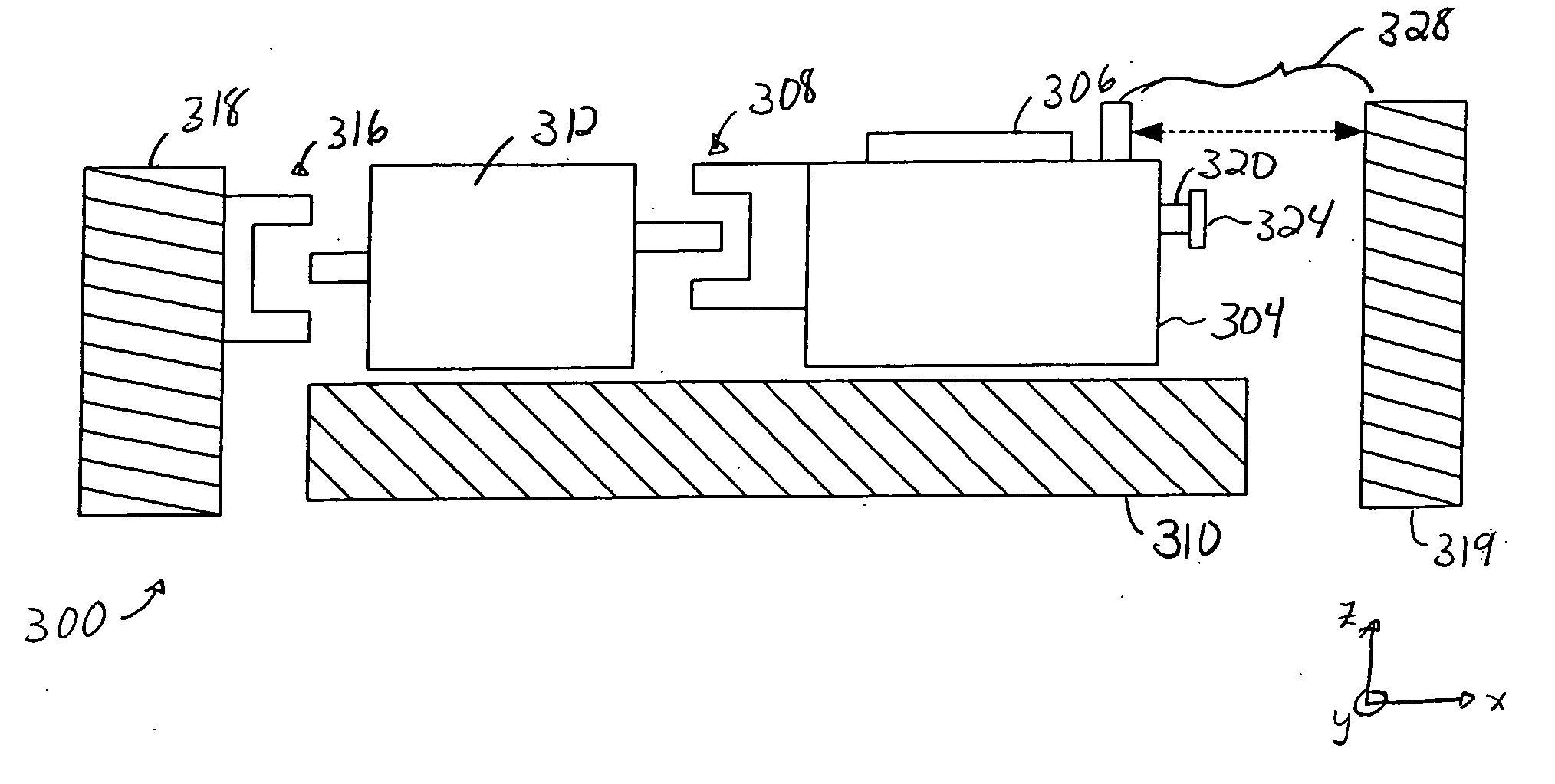
Figure 1 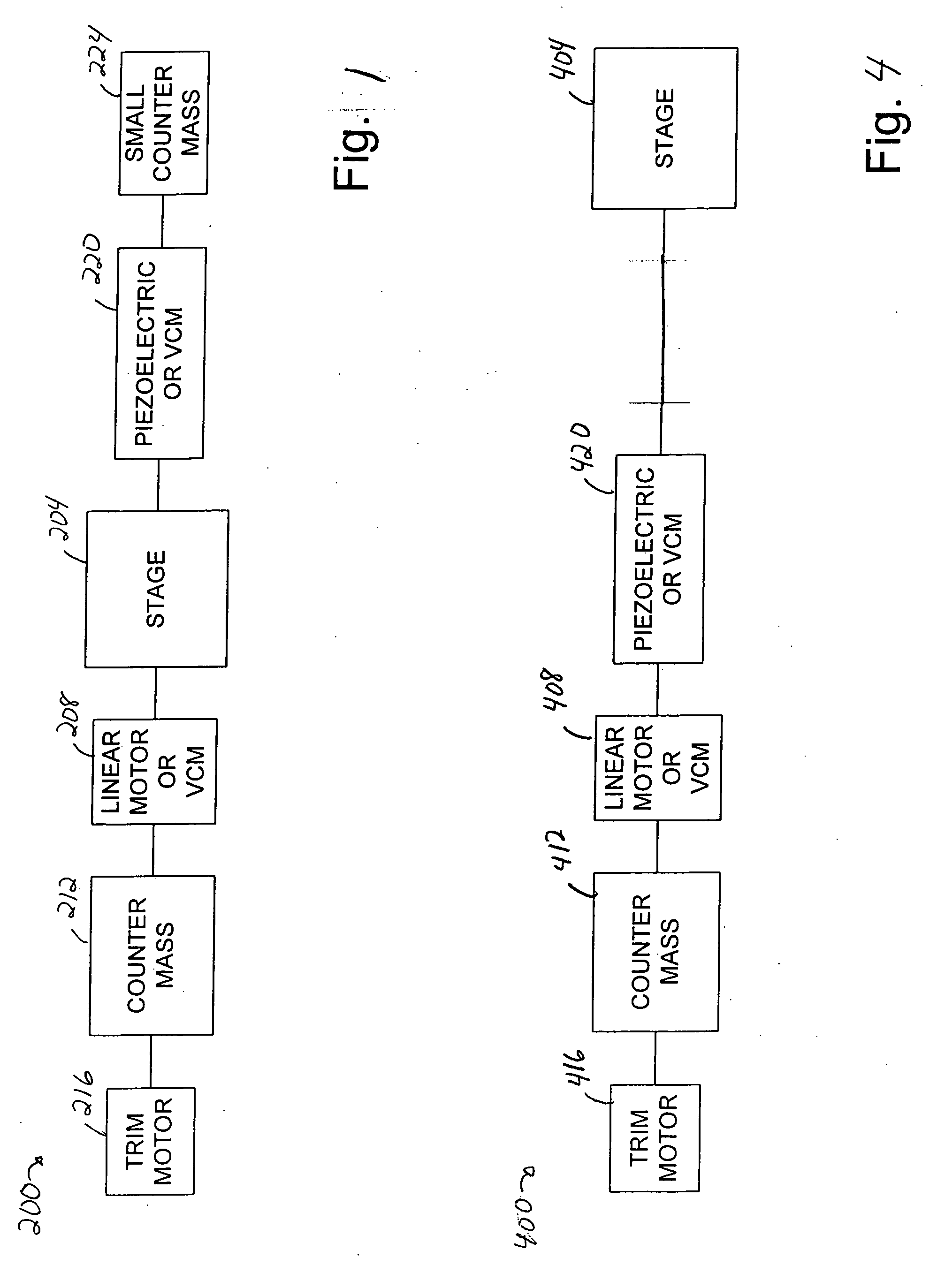
Figure 2 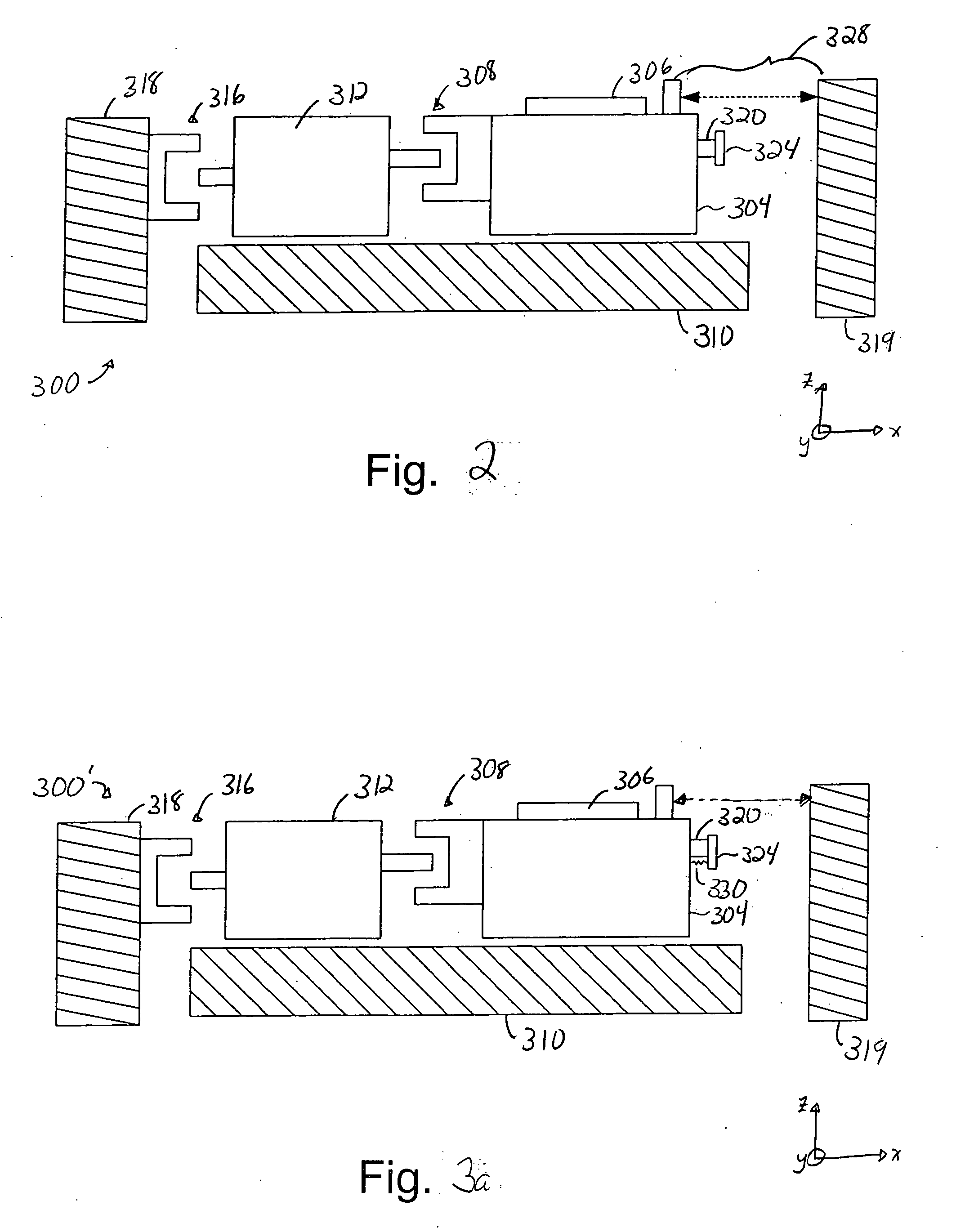
Figure 3
Abstract
Description
BACKGROUND OF THE INVENTION
[0001] 1. Field of Invention
[0002] The present invention relates generally to semiconductor processing equipment. More particularly, the present invention relates to a mechanism that enables the accuracy and bandwidth associated with a moving stage may be positioned to be improved.
[0003] 2. Description of the Related Art
[0004] For precision instruments such as photolithography machines which are used in semiconductor processing, factors which affect the performance, e.g., accuracy, of the precision instrument generally must be dealt with and, insofar as possible, eliminated. When the performance of a precision instrument is adversely affected, as for example by pitching moments, products formed using the precision instrument may be improperly formed and, hence, function improperly. For instance, a photolithography machine which is subjected to pitching moments may cause an image projected by the photolithography machine to move, and, as a result, be al...
Examples
Embodiment Construction
[0031] Many stages, e.g., reticle stages or wafer stages, may not be as precisely positioned as desired. Often, measures taken to improve the precision of stages involve reducing either the effect of vibrations or oscillations or reducing the transmissibility of vibrations or oscillations. For example, the mass of the stage may be increased to reduce the effect of vibrations. Although increasing the rigidity and, hence, the mass, of the stage may reduce the effect of vibrations on an overall stage device, increasing the rigidity may require increasing the size of a linear motor or a voice coil motor (VCM) which drives the stage and enables the stage to move with a relatively long stroke. Increasing the size of a motor which drives the stage may not be acceptable in many situations.
[0032] A relatively high precision and, therefore, relatively high bandwidth stage that is driven by a linear motor or a VCM which moves a long stroke may be achieved by adding a secondary actuator, with ...