

Steel powder composition and sintered body thereof
a technology of steel powder and composition, which is applied in the field of steel powder composition and a sintered body thereof, can solve the problems of poor sinterability, poor dimensional stability, non-uniform sintered density, etc., and achieves low sintered density, good sintering effect, and good dimensional control
Patent Information
- Authority / Receiving Office
- US · United States
- Patent Type
- Applications(United States)
- Current Assignee / Owner
- Publication Date
- 2012-07-12
- Estimated Expiration
- Not applicable · inactive patent
Smart Images
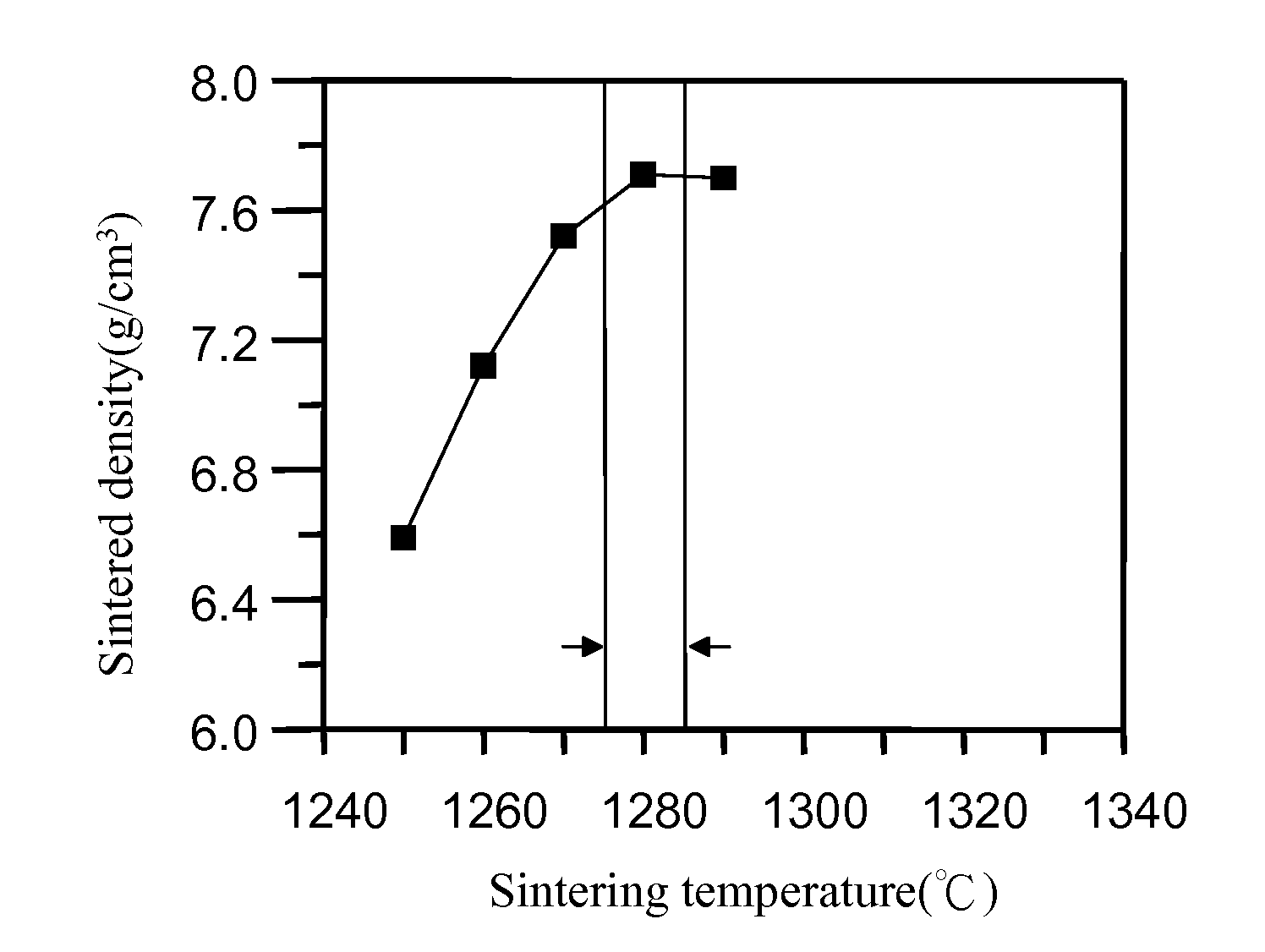
Figure 1 
Figure 2 
Figure 3
Abstract
Description
FIELD OF INVENTION
[0001] The present invention relates to a steel powder composition and a sintered body thereof, and more particularly to a martensitic stainless steel powder composition for metal injection molding, which has an improved dimensional control, and a sintered body thereof.BACKGROUND OF THE INVENTION
[0002] Metal injection molding (MIM) includes processes such as mixing a metal powder and a polymer binder, molding with an injection molding machine, debinding, and sintering at high temperatures, to obtain a metal part of near net shape. The technology involves in two fields, that is, powder metallurgy and plastic injection molding. Due to the high strength and hardness requirements for a MIM material, martensitic stainless steel is widely used, for example, steel species such as Japanese SUS410 series, Japanese SUS420 series, and Japanese SUS440C series.
[0003] However, the martensitic stainless steel powders generally have problems of poor sinterability, such as poor dimens...
Examples
embodiment 1
[0030]the alloy composition of this embodiment is shown in Table 1. In this embodiment, a titanium-containing pre-alloyed powder prepared by gas atomization is subjected to the process in Comparative Embodiment 1. FIG. 5 shows the sintering characteristics of this embodiment. The sintering window of Embodiment 1 is increased to 50° C., that is, within ±25° C. Such a sintering window improves the sinterability significantly, and is capable of being used in a common sintering furnace in the industry.
embodiment 2
[0031]the alloy composition of this embodiment is shown in Table 1. In this embodiment, titanium (Ti) is provided by adding 1.0 wt % of the titanium carbide (TiC) powder, and this powder mixture is subjected to the process in Comparative Embodiment 1. FIG. 6 shows the sintering characteristics. The sintering window of this embodiment is increased to 20° C., that is, within ±10° C.
embodiment 3
[0032]the alloy composition of this embodiment is shown in Table 1. In this embodiment, titanium (Ti) is provided by adding 2.0 wt % of the titanium carbide (TiC) powder, and this powder mixture is subjected to the process in Comparative Embodiment 1. FIG. 7 shows the sintering characteristics. The sintering window of this embodiment is increased to 40° C., that is, within ±20° C., indicating that the addition of titanium carbide (TiC) powder improves the sintering behavior.