
Plant growth medium
a technology of growth medium and plant, applied in the field of plant husbandry, can solve the problems of poor aeration, heavy soil, and general unsuitability of natural soil for growing plants, and achieve the effects of enhancing the growth of a wide range of commercially important plants, and reducing the amount of water availabl
Patent Information
- Authority / Receiving Office
- US · United States
- Patent Type
- Applications(United States)
- Current Assignee / Owner
- Publication Date
- 2013-01-24
Smart Images
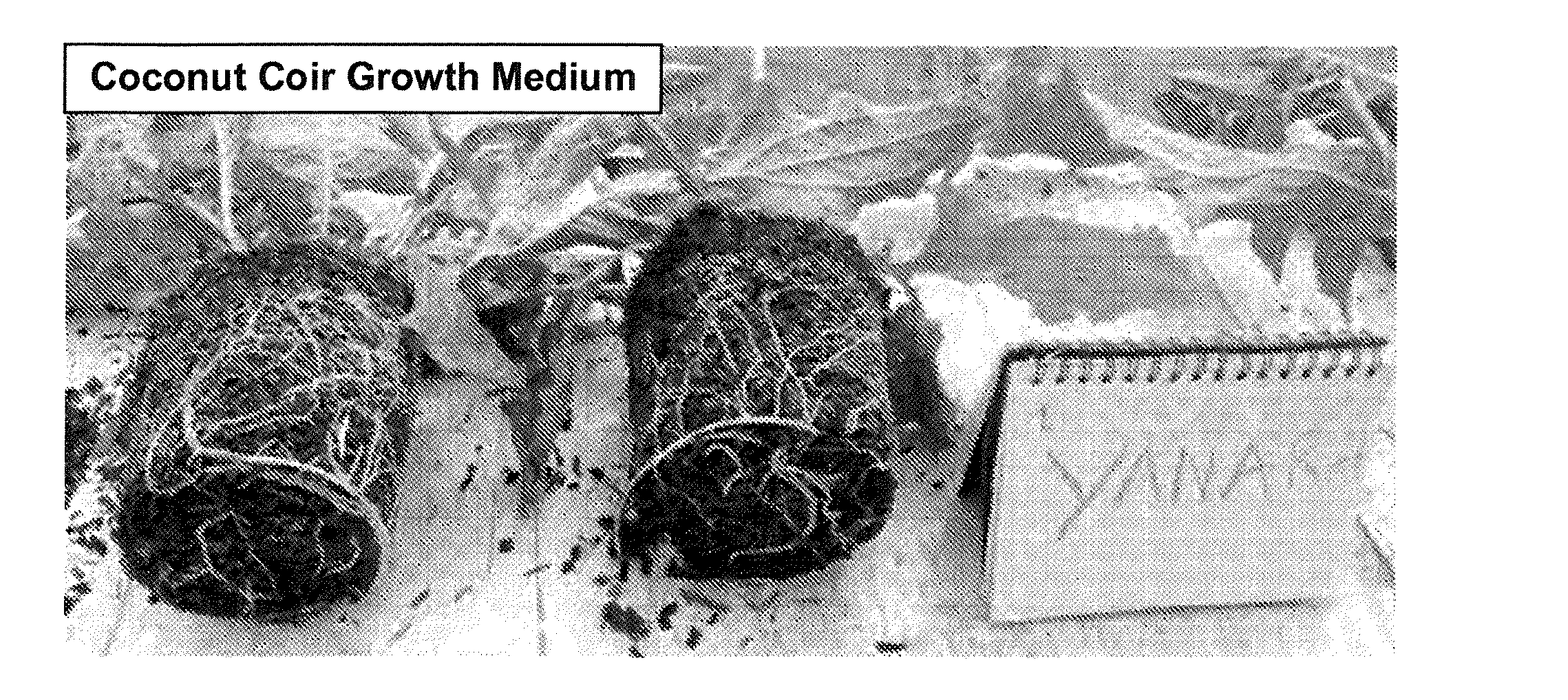
Figure 1 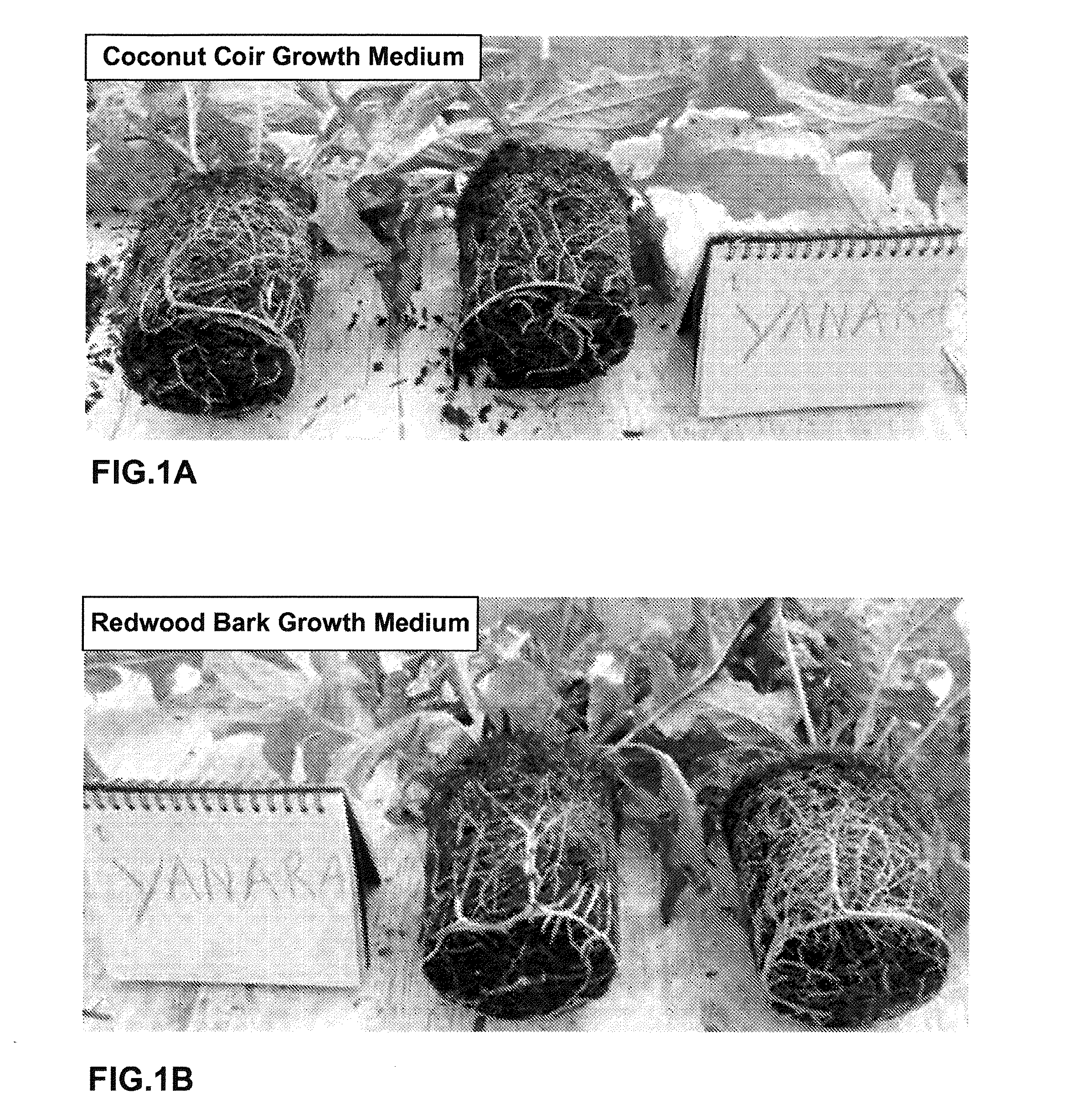
Figure 2 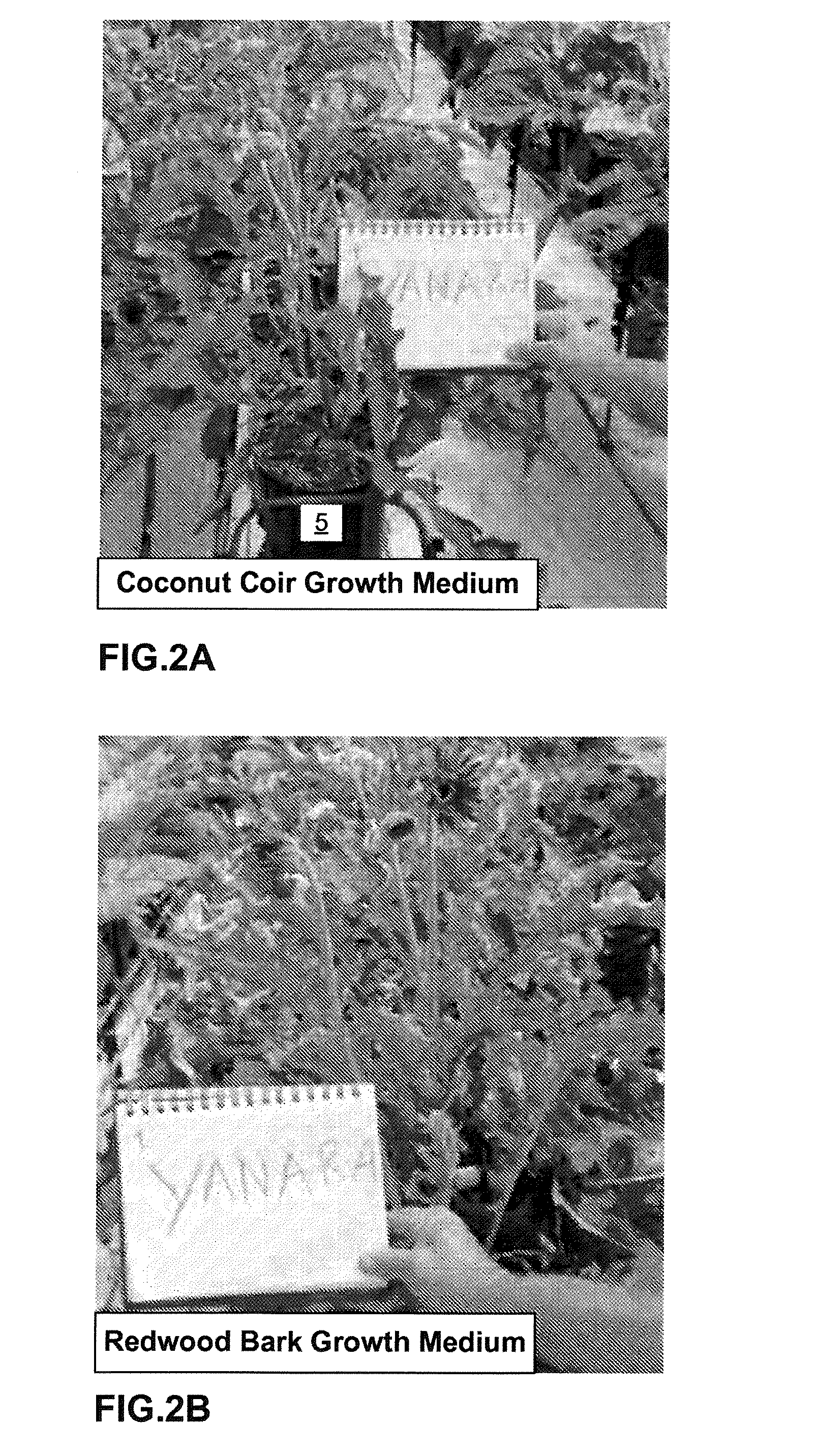
Figure 3
Abstract
Description
CROSS-REFERENCE TO RELATED APPLICATIONS
[0001] This application takes priority under 35 U.S.C. §119(e) from co-pending provisional patent application 61 / 389,880 filed Oct. 5, 2010 to the instant inventors, said provisional application is hereby incorporated by reference as if fully set forth herein.RELEVANT FIELD
[0002] This application is directed generally toward plant husbandry and more specifically toward plant growth mediums. RELEVANT ART
[0003] Natural soils are generally unsuitable for growing plants, seeds, seedlings, cuttings in containers in commercial applications. For example, ordinary soils are often heavy, provide poor aeration, are difficult to maintain physiochemical uniformity and may introduce pathogens or other biological or chemical agents which impact the healthy growth of plants. These and other deficiencies increase labor, irrigation and treatment costs which impact commercial aspects of the growing enterprise.
[0004] To address the deficiencies of natural soi...
Examples
example 1
[0033] Referring to FIGS. 1A&B, root structures of plants of the variety Gerbera (“Yanara,”) planted in coconut coir and the inventive growth mediums are depicted. This variety of Gerbera produces large ornamental red daisy flowers. In FIG. 1A, the root structures after approximately 90 days of growth of the Gerbera using coconut coir as a plant growth medium are comparatively less well developed or prolific than the Gerbera grown in the inventive growth medium as depicted in FIG. 1B for an equivalent time period of approximately 90 days. The tests were grown in a traditional greenhouse environment using normal irrigation without attempts to optimize for either the coconut coir or the inventive growth medium and under controlled growing conditions in terms of temperature and solar illumination. A greenhouse environment is not required in the use of the inventive growth medium.
example 2
[0034] Referring to FIGS. 2A&B, leaf and flower structures of plants of the variety Gerbera (“Yanara,”) planted in coconut coir and the inventive growth mediums are depicted. In FIG. 2A, the leaf and flower structures after approximately 90 days of growth of the Gerbera using coconut coir as a plant growth medium are less extensive with far fewer flowers than the Gerbera grown in the inventive growth medium as depicted in FIG. 2B for an equivalent time period of approximately 90 days. As before, the tests were grown in a traditional greenhouse environment using normal irrigation without attempts to optimize for either the coconut coir or the inventive growth medium and under controlled growing conditions in terms of temperature and solar illumination. A greenhouse environment is not required in the use of the inventive growth medium.
example 3
[0035] Referring to FIGS. 3A&B, root structures of plants of another variety of Gerbera (“Dream,”) planted in coconut coir and the inventive growth mediums are depicted. This variety of Gerbera produces ornamental pink daisy flowers. In FIG. 3A, the root structures after approximately 2 years of growth of the Gerbera using coconut coir as a plant growth medium are about the same as the Gerbera grown in the inventive growth medium depicted in FIG. 3B for an equivalent time period of approximately 2 years. However, as is evident in FIG. 3A, the coconut coir growth medium has deteriorated to a more vegetative state with considerably higher water content of approximately 80% by volume while the inventive growth medium depicted in FIG. 3B remains steerable and generally intact, with a water content of approximately 55% by volume. As before, the tests were grown in a traditional greenhouse environment using normal irrigation without attempts to optimize for either the coconut coir or the ...