
Rubber laminate, run-flat tire, and pneumatic tire
a technology of rubber laminate and run-flat tire, which is applied in the direction of transportation and packaging, synthetic resin layered products, chemistry apparatus and processes, etc., can solve the problems of poor co-crosslinking and discoloration of the color layer layer, and achieve excellent run-flat durability, high adhesion, and high adhesion.
Patent Information
- Authority / Receiving Office
- US · United States
- Patent Type
- Applications(United States)
- Current Assignee / Owner
- Publication Date
- 2013-11-28
- Estimated Expiration
- Not applicable · inactive patent
Smart Images
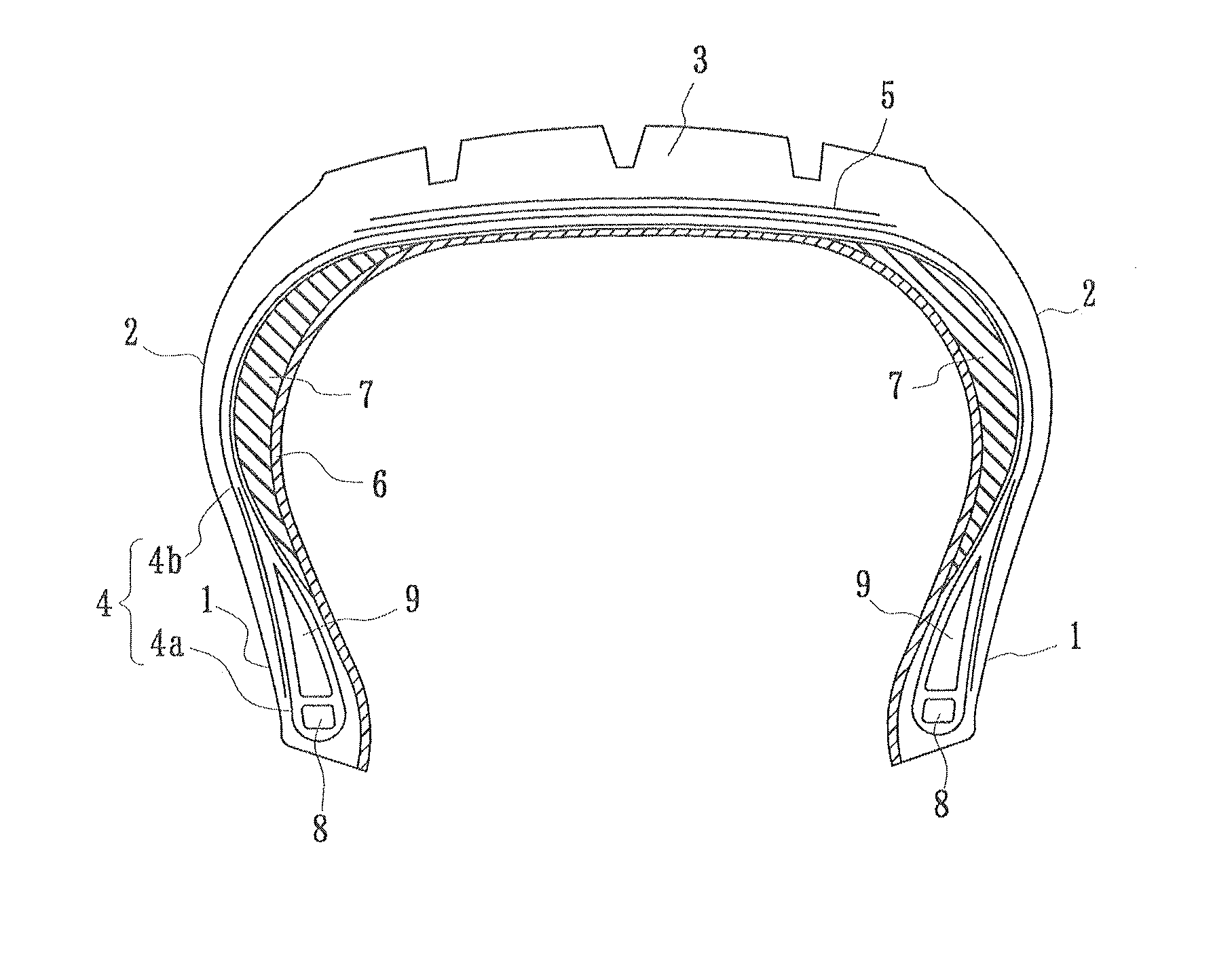
Figure 1 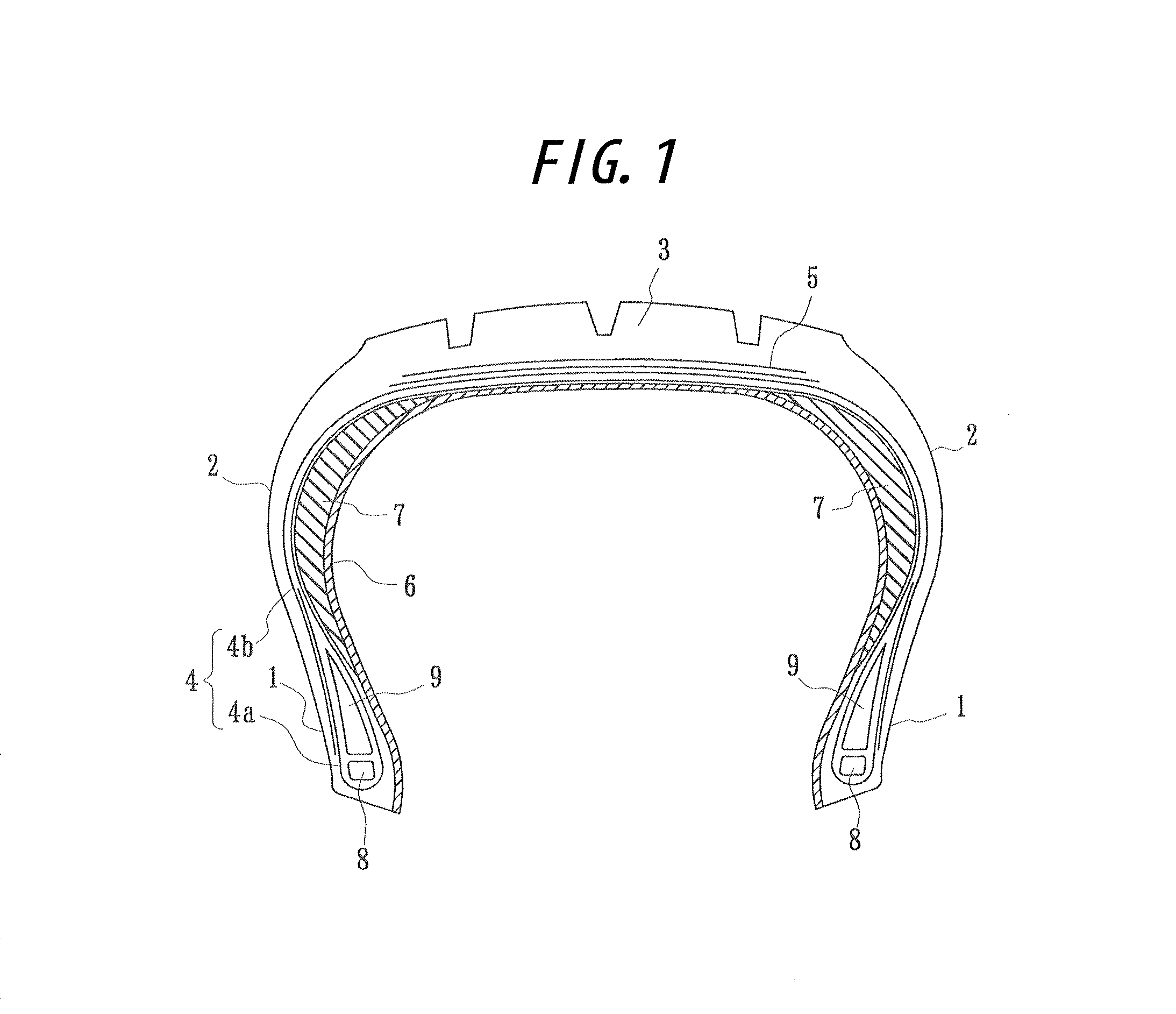
Figure 2 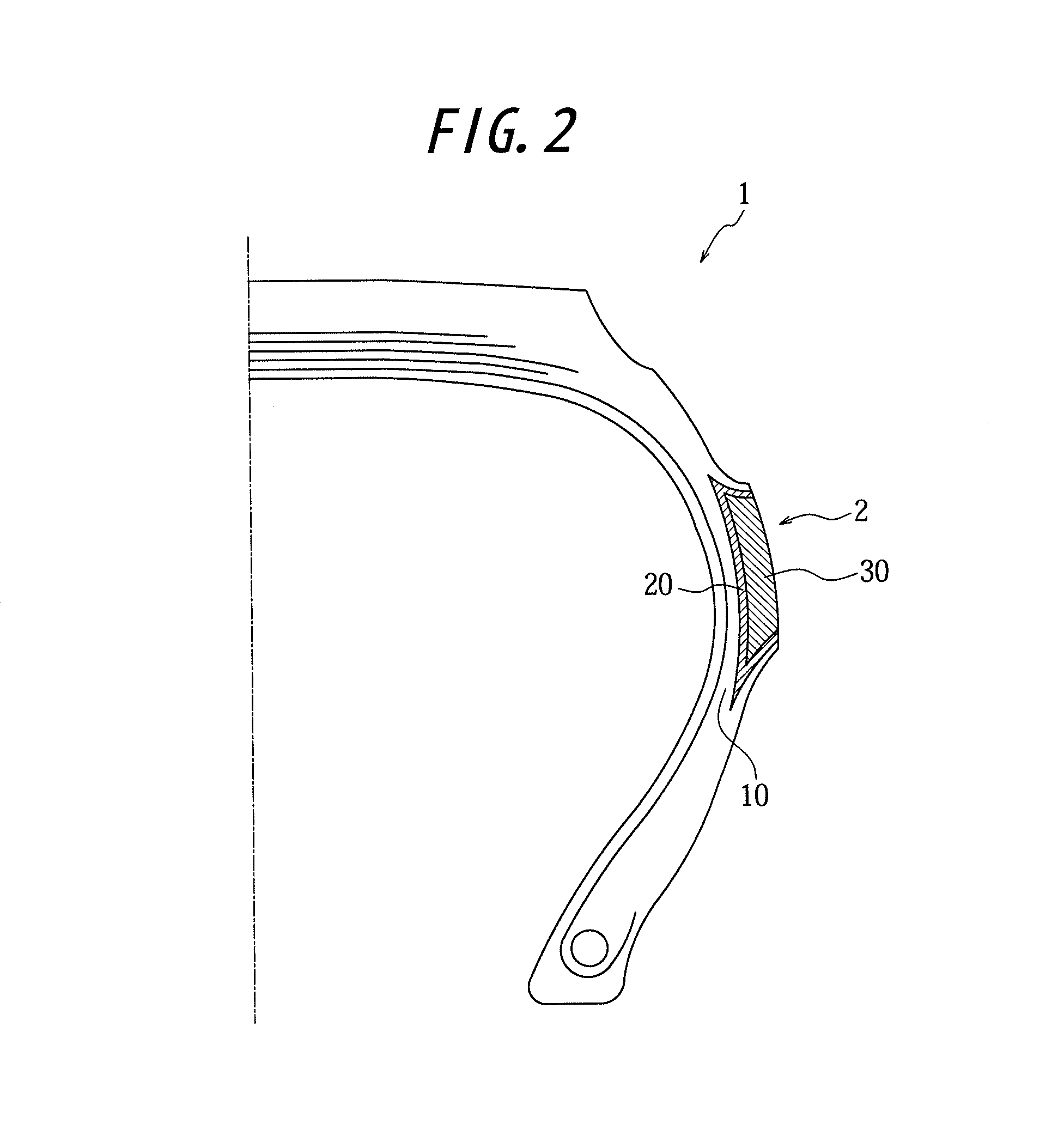
Figure 3
Abstract
Description
TECHNICAL FIELD
[0001] The present invention relates to: a rubber laminate having high adhesion between a rubber member including a non-diene rubber and a rubber member including a diene rubber; a run-flat tire obtained by using the rubber laminate, having high adhesion between a side-reinforcing rubber layer and an inner liner, with excellent run-flat durability; and a pneumatic tire having high adhesion force to a side rubber and a color layer having excellent stain resistance.BACKGROUND ART
[0002] As a so-called run-flat tire capable of safely running over a certain distance even in an internal pressure-reduced state due to a puncture or the like, there is conventionally known a side-reinforced type run-flat tire in which a side-reinforcing rubber with a crescent-shaped section is provided on the inner surface of a carcass in a sidewall portion so as to enhance rigidity of the sidewall portion.
[0003] The run-flat tire generally has an inner liner disposed on the inner surface thereof....
Examples
examples
[0087]The present invention is described in more detail with reference to the examples below, but there is no intension of limiting the present invention to the following examples.
examples 1 to 10
, Comparative Examples 1 to 6
[0088]Rubber compositions for the side-reinforcing rubber layer were prepared based on the formulations shown in Table 1. Further, rubber compositions for the inner liner were prepared based on the formulations shown in Table 2. The rubber compositions thus prepared were measured for the air permeability coefficient according to the following method. The results thereof are shown in Table 2.
[0089](1) Air Permeability Coefficient Samples obtained by vulcanizing the rubber compositions at 160° C. for 30 minutes were measured for the air permeability coefficient at 60° C. by using the air permeation tester M-C1 (manufactured by TOYO SEIKI Co., Ltd.).
TABLE 1Rubber Composition for Side-Reinforcing Rubber LayerRubberRubberRubberRubberRubberRubberRubberRubberComposi-Composi-Composi-Composi-Composi-Composi-Composi-Composi-tion Ation Btion Ction Dtion Etion Ftion Gtion HFormulationNatural RubberParts50.050.050.050.050.050.050.050.0Synthetic Rubber *1by50.050.050....
examples 11 to 17
, Comparative Examples 7 to 11
[0096]The components shown in Table 5, excluding sulfur and vulcanization accelerator, were mixed and kneaded at about 130° C. for 3.0 minutes using a kneader. Then, sulfur and a vulcanization accelerator were added, and the components were mixed and kneaded at about 100° C. for an additional 2.0 minutes with a biaxial open roller, and removed as a sheet including a barrier layer and a rubber layer in a predetermined thickness. Sample pieces for Examples and Comparative Examples were prepared from the sheet.
[0097](Evaluation)
[0098](1) Stain Resistance
[0099]Rubber laminates each including, between contaminated rubber including a certain amount of contaminant and white rubber, the sample piece prepared for each of Examples and Comparative Examples were vulcanized, and the laminate thus vulcanized was measured, by using a spectrophotometer CM-700d (manufactured by Konica Minolta, Inc.), for chromatic deviation on the white rubber surface before and after b...