
Friction Modifiers for Slideway Applications
a technology of friction modifiers and slideways, applied in the field of additive formulations used in slideways, can solve the problems that lubricant additives that are effective for metal surfaces may not be effective in reducing friction, and achieve the effect of improving friction-reducing properties and similar friction-reducing properties
Patent Information
- Authority / Receiving Office
- US · United States
- Patent Type
- Applications(United States)
- Current Assignee / Owner
- Publication Date
- 2014-02-20
Smart Images
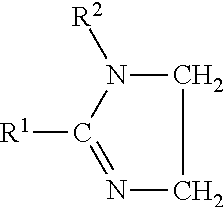
Figure 1 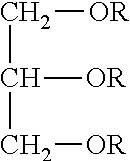
Figure 2 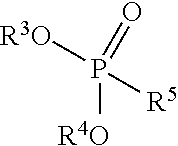
Figure 3
Abstract
Description
CROSS REFERENCE TO RELATED APPLICATION
[0001] This application is a continuation of U.S. application Ser. No. 12 / 144,010, filed Jun. 23, 2008, the entire contents of which is hereby incorporated herein by reference.TECHNICAL FIELD
[0002] The embodiments described herein relate to lubricant additives and use of such additives in lubricating oil formulations, and in particular to additive formulations used for slideway applications.BACKGROUND AND SUMMARY
[0003] A slideway is a mechanical guide designed to provide a device with a track surface that is stable under load (i.e., minimal deflection) with a consistent finish for constant frictional forces, regardless of the rate of movement along the slideway. Slideways may be used in heavy machine tool applications as well as in various electronic components such as disk drives for computers. Other slideways may be included in automotive shifting mechanisms. In order to prevent stick-slip in slideway applications friction at low speed (hereinaft...
Examples
example 1
[0036]Boundary friction coefficients were measured using a PCS Instruments High Frequency Reciprocating Rig (HFRR). Friction coefficients were measured at 130° C. between a SAE 52100 metal ball and either a SAE 52100 metal disk or a 1 cm by 1 cm piece of plastic slideway material. The ball was oscillated across the materials at a frequency of 20 Hz over a 1 mm path, with an applied load of 4.0 N.
[0037]All fluids in Table I were blended into a Group II base oil with a 100° C. kinematic viscosity of ˜4.0 cSt. The friction modifiers, anti-wear / extreme pressure agents and detergents were added to the base oil at a concentration of 0.40 weight percent. The dispersants were added to the base oil at a concentration of 3.0 weight percent.
[0038]Table I shows the friction data for a series of fluids containing 1) a friction modifier, 2) an anti-wear / extreme pressure agent 3) a detergent and 4) a dispersant. The friction modifiers used in these fluids include: a metal-free, amine-containing fr...
example 2
[0042]In another series of tests, boundary friction coefficients were measured as in Example 1 at 130° C. between a SAE 52100 metal ball and a 1 cm by 1 cm piece of plastic slideway material. In test fluid contained a base oil having only 0.2 weight percent of each of the friction modifiers or anti-wear agents listed in example 1. The results are given in the following Table 3.
TABLE 3Weight percent130° C. Frictionin base oilAdditiveCoefficient on plastic0.20MoDTC0.2680.20ZDDP0.2020.20Thiadiazole0.1420.20GMO0.1060.20DMOP0.0940.20U-O0.072
[0043]According to the foregoing examples, the following observations may be articulated:[0044]1) metal-free friction modifiers (thiadiazole, GMO, DMOP and U-O) reduce friction on plastic better than metal-containing friction modifiers.[0045]2) amine-containing metal-free friction modifiers (U-O) reduce friction better than amine-free metal-free friction modifiers.[0046]3) metal- and sulfur-free phosphorus compounds (DMOP) reduce friction on plastic b...