
Solid electrolyte composition, solid electrolyte-containing sheet, all-solid state secondary battery, and methods for manufacturing solid electrolyte-containing sheet and all-solid state secondary battery
Patent Information
- Authority / Receiving Office
- US · United States
- Current Assignee / Owner
- Publication Date
- 2019-03-21
- Estimated Expiration
- Not applicable · inactive patent
Smart Images
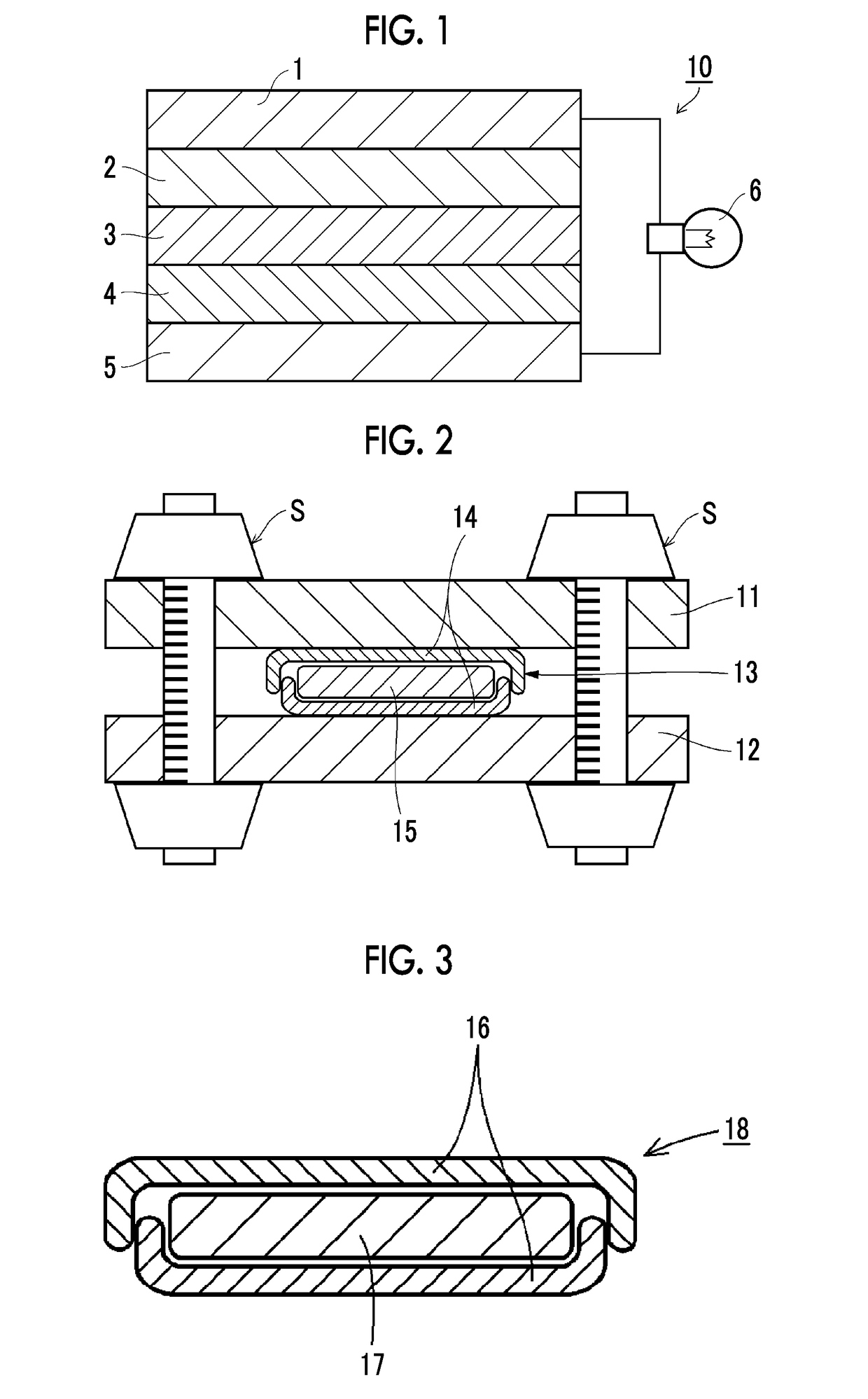
Figure 1
Abstract
Description
CROSS-REFERENCE TO RELATED APPLICATIONS
[0001] This application is a Continuation of PCT International Application No. PCT / JP2017 / 018288 filed on May 16, 2017, which claims priorities under 35 U.S.C. § 119 (a) to Japanese Patent Application No. 2016-102287 filed in Japan on May 23, 2016 and Japanese Patent Application No. 2017-094610 filed in Japan on May 11, 2017. Each of the above applications is hereby expressly incorporated by reference, in its entirety, into the present application.BACKGROUND OF THE INVENTION1. Field of the Invention
[0002] The present invention relates to a solid electrolyte composition, a solid electrolyte-containing sheet, an all-solid state secondary battery, and methods for manufacturing a solid electrolyte-containing sheet and an all-solid state secondary battery.2. Description of the Related Art
[0003] A lithium ion secondary battery is a storage battery which has a negative electrode, a positive electrode and an electrolyte sandwiched between the negative ele...
Examples
embodiment
Preferred Embodiment
[0038]FIG. 1 is a cross-sectional view schematically illustrating an all-solid state secondary battery (lithium ion secondary battery) according to a preferred embodiment of the present invention. In the case of being seen from the negative electrode side, an all-solid state secondary battery 10 of the present embodiment has a negative electrode collector 1, a negative electrode active material layer 2, a solid electrolyte layer 3, a positive electrode active material layer 4, and a positive electrode collector 5 in this order. The respective layers are in contact with one another and have a laminated structure. In a case in which the above-described structure is employed, during charging, electrons (e−) are supplied to the negative electrode side, and lithium ions (Li+) are accumulated on the negative electrode side. On the other hand, during discharging, the lithium ions (Li+) accumulated on the negative electrode side return to the positive electrode, and elec...
example 1
[0272]
[0273]On a solid electrolyte composition prepared below, a dispersion stability test, the measurement of the viscosity, the measurement of the volume-average particle diameter of the inorganic solid electrolyte in the solid electrolyte composition, and the measurement of the ion conductivity were carried out. The test and measurement results are summarized in Table 1.
[0274]In addition, on a composition for a positive electrode and a composition for a negative electrode prepared below, a dispersion stability test and the measurement of the viscosity were carried out. The test and measurement results are summarized in Tables 2 and 3.
[0275]Hereinafter, a test methods and measurement methods will be described.
[0276]
[0277]Individual compositions described below were prepared and then left to stand in a transparent sample bottle at 25° C. for 24 hours. The states of the individual compositions before and after being left to stand for 24 hours were visually observed. The solid compon...