
Method in connection with the production of mechanical pulp
a mechanical pulp and production method technology, applied in the multi-stage pulping process, pulp liquor regeneration, papermaking, etc., can solve the problems of increased complexing agent consumption, taint and odour, and increased consumption of bleaching agents, so as to reduce the consumption of peroxide and reduce the cost of primary fines. , the effect of substantial chemical savings
Patent Information
- Authority / Receiving Office
- US · United States
- Current Assignee / Owner
- Publication Date
- 2006-02-28
- Estimated Expiration
- Not applicable · inactive patent
Smart Images
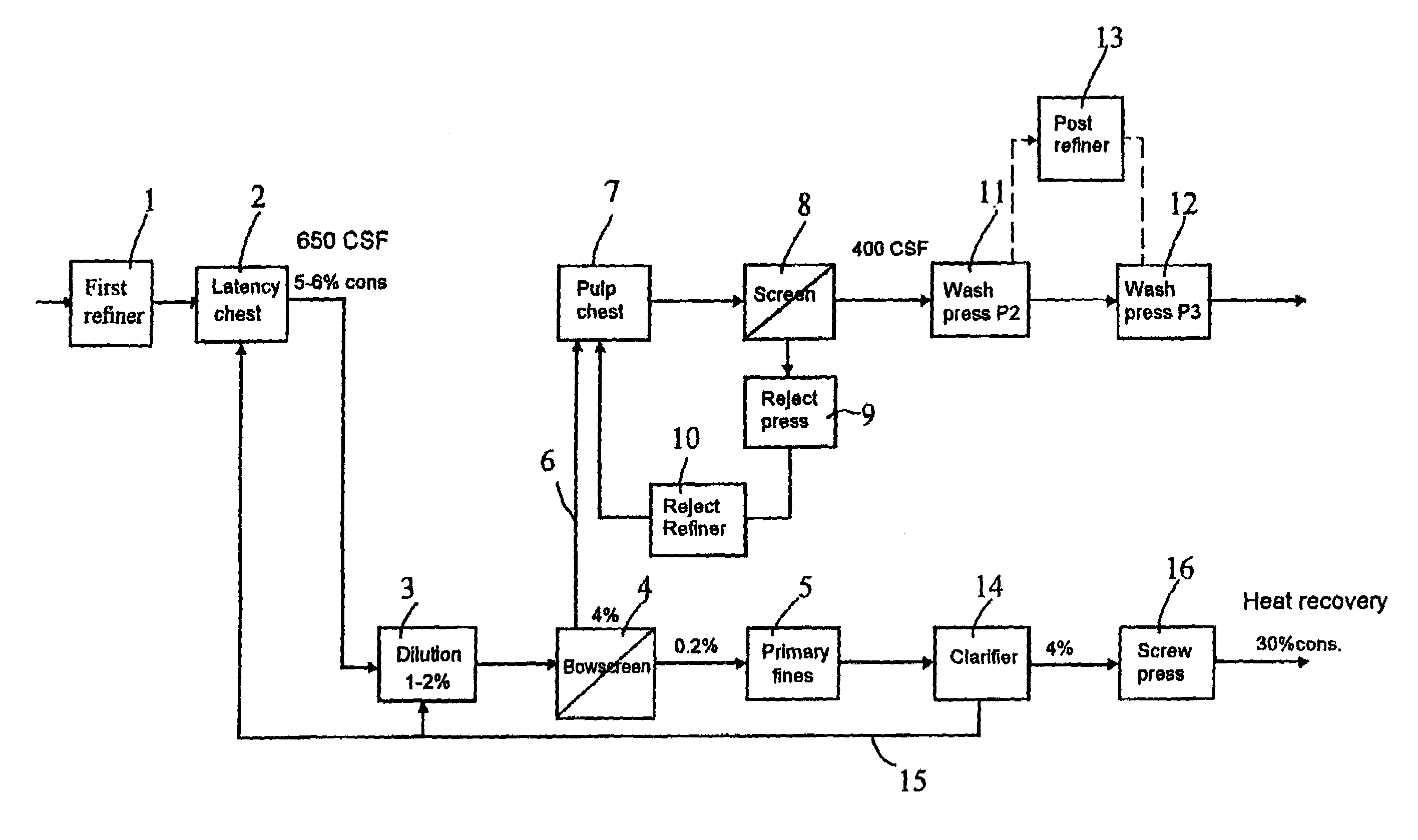
Figure 1 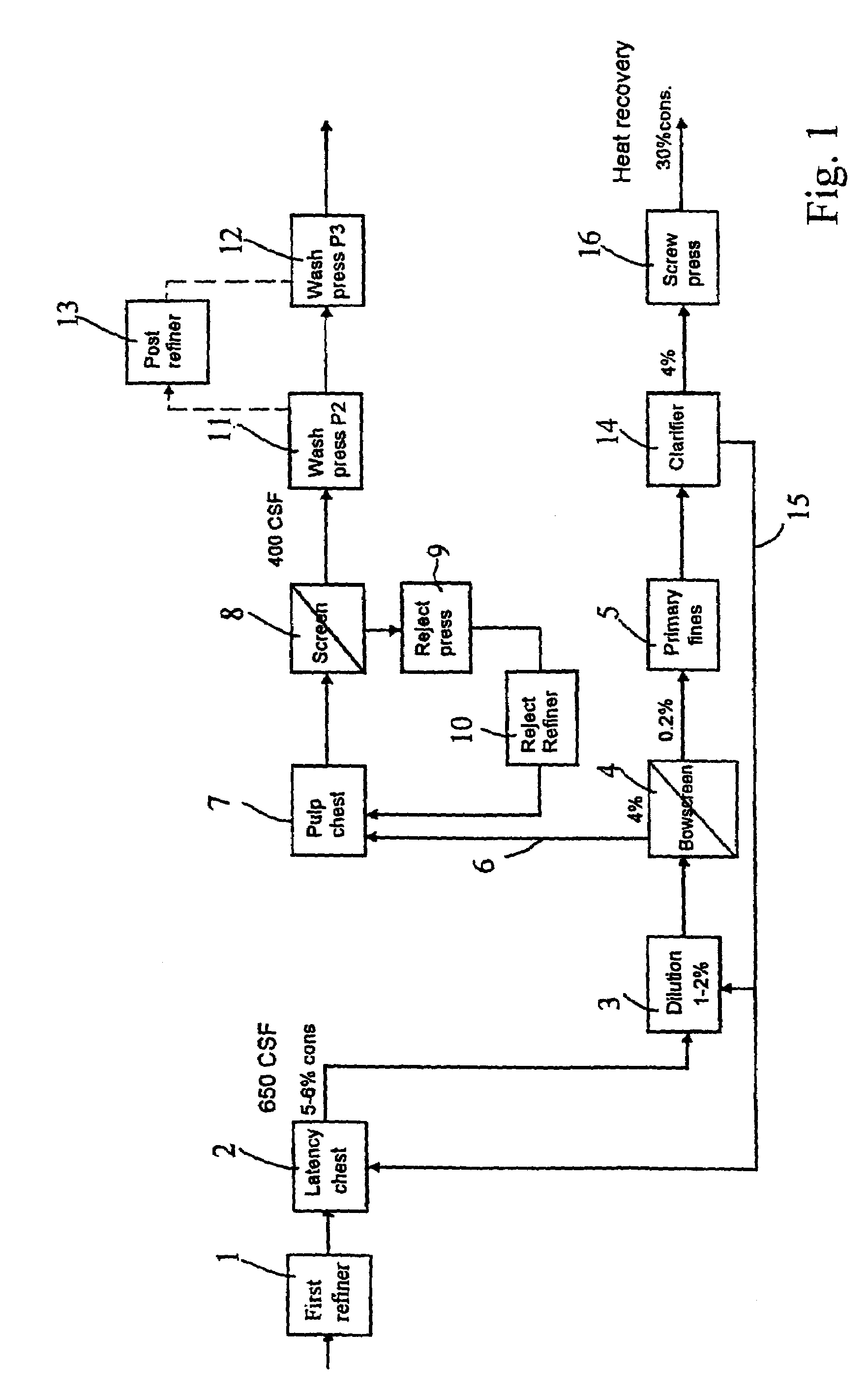
Figure 2 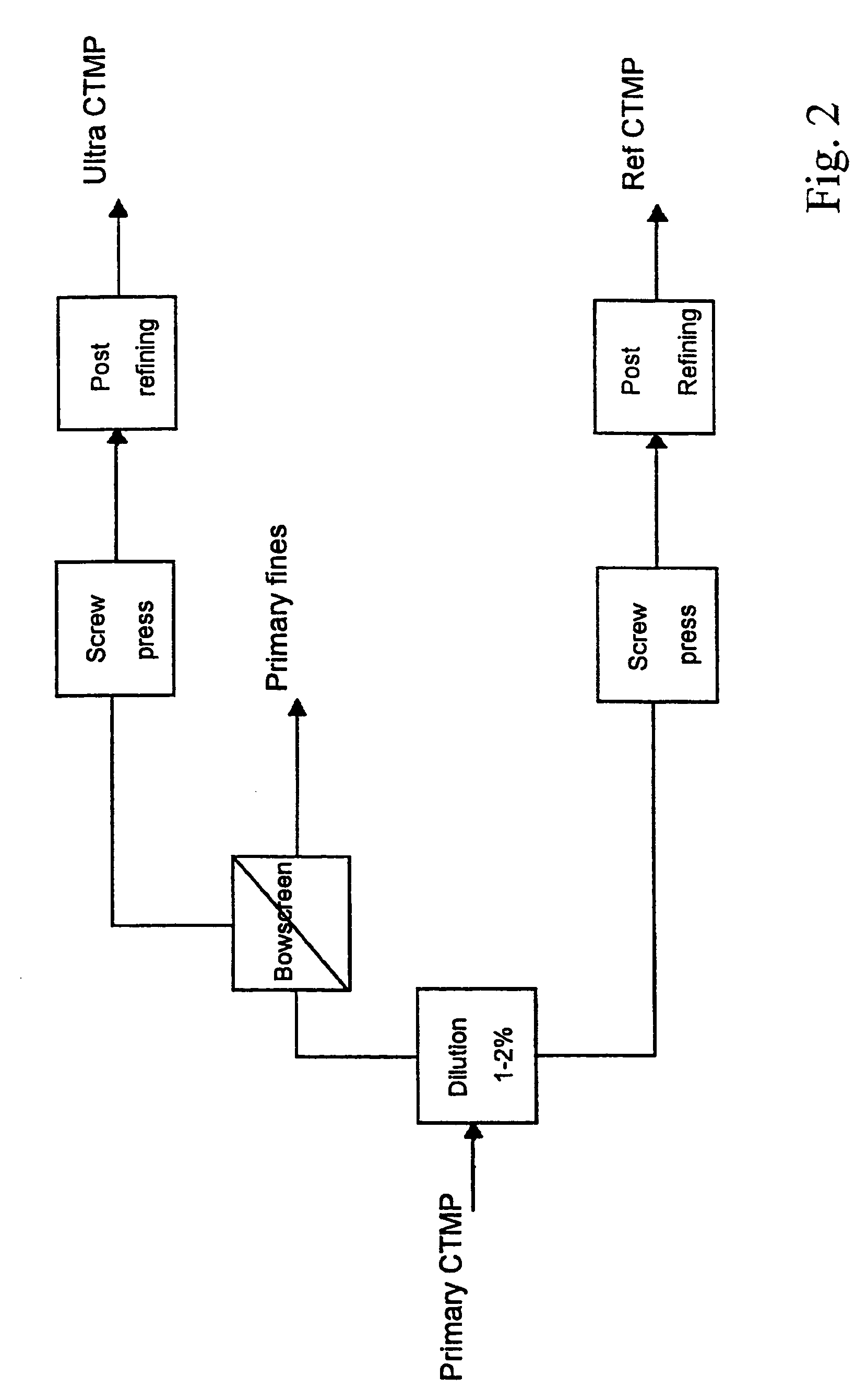
Figure 3
Abstract
Description
[0001] This application is a 371 of PCT / SE00 / 01709 filed on 6 Sep. 2000.TECHNICAL FIELD
[0002] The present invention relates to a method in connection with the production of mechanical pulp from a cellulose containing material, wherein the material is processed in at least one refining step to produce pulp. The invention also relates to a mechanical pulp, produced by the method, and a paperboard, at least partly consisting of such mechanical pulp.BACKGROUND OF THE INVENTION
[0003] Mechanical pulp, most often CTMP (Chemi Thermo Mechanical Pulp), is a major component in multiply board constructions, and often constitutes about 70% of the centre layer and up to 50% of the board furnish.
[0004] To achieve high bending stiffness of the board it is desirable to have a high strength at a sheet density of the centre ply as low as possible. A favourable Scott bond-density relationship is thus essential. To this end, there are two opposing aspects that have to be considered. Firstly, only the compon...
Examples
example
Fractionation of CTMP Pulp
[0037]Fractionation trials were carried out on CTMP pulp, which had been refined in a first refining step, using a set-up of curved screen with screen slit width 100 μm, at varied pulp consistency, inlet clearance, flow rate and hydraulic pressure (see FIG. 2). The removal of fines varied from 4.8% to 8.5%, as shown in Table 1. Pulp BSK 4, being the reject from the curved screen, with the highest fines removal was chosen for further studies.
[0038]
TABLE 1Curved screen fractionationBowscreen settingProcess parametersFinesSlit widthClearanceFlowPressureConsistencyremovalummml / minkPa%%BSK 1100313501002.04.8BSK 2100318902002.05.9BSK 310029001001.17.8BSK 4100212602001.18.5
[0039]
TABLE 2Bauer McNett fractionation of CTMP pulpBauer McNett FractionationWhole Pulp>16 mesh>30>100>200MnFreeness%%%%%ppmCSFPrimary49.218.5133.912.025590BSK 453.619.8144.18.213650Reference47.919.9144.313.518390Ultra-CTMP47.620154.113.311390
[0040]When comparing the incoming pulp (Primary), wi...