
Iterative channel and interference estimation and decoding
a technology of interference estimation and decoding, applied in the field of communication, can solve the problems of affecting the reliability of decoded data, affecting the quality of recovered data symbols, and affecting the noise and interference of signals, so as to achieve the effect of improving performan
Patent Information
- Authority / Receiving Office
- US · United States
- Patent Type
- Patents(United States)
- Current Assignee / Owner
- Publication Date
- 2008-09-02
Smart Images
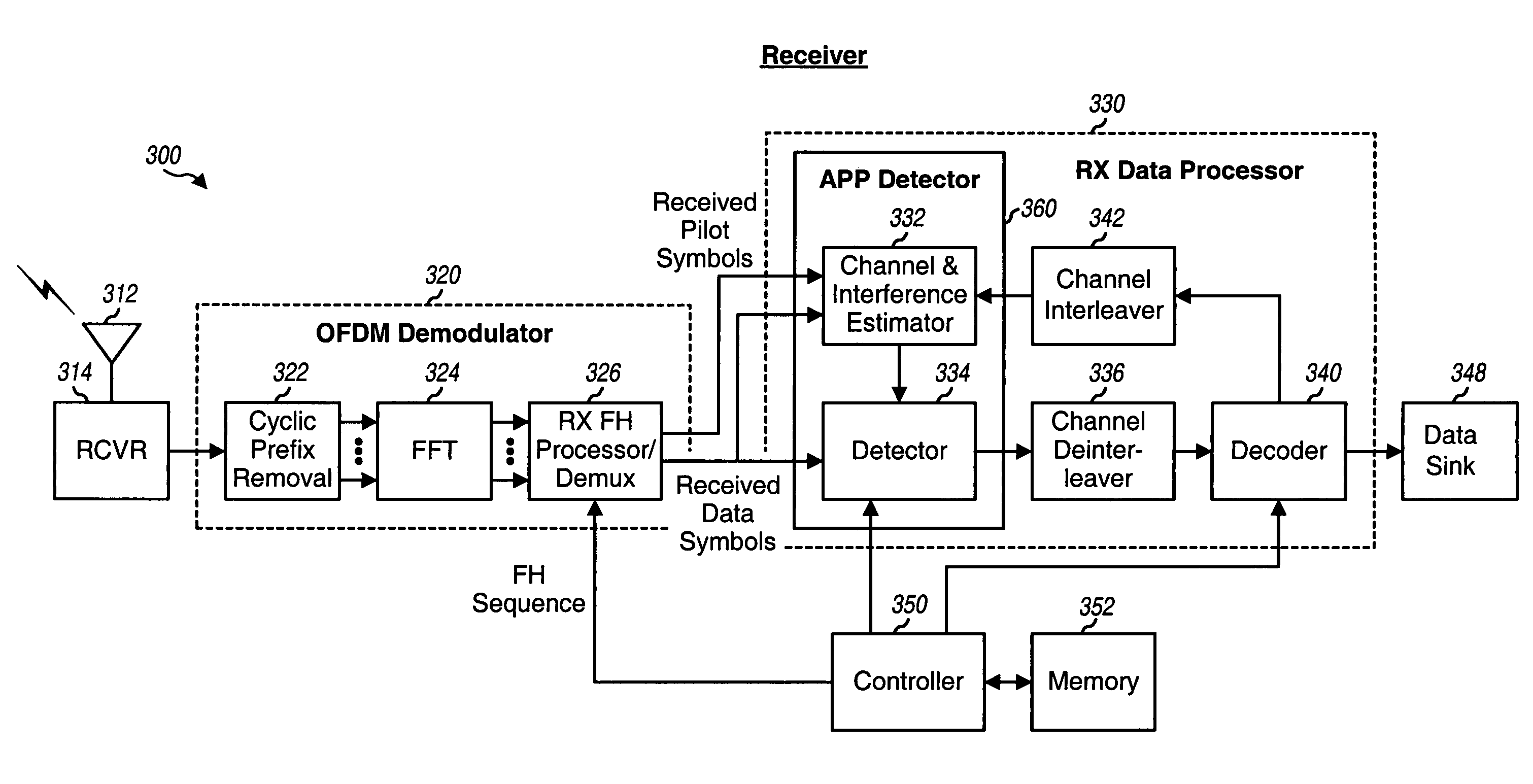
Figure 1 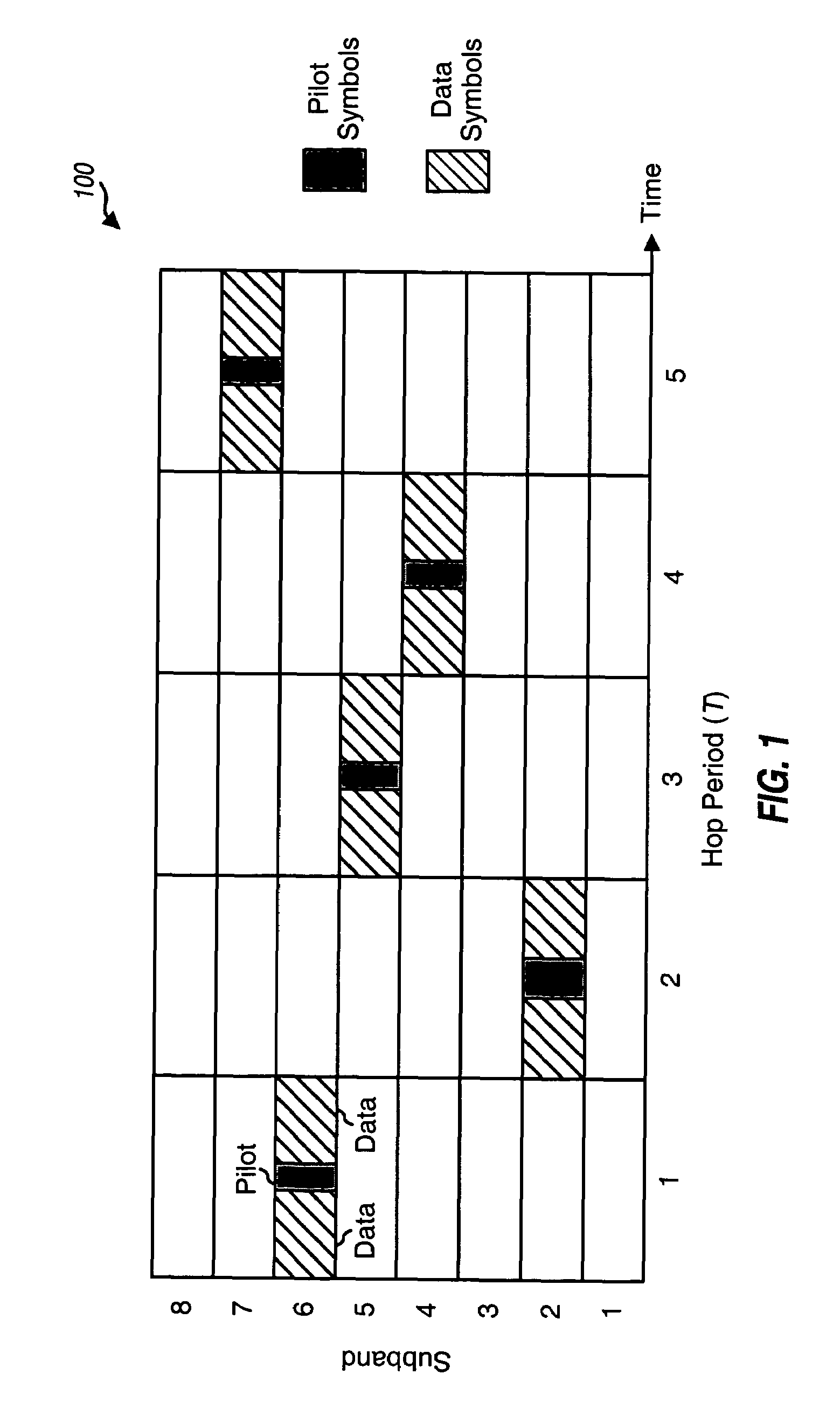
Figure 2 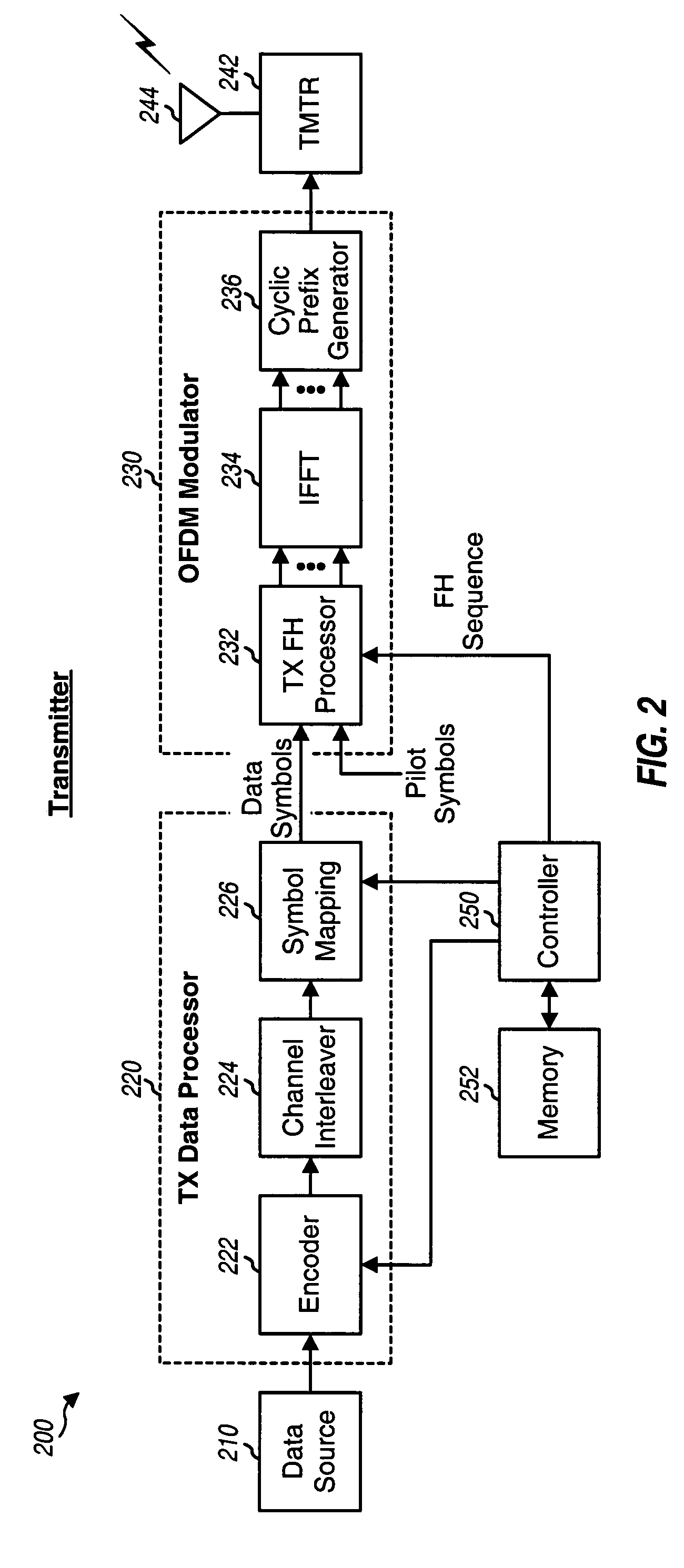
Figure 3
Abstract
Description
BACKGROUND
[0001] I. Field
[0002] The present invention relates generally to communication, and more specifically to techniques for recovering data in the presence of noise and interference at a receiver in a wireless communication system.
[0003] II. Background
[0004] In a wireless communication system, a transmitter typically encodes, interleaves, and modulates (i.e., symbol maps) traffic data to obtain data symbols, which are modulation symbols for data. For a coherent system, the transmitter multiplexes pilot symbols with the data symbols, processes the multiplexed pilot and data symbols to generate a modulated signal, and transmits the signal via a wireless channel. The channel distorts the transmitted signal with a channel response and further degrades the signal with noise and interference.
[0005] A receiver receives the transmitted signal and processes the received signal to obtain received symbols. For a coherent system, the receiver typically estimates the channel response with the r...
Examples
Embodiment Construction
[0022]The word “exemplary” is used herein to mean “serving as an example, instance, or illustration.” Any embodiment or design described herein as “exemplary” is not necessarily to be construed as preferred or advantageous over other embodiments or designs.
[0023]The iterative receiver processing techniques described herein may be used for various wireless communication systems that experience interference. For clarity, these techniques are described for a frequency hopping communication system in which data is transmitted on different frequency subbands in different time intervals, which are also referred to as “hop periods”. With frequency hopping, a data transmission hops from subband to subband in a pseudo-random manner. This hopping provides frequency diversity and allows the data transmission to better withstand deleterious path effects such as narrow-band interference, jamming, fading, and so on.
[0024]The subbands in a frequency hopping system may be provided by orthogonal fre...