
Method, base station and mobile station for timeslot selection and timeslot assignment
a timelot and assignment technology, applied in the field of timelot selection and timelot assignment, can solve the problems of low adaptability to a cellular system where the same frequency waves are used repeatedly, high throughput cannot be obtained, and the desired carrier-to-interference ratio cannot be obtained, so as to achieve high throughput and low delay
Patent Information
- Authority / Receiving Office
- US · United States
- Patent Type
- Patents(United States)
- Current Assignee / Owner
- Publication Date
- 2009-11-17
- Estimated Expiration
- Not applicable · inactive patent
Smart Images
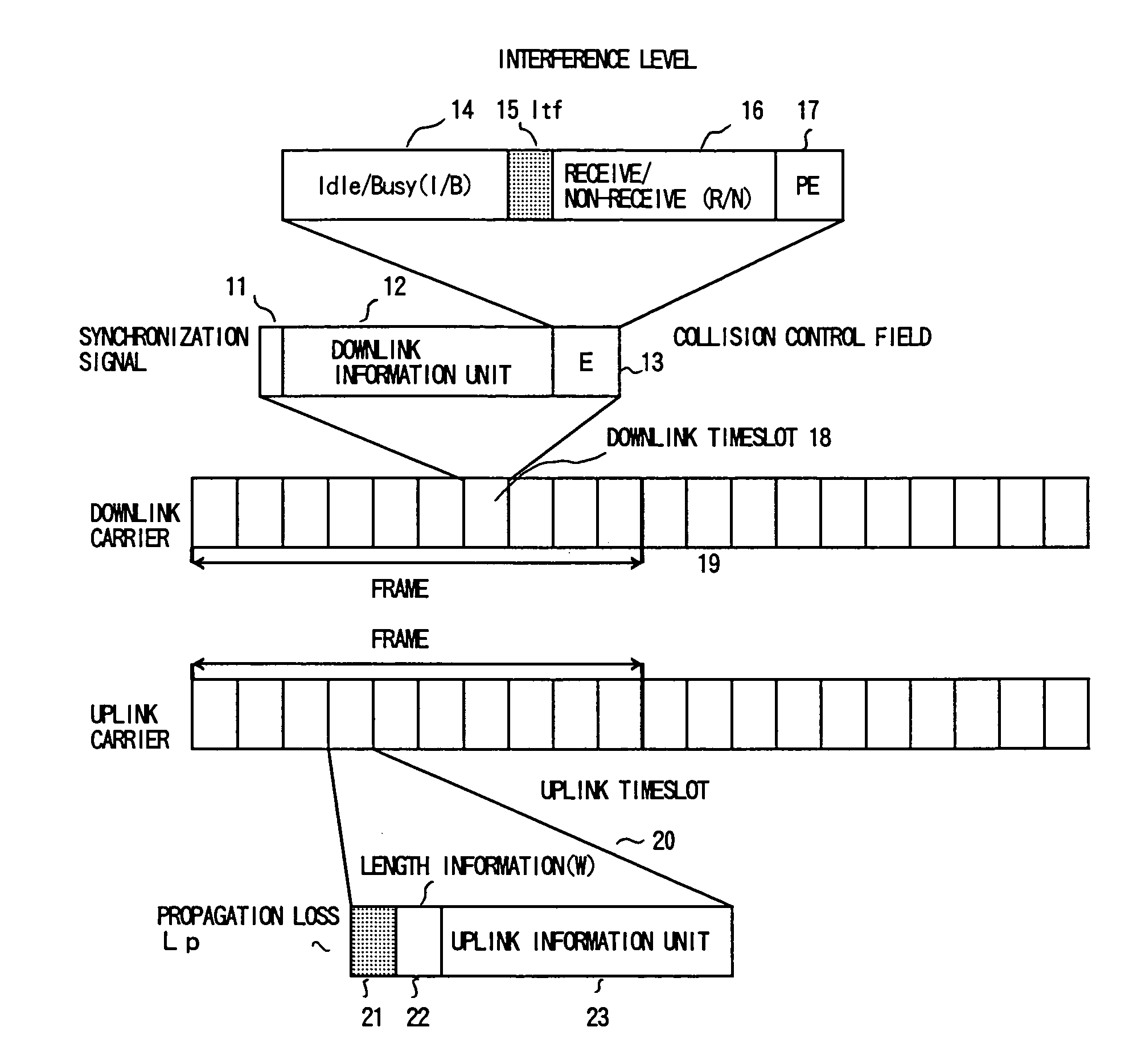
Figure 1 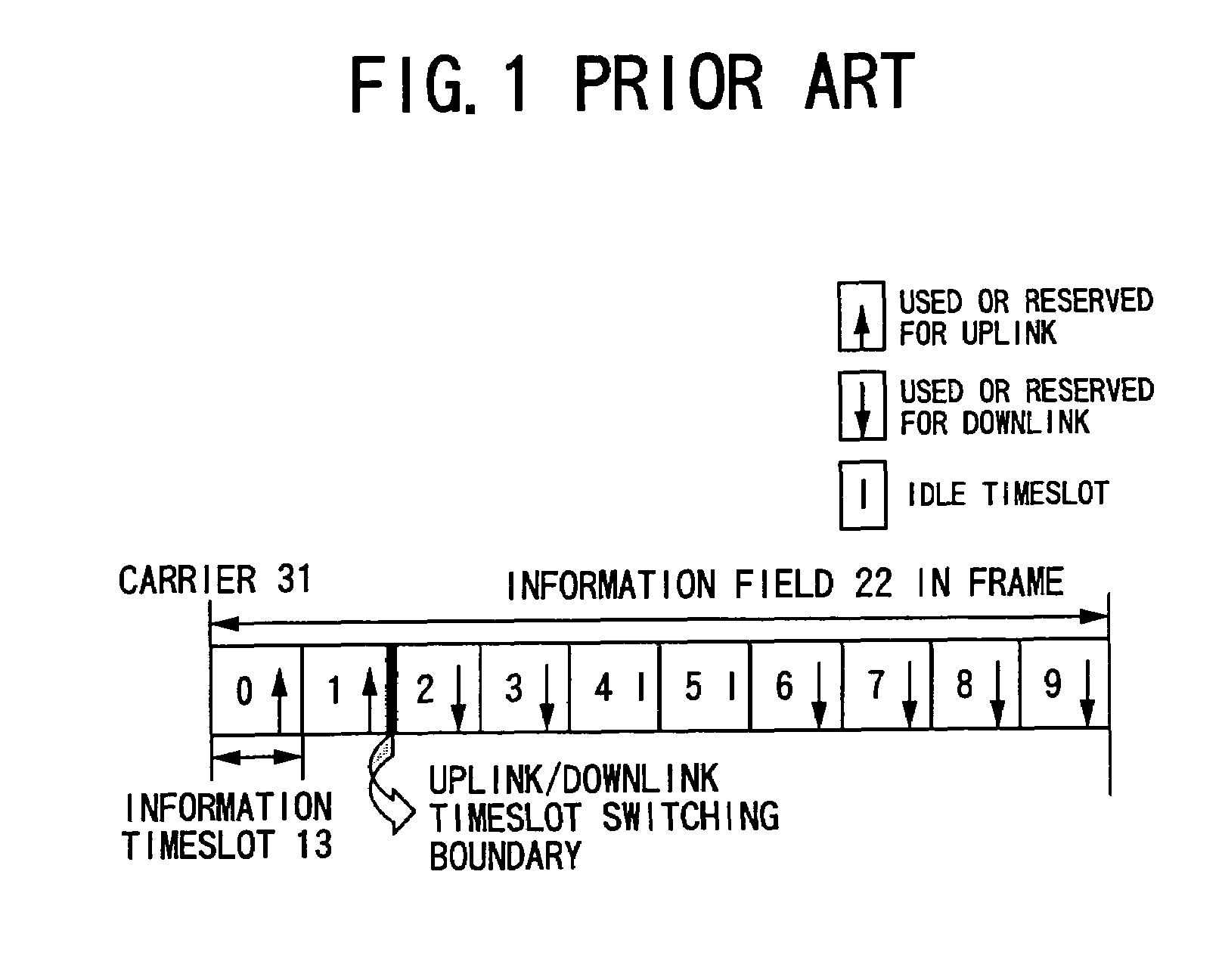
Figure 2 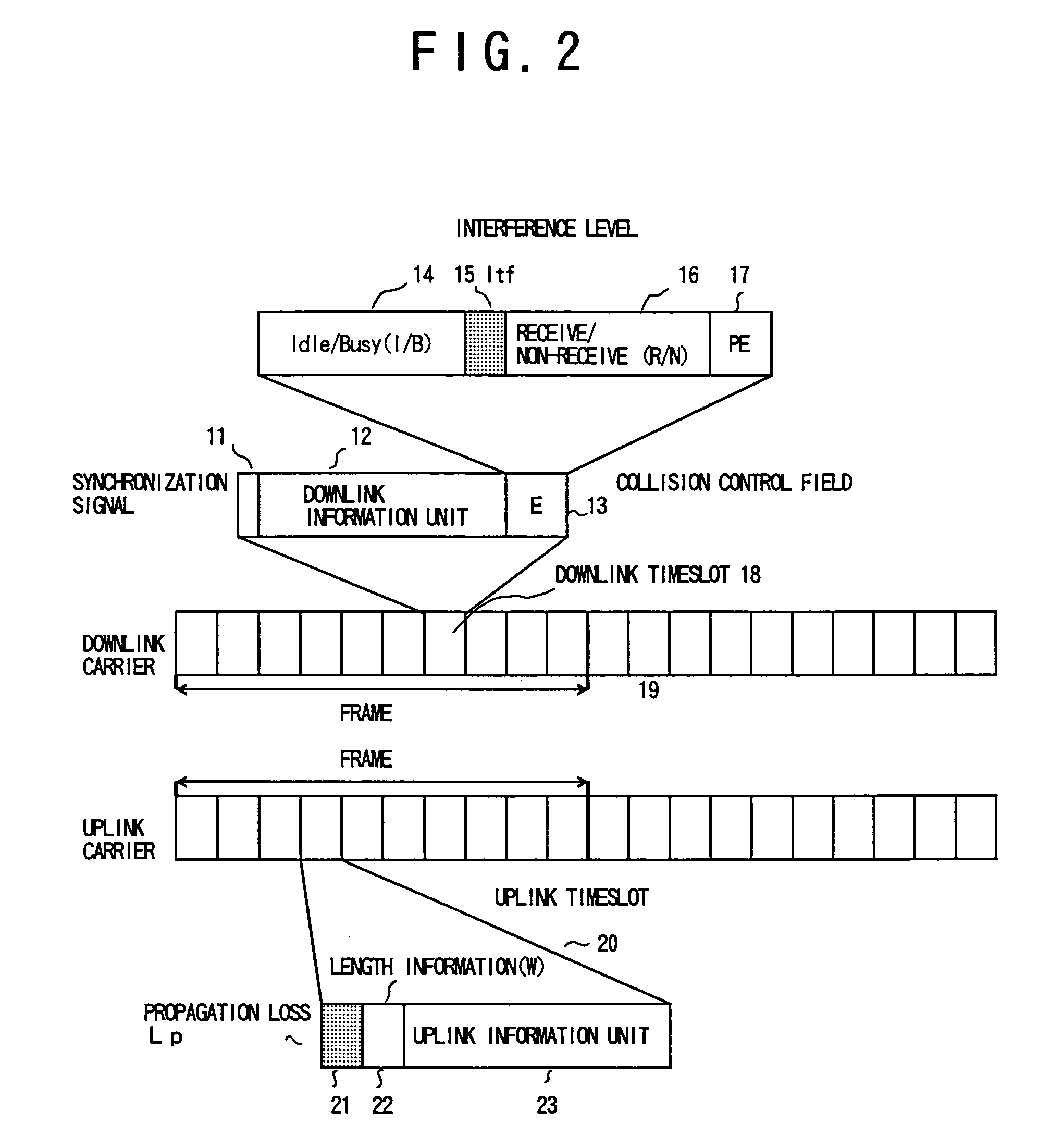
Figure 3
Abstract
Description
BACKGROUND OF THE INVENTION
[0001] 1. Field of the Invention
[0002] The present invention relates to a technique wherein a plurality of mobile stations access a base station randomly for performing packet transmission in a cellular system which uses radio waves of the same frequency repetitively.
[0003] Further, the present invention relates to a timeslot assignment method in a TDD system for mobile communications, a base station and a mobile station using the method.
[0004] 2. Description of the Related Art
[0005] It is well known that random access controlled by a base station is necessary for preventing throughput reduction caused by collisions of packets which are sent simultaneously from a plurality of mobile stations when the mobile stations access a base station randomly.
[0006] As a conventional random access method, an ICMA-PE (Idle-Signal Casting Multiple Access with Partial Echo) method is proposed in Japanese patent application No. 1-240822. In the ICMA-PE method, a mobile station s...
Examples
first embodiment
[0150]In the following, an embodiment of the present invention corresponding to the first object will be described as a first embodiment.
[0151]The present invention corresponding to the first object is applicable to TDMA and CDMA for an access method and is applicable to TDD and FDD for a duplex method. In the following, an embodiment in the case of TDMA / FDD will be described with reference to figures. interference
[0152]FIG. 2 shows a timeslot configuration according to the first embodiment of the present invention. A carrier is divided into frames and the frame is divided into timeslots. As shown in a downlink timeslot 18 in the figure, a collision control field (E) 13 is added to each timeslot of the downlink carrier. The collision control field 13 includes Idle / Busy (I / B) bits 14, interference level (Itf) bits 15, receive / non-receive (R / N) bits 16, and partial echo bits 17. In an uplink timeslot 20, propagation loss (Lp) bits 21 and remaining information unit number (W) bits 22 a...
second embodiment
[0189]In the following, the basic operation of the present invention for TDMA / TDD will be described with reference to figures.
[0190]FIGS. 14A and 14B show a timeslot configuration according to the second embodiment of the present invention. As shown in the figure, a carrier 31 includes a frame 32 which repeats with a predetermined interval. The frame includes a plurality of timeslots 33 (information timeslots), control mini-slots 34 each of which slots corresponds to one of the information timeslots 33. The information timeslot is used uplink or downlink.
[0191]In this embodiment, uplink or downlink is assigned without constraint. That is, it is permissible that a plurality of boundaries between uplink timeslots and downlink timeslots exist. In the example shown in FIG. 14A, a frame includes ten information timeslots and there are three uplink / downlink boundaries between S1-S2, S3-S4 and S4-S5 respectively.
[0192]The control mini-slots 34 are provided at the tail end of each frame. Th...
third embodiment
[0220]In the third embodiment, packet transmission is prioritized and timeslots are assigned by using the QoS request according to traffic state at the time of packet transmission acceptance.
[0221]In this embodiment, the prioritization includes two stages which are a service class 1 and a service class 2. However, it is possible to provide more service classes such that timeslots are allocated more flexibly according to multi-QoS.
[0222]In this embodiment, channel (timeslot) assignment is performed so that desired quality is assured maximally for a user of the service class 1 (high class). For a user of the service class 2 (low class), channel (timeslot) assignment is performed on best-effort basis.
[0223]In addition, quality is degraded for the class 2 user in higher priority when traffic is congested at the time of packet transmission acceptance.
[0224]That is, as mentioned later, when available timeslots are insufficient for a class 1 user, timeslots are assigned for the class 1 use...