
Sealing device and method for sealing fractures or leaks in wall or formation surrounding tube-shaped channel
Patent Information
- Authority / Receiving Office
- US · United States
- Current Assignee / Owner
- Publication Date
- 2018-04-10
Smart Images
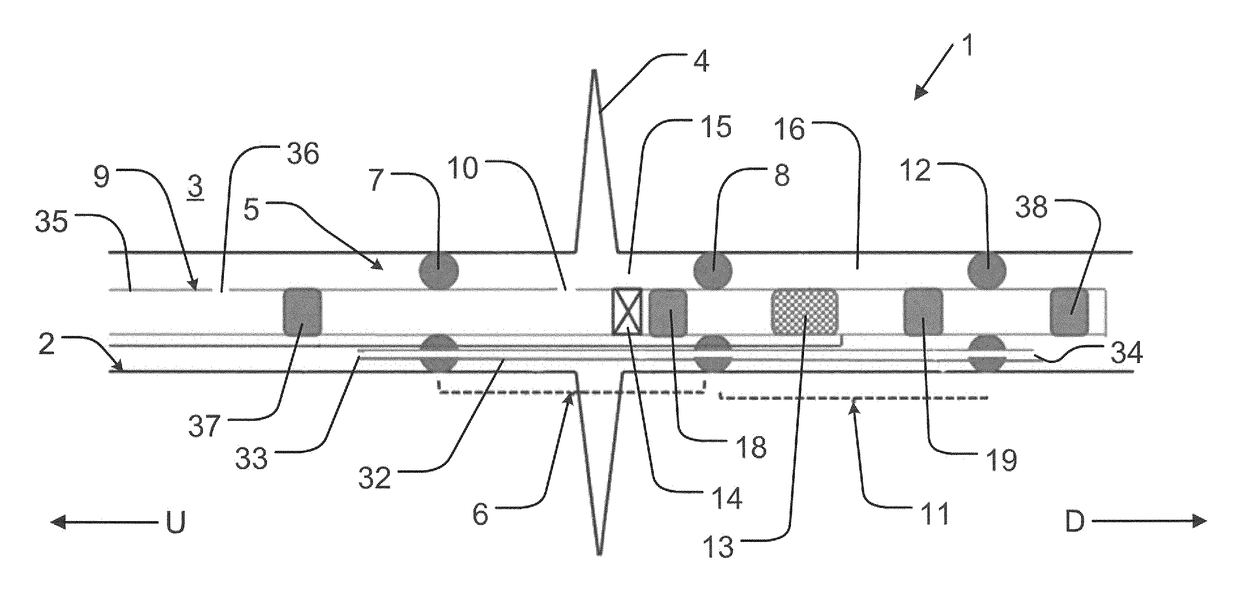
Figure 1 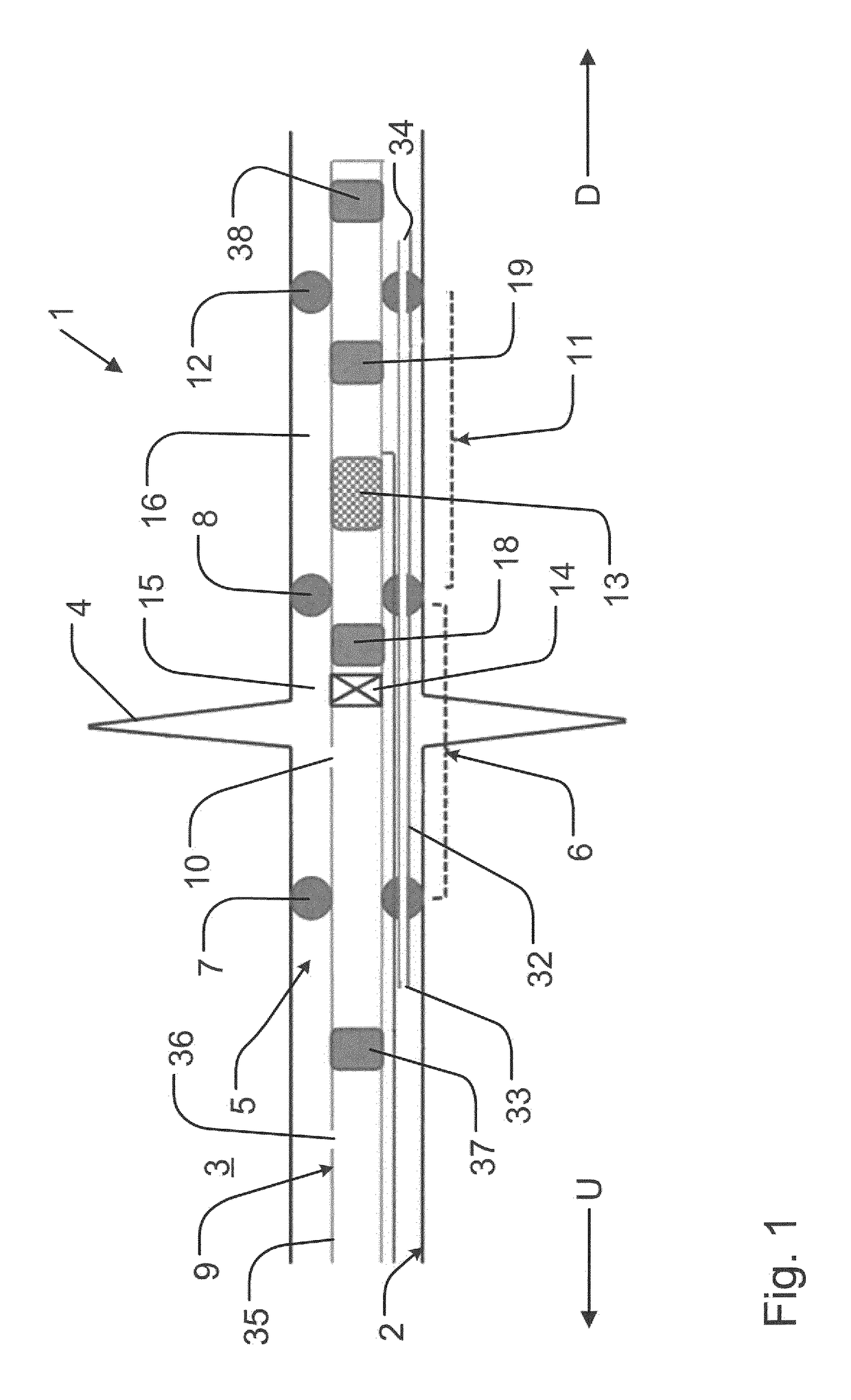
Figure 2 
Figure 3
Abstract
Description
RELATED APPLICATIONS
[0001] This application claims the benefit under 35 U.S.C. § 371 of International Patent Application No. PCT / EP2013 / 074861, having an international filing date of Nov. 27, 2013, which claims priority to European Application No. 12194965.5, filed Nov. 30, 2012, the contents of all of which are incorporated herein by reference in their entirety.BACKGROUND OF THE INVENTIONField of the Invention
[0002] The present invention relates to a sealing device for sealing fractures or leaks in a wall or formation surrounding a tube-shaped channel, such as a drain, pipeline or well bore.Description of Related Art
[0003] U.S. Pat. No. 6,955,216 B1 discloses a device for injecting a fluid into an earth formation surrounding a wellbore. For example, such injection is desirable in order to seal-off a formation, or a natural or induced fracture in a formation, around a perforated well tubular in the wellbore. The device is suitable to be arranged in the wellbore and is provided with a p...
Examples
first embodiment
[0098]In a first embodiment, the sealing fluid 17 forms a first component of a two-part epoxy, and an activation fluid forms a second component of said two-part epoxy. The activation fluid may be ejected by the sealing fluid activation section 11 in order to start curing of the epoxy. Furthermore, the sealing fluid activation section 11 may include a heater in order to accelerate curing of a resulting thermosetting polymer.
second embodiment
[0099]In a second embodiment, the sealing fluid 17 may include particles having a protective outer layer or coating enclosing a first component of a two-part epoxy and / or particles having a protective outer layer or coating enclosing a second component of said two-part epoxy. Thereby, said first and second components may be separated during placement of the sealing fluid 17. Removal of the protective layer may take place as described above by means of the sealing fluid activation device 13. Furthermore, the sealing fluid activation section 11 may include a heater in order to accelerate curing of a resulting thermosetting polymer.
[0100]Optionally, the sealing fluid 17 may comprise a filler, for instance in the form of sand, grit, glass fibres, stone fibres or any other suitable material that may strengthen the material.