
Food product containing starch gel, starch granule, production method and use thereof
a technology of starch gel and starch granule, which is applied in the field of starch gelcontaining food, can solve the problems of mixing two or more kinds of gelling agents, affecting not having nice physical properties, etc., and achieves the effects of improving the gel forming ability of starch, strong gel forming ability, and high viscosity
Patent Information
- Authority / Receiving Office
- US · United States
- Patent Type
- Patents(United States)
- Current Assignee / Owner
- Publication Date
- 2018-05-08
Smart Images
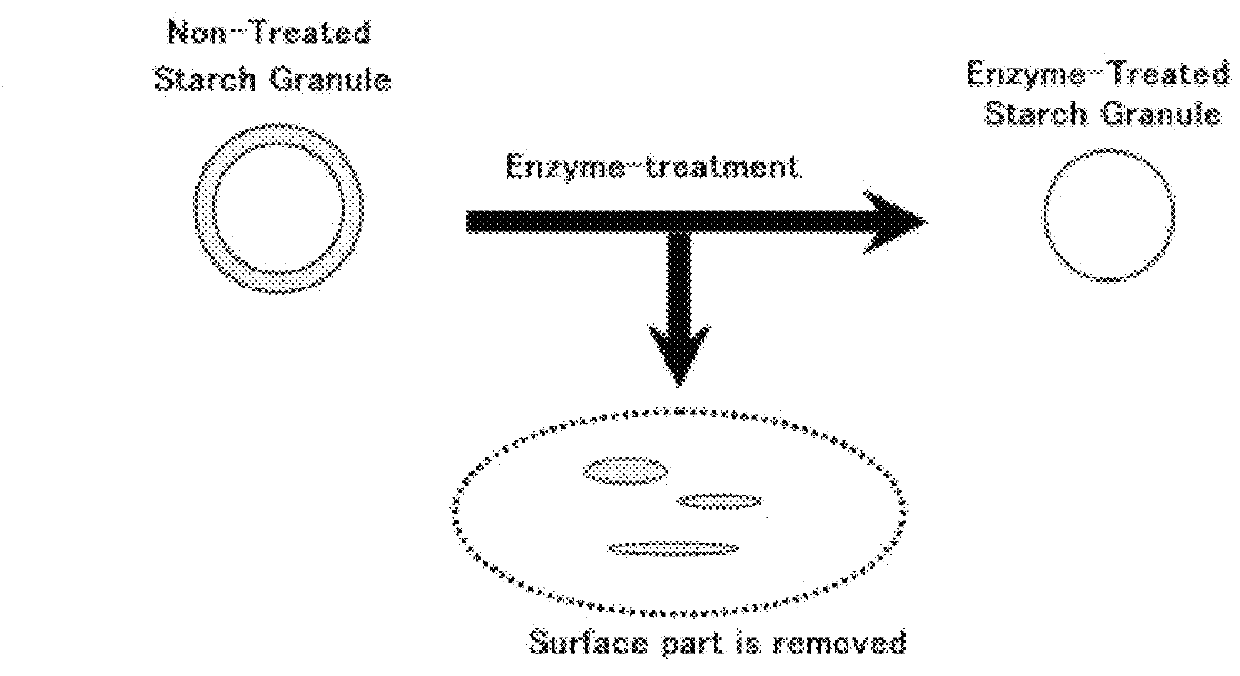
Figure 1 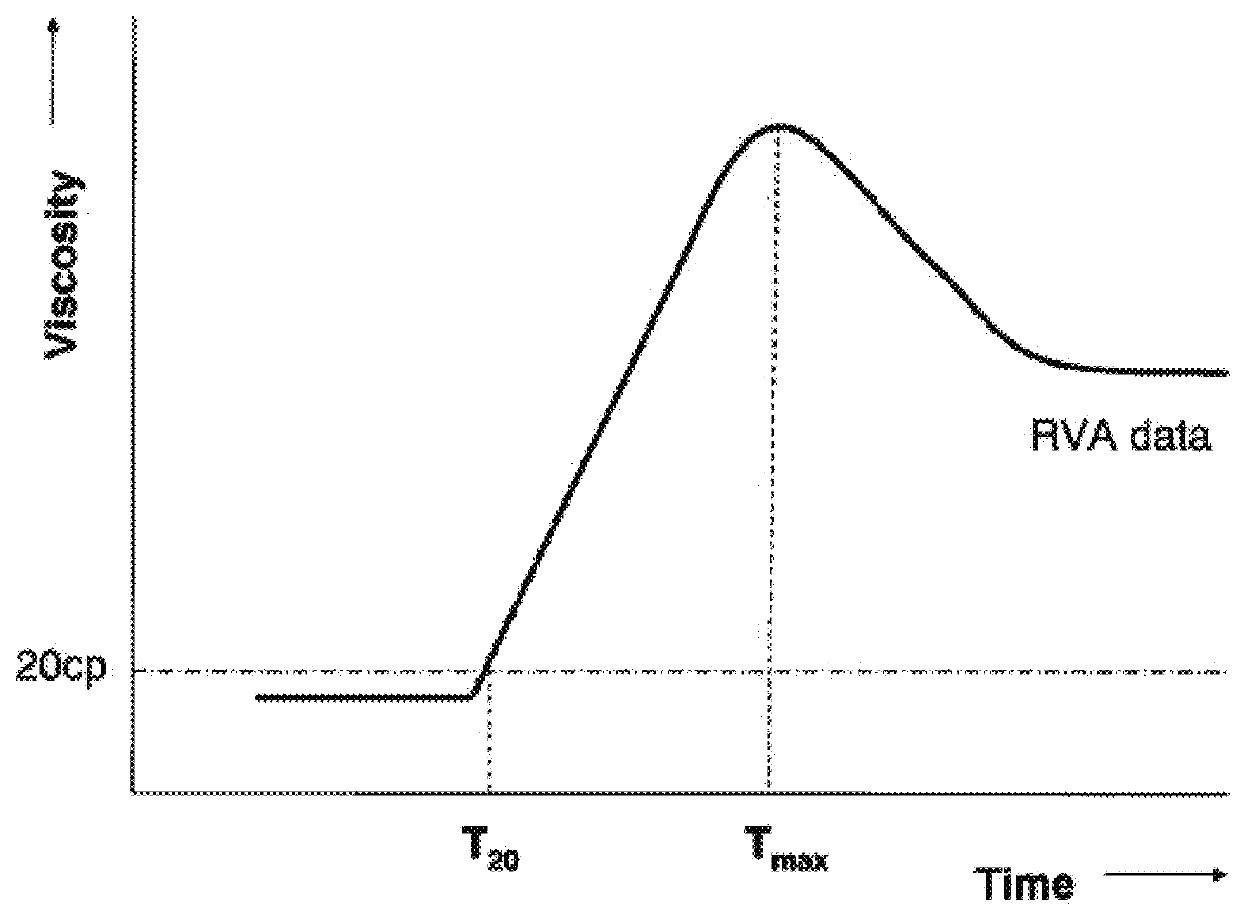
Figure 2
Abstract
Description
TECHNICAL FIELD
[0001] The present invention relates to a starch gel-containing food, a starch having a high viscosity and a gel forming ability, a food containing the starch, a method of producing thereof and use thereof. More particularly, the present invention relates to a method of producing a starch gel-containing food using an enzyme capable of improving a gel forming ability of a starch.BACKGROUND ART
[0002] With diversification of foods, foods having various shapes, physical properties and textures have been required. Particularly, intense interest has recently been shown towards melt in mouth and texture as important physical properties for the purpose of designing foods. Also in the fields related to deglutition and care toward which intense interest has recently been shown, texture has been studied as important physical properties.
[0003] In the case of designing processed foods, utilization of a gelling agent is important so as to improve texture and physical properties, and i...
Examples
examples 1-1 and 1-2
[0460]To 400 g of an untreated native wheat starch of the same lot as what was used in Comparative Example 1, 900 g of ion-exchange water was added to prepare a starch suspension. After adjusting the pH of the suspension to 5.0, 0.1% by weight (based on starch solid content) of α-amylase (“Biozyme A” derived from Aspergillus oryzae, manufactured by Amano Enzyme Inc.; optimum pH of 5.0) was added and stirred at 50° C. for 1 hour to carry out an enzyme reaction and resulted in preparation of a sample having a degradation ratio of about 5% by weight (Example 1-1). Using a similar amount of the enzyme, stirring was carried out at 50° C. for 3 hours to prepare a sample having a degradation ratio of about 10% by weight (Example 1-2). After completion of the reaction, enzyme-treated starch granules were obtained by centrifugal filtration and blow drying. Viscosity characteristics of the obtained enzyme-treated starch granules were analyzed by the amylograph and the rheometer. After complet...
example 1-3
[0461]To 400 g of an untreated native wheat starch of the same lot as what was used in Comparative Example 1, 900 g of ion-exchange water was added to prepare a starch suspension. After adjusting the pH of the suspension to 5.0, 1% by weight (based on starch solid content) of α-amylase (“Biozyme A” derived from Aspergillus oryzae, manufactured by Amano Enzyme Inc.; optimum pH of 5.0) was added and stirred at 50° C. for 18 hours to carry out an enzyme reaction. After completion of the reaction, enzyme-treated starch granules were obtained y centrifugal filtration and blow drying. Viscosity characteristics of the obtained enzyme-treated starch granules were analyzed by the amylograph and the rheometer. Also, after completion of the reaction, a degradation ratio was determined using a part of the reaction solution. The results are shown in Table 2-2.
example 2a
[0462]To 400 g of an untreated native wheat starch of the same lot as what was used in Comparative Example 1, 900 g of ion-exchange water was added to prepare a starch suspension. After adjusting the pH of the suspension to 5.0, 1% by weight (based on starch solid content) of α-amylase (“AMYLEX A3” derived from Aspergillus niger, manufactured by DANISCO; optimum pH of 5.0) was added and stirred at 50° C. for 18 hours to carry out an enzyme reaction. After completion of the reaction, enzyme-treated starch granules were obtained by centrifugal filtration and blow drying. Viscosity characteristics of the obtained enzyme-treated starch granules were analyzed by the amylograph and the rheometer. After completion of the reaction, a degradation ratio was determined using apart of the reaction solution. The results are shown in Table 2-2.