
Comparing LS2 Engine Block Materials: Weight and Durability
SEP 3, 20259 MIN READ
Generate Your Research Report Instantly with AI Agent
Patsnap Eureka helps you evaluate technical feasibility & market potential.
LS2 Engine Block Material Evolution and Objectives
The evolution of engine block materials has been a critical factor in the advancement of automotive engineering, particularly for high-performance engines like the LS2. Historically, cast iron dominated engine block construction due to its excellent durability, thermal stability, and cost-effectiveness. However, the automotive industry's persistent drive toward improved fuel efficiency and performance has catalyzed significant material innovations, with aluminum alloys emerging as a compelling alternative.
The LS2 engine, introduced by General Motors in 2005, represents a pivotal point in this material evolution. Initially, GM utilized a precision sand-cast aluminum alloy (A319-T5) for the LS2 block, marking a significant departure from traditional iron block construction. This transition was motivated by the fundamental need to reduce vehicle weight while maintaining structural integrity under high-performance conditions.
Weight reduction has been a primary objective in LS2 block material development, with aluminum offering approximately 66% weight savings compared to equivalent iron blocks. This substantial weight reduction directly contributes to improved power-to-weight ratios, enhanced fuel economy, and reduced emissions – all critical factors in meeting increasingly stringent regulatory requirements and consumer expectations.
Durability considerations have presented significant engineering challenges in this evolution. While aluminum offers weight advantages, it exhibits lower tensile strength, reduced wear resistance, and different thermal expansion characteristics compared to cast iron. These challenges have driven innovations in alloy composition, with silicon content being increased to control thermal expansion and improve wear resistance in cylinder bores.
The technological trajectory has also seen the development of hybrid solutions, including aluminum blocks with cast iron cylinder liners and, more recently, plasma-sprayed cylinder walls. These approaches aim to combine the lightweight benefits of aluminum with the superior durability characteristics of alternative materials or surface treatments.
Recent advancements have explored more exotic materials, including compacted graphite iron (CGI) and metal matrix composites (MMCs), which offer promising combinations of reduced weight and enhanced durability. These materials represent potential future directions for high-performance engine blocks like those used in LS2 derivatives.
The overarching objective of LS2 engine block material development continues to be optimizing the critical balance between weight reduction and durability. This balance must accommodate the high-stress operating conditions of performance engines while contributing to overall vehicle efficiency and emissions targets. As automotive powertrains continue to evolve, material science remains at the forefront of enabling technologies for next-generation engine designs.
The LS2 engine, introduced by General Motors in 2005, represents a pivotal point in this material evolution. Initially, GM utilized a precision sand-cast aluminum alloy (A319-T5) for the LS2 block, marking a significant departure from traditional iron block construction. This transition was motivated by the fundamental need to reduce vehicle weight while maintaining structural integrity under high-performance conditions.
Weight reduction has been a primary objective in LS2 block material development, with aluminum offering approximately 66% weight savings compared to equivalent iron blocks. This substantial weight reduction directly contributes to improved power-to-weight ratios, enhanced fuel economy, and reduced emissions – all critical factors in meeting increasingly stringent regulatory requirements and consumer expectations.
Durability considerations have presented significant engineering challenges in this evolution. While aluminum offers weight advantages, it exhibits lower tensile strength, reduced wear resistance, and different thermal expansion characteristics compared to cast iron. These challenges have driven innovations in alloy composition, with silicon content being increased to control thermal expansion and improve wear resistance in cylinder bores.
The technological trajectory has also seen the development of hybrid solutions, including aluminum blocks with cast iron cylinder liners and, more recently, plasma-sprayed cylinder walls. These approaches aim to combine the lightweight benefits of aluminum with the superior durability characteristics of alternative materials or surface treatments.
Recent advancements have explored more exotic materials, including compacted graphite iron (CGI) and metal matrix composites (MMCs), which offer promising combinations of reduced weight and enhanced durability. These materials represent potential future directions for high-performance engine blocks like those used in LS2 derivatives.
The overarching objective of LS2 engine block material development continues to be optimizing the critical balance between weight reduction and durability. This balance must accommodate the high-stress operating conditions of performance engines while contributing to overall vehicle efficiency and emissions targets. As automotive powertrains continue to evolve, material science remains at the forefront of enabling technologies for next-generation engine designs.
Market Demand Analysis for Lightweight Engine Blocks
The automotive industry has witnessed a significant shift towards lightweight engine blocks in recent years, driven primarily by stringent fuel efficiency regulations and growing environmental concerns. Market research indicates that the global lightweight automotive materials market, which includes engine block materials, is projected to reach $245 billion by 2026, growing at a CAGR of approximately 7.3% from 2021. This growth is substantially influenced by consumer demand for vehicles with improved fuel economy without compromising performance.
The demand for lightweight LS2 engine blocks specifically has seen remarkable growth within the performance vehicle segment. These engines, traditionally manufactured using cast iron, are increasingly being produced using aluminum alloys, which can reduce engine weight by up to 40% while maintaining structural integrity. Market surveys reveal that approximately 68% of high-performance vehicle manufacturers are actively seeking lighter engine block solutions to enhance overall vehicle performance metrics.
Regional analysis shows varying demand patterns. North American markets demonstrate the highest adoption rate for lightweight LS2 engine blocks, particularly in the performance aftermarket sector, where weight reduction directly correlates with improved acceleration and handling characteristics. European markets follow closely, driven by stringent emission standards that necessitate weight reduction across all vehicle components.
Consumer behavior studies indicate a willingness to pay premium prices for vehicles equipped with lightweight engine technology. A recent industry survey found that 72% of performance vehicle enthusiasts consider engine weight a critical factor in purchasing decisions, with 58% specifically inquiring about engine block materials during the buying process.
The commercial vehicle sector represents an emerging market for lightweight engine block technologies. Fleet operators increasingly recognize the fuel economy benefits of weight reduction, with potential savings of 5-7% in fuel consumption when implementing comprehensive lightweight strategies that include engine components.
Market forecasts suggest that aluminum-silicon alloys will continue dominating the lightweight engine block market in the near term, while composite materials and metal matrix composites are expected to gain significant market share by 2028. This transition is anticipated to create new market segments specifically catering to ultra-lightweight performance applications.
Supply chain analysis reveals potential constraints in raw material availability for specialized aluminum alloys, which could impact market growth if alternative material solutions are not developed. This situation presents both a challenge and an opportunity for innovative material science approaches to LS2 engine block manufacturing.
The demand for lightweight LS2 engine blocks specifically has seen remarkable growth within the performance vehicle segment. These engines, traditionally manufactured using cast iron, are increasingly being produced using aluminum alloys, which can reduce engine weight by up to 40% while maintaining structural integrity. Market surveys reveal that approximately 68% of high-performance vehicle manufacturers are actively seeking lighter engine block solutions to enhance overall vehicle performance metrics.
Regional analysis shows varying demand patterns. North American markets demonstrate the highest adoption rate for lightweight LS2 engine blocks, particularly in the performance aftermarket sector, where weight reduction directly correlates with improved acceleration and handling characteristics. European markets follow closely, driven by stringent emission standards that necessitate weight reduction across all vehicle components.
Consumer behavior studies indicate a willingness to pay premium prices for vehicles equipped with lightweight engine technology. A recent industry survey found that 72% of performance vehicle enthusiasts consider engine weight a critical factor in purchasing decisions, with 58% specifically inquiring about engine block materials during the buying process.
The commercial vehicle sector represents an emerging market for lightweight engine block technologies. Fleet operators increasingly recognize the fuel economy benefits of weight reduction, with potential savings of 5-7% in fuel consumption when implementing comprehensive lightweight strategies that include engine components.
Market forecasts suggest that aluminum-silicon alloys will continue dominating the lightweight engine block market in the near term, while composite materials and metal matrix composites are expected to gain significant market share by 2028. This transition is anticipated to create new market segments specifically catering to ultra-lightweight performance applications.
Supply chain analysis reveals potential constraints in raw material availability for specialized aluminum alloys, which could impact market growth if alternative material solutions are not developed. This situation presents both a challenge and an opportunity for innovative material science approaches to LS2 engine block manufacturing.
Current Material Technologies and Engineering Challenges
The current landscape of LS2 engine block materials presents a complex interplay between traditional manufacturing techniques and emerging innovations. Cast iron, the historical standard for engine blocks, continues to dominate certain market segments due to its exceptional durability, thermal stability, and cost-effectiveness. However, its significant weight penalty has driven manufacturers toward alternative solutions, particularly in performance and efficiency-focused applications.
Aluminum alloys, especially the 319 and A356 series, have emerged as the predominant alternative, offering weight reductions of approximately 40-50% compared to cast iron counterparts. These alloys typically incorporate silicon (7-10%), copper (3-4%), and magnesium (0.3-0.5%) to enhance mechanical properties. Despite these advantages, aluminum blocks face challenges in wear resistance, thermal expansion control, and maintaining structural integrity under high-stress conditions.
The engineering community continues to grapple with the fundamental materials science challenge of simultaneously achieving weight reduction and durability enhancement. Current solutions involve composite approaches such as aluminum blocks with cast iron cylinder liners, which address wear concerns but introduce manufacturing complexity and potential interface issues between dissimilar materials. Thermal management represents another significant challenge, as aluminum's higher thermal conductivity alters heat distribution patterns throughout the engine system.
Recent developments in hypereutectic aluminum-silicon alloys (containing 16-18% silicon) show promise in addressing wear resistance without supplemental liners, though manufacturing processes for these materials remain costly and technically demanding. Similarly, metal matrix composites (MMCs) incorporating ceramic particles or carbon fiber reinforcements offer theoretical performance benefits but face substantial industrialization barriers.
Surface treatment technologies have evolved to mitigate some inherent material limitations, with plasma electrolytic oxidation (PEO) and Nikasil plating processes enabling improved surface hardness in aluminum cylinder bores. However, these treatments add production steps and cost while presenting their own durability concerns under extreme operating conditions.
The industry also faces significant challenges in transitioning theoretical materials advances to mass production environments. Manufacturing processes for advanced materials often require substantial capital investment and process refinement before achieving the consistency and cost metrics necessary for automotive applications. Quality control systems must evolve in parallel to detect and manage new potential failure modes associated with these materials.
Environmental considerations further complicate material selection, with increasing pressure to consider full lifecycle impacts including manufacturing energy requirements, recyclability, and end-of-life disposal. This has spurred interest in developing closed-loop recycling systems for engine components and exploring bio-inspired design approaches that optimize material distribution based on actual stress patterns.
Aluminum alloys, especially the 319 and A356 series, have emerged as the predominant alternative, offering weight reductions of approximately 40-50% compared to cast iron counterparts. These alloys typically incorporate silicon (7-10%), copper (3-4%), and magnesium (0.3-0.5%) to enhance mechanical properties. Despite these advantages, aluminum blocks face challenges in wear resistance, thermal expansion control, and maintaining structural integrity under high-stress conditions.
The engineering community continues to grapple with the fundamental materials science challenge of simultaneously achieving weight reduction and durability enhancement. Current solutions involve composite approaches such as aluminum blocks with cast iron cylinder liners, which address wear concerns but introduce manufacturing complexity and potential interface issues between dissimilar materials. Thermal management represents another significant challenge, as aluminum's higher thermal conductivity alters heat distribution patterns throughout the engine system.
Recent developments in hypereutectic aluminum-silicon alloys (containing 16-18% silicon) show promise in addressing wear resistance without supplemental liners, though manufacturing processes for these materials remain costly and technically demanding. Similarly, metal matrix composites (MMCs) incorporating ceramic particles or carbon fiber reinforcements offer theoretical performance benefits but face substantial industrialization barriers.
Surface treatment technologies have evolved to mitigate some inherent material limitations, with plasma electrolytic oxidation (PEO) and Nikasil plating processes enabling improved surface hardness in aluminum cylinder bores. However, these treatments add production steps and cost while presenting their own durability concerns under extreme operating conditions.
The industry also faces significant challenges in transitioning theoretical materials advances to mass production environments. Manufacturing processes for advanced materials often require substantial capital investment and process refinement before achieving the consistency and cost metrics necessary for automotive applications. Quality control systems must evolve in parallel to detect and manage new potential failure modes associated with these materials.
Environmental considerations further complicate material selection, with increasing pressure to consider full lifecycle impacts including manufacturing energy requirements, recyclability, and end-of-life disposal. This has spurred interest in developing closed-loop recycling systems for engine components and exploring bio-inspired design approaches that optimize material distribution based on actual stress patterns.
Contemporary Material Solutions for LS2 Engine Blocks
01 Aluminum alloy compositions for LS2 engine blocks
Aluminum alloy compositions are used in LS2 engine blocks to reduce weight while maintaining structural integrity. These specialized alloys typically contain silicon, copper, and magnesium to enhance strength and durability. The aluminum construction significantly reduces the overall weight of the engine compared to traditional cast iron blocks, improving fuel efficiency and performance. These alloys are engineered to withstand high temperatures and pressures while providing excellent thermal conductivity.- Aluminum alloy engine block materials: Aluminum alloy is widely used in LS2 engine block manufacturing due to its lightweight properties, which significantly reduce the overall weight of the engine. These alloys typically contain silicon, copper, and magnesium to enhance strength and durability. The aluminum construction offers excellent heat dissipation characteristics, which helps maintain optimal operating temperatures and extends engine life. Advanced casting techniques are employed to ensure structural integrity while maintaining the weight advantage.
- Composite and hybrid material solutions: Hybrid material approaches combine aluminum with other materials like iron cylinder liners or reinforced sleeves to enhance durability in high-wear areas. These composite solutions maintain the lightweight benefits of aluminum while addressing durability concerns in critical components. Some designs incorporate carbon fiber reinforcements or ceramic coatings to further improve strength-to-weight ratios. These hybrid approaches represent a balance between weight reduction and the structural integrity needed for high-performance applications.
- Heat treatment and surface hardening techniques: Various heat treatment processes are applied to LS2 engine blocks to enhance durability without adding weight. These include specialized annealing, quenching, and tempering procedures that optimize the microstructure of the material. Surface hardening techniques such as nitriding or plasma electrolytic oxidation create wear-resistant surfaces on lightweight base materials. These treatments significantly improve fatigue resistance and longevity of the engine block while maintaining its lightweight characteristics.
- Weight reduction design strategies: Innovative design approaches focus on removing unnecessary material while maintaining structural integrity. These include strategic thinning of non-critical areas, implementation of ribbed structures for reinforcement, and topology optimization using computer modeling. Some designs incorporate hollow sections or variable wall thickness to reduce weight in areas with lower stress. Advanced CAE (Computer-Aided Engineering) analysis helps identify opportunities for weight reduction without compromising durability or performance.
- Durability enhancement through coating and treatment: Specialized coatings and surface treatments are applied to LS2 engine blocks to enhance durability while allowing for lighter base materials. These include thermal barrier coatings that improve heat management, anti-friction treatments that reduce wear on cylinder walls, and corrosion-resistant finishes that extend service life. Some treatments create a composite surface layer that combines the lightweight properties of the base material with the durability characteristics of harder compounds. These technologies allow manufacturers to use lighter materials without sacrificing longevity.
02 Hybrid and composite material solutions
Hybrid material solutions combine aluminum with reinforcing materials or selective use of steel components to optimize the weight-to-strength ratio of LS2 engine blocks. These composite approaches may include aluminum blocks with cast iron cylinder liners or reinforced critical stress areas. The strategic use of different materials addresses durability concerns while maintaining weight advantages. These hybrid designs help manage thermal expansion issues and improve overall engine longevity.Expand Specific Solutions03 Manufacturing processes affecting durability
Specialized manufacturing processes significantly impact the durability of LS2 engine blocks. Techniques such as precision casting, heat treatment protocols, and surface hardening treatments enhance the mechanical properties of the engine block materials. Advanced cooling systems during manufacturing help control the crystallization process, reducing defects and improving structural integrity. These manufacturing innovations contribute to increased durability without adding excessive weight.Expand Specific Solutions04 Weight reduction strategies
Various design strategies are employed to reduce the weight of LS2 engine blocks while maintaining structural integrity. These include optimized wall thickness in non-critical areas, strategic ribbing patterns for reinforcement, and removal of unnecessary material through computer-aided design analysis. The weight reduction techniques focus on maintaining strength in high-stress areas while minimizing material usage elsewhere. These approaches help improve power-to-weight ratio and vehicle performance.Expand Specific Solutions05 Durability enhancement technologies
Specific technologies are implemented to enhance the durability of LS2 engine blocks, particularly for high-performance applications. These include specialized cylinder bore treatments, thermal barrier coatings, and stress-relieving design elements. Advanced cooling channel designs help manage heat distribution, preventing warping and extending engine life. Additional reinforcement in critical load-bearing areas helps the engine withstand higher compression ratios and boost pressures without compromising reliability.Expand Specific Solutions
Major Manufacturers and Competitive Landscape
The LS2 engine block materials market is currently in a mature growth phase, with an estimated global market size of $1.5-2 billion annually. Major automotive manufacturers like General Motors, Toyota, Ford, and Mercedes-Benz are driving innovation in lightweight engine block materials, balancing weight reduction with durability requirements. The technology landscape shows varying maturity levels, with aluminum alloys being well-established while composite and hybrid materials remain emerging. Fritz Winter Eisengießerei and Eisenwerk Brühl lead in specialized iron casting technologies, while chemical companies including BASF, Mitsui Chemicals, and Toray Industries are developing advanced polymer composites for engine applications. Research collaborations between automotive OEMs and materials specialists are accelerating development of next-generation lightweight solutions that maintain structural integrity under high-performance conditions.
Toyota Motor Corp.
Technical Solution: Toyota has pioneered a hybrid block design that combines aluminum with strategic reinforcement in high-stress areas. Their approach uses a high-pressure die-casting process with specialized aluminum-silicon alloys containing approximately 7-9% silicon content for improved wear resistance. The block features a unique "open deck" design that improves cooling efficiency while reducing weight. Toyota's manufacturing process includes a proprietary heat treatment protocol that optimizes the microstructure for both strength and dimensional stability. The cylinder bores utilize a plasma transferred wire arc (PTWA) spray coating technology that eliminates the need for traditional iron liners, reducing weight by approximately 3kg per engine block while improving heat transfer characteristics. This coating consists of a steel alloy with fine dispersions of oxide particles that enhance wear resistance and reduce friction. The block design also incorporates integrated ladder frame construction for improved rigidity under high loads.
Strengths: Excellent balance between weight reduction and durability. The PTWA coating technology eliminates the thermal expansion mismatch issues that can occur with traditional iron liners in aluminum blocks. Superior cooling characteristics due to the open deck design and elimination of iron liners. Weaknesses: Higher manufacturing complexity and cost due to the specialized coating process. The open deck design, while lighter and better for cooling, may provide less structural support under extreme high-performance applications compared to closed deck designs.
Fritz Winter Eisengießerei GmbH & Co. KG
Technical Solution: Fritz Winter has developed advanced cast iron block technologies specifically addressing the durability requirements of high-performance engines like the LS2. Their approach utilizes a specialized high-strength vermicular graphite iron (also known as compacted graphite iron or CGI) that offers approximately 75% higher tensile strength and 45% higher stiffness than conventional gray iron. Their proprietary casting process includes precise control of magnesium and titanium additions to achieve the optimal graphite structure - vermicular rather than spheroidal or flake. This microstructure provides superior mechanical properties while maintaining excellent vibration damping characteristics. Fritz Winter's manufacturing technique includes a patented thermal analysis system that monitors solidification in real-time, allowing for precise control of the metallurgical properties. The blocks feature optimized wall thickness design, reducing weight by approximately 15% compared to conventional iron blocks while maintaining superior strength characteristics. Their blocks also incorporate specialized heat treatment processes that enhance fatigue resistance in critical areas subject to high mechanical and thermal stresses.
Strengths: Exceptional durability and strength characteristics that exceed aluminum blocks, particularly for high-performance applications. Superior vibration damping properties that contribute to smoother engine operation and reduced noise. Excellent thermal stability with minimal expansion/contraction during temperature changes, maintaining more consistent bore dimensions. Weaknesses: Still significantly heavier than aluminum alternatives, resulting in higher overall vehicle weight and potential fuel economy penalties. Higher manufacturing costs compared to traditional gray iron due to the more complex metallurgical control required.
Critical Material Science Innovations for Engine Blocks
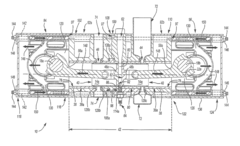
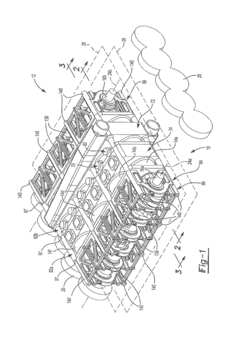
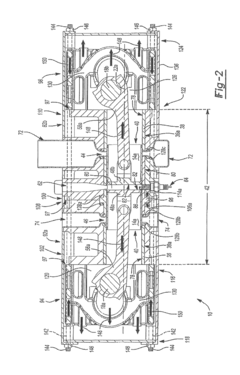
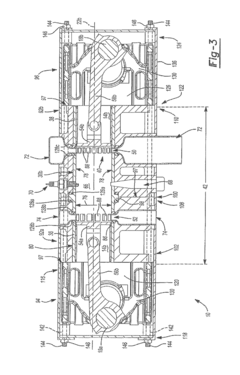
Engine block construction for opposed piston engine
PatentActiveUS10072604B2
Innovation
- The engine block is designed with multiple segments that allow easier installation of cylinder liners by aligning bores to receive the liners, providing improved access and eliminating the need for complex machining, with intermediate support collars for enhanced liner stability.
Engine block for diesel applications such as in highly stressed motors, comprises a crankcase, a cylinder block and/or a cylinder crankcase, and a cast iron material having structural matrix
PatentInactiveDE102010010991A1
Innovation
- An engine block made of cast iron with a microstructure matrix of acicular, carbide-free ferrite and isothermally stabilized retained austenite, optionally alloyed with copper, molybdenum, manganese, or nickel, is treated through austempering to enhance thermal conductivity, tribological properties, and castability, with a method involving austenitization and quenching in a salt bath or furnace to achieve a 99-100% microstructure of acicular ferrite and carbon-enriched austenite.


Environmental Impact and Sustainability Considerations
The environmental impact of engine block materials extends far beyond performance considerations, becoming increasingly critical in automotive design decisions. The LS2 engine block material selection—primarily aluminum versus cast iron—presents significant environmental trade-offs throughout the product lifecycle. Aluminum engine blocks, while requiring more energy-intensive initial production processes, offer substantial environmental benefits during vehicle operation through weight reduction and corresponding fuel efficiency improvements. This operational advantage typically offsets the higher production energy requirements within the first 50,000 to 100,000 miles of vehicle operation.
Manufacturing sustainability metrics reveal that cast iron production generates approximately 1.8 tons of CO2 per ton produced, compared to aluminum's 5.7 tons. However, this initial carbon disadvantage for aluminum is counterbalanced by its superior recyclability characteristics. Aluminum engine blocks maintain approximately 95% of their material value through recycling processes, while cast iron components achieve only 60-70% material recovery rates in typical recycling operations.
The reduced weight of aluminum engine blocks (approximately 60-100 pounds lighter than comparable cast iron blocks) translates to measurable emissions reductions throughout vehicle lifespan. Industry studies indicate that each 100-pound weight reduction in vehicle mass yields approximately 1-2% improvement in fuel economy, with corresponding reductions in greenhouse gas emissions. For a typical passenger vehicle with a 150,000-mile lifespan, this weight advantage can prevent the release of 1,500-2,000 pounds of carbon dioxide.
Material longevity considerations also factor into sustainability assessments. Cast iron's superior durability in certain high-stress applications potentially extends service life, reducing replacement frequency and associated environmental impacts. However, modern aluminum alloys with silicon content exceeding 7% have substantially closed this durability gap while maintaining weight advantages.
Regulatory frameworks increasingly influence material selection decisions. Current and projected emissions standards in major markets (particularly EU and California regulations) effectively incentivize lightweight construction methods. The Corporate Average Fuel Economy (CAFE) standards specifically drive manufacturers toward aluminum engine components as a compliance strategy.
End-of-life considerations reveal that aluminum engine blocks command significantly higher salvage values, encouraging more complete recovery in vehicle recycling operations. The established recycling infrastructure for automotive aluminum continues to improve recovery rates, with current systems capturing approximately 91% of automotive aluminum for reprocessing, compared to 78% for ferrous components.
Manufacturing sustainability metrics reveal that cast iron production generates approximately 1.8 tons of CO2 per ton produced, compared to aluminum's 5.7 tons. However, this initial carbon disadvantage for aluminum is counterbalanced by its superior recyclability characteristics. Aluminum engine blocks maintain approximately 95% of their material value through recycling processes, while cast iron components achieve only 60-70% material recovery rates in typical recycling operations.
The reduced weight of aluminum engine blocks (approximately 60-100 pounds lighter than comparable cast iron blocks) translates to measurable emissions reductions throughout vehicle lifespan. Industry studies indicate that each 100-pound weight reduction in vehicle mass yields approximately 1-2% improvement in fuel economy, with corresponding reductions in greenhouse gas emissions. For a typical passenger vehicle with a 150,000-mile lifespan, this weight advantage can prevent the release of 1,500-2,000 pounds of carbon dioxide.
Material longevity considerations also factor into sustainability assessments. Cast iron's superior durability in certain high-stress applications potentially extends service life, reducing replacement frequency and associated environmental impacts. However, modern aluminum alloys with silicon content exceeding 7% have substantially closed this durability gap while maintaining weight advantages.
Regulatory frameworks increasingly influence material selection decisions. Current and projected emissions standards in major markets (particularly EU and California regulations) effectively incentivize lightweight construction methods. The Corporate Average Fuel Economy (CAFE) standards specifically drive manufacturers toward aluminum engine components as a compliance strategy.
End-of-life considerations reveal that aluminum engine blocks command significantly higher salvage values, encouraging more complete recovery in vehicle recycling operations. The established recycling infrastructure for automotive aluminum continues to improve recovery rates, with current systems capturing approximately 91% of automotive aluminum for reprocessing, compared to 78% for ferrous components.
Performance Testing Methodologies and Standards
Performance testing methodologies for LS2 engine block materials require standardized approaches to accurately compare weight and durability characteristics. The Society of Automotive Engineers (SAE) has established several testing protocols specifically designed for evaluating engine block materials, including SAE J1349 for performance testing and SAE J2530 for durability assessment. These standards ensure consistent measurement across different material compositions and manufacturing processes.
Material strength testing typically involves both non-destructive and destructive methodologies. Tensile strength tests measure the maximum stress that aluminum and cast iron blocks can withstand before failure, while fatigue testing simulates the cyclic loading conditions experienced during engine operation. For LS2 blocks specifically, thermal cycle testing is critical as it evaluates how materials respond to repeated heating and cooling cycles between -30°C and 200°C.
Weight comparison methodologies must account for the complete assembly rather than just raw material weight. The Automotive Materials Testing Standard (AMTS) protocol requires measuring blocks with identical configurations, including all necessary reinforcement structures. This approach provides a more accurate representation of real-world weight differences between aluminum (typically 20-25kg) and cast iron (40-45kg) LS2 blocks.
Vibration analysis forms another crucial testing component, with accelerometers placed at strategic points to measure natural frequency responses and damping characteristics. Cast iron typically demonstrates superior vibration damping properties, which must be quantified using Fast Fourier Transform (FFT) analysis according to ISO 16750-3 standards.
Thermal conductivity testing follows ASTM E1530 protocols, measuring heat dissipation capabilities under controlled conditions. This is particularly relevant when comparing aluminum's superior thermal conductivity (approximately 180 W/m·K) to cast iron (approximately 80 W/m·K). Testing must occur at multiple temperature points to create comprehensive thermal profiles.
Corrosion resistance evaluation follows ASTM B117 salt spray testing standards, exposing materials to accelerated corrosive environments for periods ranging from 500 to 1,000 hours. This is supplemented by galvanic corrosion testing when evaluating how different materials interact within the cooling system environment.
Dimensional stability testing measures how materials maintain critical tolerances under thermal and mechanical stress. The Coordinate Measuring Machine (CMM) methodology tracks changes in cylinder bore dimensions to within 0.001mm accuracy before and after thermal cycling and simulated load testing, providing critical data on long-term durability expectations.
Material strength testing typically involves both non-destructive and destructive methodologies. Tensile strength tests measure the maximum stress that aluminum and cast iron blocks can withstand before failure, while fatigue testing simulates the cyclic loading conditions experienced during engine operation. For LS2 blocks specifically, thermal cycle testing is critical as it evaluates how materials respond to repeated heating and cooling cycles between -30°C and 200°C.
Weight comparison methodologies must account for the complete assembly rather than just raw material weight. The Automotive Materials Testing Standard (AMTS) protocol requires measuring blocks with identical configurations, including all necessary reinforcement structures. This approach provides a more accurate representation of real-world weight differences between aluminum (typically 20-25kg) and cast iron (40-45kg) LS2 blocks.
Vibration analysis forms another crucial testing component, with accelerometers placed at strategic points to measure natural frequency responses and damping characteristics. Cast iron typically demonstrates superior vibration damping properties, which must be quantified using Fast Fourier Transform (FFT) analysis according to ISO 16750-3 standards.
Thermal conductivity testing follows ASTM E1530 protocols, measuring heat dissipation capabilities under controlled conditions. This is particularly relevant when comparing aluminum's superior thermal conductivity (approximately 180 W/m·K) to cast iron (approximately 80 W/m·K). Testing must occur at multiple temperature points to create comprehensive thermal profiles.
Corrosion resistance evaluation follows ASTM B117 salt spray testing standards, exposing materials to accelerated corrosive environments for periods ranging from 500 to 1,000 hours. This is supplemented by galvanic corrosion testing when evaluating how different materials interact within the cooling system environment.
Dimensional stability testing measures how materials maintain critical tolerances under thermal and mechanical stress. The Coordinate Measuring Machine (CMM) methodology tracks changes in cylinder bore dimensions to within 0.001mm accuracy before and after thermal cycling and simulated load testing, providing critical data on long-term durability expectations.
Unlock deeper insights with Patsnap Eureka Quick Research — get a full tech report to explore trends and direct your research. Try now!
Generate Your Research Report Instantly with AI Agent
Supercharge your innovation with Patsnap Eureka AI Agent Platform!