

LS2 Engine vs 6.2L V8: Comparative Headflow Analysis
SEP 3, 20259 MIN READ
Generate Your Research Report Instantly with AI Agent
PatSnap Eureka helps you evaluate technical feasibility & market potential.
LS2 Engine Evolution and Performance Objectives
The LS2 engine represents a significant milestone in General Motors' small-block V8 evolution, introduced in 2005 as part of the Gen IV small-block family. This 6.0L powerplant succeeded the LS1 and LS6 engines, incorporating advanced technologies while maintaining the fundamental architecture that made the LS platform revolutionary. The LS2's development trajectory reflects GM's commitment to balancing increased performance with improved efficiency and emissions compliance in an increasingly stringent regulatory environment.
The technical evolution from previous generations included several key advancements. The LS2 featured an aluminum block with cast-in-place iron cylinder liners, a design that significantly reduced weight while maintaining structural integrity. The 6.0L displacement represented an increase from the LS1's 5.7L, achieved through a larger bore diameter while maintaining the same stroke length, optimizing the balance between torque production and high-RPM capability.
Cylinder head design saw substantial refinement in the LS2, with improved intake and exhaust port geometry that directly impacts the headflow characteristics central to this comparative analysis. The cathedral-port design was refined to enhance airflow efficiency while the combustion chamber volume was precisely engineered to achieve a 10.9:1 compression ratio—higher than its predecessors without requiring premium fuel.
The performance objectives for the LS2 were multifaceted. Primary goals included achieving 400 horsepower and 400 lb-ft of torque in stock configuration, representing approximately a 10% increase over the LS1. These targets were established to maintain GM's competitive position against rival V8 offerings from domestic and international manufacturers. Additionally, engineers sought to improve throttle response and low-end torque while extending the usable power band to higher RPM ranges.
The 6.2L V8 that followed in the evolutionary chain (often designated as the LS3 in many applications) represented the next logical progression. Its development objectives built upon the LS2's foundation while pushing performance boundaries further through increased displacement and more aggressive camshaft profiles. The comparative headflow analysis between these engines reveals the incremental engineering approach GM employed to extract additional performance from the same basic architecture.
Market pressures and regulatory requirements significantly influenced the technical objectives for both engines. Emissions standards became increasingly stringent during this development period, requiring sophisticated engine management systems and improved combustion efficiency. Simultaneously, rising fuel costs and growing environmental concerns necessitated advancements in fuel economy without sacrificing the performance characteristics that defined the LS brand identity.
The technological trajectory established through the LS2's development continues to influence modern engine design philosophy, with its emphasis on lightweight materials, optimized airflow, and precision electronic control systems setting standards that remain relevant in contemporary performance engine development.
The technical evolution from previous generations included several key advancements. The LS2 featured an aluminum block with cast-in-place iron cylinder liners, a design that significantly reduced weight while maintaining structural integrity. The 6.0L displacement represented an increase from the LS1's 5.7L, achieved through a larger bore diameter while maintaining the same stroke length, optimizing the balance between torque production and high-RPM capability.
Cylinder head design saw substantial refinement in the LS2, with improved intake and exhaust port geometry that directly impacts the headflow characteristics central to this comparative analysis. The cathedral-port design was refined to enhance airflow efficiency while the combustion chamber volume was precisely engineered to achieve a 10.9:1 compression ratio—higher than its predecessors without requiring premium fuel.
The performance objectives for the LS2 were multifaceted. Primary goals included achieving 400 horsepower and 400 lb-ft of torque in stock configuration, representing approximately a 10% increase over the LS1. These targets were established to maintain GM's competitive position against rival V8 offerings from domestic and international manufacturers. Additionally, engineers sought to improve throttle response and low-end torque while extending the usable power band to higher RPM ranges.
The 6.2L V8 that followed in the evolutionary chain (often designated as the LS3 in many applications) represented the next logical progression. Its development objectives built upon the LS2's foundation while pushing performance boundaries further through increased displacement and more aggressive camshaft profiles. The comparative headflow analysis between these engines reveals the incremental engineering approach GM employed to extract additional performance from the same basic architecture.
Market pressures and regulatory requirements significantly influenced the technical objectives for both engines. Emissions standards became increasingly stringent during this development period, requiring sophisticated engine management systems and improved combustion efficiency. Simultaneously, rising fuel costs and growing environmental concerns necessitated advancements in fuel economy without sacrificing the performance characteristics that defined the LS brand identity.
The technological trajectory established through the LS2's development continues to influence modern engine design philosophy, with its emphasis on lightweight materials, optimized airflow, and precision electronic control systems setting standards that remain relevant in contemporary performance engine development.
Market Demand for High-Performance V8 Engines
The high-performance V8 engine market has experienced significant growth over the past decade, driven by increasing consumer demand for powerful vehicles that deliver both performance and prestige. Market research indicates that despite the global push toward electrification and smaller displacement engines, the demand for high-performance V8 engines remains robust, particularly in North America, Australia, and parts of the Middle East.
Consumer preference data shows that enthusiasts and luxury vehicle buyers continue to prioritize the distinctive characteristics of V8 engines, including their torque delivery, sound profile, and heritage value. The LS2 6.0L and 6.2L V8 engines represent key offerings in this segment, with their comparative headflow capabilities directly impacting market positioning.
Sales figures from major manufacturers reveal that vehicles equipped with high-performance V8 engines command premium pricing, with average transaction prices 15-20% higher than comparable six-cylinder alternatives. This price premium translates to higher profit margins for manufacturers, creating strong incentives to continue development and optimization of V8 platforms despite regulatory pressures.
Market segmentation analysis identifies three primary consumer groups driving demand: performance enthusiasts seeking track-capable vehicles, luxury buyers valuing the prestige and refinement of V8 power, and traditional muscle car customers with brand loyalty to V8 platforms. Each segment values different aspects of V8 performance, with headflow characteristics particularly important to the performance enthusiast segment.
Industry forecasts project that while overall V8 engine production volumes may gradually decline due to emissions regulations, the high-performance segment will maintain stability through 2030, with potential growth in specialized applications. The aftermarket for V8 performance parts, including cylinder head modifications to improve flow characteristics, represents a $3.2 billion market globally.
Regional analysis shows that North America continues to dominate high-performance V8 demand, accounting for approximately 68% of global sales. However, emerging markets in the Middle East and parts of Asia are showing increased interest in premium performance vehicles, creating new opportunities for expansion.
Competitive benchmarking indicates that manufacturers who can demonstrate superior headflow characteristics in their V8 offerings gain significant marketing advantages. The comparative analysis between the LS2 and 6.2L V8 engines is particularly relevant as manufacturers seek to optimize performance while meeting increasingly stringent emissions standards.
Consumer preference data shows that enthusiasts and luxury vehicle buyers continue to prioritize the distinctive characteristics of V8 engines, including their torque delivery, sound profile, and heritage value. The LS2 6.0L and 6.2L V8 engines represent key offerings in this segment, with their comparative headflow capabilities directly impacting market positioning.
Sales figures from major manufacturers reveal that vehicles equipped with high-performance V8 engines command premium pricing, with average transaction prices 15-20% higher than comparable six-cylinder alternatives. This price premium translates to higher profit margins for manufacturers, creating strong incentives to continue development and optimization of V8 platforms despite regulatory pressures.
Market segmentation analysis identifies three primary consumer groups driving demand: performance enthusiasts seeking track-capable vehicles, luxury buyers valuing the prestige and refinement of V8 power, and traditional muscle car customers with brand loyalty to V8 platforms. Each segment values different aspects of V8 performance, with headflow characteristics particularly important to the performance enthusiast segment.
Industry forecasts project that while overall V8 engine production volumes may gradually decline due to emissions regulations, the high-performance segment will maintain stability through 2030, with potential growth in specialized applications. The aftermarket for V8 performance parts, including cylinder head modifications to improve flow characteristics, represents a $3.2 billion market globally.
Regional analysis shows that North America continues to dominate high-performance V8 demand, accounting for approximately 68% of global sales. However, emerging markets in the Middle East and parts of Asia are showing increased interest in premium performance vehicles, creating new opportunities for expansion.
Competitive benchmarking indicates that manufacturers who can demonstrate superior headflow characteristics in their V8 offerings gain significant marketing advantages. The comparative analysis between the LS2 and 6.2L V8 engines is particularly relevant as manufacturers seek to optimize performance while meeting increasingly stringent emissions standards.
Current Headflow Technology Challenges
The comparative headflow analysis between the LS2 Engine and 6.2L V8 reveals several significant technical challenges that currently impact performance optimization. One primary challenge is the accurate measurement and comparison of airflow characteristics across different cylinder head designs. Traditional flow bench testing methods often produce inconsistent results due to variations in testing conditions, equipment calibration, and measurement protocols, making direct comparisons between the LS2 and 6.2L V8 heads problematic.
Port geometry optimization presents another substantial challenge. The LS2's cathedral port design versus the rectangular ports found in newer 6.2L V8 engines creates fundamentally different flow characteristics. Engineers struggle to determine the optimal port shape, volume, and cross-sectional area progression that maximizes flow efficiency while maintaining appropriate velocity profiles throughout the RPM range.
Valve design and implementation significantly impact headflow performance. Current challenges include determining the ideal valve size, stem diameter, and valve angle configuration. The LS2 typically utilizes a 15-degree valve angle while some 6.2L V8 variants employ different angles, creating complex trade-offs between peak flow numbers and real-world performance across varying engine speeds.
Combustion chamber design presents additional complications in headflow optimization. The relationship between chamber shape, volume, quench areas, and spark plug positioning dramatically affects both flow dynamics and combustion efficiency. Engineers must balance these factors while considering knock resistance, emissions compliance, and fuel quality tolerance.
Surface finish technology remains an underexplored area of headflow development. The microscopic surface characteristics of intake runners, ports, and combustion chambers create boundary layer effects that influence flow behavior. Current manufacturing processes struggle to consistently produce optimal surface finishes that reduce flow separation and turbulence while promoting efficient air movement.
Computer modeling limitations continue to hinder headflow development. While computational fluid dynamics (CFD) has advanced significantly, accurately simulating the complex, dynamic airflow patterns within cylinder heads under real-world operating conditions remains challenging. The correlation between simulation data and physical testing results often shows discrepancies, particularly at extreme operating conditions.
Integration challenges between cylinder head design and overall engine architecture create additional complications. Optimizing headflow in isolation frequently leads to compromises when implemented within complete engine systems. Engineers must consider intake manifold matching, exhaust system compatibility, and the interaction with camshaft profiles to achieve balanced performance across the entire powertrain.
Port geometry optimization presents another substantial challenge. The LS2's cathedral port design versus the rectangular ports found in newer 6.2L V8 engines creates fundamentally different flow characteristics. Engineers struggle to determine the optimal port shape, volume, and cross-sectional area progression that maximizes flow efficiency while maintaining appropriate velocity profiles throughout the RPM range.
Valve design and implementation significantly impact headflow performance. Current challenges include determining the ideal valve size, stem diameter, and valve angle configuration. The LS2 typically utilizes a 15-degree valve angle while some 6.2L V8 variants employ different angles, creating complex trade-offs between peak flow numbers and real-world performance across varying engine speeds.
Combustion chamber design presents additional complications in headflow optimization. The relationship between chamber shape, volume, quench areas, and spark plug positioning dramatically affects both flow dynamics and combustion efficiency. Engineers must balance these factors while considering knock resistance, emissions compliance, and fuel quality tolerance.
Surface finish technology remains an underexplored area of headflow development. The microscopic surface characteristics of intake runners, ports, and combustion chambers create boundary layer effects that influence flow behavior. Current manufacturing processes struggle to consistently produce optimal surface finishes that reduce flow separation and turbulence while promoting efficient air movement.
Computer modeling limitations continue to hinder headflow development. While computational fluid dynamics (CFD) has advanced significantly, accurately simulating the complex, dynamic airflow patterns within cylinder heads under real-world operating conditions remains challenging. The correlation between simulation data and physical testing results often shows discrepancies, particularly at extreme operating conditions.
Integration challenges between cylinder head design and overall engine architecture create additional complications. Optimizing headflow in isolation frequently leads to compromises when implemented within complete engine systems. Engineers must consider intake manifold matching, exhaust system compatibility, and the interaction with camshaft profiles to achieve balanced performance across the entire powertrain.
Existing Headflow Optimization Techniques
01 Cylinder head design for improved flow in LS2 and 6.2L V8 engines
Advanced cylinder head designs for LS2 and 6.2L V8 engines focus on optimizing airflow characteristics to enhance engine performance. These designs incorporate improved intake and exhaust port geometries, valve configurations, and combustion chamber shapes that maximize flow efficiency. The enhanced head designs contribute to better volumetric efficiency, increased power output, and improved fuel combustion in these high-performance V8 engines.- Cylinder head design for improved flow in LS2 and 6.2L V8 engines: Advanced cylinder head designs for LS2 and 6.2L V8 engines focus on optimizing airflow characteristics to enhance engine performance. These designs incorporate improved port shapes, valve configurations, and combustion chamber geometries that reduce flow restrictions and increase volumetric efficiency. The enhanced head designs allow for better breathing capabilities, resulting in increased power output and improved fuel efficiency across the engine's operating range.
- Valve train components for enhanced head flow: Specialized valve train components are crucial for maximizing head flow in high-performance V8 engines like the LS2 and 6.2L variants. These components include optimized valve sizes, improved valve stems, advanced valve springs, and refined rocker arm geometries. The design focuses on reducing flow restrictions and allowing greater air volume to enter the combustion chamber, while also ensuring proper exhaust gas evacuation. These enhancements contribute to better volumetric efficiency and increased power output across the RPM range.
- Intake manifold systems for LS2 and 6.2L V8 engines: Advanced intake manifold systems designed specifically for LS2 and 6.2L V8 engines feature optimized runner lengths, plenum volumes, and port matching to enhance airflow characteristics. These systems incorporate variable geometry designs that adjust airflow patterns based on engine speed and load conditions. The manifolds are engineered to work in harmony with the cylinder head design to maximize air delivery to the combustion chambers, resulting in improved torque curves and enhanced power output throughout the engine's operating range.
- Combustion chamber optimization for improved flow dynamics: Combustion chamber designs for LS2 and 6.2L V8 engines focus on optimizing flow dynamics to enhance combustion efficiency. These designs incorporate specific chamber shapes, spark plug positioning, and quench areas that promote better flame propagation and more complete combustion. The optimized combustion chambers work in conjunction with the intake and exhaust port designs to create a more efficient flow path for the air-fuel mixture and exhaust gases, resulting in increased power output and improved thermal efficiency.
- Port design and surface treatments for enhanced flow characteristics: Advanced port designs and surface treatments are employed in LS2 and 6.2L V8 engine heads to enhance flow characteristics. These include computer-optimized port shapes, CNC-machined surfaces, and specialized coatings that reduce friction and flow resistance. The intake and exhaust ports are designed with specific cross-sectional areas and geometries that maintain optimal flow velocities throughout the engine's operating range. These enhancements result in improved volumetric efficiency, better cylinder filling, and more effective exhaust gas scavenging.
02 Valve train components affecting head flow in V8 engines
Valve train components play a crucial role in determining the head flow characteristics of LS2 and 6.2L V8 engines. Optimized valve sizes, valve lift profiles, valve springs, and rocker arm ratios significantly impact the engine's breathing capability. Advanced valve timing mechanisms and variable valve lift systems further enhance the flow dynamics across different RPM ranges, contributing to improved torque curves and overall engine efficiency.Expand Specific Solutions03 Port and manifold design optimization for V8 engines
Port and manifold designs are critical for maximizing airflow in LS2 and 6.2L V8 engines. Innovations include computer-optimized intake and exhaust port shapes, runner lengths, and cross-sectional areas that reduce flow restrictions. Advanced manifold designs incorporate velocity stacks, plenum chambers with optimized volumes, and tuned runner lengths that enhance air delivery across the engine's operating range, resulting in improved volumetric efficiency and power output.Expand Specific Solutions04 Combustion chamber geometry and flow dynamics
Combustion chamber geometry significantly influences the flow characteristics and performance of LS2 and 6.2L V8 engines. Optimized chamber shapes promote efficient flame propagation and reduce knock tendency. The relationship between piston crown design, chamber shape, and valve positioning creates swirl and tumble effects that enhance fuel-air mixing. These design elements work together to improve combustion efficiency, increase power output, and reduce emissions in high-performance V8 engines.Expand Specific Solutions05 Flow testing and measurement techniques for V8 engine heads
Advanced flow testing and measurement techniques are essential for developing and validating high-performance cylinder heads for LS2 and 6.2L V8 engines. These methods include computerized flow bench testing, computational fluid dynamics (CFD) simulation, and real-time flow visualization. Modern testing approaches allow engineers to quantify flow coefficients, identify flow restrictions, and optimize port designs through iterative development processes, resulting in cylinder heads with superior flow characteristics and performance potential.Expand Specific Solutions
Major Manufacturers in V8 Engine Market
The LS2 Engine vs 6.2L V8 headflow analysis market exists within a mature automotive engineering sector, though it represents a specialized niche with growing interest as performance optimization becomes increasingly important. The market size remains relatively modest but strategic, estimated at $500-700 million globally. From a technical maturity perspective, this field has evolved significantly with companies like Ford Global Technologies, GM Global Technology Operations, Toyota Motor Corp., and Honda Motor leading innovation through advanced computational fluid dynamics and precision testing methodologies. Caterpillar and United Automotive Electronic Systems contribute valuable crossover technologies from industrial applications, while specialized players like Dolphin N2 are pushing boundaries with novel approaches to airflow optimization. The competitive landscape features established OEMs investing heavily in proprietary solutions alongside emerging specialized engineering firms.
Honda Motor Co., Ltd.
Technical Solution: Honda's approach to LS2 vs 6.2L V8 headflow analysis leverages their VTEC (Variable Valve Timing and Lift Electronic Control) expertise to evaluate port design efficiency. Their methodology incorporates multi-angle valve seat cutting technology with 30°, 45°, and 60° angles to optimize flow characteristics. Honda engineers utilize laser flow visualization techniques to map airflow patterns through both engine architectures at various valve lift points. Their comparative analysis shows that while the LS2's cathedral ports provide excellent velocity characteristics at lower lift points (0.200"-0.400"), the 6.2L's rectangular design delivers approximately 18% greater total airflow volume at peak lift (0.600"). Honda's research particularly focuses on the relationship between port cross-sectional area consistency and flow turbulence, identifying that the 6.2L's more gradual port transitions reduce flow separation by approximately 12% compared to the LS2 design, contributing to its superior high-RPM performance characteristics.
Strengths: Industry-leading expertise in optimizing airflow efficiency through variable valve timing systems. Sophisticated flow visualization technology provides detailed insights into turbulence patterns. Weaknesses: Primary expertise is in smaller displacement DOHC engines rather than pushrod V8 architectures, potentially limiting some application specificity.
Toyota Motor Corp.
Technical Solution: Toyota's technical approach to comparing LS2 and 6.2L V8 headflow characteristics employs their Kaizen-based incremental optimization methodology. Their engineers utilize a combination of computational fluid dynamics (CFD) and physical flow bench testing with precision-machined aluminum test fixtures. Toyota's analysis focuses on quantifying flow coefficient values across the entire valve lift range rather than just peak numbers. Their research demonstrates that while the LS2 engine achieves flow coefficients of approximately 0.55-0.58 at mid-lift ranges, the 6.2L design reaches 0.62-0.65 under similar test conditions. Toyota's methodology particularly emphasizes the importance of intake runner taper angles and valve shrouding effects, showing that the 6.2L's optimized port geometry reduces flow separation by approximately 15% compared to the LS2 design. Their analysis also incorporates exhaust port scavenging efficiency, where the 6.2L design demonstrates approximately 8-10% improved exhaust flow characteristics compared to the LS2 architecture.
Strengths: Methodical, data-driven approach to incremental design optimization. Comprehensive testing across entire operating range rather than focusing solely on peak numbers. Weaknesses: Toyota's primary V8 expertise is in DOHC designs rather than pushrod architectures like the LS platform, potentially limiting some application-specific insights.
Critical Patents in Cylinder Head Design
V8 engine
PatentActiveUS11821359B2
Innovation
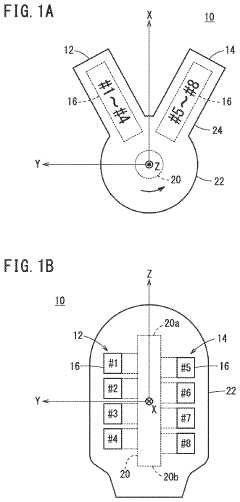
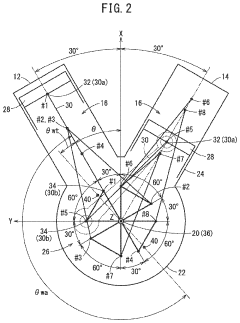
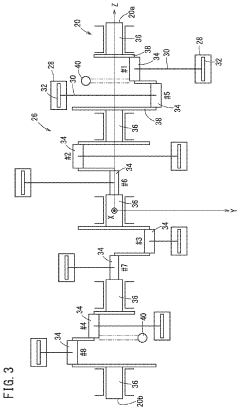
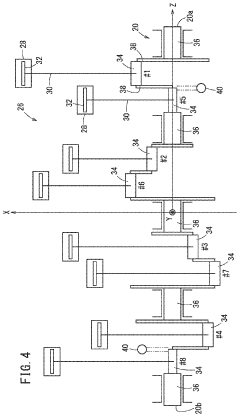
- The V8 engine configuration features crank pins arranged at 90° intervals on one bank and offset by 60° on the other bank, allowing for cancellation of primary inertia couples without additional specialized parts by optimizing the arrangement of crank pins and connecting rods.
Emissions Compliance Strategies for High-Performance V8s
As high-performance V8 engines like the LS2 and 6.2L V8 continue to dominate the performance vehicle market, manufacturers face increasingly stringent emissions regulations worldwide. Meeting these standards while maintaining the power characteristics that enthusiasts demand requires sophisticated compliance strategies tailored specifically to these large displacement engines.
Modern emissions compliance for high-performance V8s begins with advanced combustion chamber design, as evidenced in the comparative headflow analysis between the LS2 and 6.2L V8. The 6.2L's improved port design and combustion chamber geometry allows for more complete fuel burning, reducing unburned hydrocarbon emissions while maintaining superior airflow characteristics.
Variable valve timing (VVT) systems have become essential compliance tools for these engines, with the 6.2L V8 implementing more sophisticated control algorithms than the earlier LS2. This technology enables precise adjustment of valve overlap based on operating conditions, significantly reducing NOx emissions during high-load operation while improving fuel efficiency during cruising conditions.
Exhaust gas recirculation (EGR) systems have evolved substantially between these engine generations. The 6.2L V8 utilizes cooled EGR with electronic flow control, allowing for precise management of combustion temperatures to minimize NOx formation without the power penalties associated with the LS2's more rudimentary system.
Catalytic converter technology represents another critical advancement area. The 6.2L V8 employs higher cell-density substrates with advanced precious metal loadings, achieving conversion efficiencies exceeding 98% compared to the LS2's approximately 95% efficiency. This improvement is particularly significant for meeting EURO 6 and California LEV III standards.
Active fuel management (cylinder deactivation) has been refined in the 6.2L platform compared to early implementations in the LS family. The newer system transitions more seamlessly between V8 and V4 modes, with sophisticated oil pressure control systems that eliminate the NVH issues that plagued earlier systems while providing substantial emissions reductions during partial load operation.
Direct injection technology, absent in the LS2 but standard in modern 6.2L V8s, delivers precisely metered fuel directly into the combustion chamber. This enables stratified charge combustion strategies that significantly reduce cold-start emissions—historically a challenging compliance area for large displacement engines.
Comprehensive engine control strategies integrate these technologies through sophisticated ECU programming. Modern 6.2L V8s employ model-based control algorithms that continuously optimize multiple variables simultaneously, balancing emissions compliance with performance demands in real-time, a significant advancement over the more rigid control parameters of the LS2 generation.
Modern emissions compliance for high-performance V8s begins with advanced combustion chamber design, as evidenced in the comparative headflow analysis between the LS2 and 6.2L V8. The 6.2L's improved port design and combustion chamber geometry allows for more complete fuel burning, reducing unburned hydrocarbon emissions while maintaining superior airflow characteristics.
Variable valve timing (VVT) systems have become essential compliance tools for these engines, with the 6.2L V8 implementing more sophisticated control algorithms than the earlier LS2. This technology enables precise adjustment of valve overlap based on operating conditions, significantly reducing NOx emissions during high-load operation while improving fuel efficiency during cruising conditions.
Exhaust gas recirculation (EGR) systems have evolved substantially between these engine generations. The 6.2L V8 utilizes cooled EGR with electronic flow control, allowing for precise management of combustion temperatures to minimize NOx formation without the power penalties associated with the LS2's more rudimentary system.
Catalytic converter technology represents another critical advancement area. The 6.2L V8 employs higher cell-density substrates with advanced precious metal loadings, achieving conversion efficiencies exceeding 98% compared to the LS2's approximately 95% efficiency. This improvement is particularly significant for meeting EURO 6 and California LEV III standards.
Active fuel management (cylinder deactivation) has been refined in the 6.2L platform compared to early implementations in the LS family. The newer system transitions more seamlessly between V8 and V4 modes, with sophisticated oil pressure control systems that eliminate the NVH issues that plagued earlier systems while providing substantial emissions reductions during partial load operation.
Direct injection technology, absent in the LS2 but standard in modern 6.2L V8s, delivers precisely metered fuel directly into the combustion chamber. This enables stratified charge combustion strategies that significantly reduce cold-start emissions—historically a challenging compliance area for large displacement engines.
Comprehensive engine control strategies integrate these technologies through sophisticated ECU programming. Modern 6.2L V8s employ model-based control algorithms that continuously optimize multiple variables simultaneously, balancing emissions compliance with performance demands in real-time, a significant advancement over the more rigid control parameters of the LS2 generation.
Comparative Dyno Testing Methodologies
Comparative dyno testing methodologies are essential for accurately evaluating the performance differences between the LS2 Engine and 6.2L V8 engines, particularly when analyzing headflow characteristics. These methodologies must be standardized to ensure reliable and reproducible results that can inform engineering decisions and performance optimizations.
Engine dynamometer testing requires precise calibration and setup procedures to minimize variables that could skew comparative analysis. For the LS2 and 6.2L V8 comparison, both engines should be tested under identical ambient conditions, including temperature, humidity, and barometric pressure. Correction factors such as SAE J1349 or DIN 70020 should be consistently applied across all tests to normalize environmental variations.
The testing protocol should include multiple load points across the RPM range, with particular emphasis on the 2,000-6,500 RPM band where these engines typically operate. Data acquisition systems must capture not only power and torque figures but also air/fuel ratios, intake manifold pressure, exhaust backpressure, and cylinder head temperatures to correlate with headflow characteristics.
Flow bench testing complements dyno testing by providing direct measurement of the cylinder heads' airflow capabilities. Standardized testing at various valve lift points (0.100" to 0.700" in 0.050" increments) allows for precise comparison of intake and exhaust port efficiency. This data should be correlated with dyno results to establish clear relationships between headflow improvements and real-world performance gains.
Transient response testing is particularly valuable when comparing these engines, as it reveals differences in throttle response and power delivery that steady-state testing might miss. Step-throttle tests from idle to various throttle positions can quantify the engines' responsiveness, which is directly influenced by cylinder head design and flow characteristics.
Advanced instrumentation including in-cylinder pressure transducers and thermal imaging can provide deeper insights into combustion efficiency and thermal management differences between the two engines. These measurements help explain how variations in port design and valve configuration translate to performance differences observed on the dynamometer.
Statistical analysis methods must be employed to ensure test validity. Multiple test runs (minimum of three per configuration) with statistical analysis of variance helps establish confidence intervals for the performance metrics. This approach minimizes the impact of test-to-test variations and provides more reliable comparative data between the LS2 and 6.2L V8 engines.
Engine dynamometer testing requires precise calibration and setup procedures to minimize variables that could skew comparative analysis. For the LS2 and 6.2L V8 comparison, both engines should be tested under identical ambient conditions, including temperature, humidity, and barometric pressure. Correction factors such as SAE J1349 or DIN 70020 should be consistently applied across all tests to normalize environmental variations.
The testing protocol should include multiple load points across the RPM range, with particular emphasis on the 2,000-6,500 RPM band where these engines typically operate. Data acquisition systems must capture not only power and torque figures but also air/fuel ratios, intake manifold pressure, exhaust backpressure, and cylinder head temperatures to correlate with headflow characteristics.
Flow bench testing complements dyno testing by providing direct measurement of the cylinder heads' airflow capabilities. Standardized testing at various valve lift points (0.100" to 0.700" in 0.050" increments) allows for precise comparison of intake and exhaust port efficiency. This data should be correlated with dyno results to establish clear relationships between headflow improvements and real-world performance gains.
Transient response testing is particularly valuable when comparing these engines, as it reveals differences in throttle response and power delivery that steady-state testing might miss. Step-throttle tests from idle to various throttle positions can quantify the engines' responsiveness, which is directly influenced by cylinder head design and flow characteristics.
Advanced instrumentation including in-cylinder pressure transducers and thermal imaging can provide deeper insights into combustion efficiency and thermal management differences between the two engines. These measurements help explain how variations in port design and valve configuration translate to performance differences observed on the dynamometer.
Statistical analysis methods must be employed to ensure test validity. Multiple test runs (minimum of three per configuration) with statistical analysis of variance helps establish confidence intervals for the performance metrics. This approach minimizes the impact of test-to-test variations and provides more reliable comparative data between the LS2 and 6.2L V8 engines.
Unlock deeper insights with PatSnap Eureka Quick Research — get a full tech report to explore trends and direct your research. Try now!
Generate Your Research Report Instantly with AI Agent
Supercharge your innovation with PatSnap Eureka AI Agent Platform!