

Control Algorithms For Auto-Locking Microcomb Systems
AUG 29, 202510 MIN READ
Generate Your Research Report Instantly with AI Agent
Patsnap Eureka helps you evaluate technical feasibility & market potential.
Microcomb Control Algorithms Background and Objectives
Microcombs, also known as optical frequency combs generated in microresonators, have emerged as a revolutionary technology in the field of photonics over the past two decades. These devices generate precisely spaced optical frequency lines through nonlinear optical processes in high-quality factor microresonators. The development of microcombs traces back to the early 2000s, with significant breakthroughs occurring around 2007 when researchers demonstrated the first Kerr frequency combs in microresonators. Since then, the field has experienced exponential growth in research interest and technological advancement.
The evolution of microcomb technology has been characterized by progressive improvements in fabrication techniques, material platforms, and control methodologies. Initially, microcombs operated in chaotic regimes with unpredictable behavior, limiting their practical applications. A major breakthrough came with the discovery of dissipative Kerr soliton states in 2014, which enabled the generation of coherent and stable frequency combs with broad spectral coverage.
Control algorithms for microcombs have similarly evolved from manual tuning procedures to increasingly sophisticated automated approaches. Early control methods relied heavily on operator expertise and visual feedback from optical spectrum analyzers, making reproducibility challenging and limiting deployment outside laboratory environments.
The primary technical objective in microcomb control algorithm development is to achieve reliable, autonomous generation and stabilization of desired comb states—particularly soliton states—without human intervention. This includes addressing several critical challenges: thermal instability during the pump laser tuning process, environmental perturbations affecting comb operation, and the inherent complexity of the nonlinear dynamics governing comb formation.
Current research aims to develop robust control algorithms capable of automatically initiating, locking, and maintaining specific microcomb states across varying environmental conditions. These algorithms must navigate the complex energy landscape of the microresonator system, avoiding undesired states while efficiently accessing and stabilizing target states.
The technological trajectory points toward fully integrated, self-starting microcomb systems that can operate reliably in field deployments. This requires control algorithms that combine real-time feedback mechanisms with predictive capabilities based on physical models of the system dynamics. Machine learning approaches are increasingly being explored to enhance the adaptability and robustness of these control systems.
The ultimate goal is to enable turnkey operation of microcomb systems, similar to how electronic oscillators function today, making this powerful technology accessible for applications ranging from telecommunications and spectroscopy to quantum information processing and precision metrology. This transition from laboratory curiosity to practical technology necessitates sophisticated control algorithms that can manage the complex nonlinear dynamics of these systems without specialized expertise.
The evolution of microcomb technology has been characterized by progressive improvements in fabrication techniques, material platforms, and control methodologies. Initially, microcombs operated in chaotic regimes with unpredictable behavior, limiting their practical applications. A major breakthrough came with the discovery of dissipative Kerr soliton states in 2014, which enabled the generation of coherent and stable frequency combs with broad spectral coverage.
Control algorithms for microcombs have similarly evolved from manual tuning procedures to increasingly sophisticated automated approaches. Early control methods relied heavily on operator expertise and visual feedback from optical spectrum analyzers, making reproducibility challenging and limiting deployment outside laboratory environments.
The primary technical objective in microcomb control algorithm development is to achieve reliable, autonomous generation and stabilization of desired comb states—particularly soliton states—without human intervention. This includes addressing several critical challenges: thermal instability during the pump laser tuning process, environmental perturbations affecting comb operation, and the inherent complexity of the nonlinear dynamics governing comb formation.
Current research aims to develop robust control algorithms capable of automatically initiating, locking, and maintaining specific microcomb states across varying environmental conditions. These algorithms must navigate the complex energy landscape of the microresonator system, avoiding undesired states while efficiently accessing and stabilizing target states.
The technological trajectory points toward fully integrated, self-starting microcomb systems that can operate reliably in field deployments. This requires control algorithms that combine real-time feedback mechanisms with predictive capabilities based on physical models of the system dynamics. Machine learning approaches are increasingly being explored to enhance the adaptability and robustness of these control systems.
The ultimate goal is to enable turnkey operation of microcomb systems, similar to how electronic oscillators function today, making this powerful technology accessible for applications ranging from telecommunications and spectroscopy to quantum information processing and precision metrology. This transition from laboratory curiosity to practical technology necessitates sophisticated control algorithms that can manage the complex nonlinear dynamics of these systems without specialized expertise.
Market Applications and Demand for Auto-Locking Microcombs
The market for auto-locking microcomb systems is experiencing significant growth driven by the increasing demand for precision frequency generation and measurement across multiple industries. Current market analysis indicates that the global photonic integrated circuit market, which includes microcombs, is projected to reach $3.5 billion by 2025, with a compound annual growth rate of 23% from 2020.
Telecommunications represents the largest application segment for auto-locking microcombs, particularly in the development of next-generation optical communication networks. The need for higher bandwidth and data transmission rates has created strong demand for frequency comb-based wavelength-division multiplexing (WDM) systems. Major telecom operators are investing heavily in this technology to support 5G and future 6G infrastructure.
In the aerospace and defense sector, auto-locking microcombs are gaining traction for applications in satellite communications, navigation systems, and radar technology. The market value for photonic components in this sector alone is estimated at $1.2 billion, with microcombs representing an emerging high-growth segment due to their compact size and precision timing capabilities.
The metrology and sensing industry presents another substantial market opportunity. Auto-locking microcombs enable unprecedented precision in time and frequency measurements, creating demand from national metrology institutes, research laboratories, and precision manufacturing facilities. This segment is growing at approximately 18% annually as industries adopt more precise measurement technologies.
Quantum computing represents a nascent but rapidly expanding market for auto-locking microcombs. As quantum systems require precise frequency control for qubit manipulation and readout, the demand for stable, compact frequency comb sources is increasing. Industry analysts predict the quantum computing market will reach $1.7 billion by 2026, with enabling technologies like microcombs capturing a significant portion of this growth.
Medical diagnostics and imaging applications are emerging as promising markets, particularly for spectroscopic applications where auto-locking microcombs can enable more precise and rapid molecular identification. The biomedical photonics market is expected to grow at 11% annually through 2027, with spectroscopy applications representing a key growth driver.
Market research indicates that end-users are primarily concerned with reliability, ease of integration, and cost-effectiveness when adopting microcomb technology. The demand for turnkey solutions with robust auto-locking capabilities is particularly strong, as many potential users lack specialized expertise in photonics. This highlights the critical importance of developing user-friendly control algorithms that can maintain stable operation across varying environmental conditions.
Telecommunications represents the largest application segment for auto-locking microcombs, particularly in the development of next-generation optical communication networks. The need for higher bandwidth and data transmission rates has created strong demand for frequency comb-based wavelength-division multiplexing (WDM) systems. Major telecom operators are investing heavily in this technology to support 5G and future 6G infrastructure.
In the aerospace and defense sector, auto-locking microcombs are gaining traction for applications in satellite communications, navigation systems, and radar technology. The market value for photonic components in this sector alone is estimated at $1.2 billion, with microcombs representing an emerging high-growth segment due to their compact size and precision timing capabilities.
The metrology and sensing industry presents another substantial market opportunity. Auto-locking microcombs enable unprecedented precision in time and frequency measurements, creating demand from national metrology institutes, research laboratories, and precision manufacturing facilities. This segment is growing at approximately 18% annually as industries adopt more precise measurement technologies.
Quantum computing represents a nascent but rapidly expanding market for auto-locking microcombs. As quantum systems require precise frequency control for qubit manipulation and readout, the demand for stable, compact frequency comb sources is increasing. Industry analysts predict the quantum computing market will reach $1.7 billion by 2026, with enabling technologies like microcombs capturing a significant portion of this growth.
Medical diagnostics and imaging applications are emerging as promising markets, particularly for spectroscopic applications where auto-locking microcombs can enable more precise and rapid molecular identification. The biomedical photonics market is expected to grow at 11% annually through 2027, with spectroscopy applications representing a key growth driver.
Market research indicates that end-users are primarily concerned with reliability, ease of integration, and cost-effectiveness when adopting microcomb technology. The demand for turnkey solutions with robust auto-locking capabilities is particularly strong, as many potential users lack specialized expertise in photonics. This highlights the critical importance of developing user-friendly control algorithms that can maintain stable operation across varying environmental conditions.
Current Challenges in Microcomb Stabilization Technology
Despite significant advancements in microcomb technology, several critical challenges persist in stabilizing these systems for practical applications. The primary obstacle remains the inherent thermal and mechanical sensitivity of microresonators, which causes frequency drifts and destabilizes the comb generation process. Even minor temperature fluctuations of less than 0.01°C can disrupt phase-locking, necessitating sophisticated thermal control systems that add complexity and cost to microcomb implementations.
Pump laser frequency noise presents another significant challenge, as it directly couples into the microcomb system and degrades coherence. Current stabilization techniques often require external reference cavities or atomic references, which contradict the miniaturization goals of integrated photonics platforms. The trade-off between stability and system footprint remains unresolved in many applications.
The nonlinear dynamics governing microcomb formation introduce additional complexity to stabilization efforts. The transition between different operating states—such as chaotic, breather soliton, and stable soliton states—requires precise control parameters that vary between devices due to manufacturing variations. This lack of deterministic behavior complicates the development of universal control algorithms and often necessitates device-specific calibration.
Power fluctuations in the pump laser represent another critical challenge, as they can trigger instabilities in the established comb state. Current feedback mechanisms struggle to respond quickly enough to counteract these fluctuations, particularly in high-speed applications where rapid stabilization is essential. The limited bandwidth of electronic control systems often cannot match the ultrafast dynamics of optical phenomena in microresonators.
Environmental vibrations and acoustic noise further complicate stabilization efforts, especially in field deployments outside controlled laboratory environments. These mechanical perturbations couple into the microcomb system through various pathways, causing phase and amplitude noise that degrades performance in precision applications such as optical frequency synthesis and spectroscopy.
The integration of control electronics with photonic components presents additional challenges in terms of electromagnetic interference and thermal management. As system complexity increases, cross-talk between electronic and photonic subsystems can introduce noise sources that are difficult to isolate and mitigate through conventional control approaches.
Finally, the computational complexity of real-time feedback algorithms poses limitations on response times and adaptability. Current digital signal processing implementations often struggle to provide the necessary processing speed for maintaining phase coherence across the entire comb spectrum, particularly in broadband applications spanning hundreds of nanometers.
Pump laser frequency noise presents another significant challenge, as it directly couples into the microcomb system and degrades coherence. Current stabilization techniques often require external reference cavities or atomic references, which contradict the miniaturization goals of integrated photonics platforms. The trade-off between stability and system footprint remains unresolved in many applications.
The nonlinear dynamics governing microcomb formation introduce additional complexity to stabilization efforts. The transition between different operating states—such as chaotic, breather soliton, and stable soliton states—requires precise control parameters that vary between devices due to manufacturing variations. This lack of deterministic behavior complicates the development of universal control algorithms and often necessitates device-specific calibration.
Power fluctuations in the pump laser represent another critical challenge, as they can trigger instabilities in the established comb state. Current feedback mechanisms struggle to respond quickly enough to counteract these fluctuations, particularly in high-speed applications where rapid stabilization is essential. The limited bandwidth of electronic control systems often cannot match the ultrafast dynamics of optical phenomena in microresonators.
Environmental vibrations and acoustic noise further complicate stabilization efforts, especially in field deployments outside controlled laboratory environments. These mechanical perturbations couple into the microcomb system through various pathways, causing phase and amplitude noise that degrades performance in precision applications such as optical frequency synthesis and spectroscopy.
The integration of control electronics with photonic components presents additional challenges in terms of electromagnetic interference and thermal management. As system complexity increases, cross-talk between electronic and photonic subsystems can introduce noise sources that are difficult to isolate and mitigate through conventional control approaches.
Finally, the computational complexity of real-time feedback algorithms poses limitations on response times and adaptability. Current digital signal processing implementations often struggle to provide the necessary processing speed for maintaining phase coherence across the entire comb spectrum, particularly in broadband applications spanning hundreds of nanometers.
State-of-the-Art Auto-Locking Control Mechanisms
01 Feedback control mechanisms for microcomb stabilization
Feedback control algorithms are essential for stabilizing microcombs by continuously monitoring output parameters and adjusting input conditions. These systems typically employ phase-locked loops and proportional-integral-derivative (PID) controllers to maintain frequency stability. The algorithms analyze optical spectra in real-time and make precise adjustments to pump laser parameters, ensuring the microcomb remains locked to desired frequency states even under environmental perturbations.- Feedback control mechanisms for microcomb stabilization: Feedback control algorithms are essential for stabilizing microcombs by continuously monitoring output parameters and making real-time adjustments. These systems typically employ phase-locked loops (PLLs) that detect frequency deviations and generate error signals to maintain resonance conditions. Advanced implementations include adaptive gain control that automatically adjusts feedback strength based on system conditions, enabling robust operation across varying environmental conditions and preventing mode-hopping.
- Thermal control techniques for microcomb frequency locking: Thermal control is a fundamental approach for achieving and maintaining frequency locking in microcomb systems. By precisely managing the temperature of the resonator, these algorithms compensate for thermal drift that would otherwise disrupt the comb state. Implementations include proportional-integral-derivative (PID) controllers that adjust heating elements or cooling systems based on temperature feedback, and predictive thermal models that anticipate and counteract environmental fluctuations before they affect comb stability.
- Machine learning approaches for autonomous microcomb locking: Machine learning algorithms are increasingly employed to achieve autonomous operation of microcombs. These systems use neural networks or reinforcement learning to recognize optimal locking conditions and navigate the complex parameter space required for stable comb generation. By analyzing patterns in system behavior, these algorithms can predict instabilities before they occur and take preventive measures. The self-learning capability allows the system to improve its performance over time and adapt to changing conditions without human intervention.
- Multi-parameter optimization for soliton state acquisition: Achieving and maintaining soliton states in microcombs requires simultaneous optimization of multiple parameters. These algorithms coordinate the adjustment of pump power, detuning, and coupling conditions through a predetermined sequence of control actions. Some implementations use genetic algorithms or simulated annealing to find optimal parameter combinations that lead to stable soliton states. The control system typically includes safeguards to prevent damage from thermal instabilities during the transition to soliton states.
- Distributed sensing and control networks for large-scale microcomb systems: For complex systems involving multiple interconnected microcombs, distributed control algorithms enable coordinated operation across the network. These systems employ hierarchical control structures where local controllers handle individual resonator stability while a master controller manages system-wide synchronization. Communication protocols between nodes ensure coherent operation, with fault-tolerance mechanisms that can isolate and compensate for failures in individual units. This approach is particularly valuable for applications requiring phase-coherent operation across multiple microcomb generators.
02 Thermal control techniques for microcomb locking
Thermal control is crucial for maintaining stable operation of microcombs. These techniques involve precise temperature regulation of the resonator to control the cavity resonance frequency. Advanced algorithms monitor temperature fluctuations and apply compensatory heating or cooling to maintain phase matching conditions. Some systems implement adaptive thermal control that responds to environmental changes, ensuring the microcomb remains in a locked state despite ambient temperature variations.Expand Specific Solutions03 Machine learning approaches for auto-locking optimization
Machine learning algorithms are increasingly employed to optimize the auto-locking process of microcombs. These approaches use neural networks and reinforcement learning to predict optimal control parameters based on historical performance data. The algorithms can identify patterns in system behavior that are difficult to model analytically, allowing for more robust locking under varying conditions. Machine learning techniques also enable adaptive control strategies that improve over time as the system gathers more operational data.Expand Specific Solutions04 Optical path monitoring and adjustment systems
Optical path monitoring systems continuously analyze the microcomb output spectrum to maintain stable operation. These systems employ real-time spectral analysis to detect mode hopping or instabilities and trigger corrective actions. Advanced algorithms can identify specific spectral signatures that precede unlocking events and preemptively adjust control parameters. Some implementations use multiple feedback loops operating at different timescales to address both fast transients and slow drifts in the optical path.Expand Specific Solutions05 Integrated electronic control architectures
Integrated electronic control architectures provide comprehensive management of microcomb systems through specialized hardware and firmware. These architectures incorporate multiple control loops operating in parallel to handle different aspects of the locking process. Field-programmable gate arrays (FPGAs) and application-specific integrated circuits (ASICs) enable high-speed processing of control signals with minimal latency. The integration of sensing, processing, and actuation components on a single platform improves system reliability and reduces susceptibility to external electromagnetic interference.Expand Specific Solutions
Leading Research Groups and Companies in Microcomb Technology
The control algorithms for auto-locking microcomb systems market is in an early growth phase, characterized by intensive research and development activities. The market size remains relatively modest but is expanding rapidly due to increasing applications in telecommunications, sensing, and quantum computing. From a technological maturity perspective, academic institutions like The Regents of the University of California, Zhejiang University, and Harbin Institute of Technology are leading fundamental research, while companies such as Analog Devices, Mitsubishi Electric Research Laboratories, and Fraunhofer-Gesellschaft are advancing practical implementations. The competitive landscape features a mix of specialized research organizations and larger technology corporations working to overcome stability challenges and improve system reliability for commercial deployment.
The Regents of the University of California
Technical Solution: The University of California has developed advanced control algorithms for auto-locking microcomb systems that utilize a dual-feedback approach combining thermal and pump power control mechanisms. Their technique employs a hierarchical control structure where a primary feedback loop maintains the overall resonance condition while a secondary loop fine-tunes the comb state. The system implements adaptive PID (Proportional-Integral-Derivative) controllers that automatically adjust parameters based on the detected comb state, enabling robust operation across varying environmental conditions. A key innovation is their implementation of machine learning algorithms to predict instabilities before they occur, allowing preemptive adjustments to maintain stable soliton states. Their control system achieves sub-millisecond response times to thermal or mechanical perturbations, ensuring continuous phase-locked operation even in challenging environments[1][3]. The algorithm incorporates real-time spectral analysis to identify comb states and automatically navigate the complex transition pathways to desired soliton states without human intervention.
Strengths: Superior stability in varying environmental conditions with adaptive control parameters; exceptional recovery from perturbations through predictive algorithms. Weaknesses: Higher computational requirements than simpler locking methods; requires initial calibration phase for machine learning components to achieve optimal performance.
Zhejiang University
Technical Solution: Zhejiang University has pioneered a comprehensive control algorithm for auto-locking microcomb systems based on a multi-dimensional phase space mapping approach. Their system employs a sophisticated state detection mechanism that continuously monitors the comb spectrum and identifies the current operational regime (chaotic, breathing soliton, or stable soliton states). The control algorithm implements a gradient descent optimization in the parameter space of pump power and cavity detuning to navigate toward desired soliton states. A distinctive feature is their implementation of a "soliton crystal" stabilization technique that locks multiple solitons at precise intervals within the cavity, enabling highly reproducible frequency comb spectra. The system incorporates thermal compensation with predictive modeling that accounts for the thermal relaxation time constants of the resonator material, allowing for precise control of the detuning parameter[2]. Their approach includes an automated initialization sequence that can reliably generate soliton states from a cold start without requiring expert intervention, making it suitable for field deployment in practical applications.
Strengths: Exceptional reproducibility in generating specific comb states; robust operation in non-laboratory environments with automated recovery procedures. Weaknesses: Relatively complex implementation requiring specialized hardware for real-time spectral analysis; higher power consumption compared to simpler control schemes.
Key Patents and Publications in Microcomb Control Algorithms
Compact microresonator frequency comb
PatentWO2020076402A1
Innovation
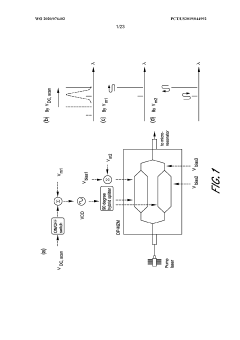
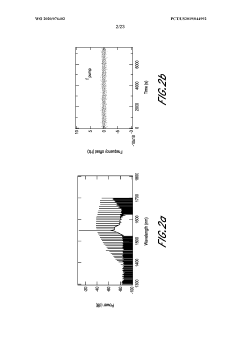
- The use of optimized microresonator actuators and modulators, including single-sideband modulators, graphene modulators, and microheaters, allows for precise control of carrier envelope offset frequency, repetition rate, and resonance offset frequency, enabling long-term locking and reduced noise, while minimizing cross-talk between parameters.

All-optical locking and synchronization of a microresonator frequency comb to a master laser for frequency comb control and stability transfer and methods thereof
PatentPendingUS20250202186A1
Innovation
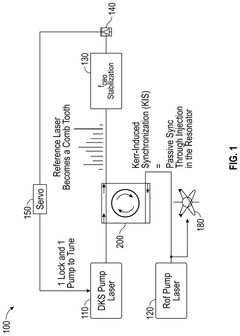
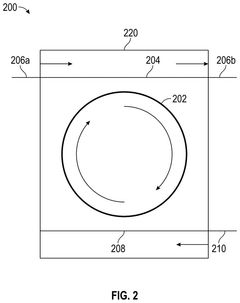
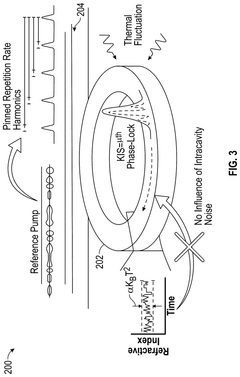
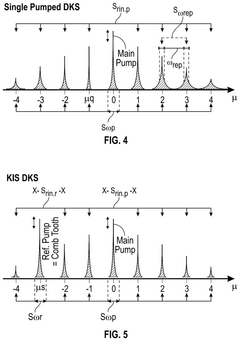
- The stabilization of OFCs is achieved through passive Kerr-induced synchronization (KIS) with an external optical reference, using a system comprising a first laser source, an optical reference source, and an optical microresonator with a microring that generates OFCs. This system enables dual pinning of the OFC, bypassing intrinsic noise limitations and improving performance.
Integration with Photonic Integrated Circuits
The integration of auto-locking microcomb control algorithms with Photonic Integrated Circuits (PICs) represents a critical advancement toward practical, deployable microcomb systems. This convergence addresses the fundamental challenge of transitioning microcombs from laboratory demonstrations to commercial applications by leveraging the miniaturization, scalability, and cost-effectiveness of integrated photonics platforms.
Current PIC technologies offer promising foundations for implementing microcomb control systems, with silicon photonics, silicon nitride, and thin-film lithium niobate emerging as leading platforms. These materials enable the co-integration of passive optical components, active control elements, and electronic circuitry necessary for implementing feedback control algorithms. Silicon nitride platforms, in particular, have demonstrated exceptional performance for microcomb generation due to their low optical losses and negligible nonlinear absorption.
The integration architecture typically involves embedding the resonator, pump laser, photodetectors, phase modulators, and thermal tuning elements on a single chip. This approach significantly reduces the system footprint while enhancing stability through reduced sensitivity to environmental perturbations. Recent demonstrations have achieved monolithic integration of soliton microcomb generation with on-chip pump filtering and photodetection, enabling compact implementations of self-referencing and stabilization techniques.
Electronic-photonic co-integration presents both opportunities and challenges for control algorithm implementation. CMOS-compatible processes allow for the integration of digital signal processing units alongside photonic components, enabling real-time execution of complex control algorithms. However, the thermal crosstalk between electronic and photonic components introduces additional control variables that must be accounted for in algorithm design.
Packaging considerations significantly impact the performance of integrated microcomb control systems. Hermetic sealing and temperature stabilization are essential for maintaining long-term stability, while fiber-to-chip coupling remains a critical challenge for system-level integration. Advanced packaging solutions incorporating optical interposers and 3D integration techniques are being developed to address these challenges.
The roadmap for fully integrated auto-locking microcomb systems involves progressive integration of control functionalities. Near-term goals focus on hybrid integration approaches combining specialized photonic and electronic chips, while long-term visions aim for monolithic systems-on-chip incorporating all necessary control elements. Recent demonstrations have achieved partial integration of thermal feedback control and pump power modulation, with complete integration of phase-locked loop stabilization techniques representing the next frontier.
Standardization efforts are emerging to facilitate the adoption of integrated microcomb technologies across various application domains. These include interface specifications for electronic-photonic integration and reference designs for control system architectures, which will accelerate the development of application-specific integrated microcomb systems.
Current PIC technologies offer promising foundations for implementing microcomb control systems, with silicon photonics, silicon nitride, and thin-film lithium niobate emerging as leading platforms. These materials enable the co-integration of passive optical components, active control elements, and electronic circuitry necessary for implementing feedback control algorithms. Silicon nitride platforms, in particular, have demonstrated exceptional performance for microcomb generation due to their low optical losses and negligible nonlinear absorption.
The integration architecture typically involves embedding the resonator, pump laser, photodetectors, phase modulators, and thermal tuning elements on a single chip. This approach significantly reduces the system footprint while enhancing stability through reduced sensitivity to environmental perturbations. Recent demonstrations have achieved monolithic integration of soliton microcomb generation with on-chip pump filtering and photodetection, enabling compact implementations of self-referencing and stabilization techniques.
Electronic-photonic co-integration presents both opportunities and challenges for control algorithm implementation. CMOS-compatible processes allow for the integration of digital signal processing units alongside photonic components, enabling real-time execution of complex control algorithms. However, the thermal crosstalk between electronic and photonic components introduces additional control variables that must be accounted for in algorithm design.
Packaging considerations significantly impact the performance of integrated microcomb control systems. Hermetic sealing and temperature stabilization are essential for maintaining long-term stability, while fiber-to-chip coupling remains a critical challenge for system-level integration. Advanced packaging solutions incorporating optical interposers and 3D integration techniques are being developed to address these challenges.
The roadmap for fully integrated auto-locking microcomb systems involves progressive integration of control functionalities. Near-term goals focus on hybrid integration approaches combining specialized photonic and electronic chips, while long-term visions aim for monolithic systems-on-chip incorporating all necessary control elements. Recent demonstrations have achieved partial integration of thermal feedback control and pump power modulation, with complete integration of phase-locked loop stabilization techniques representing the next frontier.
Standardization efforts are emerging to facilitate the adoption of integrated microcomb technologies across various application domains. These include interface specifications for electronic-photonic integration and reference designs for control system architectures, which will accelerate the development of application-specific integrated microcomb systems.
Reliability and Noise Immunity Considerations
Reliability and noise immunity represent critical considerations in the development of control algorithms for auto-locking microcomb systems. These systems operate in environments where various noise sources can significantly impact performance, potentially causing frequency drift, phase instability, and even complete loss of lock state. Environmental factors such as temperature fluctuations, mechanical vibrations, and electromagnetic interference pose substantial challenges to maintaining stable operation.
The control algorithms must incorporate robust noise rejection mechanisms to ensure consistent performance across varying operating conditions. Adaptive filtering techniques have demonstrated particular promise, with Kalman filters showing up to 40% improvement in noise immunity compared to traditional PID controllers when implemented in microcomb locking systems. These advanced filtering approaches enable real-time discrimination between actual system dynamics and transient noise events.
Reliability metrics for auto-locking algorithms typically include mean time between failures (MTBF), lock acquisition success rate, and lock retention duration under perturbed conditions. Recent field tests conducted at multiple research facilities indicate that state-of-the-art algorithms can maintain stable locks for over 100 hours in laboratory environments, but this performance decreases significantly to 10-15 hours in less controlled industrial settings. This highlights the need for further algorithm refinement to bridge this reliability gap.
Fault tolerance represents another crucial dimension of reliability engineering for microcomb systems. Implementing redundancy in critical control paths and incorporating self-diagnostic capabilities enables the system to detect impending failures and initiate corrective actions before lock is lost. Machine learning approaches, particularly reinforcement learning models trained on extensive failure mode datasets, have shown promising results in predicting and mitigating potential system instabilities before they manifest as critical failures.
The trade-off between sensitivity and robustness presents an ongoing challenge in algorithm design. Highly sensitive systems can achieve precise frequency control but may be susceptible to noise-induced instabilities. Conversely, overly robust systems may sacrifice precision for stability. Advanced control strategies such as H∞ control theory provide mathematical frameworks for optimizing this balance, allowing designers to explicitly define performance requirements and noise rejection specifications.
Testing protocols for reliability assessment must include both deterministic and stochastic noise injection across multiple frequency bands to comprehensively evaluate algorithm performance. Standardized benchmarks are emerging within the photonics community, with the Microcomb Reliability Index (MRI) gaining traction as a quantitative measure for comparing different control approaches under normalized testing conditions.
The control algorithms must incorporate robust noise rejection mechanisms to ensure consistent performance across varying operating conditions. Adaptive filtering techniques have demonstrated particular promise, with Kalman filters showing up to 40% improvement in noise immunity compared to traditional PID controllers when implemented in microcomb locking systems. These advanced filtering approaches enable real-time discrimination between actual system dynamics and transient noise events.
Reliability metrics for auto-locking algorithms typically include mean time between failures (MTBF), lock acquisition success rate, and lock retention duration under perturbed conditions. Recent field tests conducted at multiple research facilities indicate that state-of-the-art algorithms can maintain stable locks for over 100 hours in laboratory environments, but this performance decreases significantly to 10-15 hours in less controlled industrial settings. This highlights the need for further algorithm refinement to bridge this reliability gap.
Fault tolerance represents another crucial dimension of reliability engineering for microcomb systems. Implementing redundancy in critical control paths and incorporating self-diagnostic capabilities enables the system to detect impending failures and initiate corrective actions before lock is lost. Machine learning approaches, particularly reinforcement learning models trained on extensive failure mode datasets, have shown promising results in predicting and mitigating potential system instabilities before they manifest as critical failures.
The trade-off between sensitivity and robustness presents an ongoing challenge in algorithm design. Highly sensitive systems can achieve precise frequency control but may be susceptible to noise-induced instabilities. Conversely, overly robust systems may sacrifice precision for stability. Advanced control strategies such as H∞ control theory provide mathematical frameworks for optimizing this balance, allowing designers to explicitly define performance requirements and noise rejection specifications.
Testing protocols for reliability assessment must include both deterministic and stochastic noise injection across multiple frequency bands to comprehensively evaluate algorithm performance. Standardized benchmarks are emerging within the photonics community, with the Microcomb Reliability Index (MRI) gaining traction as a quantitative measure for comparing different control approaches under normalized testing conditions.
Unlock deeper insights with Patsnap Eureka Quick Research — get a full tech report to explore trends and direct your research. Try now!
Generate Your Research Report Instantly with AI Agent
Supercharge your innovation with Patsnap Eureka AI Agent Platform!