

Microcomb Synchronization Across Distributed Photonic Nodes
AUG 29, 20259 MIN READ
Generate Your Research Report Instantly with AI Agent
Patsnap Eureka helps you evaluate technical feasibility & market potential.
Microcomb Technology Background and Objectives
Microcombs, or optical frequency combs generated in microresonators, represent a revolutionary advancement in photonic technology that has evolved significantly over the past two decades. These devices generate a spectrum of equally spaced frequency lines through nonlinear optical processes in high-quality factor microresonators, offering unprecedented capabilities for precision measurement, spectroscopy, telecommunications, and quantum information processing.
The evolution of microcomb technology began with the demonstration of optical frequency combs using mode-locked lasers, which earned the 2005 Nobel Prize in Physics. The subsequent miniaturization efforts led to the development of microresonator-based frequency combs around 2007, marking a paradigm shift in integrated photonics. Since then, the field has witnessed remarkable progress in materials, fabrication techniques, and operational regimes, transitioning from proof-of-concept demonstrations to practical applications.
Current microcomb platforms span various material systems including silicon nitride, lithium niobate, aluminum nitride, and silica, each offering distinct advantages in terms of nonlinearity, dispersion engineering, and integration capabilities. The development trajectory has focused on achieving lower power consumption, broader spectral coverage, enhanced stability, and seamless integration with existing photonic and electronic infrastructures.
The synchronization of microcombs across distributed photonic nodes represents a frontier challenge that addresses the growing need for coherent, scalable photonic networks. Such synchronization is essential for applications requiring precise timing and phase relationships across physically separated locations, including optical atomic clocks, distributed quantum computing, coherent optical communications, and large-scale sensing arrays.
The primary technical objectives for microcomb synchronization include establishing robust phase-locking mechanisms between spatially separated microcombs, developing efficient protocols for maintaining synchronization despite environmental perturbations, and creating scalable architectures that can accommodate numerous nodes without degradation in performance or excessive overhead.
Additionally, the research aims to achieve low-latency synchronization with sub-femtosecond precision, minimize power consumption for deployment in energy-constrained environments, and ensure compatibility with existing fiber-optic infrastructure and wavelength-division multiplexing systems. These objectives align with broader goals in photonic integration and quantum technologies.
The successful realization of synchronized microcomb networks would enable transformative capabilities in quantum networking, ultra-precise timing distribution, coherent optical communications with unprecedented spectral efficiency, and distributed sensing with enhanced sensitivity. This technology could serve as a foundational platform for next-generation photonic systems that leverage the full potential of coherent light across distributed architectures.
The evolution of microcomb technology began with the demonstration of optical frequency combs using mode-locked lasers, which earned the 2005 Nobel Prize in Physics. The subsequent miniaturization efforts led to the development of microresonator-based frequency combs around 2007, marking a paradigm shift in integrated photonics. Since then, the field has witnessed remarkable progress in materials, fabrication techniques, and operational regimes, transitioning from proof-of-concept demonstrations to practical applications.
Current microcomb platforms span various material systems including silicon nitride, lithium niobate, aluminum nitride, and silica, each offering distinct advantages in terms of nonlinearity, dispersion engineering, and integration capabilities. The development trajectory has focused on achieving lower power consumption, broader spectral coverage, enhanced stability, and seamless integration with existing photonic and electronic infrastructures.
The synchronization of microcombs across distributed photonic nodes represents a frontier challenge that addresses the growing need for coherent, scalable photonic networks. Such synchronization is essential for applications requiring precise timing and phase relationships across physically separated locations, including optical atomic clocks, distributed quantum computing, coherent optical communications, and large-scale sensing arrays.
The primary technical objectives for microcomb synchronization include establishing robust phase-locking mechanisms between spatially separated microcombs, developing efficient protocols for maintaining synchronization despite environmental perturbations, and creating scalable architectures that can accommodate numerous nodes without degradation in performance or excessive overhead.
Additionally, the research aims to achieve low-latency synchronization with sub-femtosecond precision, minimize power consumption for deployment in energy-constrained environments, and ensure compatibility with existing fiber-optic infrastructure and wavelength-division multiplexing systems. These objectives align with broader goals in photonic integration and quantum technologies.
The successful realization of synchronized microcomb networks would enable transformative capabilities in quantum networking, ultra-precise timing distribution, coherent optical communications with unprecedented spectral efficiency, and distributed sensing with enhanced sensitivity. This technology could serve as a foundational platform for next-generation photonic systems that leverage the full potential of coherent light across distributed architectures.
Market Applications for Synchronized Photonic Networks
Synchronized photonic networks based on microcomb technology are poised to revolutionize multiple market sectors by enabling unprecedented levels of precision timing, data throughput, and system integration. The telecommunications industry stands as a primary beneficiary, where synchronized microcombs can dramatically enhance network capacity through coherent optical communications. These systems enable wavelength division multiplexing with hundreds of precisely spaced channels, potentially increasing data transmission rates beyond 100 Tbps while reducing power consumption compared to traditional laser arrays.
Quantum computing represents another high-value application domain. Synchronized photonic networks provide the precise timing control necessary for quantum operations across distributed quantum processors. This capability addresses one of quantum computing's fundamental scaling challenges by allowing quantum information processing across physically separated nodes while maintaining quantum coherence.
In the aerospace and defense sectors, synchronized photonic networks offer significant advantages for satellite communications and positioning systems. The technology enables formation flying of satellite constellations with unprecedented timing precision, enhancing Earth observation capabilities and improving global positioning accuracy to the sub-centimeter level.
Financial markets increasingly demand ultra-low latency connections for high-frequency trading operations. Synchronized photonic networks can provide deterministic latency with picosecond precision across geographically distributed trading centers, creating competitive advantages worth billions in markets where nanoseconds determine transaction success.
The healthcare industry presents emerging applications in distributed medical imaging and diagnostics. Synchronized photonic networks enable real-time correlation of multiple imaging modalities across hospital campuses or between medical facilities, supporting advanced diagnostic capabilities like distributed functional imaging that requires precise temporal alignment of data from multiple sources.
Advanced manufacturing systems benefit from synchronized photonic networks through improved coordination of distributed robotic systems and quality control processes. The technology enables nanometer-precision synchronization across factory floors, supporting next-generation semiconductor fabrication and advanced 3D printing techniques that require multi-point coordination.
Scientific research facilities represent another significant market, particularly large-scale physics experiments like particle accelerators and gravitational wave detectors. These installations require timing synchronization across kilometers with femtosecond precision—specifications that synchronized microcomb networks are uniquely positioned to deliver.
The market for synchronized photonic networks is expected to grow substantially as these technologies mature from laboratory demonstrations to commercial deployment, with particularly strong growth anticipated in data centers, telecommunications, and quantum computing applications over the next five years.
Quantum computing represents another high-value application domain. Synchronized photonic networks provide the precise timing control necessary for quantum operations across distributed quantum processors. This capability addresses one of quantum computing's fundamental scaling challenges by allowing quantum information processing across physically separated nodes while maintaining quantum coherence.
In the aerospace and defense sectors, synchronized photonic networks offer significant advantages for satellite communications and positioning systems. The technology enables formation flying of satellite constellations with unprecedented timing precision, enhancing Earth observation capabilities and improving global positioning accuracy to the sub-centimeter level.
Financial markets increasingly demand ultra-low latency connections for high-frequency trading operations. Synchronized photonic networks can provide deterministic latency with picosecond precision across geographically distributed trading centers, creating competitive advantages worth billions in markets where nanoseconds determine transaction success.
The healthcare industry presents emerging applications in distributed medical imaging and diagnostics. Synchronized photonic networks enable real-time correlation of multiple imaging modalities across hospital campuses or between medical facilities, supporting advanced diagnostic capabilities like distributed functional imaging that requires precise temporal alignment of data from multiple sources.
Advanced manufacturing systems benefit from synchronized photonic networks through improved coordination of distributed robotic systems and quality control processes. The technology enables nanometer-precision synchronization across factory floors, supporting next-generation semiconductor fabrication and advanced 3D printing techniques that require multi-point coordination.
Scientific research facilities represent another significant market, particularly large-scale physics experiments like particle accelerators and gravitational wave detectors. These installations require timing synchronization across kilometers with femtosecond precision—specifications that synchronized microcomb networks are uniquely positioned to deliver.
The market for synchronized photonic networks is expected to grow substantially as these technologies mature from laboratory demonstrations to commercial deployment, with particularly strong growth anticipated in data centers, telecommunications, and quantum computing applications over the next five years.
Current Challenges in Distributed Microcomb Systems
Despite significant advancements in microcomb technology, distributed microcomb systems face several critical challenges that impede their widespread implementation. The primary obstacle remains phase noise and frequency stability across physically separated nodes. Current systems struggle to maintain coherence when microcombs are distributed over distances exceeding several meters, resulting in degraded spectral purity and increased bit error rates in communication applications.
Thermal management presents another substantial challenge. Microresonators are highly sensitive to temperature fluctuations, with frequency shifts of approximately 2-3 GHz per degree Celsius commonly observed in silicon nitride platforms. In distributed environments where nodes experience different ambient conditions, maintaining consistent operational parameters becomes exceedingly difficult without sophisticated thermal control systems.
Environmental perturbations pose significant obstacles to stable operation. Mechanical vibrations, acoustic noise, and air currents can induce phase fluctuations that are particularly problematic in free-space optical connections between nodes. Even in fiber-based systems, strain and temperature gradients along interconnecting fibers introduce additional phase noise that compounds synchronization difficulties.
Power consumption requirements present scaling limitations for large distributed networks. Current pump laser and control electronics configurations typically demand 5-20W per node, making extensive networks energetically costly and limiting deployment in power-constrained environments such as satellites or remote sensing platforms.
Feedback control latency emerges as a fundamental constraint in geographically dispersed systems. The finite speed of light imposes minimum bounds on control loop response times, with each kilometer of separation adding approximately 5 microseconds of round-trip delay. This latency fundamentally limits the bandwidth of phase-locking mechanisms between distant nodes.
Integration complexity increases exponentially with system scale. Current architectures require numerous discrete components including external lasers, modulators, detectors, and control electronics. The absence of standardized interfaces between components from different manufacturers creates compatibility issues that complicate system design and maintenance.
Long-term drift compensation remains inadequately addressed in existing solutions. While short-term synchronization can be achieved through various techniques, maintaining phase coherence over operational periods exceeding several hours continues to challenge researchers, particularly when environmental conditions undergo diurnal variations.
Thermal management presents another substantial challenge. Microresonators are highly sensitive to temperature fluctuations, with frequency shifts of approximately 2-3 GHz per degree Celsius commonly observed in silicon nitride platforms. In distributed environments where nodes experience different ambient conditions, maintaining consistent operational parameters becomes exceedingly difficult without sophisticated thermal control systems.
Environmental perturbations pose significant obstacles to stable operation. Mechanical vibrations, acoustic noise, and air currents can induce phase fluctuations that are particularly problematic in free-space optical connections between nodes. Even in fiber-based systems, strain and temperature gradients along interconnecting fibers introduce additional phase noise that compounds synchronization difficulties.
Power consumption requirements present scaling limitations for large distributed networks. Current pump laser and control electronics configurations typically demand 5-20W per node, making extensive networks energetically costly and limiting deployment in power-constrained environments such as satellites or remote sensing platforms.
Feedback control latency emerges as a fundamental constraint in geographically dispersed systems. The finite speed of light imposes minimum bounds on control loop response times, with each kilometer of separation adding approximately 5 microseconds of round-trip delay. This latency fundamentally limits the bandwidth of phase-locking mechanisms between distant nodes.
Integration complexity increases exponentially with system scale. Current architectures require numerous discrete components including external lasers, modulators, detectors, and control electronics. The absence of standardized interfaces between components from different manufacturers creates compatibility issues that complicate system design and maintenance.
Long-term drift compensation remains inadequately addressed in existing solutions. While short-term synchronization can be achieved through various techniques, maintaining phase coherence over operational periods exceeding several hours continues to challenge researchers, particularly when environmental conditions undergo diurnal variations.
Current Synchronization Techniques for Distributed Photonics
01 Optical frequency comb synchronization techniques
Optical frequency combs, or microcombs, can be synchronized using various techniques including phase-locking methods. These systems typically employ feedback control mechanisms to maintain precise phase relationships between multiple comb lines. The synchronization enables stable frequency references for applications in optical communications, metrology, and spectroscopy. Advanced algorithms monitor and adjust the phase relationships in real-time to maintain coherence across the frequency spectrum.- Optical frequency comb synchronization techniques: Optical frequency combs, or microcombs, can be synchronized using various techniques including phase-locking, injection locking, and optical feedback methods. These synchronization approaches enable stable frequency references for telecommunications, spectroscopy, and precision measurement applications. The synchronization typically involves controlling the repetition rate and carrier-envelope offset frequency to achieve phase coherence between multiple comb sources.
- Integrated photonic microcomb devices: Integrated photonic platforms enable the miniaturization of microcomb systems through on-chip resonators and waveguides. These devices facilitate synchronization by providing precise control over coupling conditions and dispersion properties. The integration allows for compact, power-efficient microcomb systems with enhanced stability and reduced sensitivity to environmental perturbations, making them suitable for portable applications and telecommunications infrastructure.
- Microcomb synchronization for telecommunications: Synchronized microcombs serve as multi-wavelength light sources for wavelength division multiplexing (WDM) in optical communications. The synchronization ensures consistent channel spacing and phase relationships between frequency lines, enabling coherent data transmission with higher spectral efficiency. These systems can generate hundreds of precisely spaced optical carriers from a single source, significantly reducing complexity in high-capacity optical networks.
- Feedback control systems for microcomb stabilization: Advanced feedback control systems are essential for maintaining long-term synchronization of microcombs. These systems typically employ phase-locked loops, digital signal processing algorithms, and precision electronics to continuously monitor and adjust the comb parameters. The feedback mechanisms compensate for thermal drift, mechanical vibrations, and other environmental factors that could disrupt the phase relationship between comb lines.
- Microcomb synchronization for sensing and metrology: Synchronized microcombs enable high-precision measurements in sensing and metrology applications. By maintaining phase coherence across the comb spectrum, these systems can be used for distance measurements, spectroscopic sensing, and as optical clocks. The synchronization allows for simultaneous multi-wavelength interrogation of samples, enabling rapid and comprehensive analysis in fields such as biomedical imaging, environmental monitoring, and industrial process control.
02 Integrated photonic microcomb devices
Integrated photonic platforms enable the miniaturization of microcomb systems on chip-scale devices. These integrated solutions incorporate microresonators, waveguides, and control electronics to generate and synchronize frequency combs in compact form factors. The integration allows for precise control of dispersion properties and coupling conditions, which are critical for stable comb generation and synchronization. These devices typically use silicon photonics or other compatible materials to achieve high performance in small footprints.Expand Specific Solutions03 Telecommunications applications of synchronized microcombs
Synchronized microcombs enable advanced telecommunications applications by providing multiple coherent wavelength channels for data transmission. These systems can be used for wavelength division multiplexing (WDM), coherent optical communications, and high-capacity data links. The synchronization of microcomb lines ensures phase coherence across channels, reducing inter-channel interference and enabling higher spectral efficiency. These technologies support next-generation high-bandwidth communication networks with improved capacity and reliability.Expand Specific Solutions04 Quantum-based synchronization methods
Quantum effects can be leveraged to achieve precise synchronization of microcombs. These methods utilize quantum coherence properties to establish phase relationships between comb lines with unprecedented accuracy. Quantum-based synchronization techniques often employ entangled photon pairs or quantum reference oscillators to maintain phase stability. These approaches can overcome classical noise limitations and achieve synchronization at the quantum limit, enabling applications in quantum information processing and ultra-precise timing.Expand Specific Solutions05 Signal processing algorithms for microcomb synchronization
Advanced signal processing algorithms play a crucial role in achieving and maintaining microcomb synchronization. These algorithms include adaptive filtering, machine learning techniques, and digital phase-locked loops that continuously monitor and adjust the comb parameters. Real-time processing enables dynamic compensation for environmental fluctuations and system drift, ensuring long-term stability. The algorithms can be implemented in specialized hardware like FPGAs or ASICs to achieve the required processing speed for maintaining synchronization across multiple comb lines.Expand Specific Solutions
Leading Research Groups and Industry Players
Microcomb synchronization across distributed photonic nodes is currently in an early development stage, with research primarily led by academic institutions like Peking University, Shanghai Jiao Tong University, and EPFL. The market is emerging but poised for significant growth as photonic integration becomes critical for next-generation computing and communications. While technical challenges remain in achieving reliable synchronization across distributed nodes, companies like Hewlett Packard Enterprise, Palo Alto Research Center, and Huawei Technologies are making notable advances in this field. The collaboration between academic research and industrial R&D suggests the technology is progressing toward commercial viability, though still requiring further refinement before widespread deployment.
Hewlett Packard Enterprise Development LP
Technical Solution: HPE has developed an integrated photonic solution for microcomb synchronization that leverages silicon photonics technology. Their approach utilizes a master-slave architecture where a central node generates a reference frequency comb that is distributed to multiple photonic nodes across a network. The system employs phase-locked loops (PLLs) to maintain synchronization between nodes, with feedback mechanisms that continuously adjust for phase drift. HPE's implementation includes specialized integrated circuits that combine electronic and photonic components on the same chip, enabling precise timing control with jitter below 10 femtoseconds. The technology incorporates redundant synchronization paths to ensure reliability in enterprise and data center environments, where maintaining coherence across distributed computing nodes is critical for next-generation optical interconnects.
Strengths: Integration with existing data center infrastructure and enterprise-grade reliability features. The solution benefits from HPE's extensive experience in large-scale systems deployment. Weaknesses: May require specialized hardware that increases implementation costs compared to more standardized approaches, potentially limiting adoption in cost-sensitive applications.
École Polytechnique Fédérale de Lausanne
Technical Solution: EPFL has pioneered a microcomb synchronization technique based on dissipative Kerr solitons in microresonators. Their approach utilizes a master frequency comb that is distributed via optical fiber to multiple photonic nodes, where local microcombs are injection-locked to the master signal. The system achieves sub-femtosecond timing jitter through careful dispersion engineering of the microresonators and advanced phase noise cancellation techniques. EPFL's implementation employs a hierarchical synchronization architecture that can scale to hundreds of nodes while maintaining phase coherence. Their solution incorporates adaptive feedback control systems that compensate for environmental fluctuations and fiber path length variations, ensuring long-term stability. The technology has been demonstrated in laboratory settings with synchronization maintained over distances exceeding 10 kilometers with minimal degradation in performance.
Strengths: Exceptional timing precision (sub-femtosecond) and demonstrated performance over significant distances. The solution is built on fundamental research in soliton physics, giving it strong theoretical foundations. Weaknesses: Currently remains primarily in the research domain and may require further development for commercial deployment in real-world conditions with varying environmental factors.
Key Patents and Breakthroughs in Microcomb Synchronization
All-optical locking and synchronization of a microresonator frequency comb to a master laser for frequency comb control and stability transfer and methods thereof
PatentPendingUS20250202186A1
Innovation
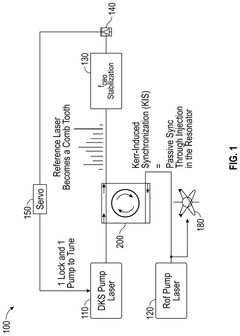
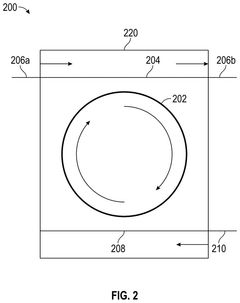
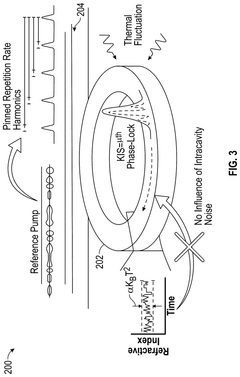
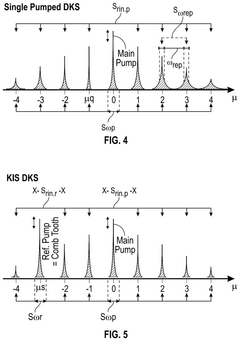
- The stabilization of OFCs is achieved through passive Kerr-induced synchronization (KIS) with an external optical reference, using a system comprising a first laser source, an optical reference source, and an optical microresonator with a microring that generates OFCs. This system enables dual pinning of the OFC, bypassing intrinsic noise limitations and improving performance.
Microresonator-frequency-comb-based platform for clinical high-resolution optical coherence tomography
PatentActiveUS11859972B2
Innovation
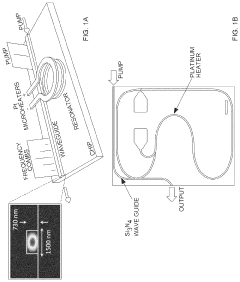
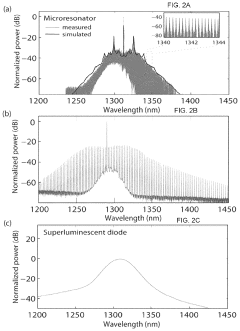
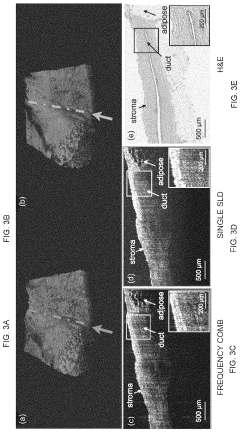
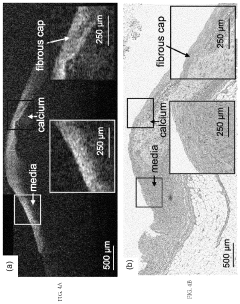
- A microresonator-frequency-comb-based platform using high-Q silicon nitride resonators and distributed feedback lasers generates broadband frequency combs, overcoming the bandwidth-power trade-off and enabling sub-micrometer axial resolution and deeper tissue penetration, compatible with standard OCT systems.
Quantum Computing Integration Possibilities
The integration of microcombs with quantum computing systems represents a frontier with transformative potential for both fields. Microcombs, with their precise frequency control and synchronization capabilities across distributed nodes, offer unique advantages for quantum computing architectures that require precise timing and coherent operations. The inherent low-noise properties and frequency stability of synchronized microcombs could significantly enhance quantum bit (qubit) control and readout operations, potentially addressing one of quantum computing's fundamental challenges: maintaining quantum coherence.
Distributed quantum computing networks could leverage synchronized microcomb technology to establish entanglement between physically separated quantum processors. This approach aligns with modular quantum computing architectures, where smaller quantum processing units are networked together to create larger effective quantum systems. The optical interconnects enabled by microcombs could provide the high-bandwidth, low-latency communication channels necessary for such distributed quantum information processing.
Furthermore, microcombs may serve as quantum-compatible frequency references for the precise control of quantum gates. The discrete, equally spaced frequency lines generated by microcombs could be utilized for addressing different qubits within a quantum processor, enabling parallel operations and potentially increasing computational throughput. This application becomes particularly relevant for neutral atom or trapped ion quantum computing platforms, where optical addressing of qubits is a standard approach.
Recent experimental demonstrations have shown promising results in using photonic integrated circuits for quantum operations. The integration of microcombs with these quantum photonic platforms could enable new quantum algorithms that leverage both the frequency domain multiplexing capabilities of microcombs and the quantum processing capabilities of photonic quantum circuits.
From a practical implementation perspective, the compact footprint of integrated microcombs aligns well with the miniaturization trends in quantum computing hardware. As quantum processors move toward chip-scale integration, synchronized microcombs could be co-integrated on the same photonic platform, providing essential timing and frequency reference functions while maintaining compatibility with cryogenic operating environments often required by quantum systems.
Looking forward, hybrid quantum-classical computing architectures might particularly benefit from microcomb technology, as these systems require efficient interfaces between classical and quantum processing units. Microcombs could serve as the bridge between these domains, translating classical control signals into the precise optical pulses needed for quantum operations.
Distributed quantum computing networks could leverage synchronized microcomb technology to establish entanglement between physically separated quantum processors. This approach aligns with modular quantum computing architectures, where smaller quantum processing units are networked together to create larger effective quantum systems. The optical interconnects enabled by microcombs could provide the high-bandwidth, low-latency communication channels necessary for such distributed quantum information processing.
Furthermore, microcombs may serve as quantum-compatible frequency references for the precise control of quantum gates. The discrete, equally spaced frequency lines generated by microcombs could be utilized for addressing different qubits within a quantum processor, enabling parallel operations and potentially increasing computational throughput. This application becomes particularly relevant for neutral atom or trapped ion quantum computing platforms, where optical addressing of qubits is a standard approach.
Recent experimental demonstrations have shown promising results in using photonic integrated circuits for quantum operations. The integration of microcombs with these quantum photonic platforms could enable new quantum algorithms that leverage both the frequency domain multiplexing capabilities of microcombs and the quantum processing capabilities of photonic quantum circuits.
From a practical implementation perspective, the compact footprint of integrated microcombs aligns well with the miniaturization trends in quantum computing hardware. As quantum processors move toward chip-scale integration, synchronized microcombs could be co-integrated on the same photonic platform, providing essential timing and frequency reference functions while maintaining compatibility with cryogenic operating environments often required by quantum systems.
Looking forward, hybrid quantum-classical computing architectures might particularly benefit from microcomb technology, as these systems require efficient interfaces between classical and quantum processing units. Microcombs could serve as the bridge between these domains, translating classical control signals into the precise optical pulses needed for quantum operations.
Standardization Efforts for Photonic Network Protocols
The standardization of photonic network protocols represents a critical frontier for enabling seamless microcomb synchronization across distributed photonic nodes. Currently, several international bodies are actively developing frameworks to address the unique requirements of integrated photonic networks. The IEEE P1918.1 working group has initiated efforts to standardize optical interface specifications specifically for microresonator-based frequency comb systems, focusing on signal integrity and synchronization parameters across multiple nodes.
The International Telecommunication Union (ITU) has also established the ITU-T SG15 focus group on photonic integration, which is working to define standardized protocols for phase-locked microcomb networks. Their recent recommendation G.698.4 outlines preliminary specifications for wavelength division multiplexing systems utilizing frequency combs as multi-wavelength sources, with particular attention to synchronization mechanisms between distributed nodes.
Industry consortia are playing an increasingly important role in this standardization landscape. The Optical Internetworking Forum (OIF) has formed a special interest group dedicated to coherent optical frequency comb implementations, with their 2023 implementation agreement providing guidelines for interface compatibility between different vendors' photonic integrated circuits supporting microcomb technology.
The Open Photonic Network Consortium, comprising major telecommunications providers and equipment manufacturers, is developing an open-source protocol stack specifically designed for microcomb-based networks. Their draft specification, expected to be finalized by Q3 2024, addresses critical aspects such as frequency locking, phase noise management, and distributed timing synchronization across photonic nodes.
Regional standardization efforts are also emerging, with the European Telecommunications Standards Institute (ETSI) launching a specialist task force on integrated photonics standardization. Their technical specification TS 103 859 provides a framework for microcomb synchronization in metro and access networks, with particular emphasis on compatibility with existing fiber infrastructure.
Challenges in standardization primarily revolve around reconciling the requirements of different application domains, from telecommunications to quantum computing networks. The diversity of microcomb generation technologies—spanning Kerr, electro-optic, and parametric processes—further complicates the development of universal protocols. Additionally, ensuring backward compatibility with existing optical network standards while accommodating the unique properties of frequency combs remains a significant hurdle.
The International Telecommunication Union (ITU) has also established the ITU-T SG15 focus group on photonic integration, which is working to define standardized protocols for phase-locked microcomb networks. Their recent recommendation G.698.4 outlines preliminary specifications for wavelength division multiplexing systems utilizing frequency combs as multi-wavelength sources, with particular attention to synchronization mechanisms between distributed nodes.
Industry consortia are playing an increasingly important role in this standardization landscape. The Optical Internetworking Forum (OIF) has formed a special interest group dedicated to coherent optical frequency comb implementations, with their 2023 implementation agreement providing guidelines for interface compatibility between different vendors' photonic integrated circuits supporting microcomb technology.
The Open Photonic Network Consortium, comprising major telecommunications providers and equipment manufacturers, is developing an open-source protocol stack specifically designed for microcomb-based networks. Their draft specification, expected to be finalized by Q3 2024, addresses critical aspects such as frequency locking, phase noise management, and distributed timing synchronization across photonic nodes.
Regional standardization efforts are also emerging, with the European Telecommunications Standards Institute (ETSI) launching a specialist task force on integrated photonics standardization. Their technical specification TS 103 859 provides a framework for microcomb synchronization in metro and access networks, with particular emphasis on compatibility with existing fiber infrastructure.
Challenges in standardization primarily revolve around reconciling the requirements of different application domains, from telecommunications to quantum computing networks. The diversity of microcomb generation technologies—spanning Kerr, electro-optic, and parametric processes—further complicates the development of universal protocols. Additionally, ensuring backward compatibility with existing optical network standards while accommodating the unique properties of frequency combs remains a significant hurdle.
Unlock deeper insights with Patsnap Eureka Quick Research — get a full tech report to explore trends and direct your research. Try now!
Generate Your Research Report Instantly with AI Agent
Supercharge your innovation with Patsnap Eureka AI Agent Platform!