

Microcomb Based Spectroscopy: Component And Signal Processing Needs
AUG 29, 202510 MIN READ
Generate Your Research Report Instantly with AI Agent
PatSnap Eureka helps you evaluate technical feasibility & market potential.
Microcomb Spectroscopy Background and Objectives
Microcombs, also known as optical frequency combs generated from microresonators, have emerged as a revolutionary technology in the field of spectroscopy over the past decade. These devices generate a spectrum of equally spaced frequency lines from a single continuous-wave laser source through nonlinear optical processes in high-quality factor microresonators. The evolution of this technology can be traced back to the development of traditional optical frequency combs, which earned John Hall and Theodor Hänsch the Nobel Prize in Physics in 2005. However, the miniaturization of these systems into chip-scale devices has only been realized in recent years.
The technological trajectory of microcombs has been characterized by significant advancements in materials science, nanofabrication techniques, and nonlinear optics. Initial demonstrations relied on silica microtoroids and crystalline resonators, while recent developments have expanded to integrated photonic platforms including silicon nitride, aluminum nitride, and lithium niobate. This progression has enabled the transition from bulky laboratory setups to compact, potentially field-deployable spectroscopic systems.
Microcomb-based spectroscopy represents a paradigm shift in molecular sensing and characterization, offering unprecedented combinations of bandwidth, resolution, and acquisition speed. The fundamental objective of this technology is to provide broadband, high-resolution spectral information while maintaining the advantages of miniaturization, power efficiency, and potential for mass production inherent to integrated photonic systems.
Current technical goals in this field include enhancing spectral coverage to span from visible to mid-infrared wavelengths, improving comb stability and noise characteristics, increasing power per comb line for improved signal-to-noise ratio, and developing robust techniques for precise control of comb parameters. Additionally, there is significant interest in developing turnkey operation capabilities that would allow non-specialists to utilize these sophisticated systems.
The integration of microcombs with advanced detection schemes and signal processing algorithms represents another critical objective. This includes the development of dual-comb spectroscopy techniques at the chip scale, which enable rapid acquisition of high-resolution spectra without moving parts. Furthermore, researchers aim to leverage machine learning approaches for real-time spectral analysis and interpretation, potentially enabling new applications in environmental monitoring, biomedical diagnostics, and industrial process control.
Looking forward, the field is trending toward fully integrated spectroscopic systems-on-chip that combine the microcomb source, sample interaction region, detection components, and signal processing in a single package. This level of integration promises to revolutionize portable sensing technologies while maintaining the performance metrics traditionally associated with laboratory-grade instruments.
The technological trajectory of microcombs has been characterized by significant advancements in materials science, nanofabrication techniques, and nonlinear optics. Initial demonstrations relied on silica microtoroids and crystalline resonators, while recent developments have expanded to integrated photonic platforms including silicon nitride, aluminum nitride, and lithium niobate. This progression has enabled the transition from bulky laboratory setups to compact, potentially field-deployable spectroscopic systems.
Microcomb-based spectroscopy represents a paradigm shift in molecular sensing and characterization, offering unprecedented combinations of bandwidth, resolution, and acquisition speed. The fundamental objective of this technology is to provide broadband, high-resolution spectral information while maintaining the advantages of miniaturization, power efficiency, and potential for mass production inherent to integrated photonic systems.
Current technical goals in this field include enhancing spectral coverage to span from visible to mid-infrared wavelengths, improving comb stability and noise characteristics, increasing power per comb line for improved signal-to-noise ratio, and developing robust techniques for precise control of comb parameters. Additionally, there is significant interest in developing turnkey operation capabilities that would allow non-specialists to utilize these sophisticated systems.
The integration of microcombs with advanced detection schemes and signal processing algorithms represents another critical objective. This includes the development of dual-comb spectroscopy techniques at the chip scale, which enable rapid acquisition of high-resolution spectra without moving parts. Furthermore, researchers aim to leverage machine learning approaches for real-time spectral analysis and interpretation, potentially enabling new applications in environmental monitoring, biomedical diagnostics, and industrial process control.
Looking forward, the field is trending toward fully integrated spectroscopic systems-on-chip that combine the microcomb source, sample interaction region, detection components, and signal processing in a single package. This level of integration promises to revolutionize portable sensing technologies while maintaining the performance metrics traditionally associated with laboratory-grade instruments.
Market Applications and Demand Analysis
Microcomb-based spectroscopy is experiencing significant market growth across multiple sectors due to its unique capabilities in high-precision molecular detection and analysis. The global spectroscopy market, valued at approximately $14.2 billion in 2022, is projected to reach $20.5 billion by 2027, with optical spectroscopy techniques representing a substantial segment of this expansion.
Healthcare and biomedical applications constitute the largest market segment for microcomb spectroscopy technologies. The demand is primarily driven by applications in non-invasive diagnostics, breath analysis for disease detection, and pharmaceutical quality control. Particularly promising is the use of microcomb spectroscopy in cancer detection through breath analysis, where early clinical trials have demonstrated detection rates exceeding 90% for certain cancer types.
Environmental monitoring represents another rapidly growing application area. Regulatory agencies worldwide are implementing stricter emissions standards, creating demand for high-precision gas sensing technologies. Microcomb-based systems offer advantages in detecting greenhouse gases and air pollutants at parts-per-billion levels with minimal false positives, addressing a market expected to grow at 8.7% CAGR through 2028.
The industrial process control sector is increasingly adopting microcomb spectroscopy for real-time monitoring of chemical processes. This adoption is particularly evident in semiconductor manufacturing, where process purity requirements continue to become more stringent. The semiconductor industry's demand for advanced spectroscopic tools is projected to grow at 12.3% annually as chip manufacturers transition to more advanced nodes requiring higher precision metrology.
Food safety and quality control applications represent an emerging market with substantial growth potential. Microcomb spectroscopy enables rapid, non-destructive analysis of food composition, contaminants, and adulterants. Major food producers are investing in these technologies to ensure compliance with increasingly strict safety regulations while reducing quality control costs.
Defense and security applications constitute a specialized but high-value market segment. The ability of microcomb spectroscopy to detect trace amounts of explosives and chemical warfare agents has attracted significant government funding, particularly in North America and Europe.
The telecommunications industry is exploring microcomb technology for wavelength-division multiplexing applications, potentially creating a substantial new market segment as data transmission demands continue to increase exponentially with 5G and future network technologies.
Market analysis indicates that while current adoption is primarily in research settings and high-end applications, the decreasing cost of key components and advances in miniaturization are expected to expand market penetration significantly over the next five years, particularly in portable and field-deployable systems.
Healthcare and biomedical applications constitute the largest market segment for microcomb spectroscopy technologies. The demand is primarily driven by applications in non-invasive diagnostics, breath analysis for disease detection, and pharmaceutical quality control. Particularly promising is the use of microcomb spectroscopy in cancer detection through breath analysis, where early clinical trials have demonstrated detection rates exceeding 90% for certain cancer types.
Environmental monitoring represents another rapidly growing application area. Regulatory agencies worldwide are implementing stricter emissions standards, creating demand for high-precision gas sensing technologies. Microcomb-based systems offer advantages in detecting greenhouse gases and air pollutants at parts-per-billion levels with minimal false positives, addressing a market expected to grow at 8.7% CAGR through 2028.
The industrial process control sector is increasingly adopting microcomb spectroscopy for real-time monitoring of chemical processes. This adoption is particularly evident in semiconductor manufacturing, where process purity requirements continue to become more stringent. The semiconductor industry's demand for advanced spectroscopic tools is projected to grow at 12.3% annually as chip manufacturers transition to more advanced nodes requiring higher precision metrology.
Food safety and quality control applications represent an emerging market with substantial growth potential. Microcomb spectroscopy enables rapid, non-destructive analysis of food composition, contaminants, and adulterants. Major food producers are investing in these technologies to ensure compliance with increasingly strict safety regulations while reducing quality control costs.
Defense and security applications constitute a specialized but high-value market segment. The ability of microcomb spectroscopy to detect trace amounts of explosives and chemical warfare agents has attracted significant government funding, particularly in North America and Europe.
The telecommunications industry is exploring microcomb technology for wavelength-division multiplexing applications, potentially creating a substantial new market segment as data transmission demands continue to increase exponentially with 5G and future network technologies.
Market analysis indicates that while current adoption is primarily in research settings and high-end applications, the decreasing cost of key components and advances in miniaturization are expected to expand market penetration significantly over the next five years, particularly in portable and field-deployable systems.
Technical Challenges and Global Development Status
Microcomb-based spectroscopy faces significant technical challenges despite its promising applications. The miniaturization of frequency combs into photonic integrated circuits presents fundamental difficulties in maintaining high Q-factors while ensuring sufficient nonlinearity for comb generation. Current fabrication techniques struggle with surface roughness issues that limit Q-factors to approximately 10^6-10^7, whereas values exceeding 10^8 are often necessary for efficient operation.
Power management represents another critical challenge, as the balance between pump power requirements and thermal stability remains difficult to optimize in integrated platforms. Most current systems require external amplification or precise temperature control, limiting their practical deployment in field applications. The trade-off between spectral bandwidth and resolution continues to constrain system performance, particularly for applications requiring simultaneous broad coverage and fine spectral discrimination.
Signal processing for microcomb spectroscopy presents its own set of challenges. The extraction of meaningful spectral information from complex interference patterns demands sophisticated algorithms capable of handling noise, calibration drift, and mode instabilities. Real-time processing requirements for dynamic spectroscopy applications further complicate implementation, especially for portable or embedded systems with limited computational resources.
Globally, microcomb spectroscopy development shows distinct regional characteristics. North American research, led by institutions like NIST, Caltech, and Harvard, focuses on fundamental physics and novel materials for enhanced performance. European efforts, particularly in Germany, Switzerland, and France, emphasize precision engineering and standardization for industrial applications. Asian development, dominated by China, Japan, and South Korea, concentrates on manufacturing scalability and integration with existing photonic technologies.
Commercial development remains predominantly concentrated in advanced economies, with emerging players in Singapore and Israel making notable contributions in specialized applications. The technology readiness level varies significantly across applications, with telecommunications applications approaching TRL 7-8, while chemical sensing and biomedical implementations remain at TRL 4-5.
Recent breakthroughs in heterogeneous integration of III-V materials with silicon photonics platforms have partially addressed some fabrication challenges, though mass production with consistent performance metrics remains elusive. The development of specialized ASIC processors for comb signal processing has improved computational efficiency but has not yet reached the performance required for comprehensive real-time analysis in portable systems.
Standardization efforts remain fragmented, with multiple competing approaches to characterization and performance metrics. This lack of standardization impedes broader adoption and complicates comparative assessment of different technological approaches, presenting a significant barrier to commercialization beyond specialized laboratory applications.
Power management represents another critical challenge, as the balance between pump power requirements and thermal stability remains difficult to optimize in integrated platforms. Most current systems require external amplification or precise temperature control, limiting their practical deployment in field applications. The trade-off between spectral bandwidth and resolution continues to constrain system performance, particularly for applications requiring simultaneous broad coverage and fine spectral discrimination.
Signal processing for microcomb spectroscopy presents its own set of challenges. The extraction of meaningful spectral information from complex interference patterns demands sophisticated algorithms capable of handling noise, calibration drift, and mode instabilities. Real-time processing requirements for dynamic spectroscopy applications further complicate implementation, especially for portable or embedded systems with limited computational resources.
Globally, microcomb spectroscopy development shows distinct regional characteristics. North American research, led by institutions like NIST, Caltech, and Harvard, focuses on fundamental physics and novel materials for enhanced performance. European efforts, particularly in Germany, Switzerland, and France, emphasize precision engineering and standardization for industrial applications. Asian development, dominated by China, Japan, and South Korea, concentrates on manufacturing scalability and integration with existing photonic technologies.
Commercial development remains predominantly concentrated in advanced economies, with emerging players in Singapore and Israel making notable contributions in specialized applications. The technology readiness level varies significantly across applications, with telecommunications applications approaching TRL 7-8, while chemical sensing and biomedical implementations remain at TRL 4-5.
Recent breakthroughs in heterogeneous integration of III-V materials with silicon photonics platforms have partially addressed some fabrication challenges, though mass production with consistent performance metrics remains elusive. The development of specialized ASIC processors for comb signal processing has improved computational efficiency but has not yet reached the performance required for comprehensive real-time analysis in portable systems.
Standardization efforts remain fragmented, with multiple competing approaches to characterization and performance metrics. This lack of standardization impedes broader adoption and complicates comparative assessment of different technological approaches, presenting a significant barrier to commercialization beyond specialized laboratory applications.
Current Component and Signal Processing Solutions
01 Microcomb generation and stabilization techniques
Various methods for generating and stabilizing microcombs for spectroscopy applications. These techniques include frequency stabilization, phase locking, and control mechanisms to ensure reliable and consistent microcomb output. Stabilized microcombs provide more accurate and reproducible spectral measurements, which is crucial for high-precision spectroscopy applications.- Microcomb generation and stabilization techniques: Various methods for generating and stabilizing microcombs for spectroscopy applications. These techniques include frequency stabilization, phase locking, and control mechanisms to ensure reliable and consistent microcomb output. Stable microcombs are essential for accurate spectroscopic measurements and signal processing, as they provide precise frequency references across a wide spectral range.
- Signal processing algorithms for microcomb spectroscopy: Advanced algorithms specifically designed for processing spectroscopic data obtained from microcomb-based systems. These algorithms include noise reduction techniques, signal enhancement methods, and computational approaches for extracting meaningful information from complex spectral data. The processing techniques enable higher sensitivity, improved resolution, and more accurate spectral analysis in various applications.
- Integration of microcombs with spectroscopic systems: Methods for integrating microcomb technology with various spectroscopic platforms to enhance performance and capabilities. This includes coupling microcombs with detection systems, sample chambers, and other optical components to create complete spectroscopic solutions. The integration approaches focus on maximizing light-matter interaction, optimizing signal collection, and ensuring efficient data acquisition for different spectroscopic applications.
- Dual-comb spectroscopy signal processing: Specialized techniques for processing signals in dual-comb spectroscopy systems, which utilize two slightly detuned frequency combs to perform rapid, high-resolution spectroscopic measurements. These processing methods address challenges such as phase correction, timing jitter compensation, and spectral reconstruction to enable real-time, broadband spectroscopic analysis with high precision and accuracy.
- Applications of microcomb spectroscopy in sensing and detection: Implementation of microcomb-based spectroscopy for various sensing and detection applications, including environmental monitoring, biomedical diagnostics, and industrial process control. These applications leverage the unique properties of microcombs, such as broad spectral coverage and high frequency precision, to enable sensitive and specific detection of chemical and biological analytes through advanced signal processing techniques.
02 Signal processing algorithms for microcomb spectroscopy
Advanced algorithms specifically designed for processing spectroscopic data generated by microcomb sources. These include digital signal processing techniques, noise reduction methods, and computational approaches for extracting meaningful spectral information. The algorithms enhance the sensitivity and resolution of microcomb-based spectroscopy systems, enabling detection of subtle spectral features.Expand Specific Solutions03 Integration of microcombs with spectroscopic systems
Methods for integrating microcomb sources with various spectroscopic platforms, including dual-comb spectroscopy, Fourier transform spectroscopy, and cavity-enhanced spectroscopy. These integration approaches optimize the coupling between the microcomb source and the spectroscopic measurement system, maximizing throughput and spectral coverage while minimizing losses and interference.Expand Specific Solutions04 Calibration and reference techniques for microcomb spectroscopy
Methods for calibrating microcomb-based spectroscopy systems to ensure accurate wavelength and intensity measurements. These techniques include the use of reference standards, calibration algorithms, and self-referencing approaches. Proper calibration is essential for quantitative spectroscopic measurements and enables comparison of results across different instruments and experiments.Expand Specific Solutions05 Applications of microcomb spectroscopy in sensing and detection
Implementation of microcomb-based spectroscopy for various sensing and detection applications, including environmental monitoring, biomedical diagnostics, and industrial process control. These applications leverage the high resolution, broad bandwidth, and rapid acquisition capabilities of microcomb sources to detect and quantify chemical species with high sensitivity and specificity.Expand Specific Solutions
Leading Research Institutions and Industrial Players
Microcomb-based spectroscopy is currently in an early growth phase, with the market expanding as applications in precision sensing, biomedical diagnostics, and telecommunications emerge. The global market size is projected to reach significant scale within the next decade as miniaturization and integration capabilities improve. From a technological maturity perspective, key players are advancing at different rates: Huawei Technologies and Menlo Systems are leading commercial development of integrated photonic solutions, while academic institutions like EPFL and Tianjin University are driving fundamental research breakthroughs. Companies including Philips, IMRA America, and Texas Instruments are focusing on signal processing components essential for practical applications. The technology is transitioning from laboratory demonstrations to early commercial implementations, with significant challenges remaining in component reliability, manufacturing scalability, and signal processing algorithms.
Menlo Systems GmbH
Technical Solution: Menlo Systems has developed advanced optical frequency comb technology specifically optimized for spectroscopy applications. Their microcomb-based spectroscopy solutions utilize proprietary frequency comb generators that provide ultra-stable and precisely controlled optical frequency references. The company's FC1500-250-WG system integrates waveguide-based microresonators to generate broadband frequency combs with mode spacing in the 10-100 GHz range, ideal for high-resolution spectroscopic measurements. Their signal processing architecture employs dual-comb spectroscopy techniques, where two slightly detuned microcombs are used to downconvert optical frequencies to the radio frequency domain, enabling rapid acquisition of broadband spectra without moving parts. Menlo's systems incorporate advanced phase-noise cancellation algorithms and real-time adaptive filtering to enhance signal-to-noise ratios in challenging measurement environments.
Strengths: Industry-leading frequency stability and coherence properties; turnkey systems with integrated signal processing capabilities; extensive experience in precision metrology applications. Weaknesses: Higher cost compared to emerging solutions; systems typically require controlled laboratory environments; relatively complex setup procedures that may require specialized training.
École Polytechnique Fédérale de Lausanne
Technical Solution: EPFL has pioneered breakthrough research in microcomb technology through their Laboratory of Photonics and Quantum Measurements. Their approach centers on silicon nitride (Si3N4) integrated photonic chips featuring ultra-high-Q microresonators that generate soliton microcombs with exceptional coherence properties. EPFL's technology enables octave-spanning frequency combs on a chip with repetition rates from 10-1000 GHz, tailored for diverse spectroscopic applications. Their signal processing framework incorporates advanced algorithms for soliton state detection, stabilization, and automated comb initialization. The lab has demonstrated dual-comb spectroscopy systems achieving microsecond-scale acquisition times with nanometer spectral resolution. EPFL's integrated photonic approach combines the microcomb source, sample interaction region, and detection components on a single chip, dramatically reducing system size while maintaining high performance for field-deployable spectroscopy applications.
Strengths: World-leading expertise in integrated photonic microcomb generation; highly compact and potentially low-cost implementation; demonstrated capability for chip-scale integration of complete spectroscopy systems. Weaknesses: Technology still primarily in research phase rather than commercial products; current implementations require specialized equipment for operation; chip fabrication requires advanced nanofabrication facilities.
Key Patents and Innovations in Microcomb Spectroscopy
Compact microresonator frequency comb
PatentWO2020076402A1
Innovation
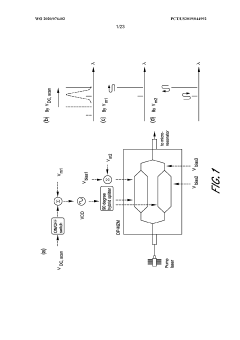
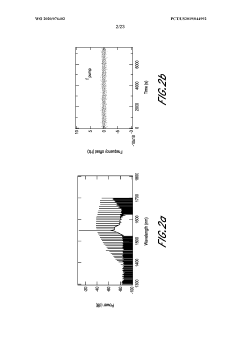
- The use of optimized microresonator actuators and modulators, including single-sideband modulators, graphene modulators, and microheaters, allows for precise control of carrier envelope offset frequency, repetition rate, and resonance offset frequency, enabling long-term locking and reduced noise, while minimizing cross-talk between parameters.

Optical devices comprising a micro-resonator frequency comb
PatentPendingUS20250246866A1
Innovation
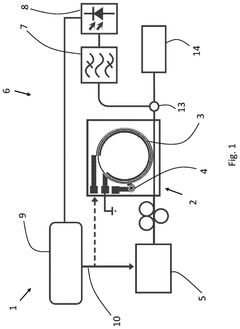
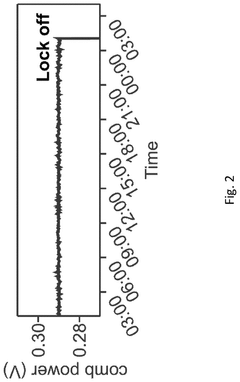
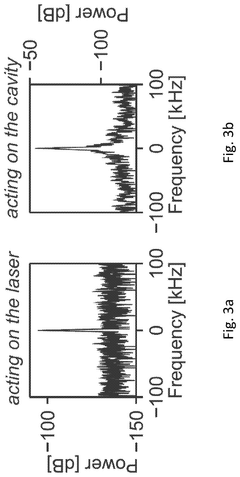
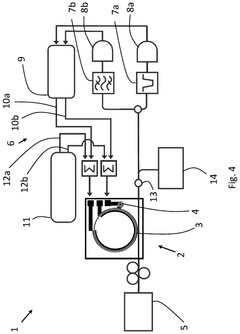
- A micro-resonator frequency comb with a feedback control loop and control circuit stabilizes optical power and detuning by using a photo detector and control circuit to adjust the pump laser or resonator cavities, allowing for stable operation and tuning of the center frequency.
Integration Strategies for Photonic Systems
The integration of microcombs into practical spectroscopic systems requires sophisticated photonic integration strategies to overcome size, cost, and performance limitations of discrete component approaches. Current integration efforts focus on three primary platforms: silicon photonics, silicon nitride (SiN), and thin-film lithium niobate (TFLN), each offering distinct advantages for microcomb spectroscopy applications.
Silicon photonics provides excellent CMOS compatibility and manufacturing scalability, making it attractive for mass production of integrated spectroscopic systems. However, silicon's nonlinear properties and mid-IR absorption limitations present challenges for broadband spectroscopy applications. Recent advances in heterogeneous integration have enabled silicon-based platforms to incorporate III-V gain materials and nonlinear optical components, expanding their functionality for microcomb generation and detection.
Silicon nitride has emerged as a leading platform for integrated microcomb spectroscopy due to its wide transparency window (400-2500 nm), low propagation losses (<0.1 dB/cm), and strong nonlinear properties. SiN-based photonic integrated circuits (PICs) have demonstrated successful integration of microresonators with on-chip lasers, modulators, and detectors. The CMOS-compatible fabrication process of SiN further enhances its appeal for commercial deployment.
Thin-film lithium niobate offers exceptional electro-optic properties and nonlinear coefficients, enabling efficient frequency conversion and modulation capabilities critical for spectroscopy. Recent breakthroughs in TFLN nanofabrication have reduced propagation losses to <0.1 dB/cm while maintaining strong nonlinear interactions, making it increasingly viable for integrated microcomb systems.
Hybrid integration approaches combining multiple material platforms are showing particular promise. For example, SiN-TFLN hybrid circuits leverage the low-loss waveguides of SiN with the superior modulation capabilities of TFLN. Similarly, III-V-on-silicon integration enables compact laser sources directly coupled to silicon photonic circuits for pump generation.
Packaging considerations represent another critical aspect of integration strategies. Fiber-to-chip coupling remains challenging, with edge coupling and grating coupler approaches each presenting trade-offs between coupling efficiency, bandwidth, and manufacturing complexity. Advanced packaging solutions incorporating temperature stabilization and hermetic sealing are essential for field-deployable spectroscopic systems based on microcombs.
The roadmap for future integration focuses on increasing functional density while maintaining performance metrics. This includes the development of 3D integration techniques to stack photonic and electronic layers, enabling more compact signal processing capabilities directly integrated with the photonic components. Such vertical integration will be crucial for realizing fully portable microcomb spectroscopy systems with real-time processing capabilities.
Silicon photonics provides excellent CMOS compatibility and manufacturing scalability, making it attractive for mass production of integrated spectroscopic systems. However, silicon's nonlinear properties and mid-IR absorption limitations present challenges for broadband spectroscopy applications. Recent advances in heterogeneous integration have enabled silicon-based platforms to incorporate III-V gain materials and nonlinear optical components, expanding their functionality for microcomb generation and detection.
Silicon nitride has emerged as a leading platform for integrated microcomb spectroscopy due to its wide transparency window (400-2500 nm), low propagation losses (<0.1 dB/cm), and strong nonlinear properties. SiN-based photonic integrated circuits (PICs) have demonstrated successful integration of microresonators with on-chip lasers, modulators, and detectors. The CMOS-compatible fabrication process of SiN further enhances its appeal for commercial deployment.
Thin-film lithium niobate offers exceptional electro-optic properties and nonlinear coefficients, enabling efficient frequency conversion and modulation capabilities critical for spectroscopy. Recent breakthroughs in TFLN nanofabrication have reduced propagation losses to <0.1 dB/cm while maintaining strong nonlinear interactions, making it increasingly viable for integrated microcomb systems.
Hybrid integration approaches combining multiple material platforms are showing particular promise. For example, SiN-TFLN hybrid circuits leverage the low-loss waveguides of SiN with the superior modulation capabilities of TFLN. Similarly, III-V-on-silicon integration enables compact laser sources directly coupled to silicon photonic circuits for pump generation.
Packaging considerations represent another critical aspect of integration strategies. Fiber-to-chip coupling remains challenging, with edge coupling and grating coupler approaches each presenting trade-offs between coupling efficiency, bandwidth, and manufacturing complexity. Advanced packaging solutions incorporating temperature stabilization and hermetic sealing are essential for field-deployable spectroscopic systems based on microcombs.
The roadmap for future integration focuses on increasing functional density while maintaining performance metrics. This includes the development of 3D integration techniques to stack photonic and electronic layers, enabling more compact signal processing capabilities directly integrated with the photonic components. Such vertical integration will be crucial for realizing fully portable microcomb spectroscopy systems with real-time processing capabilities.
Standardization Requirements for Microcomb Technologies
The standardization of microcomb technologies represents a critical step toward their widespread adoption in spectroscopy applications. Currently, the field lacks unified standards for key components, performance metrics, and signal processing methodologies, creating barriers to interoperability and commercial deployment.
A primary standardization need involves the physical specifications of microcomb devices. This includes standardized dimensions for photonic chips, waveguide geometries, and coupling interfaces that would enable plug-and-play functionality across different systems. Establishing standard form factors would significantly reduce integration challenges when incorporating microcombs into spectroscopic instruments.
Signal quality metrics require urgent standardization attention. Parameters such as comb line spacing stability, power per comb line, phase noise characteristics, and spectral coverage need universally accepted measurement protocols. Without standardized metrics, comparing performance between different microcomb implementations remains problematic, hampering technology evaluation and selection processes.
Data formats and processing algorithms represent another critical standardization domain. The complex signals generated by microcomb-based spectroscopy systems require specialized processing techniques. Standardized data formats would facilitate seamless information exchange between acquisition hardware and analysis software from different vendors. Similarly, benchmark algorithms for common tasks like calibration, noise reduction, and spectral feature extraction would accelerate development cycles.
Calibration procedures constitute a fourth standardization priority. Reliable spectroscopic measurements demand precise calibration of frequency references and intensity responses. Standard calibration protocols would ensure measurement consistency across different laboratories and commercial instruments, enhancing reproducibility of scientific results and product performance.
Safety standards specifically tailored to microcomb technologies must also be developed. These should address potential hazards related to high-power laser operation, thermal management, and electrical safety in integrated photonic systems. As microcombs transition from laboratory demonstrations to commercial products, compliance with internationally recognized safety standards becomes increasingly important.
Finally, standardization efforts should establish interoperability frameworks that define how microcomb spectroscopy systems interface with existing spectroscopic equipment and data analysis platforms. This would protect investments in current infrastructure while enabling gradual adoption of microcomb technologies across various application domains.
A primary standardization need involves the physical specifications of microcomb devices. This includes standardized dimensions for photonic chips, waveguide geometries, and coupling interfaces that would enable plug-and-play functionality across different systems. Establishing standard form factors would significantly reduce integration challenges when incorporating microcombs into spectroscopic instruments.
Signal quality metrics require urgent standardization attention. Parameters such as comb line spacing stability, power per comb line, phase noise characteristics, and spectral coverage need universally accepted measurement protocols. Without standardized metrics, comparing performance between different microcomb implementations remains problematic, hampering technology evaluation and selection processes.
Data formats and processing algorithms represent another critical standardization domain. The complex signals generated by microcomb-based spectroscopy systems require specialized processing techniques. Standardized data formats would facilitate seamless information exchange between acquisition hardware and analysis software from different vendors. Similarly, benchmark algorithms for common tasks like calibration, noise reduction, and spectral feature extraction would accelerate development cycles.
Calibration procedures constitute a fourth standardization priority. Reliable spectroscopic measurements demand precise calibration of frequency references and intensity responses. Standard calibration protocols would ensure measurement consistency across different laboratories and commercial instruments, enhancing reproducibility of scientific results and product performance.
Safety standards specifically tailored to microcomb technologies must also be developed. These should address potential hazards related to high-power laser operation, thermal management, and electrical safety in integrated photonic systems. As microcombs transition from laboratory demonstrations to commercial products, compliance with internationally recognized safety standards becomes increasingly important.
Finally, standardization efforts should establish interoperability frameworks that define how microcomb spectroscopy systems interface with existing spectroscopic equipment and data analysis platforms. This would protect investments in current infrastructure while enabling gradual adoption of microcomb technologies across various application domains.
Unlock deeper insights with PatSnap Eureka Quick Research — get a full tech report to explore trends and direct your research. Try now!
Generate Your Research Report Instantly with AI Agent
Supercharge your innovation with PatSnap Eureka AI Agent Platform!