

Microcomb System Demonstrations: From Lab To Field Trials
AUG 29, 202510 MIN READ
Generate Your Research Report Instantly with AI Agent
PatSnap Eureka helps you evaluate technical feasibility & market potential.
Microcomb Technology Evolution and Objectives
Microcombs, also known as optical frequency combs generated in microresonators, have emerged as a revolutionary technology in the field of photonics over the past two decades. The evolution of microcomb technology began with the fundamental discovery of optical Kerr frequency combs in microresonators in 2007, which demonstrated the possibility of generating broadband optical frequency combs using chip-scale devices. This breakthrough opened new avenues for compact, energy-efficient frequency comb sources that could potentially replace traditional mode-locked lasers in various applications.
The technological progression of microcombs has been marked by several significant milestones. Initially, researchers focused on understanding the complex nonlinear dynamics governing comb formation in microresonators. By 2010-2012, the discovery of dissipative Kerr solitons in microresonators represented a crucial advancement, enabling the generation of coherent and stable frequency combs with predictable spectral envelopes. This development significantly enhanced the practical utility of microcombs for precision measurements and telecommunications.
Between 2013 and 2017, substantial progress was made in diversifying the material platforms and fabrication techniques for microresonators. Silicon nitride (Si₃N₄) emerged as a leading material due to its favorable nonlinear properties and compatibility with standard semiconductor fabrication processes. Concurrently, alternative platforms such as aluminum nitride, diamond, and lithium niobate gained attention for specific applications requiring different spectral ranges or nonlinear properties.
The transition from laboratory demonstrations to field trials represents the current frontier of microcomb technology. Early system-level demonstrations were primarily confined to controlled laboratory environments, focusing on proof-of-concept experiments. Recent years have witnessed increasing efforts to address practical challenges related to packaging, thermal management, and integration with existing photonic and electronic systems, enabling field deployments in real-world scenarios.
The primary objectives of current microcomb research and development include enhancing system reliability for extended field operations, reducing power consumption to enable battery-powered or energy-harvesting applications, and developing turnkey systems that do not require expert knowledge for operation. Additionally, there is a strong focus on expanding the application space beyond traditional frequency metrology to areas such as optical communications, spectroscopy, ranging, and quantum information processing.
Looking forward, the technology roadmap aims to achieve fully integrated, CMOS-compatible microcomb systems that can be mass-produced at low cost. This integration would potentially revolutionize numerous fields by bringing the capabilities of optical frequency combs to portable devices and distributed sensing networks, ultimately enabling applications previously considered impractical due to size, cost, or complexity constraints.
The technological progression of microcombs has been marked by several significant milestones. Initially, researchers focused on understanding the complex nonlinear dynamics governing comb formation in microresonators. By 2010-2012, the discovery of dissipative Kerr solitons in microresonators represented a crucial advancement, enabling the generation of coherent and stable frequency combs with predictable spectral envelopes. This development significantly enhanced the practical utility of microcombs for precision measurements and telecommunications.
Between 2013 and 2017, substantial progress was made in diversifying the material platforms and fabrication techniques for microresonators. Silicon nitride (Si₃N₄) emerged as a leading material due to its favorable nonlinear properties and compatibility with standard semiconductor fabrication processes. Concurrently, alternative platforms such as aluminum nitride, diamond, and lithium niobate gained attention for specific applications requiring different spectral ranges or nonlinear properties.
The transition from laboratory demonstrations to field trials represents the current frontier of microcomb technology. Early system-level demonstrations were primarily confined to controlled laboratory environments, focusing on proof-of-concept experiments. Recent years have witnessed increasing efforts to address practical challenges related to packaging, thermal management, and integration with existing photonic and electronic systems, enabling field deployments in real-world scenarios.
The primary objectives of current microcomb research and development include enhancing system reliability for extended field operations, reducing power consumption to enable battery-powered or energy-harvesting applications, and developing turnkey systems that do not require expert knowledge for operation. Additionally, there is a strong focus on expanding the application space beyond traditional frequency metrology to areas such as optical communications, spectroscopy, ranging, and quantum information processing.
Looking forward, the technology roadmap aims to achieve fully integrated, CMOS-compatible microcomb systems that can be mass-produced at low cost. This integration would potentially revolutionize numerous fields by bringing the capabilities of optical frequency combs to portable devices and distributed sensing networks, ultimately enabling applications previously considered impractical due to size, cost, or complexity constraints.
Market Applications and Demand Analysis for Microcombs
The microcomb technology market is experiencing significant growth driven by increasing demands for high-precision optical frequency references and compact multi-wavelength light sources across various industries. The global photonics market, within which microcombs represent an emerging segment, is projected to reach $837 billion by 2025, with integrated photonics solutions growing at a compound annual growth rate of approximately 22%.
Telecommunications represents the primary market for microcomb technology, where the demand for higher bandwidth and data transmission rates continues to escalate. Microcombs enable wavelength division multiplexing (WDM) systems with unprecedented channel counts and spectral efficiency, addressing the telecommunications industry's need for expanded capacity in fiber optic networks. Major telecom operators and equipment manufacturers are actively exploring microcomb integration to enhance network performance while reducing power consumption and physical footprint.
The test and measurement sector constitutes another substantial market for microcombs, with applications in optical frequency metrology, spectroscopy, and calibration systems. The precision timing market alone is valued at over $6 billion globally, with optical frequency comb solutions gaining traction due to their superior stability and accuracy compared to traditional electronic oscillators.
Emerging applications in quantum technologies represent a rapidly growing market segment. Quantum computing, sensing, and secure communications all benefit from the precise frequency control and multi-wavelength capabilities of microcombs. The quantum technology market is expected to grow significantly over the next decade, with government and private investments exceeding $25 billion worldwide.
LiDAR systems for autonomous vehicles and advanced sensing applications constitute another promising market for microcomb technology. The automotive LiDAR market is projected to grow substantially as autonomous driving technologies mature, with integrated photonic solutions offering advantages in size, cost, and performance over conventional approaches.
Biomedical applications, including optical coherence tomography, spectroscopic sensing, and flow cytometry, represent additional growth opportunities. The biophotonics market is expanding at approximately 11% annually, with increasing demand for compact, high-performance optical systems for both clinical and research applications.
Defense and aerospace sectors are also showing interest in microcomb technology for applications in secure communications, navigation systems, and remote sensing. These markets value the technology's potential for miniaturization, robustness, and precision in challenging operational environments.
Market adoption faces challenges related to manufacturing scalability, packaging, and system integration. However, recent field trials demonstrating microcomb performance in real-world environments are accelerating commercial interest and investment in the technology, suggesting a transition from laboratory demonstrations to practical applications is underway.
Telecommunications represents the primary market for microcomb technology, where the demand for higher bandwidth and data transmission rates continues to escalate. Microcombs enable wavelength division multiplexing (WDM) systems with unprecedented channel counts and spectral efficiency, addressing the telecommunications industry's need for expanded capacity in fiber optic networks. Major telecom operators and equipment manufacturers are actively exploring microcomb integration to enhance network performance while reducing power consumption and physical footprint.
The test and measurement sector constitutes another substantial market for microcombs, with applications in optical frequency metrology, spectroscopy, and calibration systems. The precision timing market alone is valued at over $6 billion globally, with optical frequency comb solutions gaining traction due to their superior stability and accuracy compared to traditional electronic oscillators.
Emerging applications in quantum technologies represent a rapidly growing market segment. Quantum computing, sensing, and secure communications all benefit from the precise frequency control and multi-wavelength capabilities of microcombs. The quantum technology market is expected to grow significantly over the next decade, with government and private investments exceeding $25 billion worldwide.
LiDAR systems for autonomous vehicles and advanced sensing applications constitute another promising market for microcomb technology. The automotive LiDAR market is projected to grow substantially as autonomous driving technologies mature, with integrated photonic solutions offering advantages in size, cost, and performance over conventional approaches.
Biomedical applications, including optical coherence tomography, spectroscopic sensing, and flow cytometry, represent additional growth opportunities. The biophotonics market is expanding at approximately 11% annually, with increasing demand for compact, high-performance optical systems for both clinical and research applications.
Defense and aerospace sectors are also showing interest in microcomb technology for applications in secure communications, navigation systems, and remote sensing. These markets value the technology's potential for miniaturization, robustness, and precision in challenging operational environments.
Market adoption faces challenges related to manufacturing scalability, packaging, and system integration. However, recent field trials demonstrating microcomb performance in real-world environments are accelerating commercial interest and investment in the technology, suggesting a transition from laboratory demonstrations to practical applications is underway.
Current Microcomb Development Status and Technical Barriers
Microcombs have emerged as a revolutionary photonic technology with significant potential for various applications. Currently, the global development status of microcombs shows remarkable progress in laboratory settings, but field deployment remains limited. Leading research institutions in the US, Europe, and Asia have demonstrated functional microcomb systems with increasing stability and reliability, yet several technical barriers persist.
The primary technical challenge facing microcomb development is the achievement of consistent soliton formation in integrated photonic platforms. While laboratory demonstrations have shown successful soliton generation, maintaining this state in variable environmental conditions typical of field deployments presents significant difficulties. Temperature fluctuations, mechanical vibrations, and long-term drift effects all contribute to destabilization of the carefully balanced soliton states.
Material limitations constitute another major barrier. Current microresonator platforms predominantly utilize silicon nitride, silicon, or lithium niobate. Each material system presents trade-offs between nonlinearity, propagation loss, and fabrication complexity. Silicon nitride offers excellent performance but faces challenges in achieving thick films without cracks. Silicon provides CMOS compatibility but suffers from two-photon absorption at telecommunications wavelengths. Lithium niobate enables electro-optic functionality but presents fabrication challenges for high-Q resonators.
Power efficiency remains a critical obstacle for field deployment. Laboratory demonstrations typically employ benchtop laser systems and temperature controllers that consume substantial power. Transitioning to compact, energy-efficient systems suitable for field deployment requires significant engineering innovation in pump laser integration, thermal management, and electronic control systems.
The gap between laboratory demonstrations and field-ready systems is further widened by packaging challenges. Robust fiber-to-chip coupling with high efficiency and stability under environmental variations represents a significant hurdle. Current solutions often rely on specialized laboratory equipment for alignment maintenance, which is impractical for field applications.
Scalability in manufacturing presents another barrier. While individual high-performance devices have been demonstrated, reproducible fabrication at scale with consistent performance metrics remains elusive. Variations in resonator quality factors, dispersion profiles, and coupling efficiencies across wafers limit commercial viability.
Control electronics for microcomb systems require further development for field deployment. Current laboratory setups utilize sophisticated test equipment for frequency locking, soliton initiation, and stabilization. Transitioning these functions to application-specific integrated circuits (ASICs) with reduced size, cost, and power consumption represents a significant engineering challenge that must be overcome for practical field applications.
The primary technical challenge facing microcomb development is the achievement of consistent soliton formation in integrated photonic platforms. While laboratory demonstrations have shown successful soliton generation, maintaining this state in variable environmental conditions typical of field deployments presents significant difficulties. Temperature fluctuations, mechanical vibrations, and long-term drift effects all contribute to destabilization of the carefully balanced soliton states.
Material limitations constitute another major barrier. Current microresonator platforms predominantly utilize silicon nitride, silicon, or lithium niobate. Each material system presents trade-offs between nonlinearity, propagation loss, and fabrication complexity. Silicon nitride offers excellent performance but faces challenges in achieving thick films without cracks. Silicon provides CMOS compatibility but suffers from two-photon absorption at telecommunications wavelengths. Lithium niobate enables electro-optic functionality but presents fabrication challenges for high-Q resonators.
Power efficiency remains a critical obstacle for field deployment. Laboratory demonstrations typically employ benchtop laser systems and temperature controllers that consume substantial power. Transitioning to compact, energy-efficient systems suitable for field deployment requires significant engineering innovation in pump laser integration, thermal management, and electronic control systems.
The gap between laboratory demonstrations and field-ready systems is further widened by packaging challenges. Robust fiber-to-chip coupling with high efficiency and stability under environmental variations represents a significant hurdle. Current solutions often rely on specialized laboratory equipment for alignment maintenance, which is impractical for field applications.
Scalability in manufacturing presents another barrier. While individual high-performance devices have been demonstrated, reproducible fabrication at scale with consistent performance metrics remains elusive. Variations in resonator quality factors, dispersion profiles, and coupling efficiencies across wafers limit commercial viability.
Control electronics for microcomb systems require further development for field deployment. Current laboratory setups utilize sophisticated test equipment for frequency locking, soliton initiation, and stabilization. Transitioning these functions to application-specific integrated circuits (ASICs) with reduced size, cost, and power consumption represents a significant engineering challenge that must be overcome for practical field applications.
State-of-the-Art Microcomb System Implementations
01 Optical Frequency Comb Generation and Applications
Microcombs are optical frequency combs generated in microresonators, providing precise frequency references across the optical spectrum. These systems utilize nonlinear optical processes in high-Q microresonators to convert continuous-wave laser light into equally spaced frequency components. Applications include optical communications, spectroscopy, and precision metrology. The technology enables miniaturization of frequency comb sources that traditionally required large, complex laser systems.- Optical frequency comb generation and applications: Microcombs are optical frequency combs generated in microresonators, providing precise frequency references across the optical spectrum. These systems utilize nonlinear optical processes in high-Q microresonators to convert continuous-wave laser light into equally spaced frequency lines. Applications include optical communications, spectroscopy, metrology, and precision timing. The technology enables miniaturization of frequency comb sources that traditionally required large, complex laser systems.
- Integration of microcombs with photonic systems: Microcomb systems can be integrated with various photonic components to create compact, efficient devices. This integration involves coupling microresonators with waveguides, detectors, and other optical elements on a single chip. The approach enables the development of photonic integrated circuits that leverage the frequency precision of microcombs while maintaining small form factors. These integrated systems support applications in telecommunications, quantum computing, and sensing technologies.
- Network architecture and management for microcomb systems: Microcomb technology can be implemented in network architectures to enhance data transmission capabilities. These systems require specialized management protocols to coordinate the multiple frequency channels generated by the microcomb. The network implementations may include distributed computing frameworks, load balancing mechanisms, and resource allocation strategies optimized for the parallel nature of microcomb-based communications. This enables high-bandwidth, low-latency data transfer across various network topologies.
- Signal processing and control systems for microcombs: Advanced signal processing techniques are essential for controlling and stabilizing microcomb systems. These include feedback mechanisms to maintain phase coherence between comb lines, algorithms for noise reduction, and methods for precise frequency tuning. Digital signal processors and specialized control electronics work together to monitor and adjust the operating parameters of the microcomb in real-time. These control systems enable the generation of stable, low-noise frequency combs suitable for precision applications.
- Biological and medical applications of microcomb systems: Microcomb systems have emerging applications in biological research and medical diagnostics. The precise frequency control enables high-resolution spectroscopic analysis of biological samples, detection of biomarkers, and monitoring of physiological parameters. These systems can be integrated into medical devices for non-invasive diagnostics, continuous health monitoring, and targeted therapeutic applications. The compact nature of microcombs makes them suitable for point-of-care diagnostics and portable medical equipment.
02 Integrated Photonic Microcomb Architectures
Integrated photonic platforms for microcombs incorporate waveguides, resonators, and control electronics on a single chip. These architectures enable compact, stable, and energy-efficient microcomb generation through careful design of waveguide geometries, dispersion engineering, and coupling mechanisms. The integration allows for mass production of microcomb systems with applications in telecommunications, quantum information processing, and sensing technologies.Expand Specific Solutions03 Microcomb-based Communication Systems
Microcombs enable advanced optical communication systems by providing multiple wavelength channels from a single source. These systems utilize the equally spaced frequency lines of microcombs for wavelength division multiplexing, coherent communications, and data transmission applications. The technology offers advantages in bandwidth efficiency, power consumption, and system complexity compared to traditional multi-laser approaches in telecommunications infrastructure.Expand Specific Solutions04 Control and Stabilization of Microcomb Systems
Techniques for controlling and stabilizing microcombs involve feedback mechanisms, thermal management, and electronic control systems. These methods ensure reliable operation by maintaining phase coherence between comb lines, controlling the comb spacing, and stabilizing the carrier-envelope offset frequency. Advanced algorithms and control electronics enable robust performance under varying environmental conditions and operational requirements.Expand Specific Solutions05 Microcomb System Network Integration
Integration of microcomb systems into network infrastructures enables distributed sensing, timing synchronization, and advanced computing applications. These networked systems leverage the precise frequency references provided by microcombs for applications in distributed metrology, secure communications, and edge computing. The architecture typically includes control layers for managing microcomb resources across network nodes and interfaces for connecting with existing telecommunications infrastructure.Expand Specific Solutions
Leading Companies and Research Institutions in Microcomb Development
The microcomb technology market is currently in a transitional phase from research to commercialization, with significant growth potential as applications expand from laboratory demonstrations to field trials. Market size is projected to increase substantially as microcombs enable advances in telecommunications, sensing, and precision measurement. The technology maturity varies across applications, with leading players demonstrating different specialization areas. Academic institutions like MIT, Harvard, and Cornell are driving fundamental research, while companies including Philips, Texas Instruments, and Hitachi are developing commercial applications. Research organizations such as X Development and Life Technologies are bridging the gap between laboratory innovations and practical implementations, focusing on scaling the technology for real-world deployment.
Massachusetts Institute of Technology
Technical Solution: MIT has pioneered significant advancements in microcomb technology through their Quantum Photonics Laboratory. Their approach focuses on integrated photonic microresonators that generate optical frequency combs with precisely controlled spectral lines. MIT has demonstrated chip-scale microcombs with soliton formation capabilities that maintain phase coherence across hundreds of comb lines. Their recent field trials have showcased microcombs in telecommunications applications, achieving data transmission rates exceeding 30 Tbps through dense wavelength division multiplexing (DWDM) systems. MIT researchers have also developed novel pump-resonator detuning techniques that enhance stability in real-world environments, addressing previous limitations in field deployments. Their silicon nitride (Si3N4) platform enables low-loss waveguides with anomalous dispersion profiles optimized for soliton microcomb generation.
Strengths: Superior integration capabilities with existing silicon photonics, exceptional spectral purity, and demonstrated field reliability. Weaknesses: Higher power requirements compared to some competing technologies and relatively complex fabrication processes that may impact mass production scalability.
The Johns Hopkins University
Technical Solution: Johns Hopkins University has developed an innovative microcomb platform focused on practical field applications in biomedical sensing and spectroscopy. Their approach utilizes magnesium fluoride (MgF2) whispering-gallery-mode resonators that generate ultra-coherent optical frequency combs with line spacings precisely controlled in the microwave regime. JHU researchers have successfully transitioned this technology from laboratory demonstrations to field trials in medical diagnostics, demonstrating portable breath analysis systems capable of detecting biomarkers at parts-per-billion concentrations. Their microcomb systems incorporate proprietary thermal stabilization techniques that maintain soliton states across varying environmental conditions, addressing a key challenge in field deployments. Recent demonstrations include a field-portable dual-comb spectroscopy system that achieved laboratory-grade molecular fingerprinting in non-controlled environments. JHU has also pioneered hybrid integration approaches that combine crystalline resonators with silicon photonic circuits to create robust, alignment-free systems suitable for clinical settings.
Strengths: Exceptional frequency stability, demonstrated biomedical applications with clinical relevance, and robust operation in non-laboratory environments. Weaknesses: Higher manufacturing costs associated with crystalline resonators and more limited integration density compared to fully chip-based approaches.
Key Patents and Scientific Breakthroughs in Microcomb Technology
Microresonator-frequency-comb-based platform for clinical high-resolution optical coherence tomography
PatentActiveUS11859972B2
Innovation
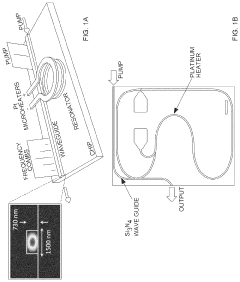
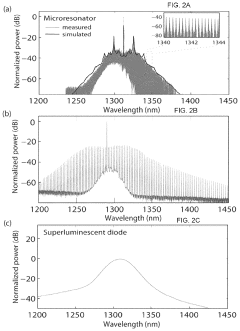
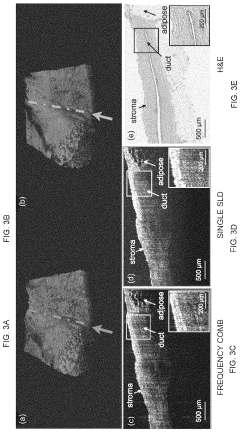
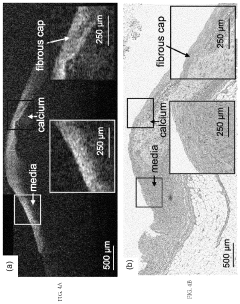
- A microresonator-frequency-comb-based platform using high-Q silicon nitride resonators and distributed feedback lasers generates broadband frequency combs, overcoming the bandwidth-power trade-off and enabling sub-micrometer axial resolution and deeper tissue penetration, compatible with standard OCT systems.
Scalability and Manufacturing Challenges for Commercial Microcombs
The transition from laboratory demonstrations to commercial deployment of microcombs faces significant manufacturing and scalability challenges. Current fabrication processes for high-quality microresonators typically rely on specialized cleanroom facilities and precision equipment, creating bottlenecks for mass production. The intricate nature of these devices, which require nanometer-level precision in waveguide dimensions and surface quality, makes yield management particularly difficult when scaling to industrial volumes.
Material consistency represents another critical challenge. Commercial microcombs demand exceptional uniformity in material properties across production batches to ensure consistent optical performance. Even minor variations in material composition can significantly alter dispersion characteristics and quality factors, leading to unpredictable comb generation behavior. This necessitates advanced material processing techniques and rigorous quality control protocols that are still evolving.
Integration with existing photonic and electronic platforms presents additional hurdles. While laboratory demonstrations often utilize discrete components with specialized interfaces, commercial applications require seamless integration with standardized photonic integrated circuits (PICs) and electronic control systems. The development of reliable packaging solutions that maintain optical alignment while providing thermal stability and environmental protection remains an ongoing challenge.
Power consumption optimization represents a significant barrier to widespread adoption. Laboratory microcomb systems typically operate with external lasers and amplifiers that consume substantial power. Commercial viability demands dramatic reductions in energy requirements through innovative pumping schemes and more efficient nonlinear processes, particularly for applications with strict power budgets like portable devices or satellite communications.
Cost-effective testing and calibration methodologies are also underdeveloped. Current characterization approaches often involve expensive equipment and time-consuming procedures suitable for research but impractical for production environments. The industry needs automated, high-throughput testing solutions that can rapidly verify performance parameters across large production volumes.
Reliability and lifetime considerations further complicate commercialization efforts. Microcombs must maintain stable operation over extended periods under varying environmental conditions. Accelerated aging tests and reliability models specific to microcomb technologies are still in their infancy, making it difficult to provide the performance guarantees expected by commercial customers.
Addressing these challenges requires coordinated efforts across multiple disciplines, from materials science and nanofabrication to packaging engineering and automated testing. Recent progress in foundry-compatible fabrication processes and standardized design rules offers promising pathways toward commercial-scale production, but significant investment in manufacturing infrastructure and process refinement remains necessary.
Material consistency represents another critical challenge. Commercial microcombs demand exceptional uniformity in material properties across production batches to ensure consistent optical performance. Even minor variations in material composition can significantly alter dispersion characteristics and quality factors, leading to unpredictable comb generation behavior. This necessitates advanced material processing techniques and rigorous quality control protocols that are still evolving.
Integration with existing photonic and electronic platforms presents additional hurdles. While laboratory demonstrations often utilize discrete components with specialized interfaces, commercial applications require seamless integration with standardized photonic integrated circuits (PICs) and electronic control systems. The development of reliable packaging solutions that maintain optical alignment while providing thermal stability and environmental protection remains an ongoing challenge.
Power consumption optimization represents a significant barrier to widespread adoption. Laboratory microcomb systems typically operate with external lasers and amplifiers that consume substantial power. Commercial viability demands dramatic reductions in energy requirements through innovative pumping schemes and more efficient nonlinear processes, particularly for applications with strict power budgets like portable devices or satellite communications.
Cost-effective testing and calibration methodologies are also underdeveloped. Current characterization approaches often involve expensive equipment and time-consuming procedures suitable for research but impractical for production environments. The industry needs automated, high-throughput testing solutions that can rapidly verify performance parameters across large production volumes.
Reliability and lifetime considerations further complicate commercialization efforts. Microcombs must maintain stable operation over extended periods under varying environmental conditions. Accelerated aging tests and reliability models specific to microcomb technologies are still in their infancy, making it difficult to provide the performance guarantees expected by commercial customers.
Addressing these challenges requires coordinated efforts across multiple disciplines, from materials science and nanofabrication to packaging engineering and automated testing. Recent progress in foundry-compatible fabrication processes and standardized design rules offers promising pathways toward commercial-scale production, but significant investment in manufacturing infrastructure and process refinement remains necessary.
Telecommunications Industry Integration and Standardization Efforts
The integration of microcomb technology into telecommunications infrastructure represents a significant advancement in optical communications. Major telecommunications operators including AT&T, Verizon, NTT, and Deutsche Telekom have initiated collaborative research programs with academic institutions and equipment manufacturers to evaluate microcomb-based systems for next-generation networks. These partnerships aim to bridge the gap between laboratory demonstrations and practical field implementations.
Industry standardization bodies such as the International Telecommunication Union (ITU-T), Institute of Electrical and Electronics Engineers (IEEE), and European Telecommunications Standards Institute (ETSI) have established working groups focused on integrating microcomb technology into existing optical communication standards. The ITU-T Study Group 15 has specifically addressed wavelength division multiplexing (WDM) specifications that accommodate microcomb-generated frequency combs, while IEEE P802.3ct task force is evaluating microcombs for 100G and beyond Ethernet applications.
Field trials conducted by Nokia Bell Labs and Cisco in partnership with network operators have demonstrated microcomb-based transmission systems in real-world network environments. These trials have achieved data rates exceeding 10 Tb/s over metropolitan distances using integrated photonic chips with microresonator-based frequency combs. The trials have validated the technology's compatibility with existing fiber infrastructure while highlighting challenges in thermal stability and long-term reliability that require further refinement.
Telecommunications equipment manufacturers including Huawei, Ciena, and Infinera have incorporated microcomb technology into their roadmaps for next-generation optical transceivers. These companies are developing compact, energy-efficient modules that leverage the precise frequency spacing and broad bandwidth capabilities of microcombs to enhance spectral efficiency in dense wavelength division multiplexing (DWDM) systems.
Industry consortia such as the Optical Internetworking Forum (OIF) and Telecom Infra Project (TIP) have established implementation agreements and reference designs for microcomb-based coherent optical interfaces. These specifications address critical parameters including frequency stability, phase noise, and power consumption requirements for carrier-grade deployment. The OIF's 2023 technical recommendations specifically include guidelines for integrating microcomb sources in 800G and 1.6T coherent transmission modules.
Regulatory bodies in North America, Europe, and Asia have begun evaluating certification frameworks for microcomb-enabled telecommunications equipment, focusing on spectral emission compliance, safety standards, and interoperability requirements. These regulatory developments are essential for facilitating commercial adoption beyond research and development environments.
Industry standardization bodies such as the International Telecommunication Union (ITU-T), Institute of Electrical and Electronics Engineers (IEEE), and European Telecommunications Standards Institute (ETSI) have established working groups focused on integrating microcomb technology into existing optical communication standards. The ITU-T Study Group 15 has specifically addressed wavelength division multiplexing (WDM) specifications that accommodate microcomb-generated frequency combs, while IEEE P802.3ct task force is evaluating microcombs for 100G and beyond Ethernet applications.
Field trials conducted by Nokia Bell Labs and Cisco in partnership with network operators have demonstrated microcomb-based transmission systems in real-world network environments. These trials have achieved data rates exceeding 10 Tb/s over metropolitan distances using integrated photonic chips with microresonator-based frequency combs. The trials have validated the technology's compatibility with existing fiber infrastructure while highlighting challenges in thermal stability and long-term reliability that require further refinement.
Telecommunications equipment manufacturers including Huawei, Ciena, and Infinera have incorporated microcomb technology into their roadmaps for next-generation optical transceivers. These companies are developing compact, energy-efficient modules that leverage the precise frequency spacing and broad bandwidth capabilities of microcombs to enhance spectral efficiency in dense wavelength division multiplexing (DWDM) systems.
Industry consortia such as the Optical Internetworking Forum (OIF) and Telecom Infra Project (TIP) have established implementation agreements and reference designs for microcomb-based coherent optical interfaces. These specifications address critical parameters including frequency stability, phase noise, and power consumption requirements for carrier-grade deployment. The OIF's 2023 technical recommendations specifically include guidelines for integrating microcomb sources in 800G and 1.6T coherent transmission modules.
Regulatory bodies in North America, Europe, and Asia have begun evaluating certification frameworks for microcomb-enabled telecommunications equipment, focusing on spectral emission compliance, safety standards, and interoperability requirements. These regulatory developments are essential for facilitating commercial adoption beyond research and development environments.
Unlock deeper insights with PatSnap Eureka Quick Research — get a full tech report to explore trends and direct your research. Try now!
Generate Your Research Report Instantly with AI Agent
Supercharge your innovation with PatSnap Eureka AI Agent Platform!