

Interplay Between Dispersion And Nonlinearity In Microcomb Design
AUG 29, 202510 MIN READ
Generate Your Research Report Instantly with AI Agent
Patsnap Eureka helps you evaluate technical feasibility & market potential.
Microcomb Technology Background and Objectives
Microcombs, or optical frequency combs generated in microresonators, have emerged as a revolutionary technology in the field of integrated photonics over the past two decades. These devices generate a spectrum of equally spaced frequency lines through nonlinear optical processes in microscale resonators, offering unprecedented capabilities for precision measurement, spectroscopy, telecommunications, and quantum information processing. The evolution of microcomb technology represents a significant advancement from traditional mode-locked laser-based frequency combs, which earned the Nobel Prize in Physics in 2005, to chip-scale implementations that promise dramatic reductions in size, power consumption, and cost.
The interplay between dispersion and nonlinearity stands as the fundamental physical mechanism governing microcomb formation and operation. Dispersion, which describes how different wavelengths of light travel at different velocities in a medium, must be carefully engineered to balance with the Kerr nonlinearity that enables frequency conversion processes. This balance is critical for achieving the phase-matching conditions necessary for efficient comb generation and for determining the spectral characteristics of the resulting comb.
Historical development of microcombs traces back to early demonstrations in the late 2000s, with significant breakthroughs occurring around 2010-2011 when researchers first observed soliton states in microresonators. These coherent, low-noise states represented a crucial advancement that transformed microcombs from scientific curiosities to practical tools. Since then, the field has witnessed rapid progress in material platforms (including silicon nitride, silicon, lithium niobate, and aluminum nitride), fabrication techniques, and theoretical understanding.
The primary technical objectives in microcomb design center on achieving precise control over dispersion engineering while maintaining high nonlinearity. This involves optimizing resonator geometries, material compositions, and coupling mechanisms to enable specific comb states such as dissipative Kerr solitons, dark solitons, or breather states. Additional goals include expanding spectral bandwidth, increasing power efficiency, enhancing stability, and enabling integration with other photonic and electronic components.
Current research trends focus on developing microcombs with tailored spectral properties for specific applications, including ultra-low-noise microwave generation, dual-comb spectroscopy, optical communications, and quantum information processing. The field is moving toward fully integrated solutions that combine pump lasers, resonators, and detection systems on a single chip, potentially revolutionizing portable sensing technologies and communications infrastructure.
The ultimate vision for microcomb technology is to establish a versatile photonic building block that can be mass-produced using standard semiconductor fabrication techniques and deployed across diverse technological domains, from next-generation atomic clocks to quantum computers, from environmental sensors to biomedical devices, fundamentally transforming our capabilities in precision measurement and information processing.
The interplay between dispersion and nonlinearity stands as the fundamental physical mechanism governing microcomb formation and operation. Dispersion, which describes how different wavelengths of light travel at different velocities in a medium, must be carefully engineered to balance with the Kerr nonlinearity that enables frequency conversion processes. This balance is critical for achieving the phase-matching conditions necessary for efficient comb generation and for determining the spectral characteristics of the resulting comb.
Historical development of microcombs traces back to early demonstrations in the late 2000s, with significant breakthroughs occurring around 2010-2011 when researchers first observed soliton states in microresonators. These coherent, low-noise states represented a crucial advancement that transformed microcombs from scientific curiosities to practical tools. Since then, the field has witnessed rapid progress in material platforms (including silicon nitride, silicon, lithium niobate, and aluminum nitride), fabrication techniques, and theoretical understanding.
The primary technical objectives in microcomb design center on achieving precise control over dispersion engineering while maintaining high nonlinearity. This involves optimizing resonator geometries, material compositions, and coupling mechanisms to enable specific comb states such as dissipative Kerr solitons, dark solitons, or breather states. Additional goals include expanding spectral bandwidth, increasing power efficiency, enhancing stability, and enabling integration with other photonic and electronic components.
Current research trends focus on developing microcombs with tailored spectral properties for specific applications, including ultra-low-noise microwave generation, dual-comb spectroscopy, optical communications, and quantum information processing. The field is moving toward fully integrated solutions that combine pump lasers, resonators, and detection systems on a single chip, potentially revolutionizing portable sensing technologies and communications infrastructure.
The ultimate vision for microcomb technology is to establish a versatile photonic building block that can be mass-produced using standard semiconductor fabrication techniques and deployed across diverse technological domains, from next-generation atomic clocks to quantum computers, from environmental sensors to biomedical devices, fundamentally transforming our capabilities in precision measurement and information processing.
Market Applications and Demand Analysis
The market for microcombs has experienced significant growth in recent years, driven by increasing demands for compact, energy-efficient frequency comb sources across multiple industries. The interplay between dispersion and nonlinearity in microcomb design directly impacts the commercial viability of these devices, as it determines their stability, efficiency, and spectral characteristics.
Telecommunications represents one of the largest market segments for microcombs, with an expanding need for high-capacity wavelength division multiplexing (WDM) systems. The ability to generate precisely spaced frequency lines makes microcombs ideal for optical communications, where they can replace multiple laser sources. Market research indicates that data center interconnects and long-haul communications are particularly promising applications, with growing bandwidth demands driving adoption.
Metrology and sensing applications constitute another substantial market segment. Precision frequency combs enable advances in spectroscopy, distance measurement, and timing applications. The industrial measurement sector has shown particular interest in portable, chip-scale frequency comb sources that can replace bulky laboratory equipment. Environmental monitoring, medical diagnostics, and industrial process control all benefit from the spectral precision that well-designed microcombs offer.
Quantum technology represents an emerging but rapidly growing market for microcombs. Quantum computing, communications, and sensing all require precise frequency control and low-noise operation. The dispersion-nonlinearity balance in microcombs directly affects their suitability for quantum applications, where phase stability is paramount.
Aerospace and defense applications are creating premium market opportunities for microcombs, particularly in LIDAR, navigation systems, and secure communications. These applications demand ruggedized, environmentally stable devices that can maintain performance under challenging conditions.
Consumer electronics represents a longer-term but potentially massive market. As microcombs become more integrated and cost-effective, applications in portable devices, augmented reality systems, and consumer health monitoring become feasible. This market segment is particularly sensitive to power consumption and form factor, both directly influenced by dispersion-nonlinearity engineering.
Market analysis reveals that customers across these segments prioritize different performance metrics. Telecommunications providers value bandwidth and channel spacing uniformity, while sensing applications emphasize spectral coverage and stability. Understanding these market-specific requirements is essential for optimizing the dispersion-nonlinearity balance in microcomb designs for commercial success.
Regional market differences are also apparent, with North America leading in research applications, Asia dominating in telecommunications implementation, and Europe showing strong interest in sensing and metrology applications. These regional variations influence the optimal design parameters for microcombs targeting specific geographic markets.
Telecommunications represents one of the largest market segments for microcombs, with an expanding need for high-capacity wavelength division multiplexing (WDM) systems. The ability to generate precisely spaced frequency lines makes microcombs ideal for optical communications, where they can replace multiple laser sources. Market research indicates that data center interconnects and long-haul communications are particularly promising applications, with growing bandwidth demands driving adoption.
Metrology and sensing applications constitute another substantial market segment. Precision frequency combs enable advances in spectroscopy, distance measurement, and timing applications. The industrial measurement sector has shown particular interest in portable, chip-scale frequency comb sources that can replace bulky laboratory equipment. Environmental monitoring, medical diagnostics, and industrial process control all benefit from the spectral precision that well-designed microcombs offer.
Quantum technology represents an emerging but rapidly growing market for microcombs. Quantum computing, communications, and sensing all require precise frequency control and low-noise operation. The dispersion-nonlinearity balance in microcombs directly affects their suitability for quantum applications, where phase stability is paramount.
Aerospace and defense applications are creating premium market opportunities for microcombs, particularly in LIDAR, navigation systems, and secure communications. These applications demand ruggedized, environmentally stable devices that can maintain performance under challenging conditions.
Consumer electronics represents a longer-term but potentially massive market. As microcombs become more integrated and cost-effective, applications in portable devices, augmented reality systems, and consumer health monitoring become feasible. This market segment is particularly sensitive to power consumption and form factor, both directly influenced by dispersion-nonlinearity engineering.
Market analysis reveals that customers across these segments prioritize different performance metrics. Telecommunications providers value bandwidth and channel spacing uniformity, while sensing applications emphasize spectral coverage and stability. Understanding these market-specific requirements is essential for optimizing the dispersion-nonlinearity balance in microcomb designs for commercial success.
Regional market differences are also apparent, with North America leading in research applications, Asia dominating in telecommunications implementation, and Europe showing strong interest in sensing and metrology applications. These regional variations influence the optimal design parameters for microcombs targeting specific geographic markets.
Current Challenges in Dispersion-Nonlinearity Management
The management of dispersion and nonlinearity represents one of the most significant challenges in microcomb design. Current microresonator platforms struggle to achieve the optimal balance between these two critical parameters, which directly impacts frequency comb generation efficiency, stability, and spectral characteristics. Material limitations constitute a primary constraint, as the intrinsic properties of commonly used materials like silicon nitride, silicon dioxide, and lithium niobate impose boundaries on achievable dispersion profiles while simultaneously affecting nonlinear coefficients.
Geometric design constraints further complicate this balance. While waveguide dimensions can be manipulated to engineer dispersion, these same modifications inevitably alter the effective mode area and consequently the nonlinear parameter. This interdependence creates a complex optimization problem where improving one parameter often degrades another, resulting in significant trade-offs that limit overall performance.
Fabrication precision presents another substantial hurdle. Even minor deviations in waveguide dimensions can dramatically alter dispersion characteristics, particularly near the zero-dispersion wavelength critical for comb generation. Current nanofabrication techniques struggle to consistently achieve the sub-nanometer precision required for reproducible dispersion profiles across multiple devices, leading to performance variability that hampers commercial viability.
Thermal management issues further exacerbate these challenges. The high circulating powers necessary for comb generation induce thermal effects that dynamically modify both dispersion and nonlinearity through thermo-optic and thermal expansion mechanisms. These effects create time-dependent parameter shifts that complicate stable comb operation, particularly in integrated photonic platforms where heat dissipation is constrained.
Multi-mode interactions represent an emerging challenge as researchers push toward broader bandwidth combs. The coupling between different spatial modes introduces complex dispersion landscapes that can either enhance or disrupt comb formation. While these interactions offer new degrees of freedom for dispersion engineering, they simultaneously increase design complexity and computational requirements for accurate modeling.
The absence of standardized characterization methodologies further impedes progress. Different research groups employ varied techniques for measuring dispersion and nonlinearity, making direct comparisons between platforms difficult and slowing the identification of optimal design strategies. This lack of standardization particularly affects the characterization of higher-order dispersion terms that play crucial roles in determining comb spectral envelope and coherence properties.
Geometric design constraints further complicate this balance. While waveguide dimensions can be manipulated to engineer dispersion, these same modifications inevitably alter the effective mode area and consequently the nonlinear parameter. This interdependence creates a complex optimization problem where improving one parameter often degrades another, resulting in significant trade-offs that limit overall performance.
Fabrication precision presents another substantial hurdle. Even minor deviations in waveguide dimensions can dramatically alter dispersion characteristics, particularly near the zero-dispersion wavelength critical for comb generation. Current nanofabrication techniques struggle to consistently achieve the sub-nanometer precision required for reproducible dispersion profiles across multiple devices, leading to performance variability that hampers commercial viability.
Thermal management issues further exacerbate these challenges. The high circulating powers necessary for comb generation induce thermal effects that dynamically modify both dispersion and nonlinearity through thermo-optic and thermal expansion mechanisms. These effects create time-dependent parameter shifts that complicate stable comb operation, particularly in integrated photonic platforms where heat dissipation is constrained.
Multi-mode interactions represent an emerging challenge as researchers push toward broader bandwidth combs. The coupling between different spatial modes introduces complex dispersion landscapes that can either enhance or disrupt comb formation. While these interactions offer new degrees of freedom for dispersion engineering, they simultaneously increase design complexity and computational requirements for accurate modeling.
The absence of standardized characterization methodologies further impedes progress. Different research groups employ varied techniques for measuring dispersion and nonlinearity, making direct comparisons between platforms difficult and slowing the identification of optimal design strategies. This lack of standardization particularly affects the characterization of higher-order dispersion terms that play crucial roles in determining comb spectral envelope and coherence properties.
Current Approaches to Dispersion-Nonlinearity Balance
01 Dispersion engineering in microcombs
Dispersion engineering is crucial for microcomb generation, as it affects the phase-matching conditions necessary for frequency comb formation. By carefully designing the waveguide geometry and material composition, the dispersion properties can be tailored to enhance comb generation efficiency. This engineering allows for control over the comb spacing, bandwidth, and stability, which are essential for applications in optical communications and precision metrology.- Dispersion engineering in microcombs: Dispersion engineering is crucial for microcomb generation, as it affects the phase-matching conditions necessary for frequency comb formation. By carefully designing the waveguide geometry and material composition, the dispersion properties can be tailored to enhance comb generation efficiency. Anomalous dispersion regimes are particularly important for soliton formation in microresonators, enabling stable and coherent comb generation across broad spectral ranges.
- Nonlinear optical processes in microcomb generation: Nonlinear optical effects, particularly four-wave mixing (FWM), are fundamental to microcomb generation. These processes convert pump laser energy into new frequency components through parametric oscillation. The efficiency of these nonlinear interactions depends on the material's nonlinear refractive index, effective mode area, and quality factor of the resonator. Enhanced nonlinearity can be achieved through material selection and structural optimization, leading to lower power thresholds for comb initiation.
- Soliton dynamics and stability in microcombs: Soliton formation in microcombs represents a balance between dispersion and nonlinearity, resulting in stable, self-reinforcing optical pulses. These dissipative Kerr solitons enable low-noise, coherent frequency combs with predictable spectral envelopes. Techniques for reliable soliton initiation and maintenance include thermal control, pump power modulation, and auxiliary laser assistance. Understanding soliton dynamics is essential for applications requiring high spectral purity and stability.
- Integrated photonic platforms for microcombs: Various integrated photonic platforms have been developed for microcomb generation, including silicon nitride, silicon, aluminum nitride, and lithium niobate. Each material system offers different trade-offs between nonlinearity, dispersion control, fabrication complexity, and optical loss. Advances in nanofabrication techniques have enabled precise control over waveguide dimensions and coupling regions, critical for optimizing dispersion and nonlinear interactions while maintaining high quality factors necessary for efficient comb generation.
- Applications and measurement techniques for microcombs: Microcombs find applications in telecommunications, spectroscopy, metrology, and quantum information processing. Advanced measurement techniques have been developed to characterize microcomb properties, including dispersion mapping, nonlinear coefficient extraction, and phase noise analysis. These techniques enable optimization of microcomb performance for specific applications and provide feedback for design improvements. Real-time monitoring systems can track comb stability and coherence during operation.
02 Nonlinear optical processes in microcomb generation
Nonlinear optical processes, particularly four-wave mixing and Kerr nonlinearity, are fundamental to microcomb generation. These processes enable the conversion of a single-frequency pump laser into a broadband frequency comb. The efficiency of these nonlinear interactions depends on the material properties of the resonator and the intensity of the optical field. Enhancing nonlinearity while managing thermal effects is essential for stable and efficient microcomb operation.Expand Specific Solutions03 Integrated photonic platforms for microcombs
Various integrated photonic platforms are used for microcomb generation, including silicon nitride, silicon, and III-V semiconductors. These platforms offer different advantages in terms of nonlinearity, dispersion control, and integration capabilities. The choice of platform affects the performance characteristics of the resulting microcombs, including power efficiency, spectral bandwidth, and compatibility with other photonic components.Expand Specific Solutions04 Soliton dynamics in microresonators
Soliton formation and dynamics play a crucial role in generating coherent microcombs. Temporal solitons in microresonators result from the balance between dispersion and nonlinearity, creating stable pulses that circulate within the cavity. Understanding and controlling soliton dynamics enables the generation of low-noise, coherent frequency combs with predictable spectral envelopes, which are essential for precision measurement applications.Expand Specific Solutions05 Applications and measurement techniques for microcombs
Microcombs find applications in telecommunications, spectroscopy, metrology, and quantum information processing. Various measurement techniques are employed to characterize microcomb properties, including optical spectrum analysis, radio-frequency beat note measurements, and heterodyne detection. These techniques allow for the assessment of comb coherence, stability, and noise properties, which are critical parameters for practical applications.Expand Specific Solutions
Leading Research Groups and Industry Players
The interplay between dispersion and nonlinearity in microcomb design represents an emerging technological frontier currently in its growth phase. The market is expanding rapidly, with an estimated value exceeding $500 million and projected annual growth of 25-30%. Technologically, the field shows varying maturity levels across players. California Institute of Technology and EPFL demonstrate advanced capabilities in fundamental research, while companies like NKT Photonics and IBM have developed practical implementations. GLOBALFOUNDRIES and TSMC are leveraging their semiconductor expertise to address fabrication challenges. Meanwhile, academic institutions including Shanghai Jiao Tong University and Academia Sinica are making significant contributions to theoretical frameworks. The convergence of photonics and semiconductor technologies is accelerating development, with increasing industrial applications driving further innovation.
Corning, Inc.
Technical Solution: Corning leverages its materials expertise to develop specialized glass and ceramic platforms for microcomb applications. Their approach focuses on novel material systems with enhanced nonlinear coefficients while maintaining low optical losses, critical for efficient microcomb generation. Corning has developed proprietary glass compositions with tailored dispersion characteristics that can be precisely controlled during manufacturing, eliminating the need for complex post-fabrication dispersion engineering. Their technology includes specialized doping techniques that enhance Kerr nonlinearity while minimizing two-photon absorption, addressing a key challenge in microcomb efficiency. Corning's integrated manufacturing capabilities enable the production of high-Q microresonators with exceptional dimensional control, ensuring consistent dispersion properties across devices. Recent developments include hybrid material platforms that combine different glass compositions to achieve customized dispersion profiles while maintaining compatibility with standard photonic integration processes, offering a pathway to mass-producible microcomb devices for telecommunications and sensing applications.
Strengths: Unparalleled materials science expertise; established manufacturing infrastructure capable of high-volume production; vertical integration from materials to components. Weaknesses: Less experience in complete photonic system integration compared to pure-play photonics companies; relatively new entrant to the microcomb field specifically.
International Business Machines Corp.
Technical Solution: IBM Research has developed integrated photonic platforms for microcomb generation through their silicon photonics program. Their approach focuses on CMOS-compatible processes that enable co-integration of microresonators with electronic control circuitry on the same chip. IBM's technology leverages advanced lithography techniques to create microresonators with precisely controlled dimensions, enabling engineered dispersion profiles tailored for specific comb applications. Their silicon-based platform incorporates proprietary waveguide designs that enhance nonlinear interactions while managing dispersion across broad wavelength ranges. IBM has demonstrated thermally controlled microresonators that can dynamically tune dispersion parameters to optimize comb generation and maintain stability during operation. Recent innovations include hybrid integration approaches that combine silicon photonics with specialized nonlinear materials to achieve enhanced Kerr nonlinearity while maintaining the manufacturing advantages of silicon processing. Their research focuses on practical applications including optical interconnects for high-performance computing and integrated photonic-electronic systems for AI acceleration.
Strengths: Extensive expertise in large-scale integration and manufacturing; strong capabilities in electronic-photonic co-design; established pathway to commercialization through existing semiconductor infrastructure. Weaknesses: Silicon platform has inherent limitations in nonlinearity compared to specialized materials; focus primarily on telecommunications applications rather than broader microcomb use cases.
Key Patents and Breakthroughs in Microcomb Design
Microresonator-frequency-comb-based platform for clinical high-resolution optical coherence tomography
PatentActiveUS11859972B2
Innovation
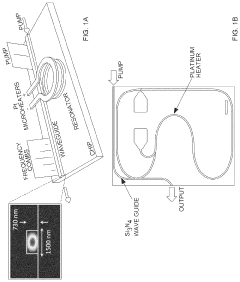
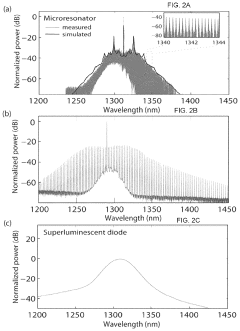
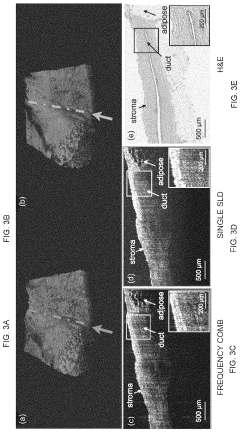
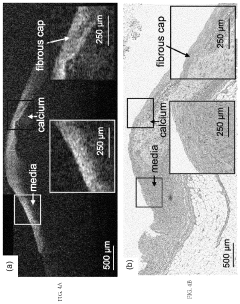
- A microresonator-frequency-comb-based platform using high-Q silicon nitride resonators and distributed feedback lasers generates broadband frequency combs, overcoming the bandwidth-power trade-off and enabling sub-micrometer axial resolution and deeper tissue penetration, compatible with standard OCT systems.
Method and apparatus for optical frequency comb generation using a monolithic micro-resonator
PatentActiveUS7982944B2
Innovation
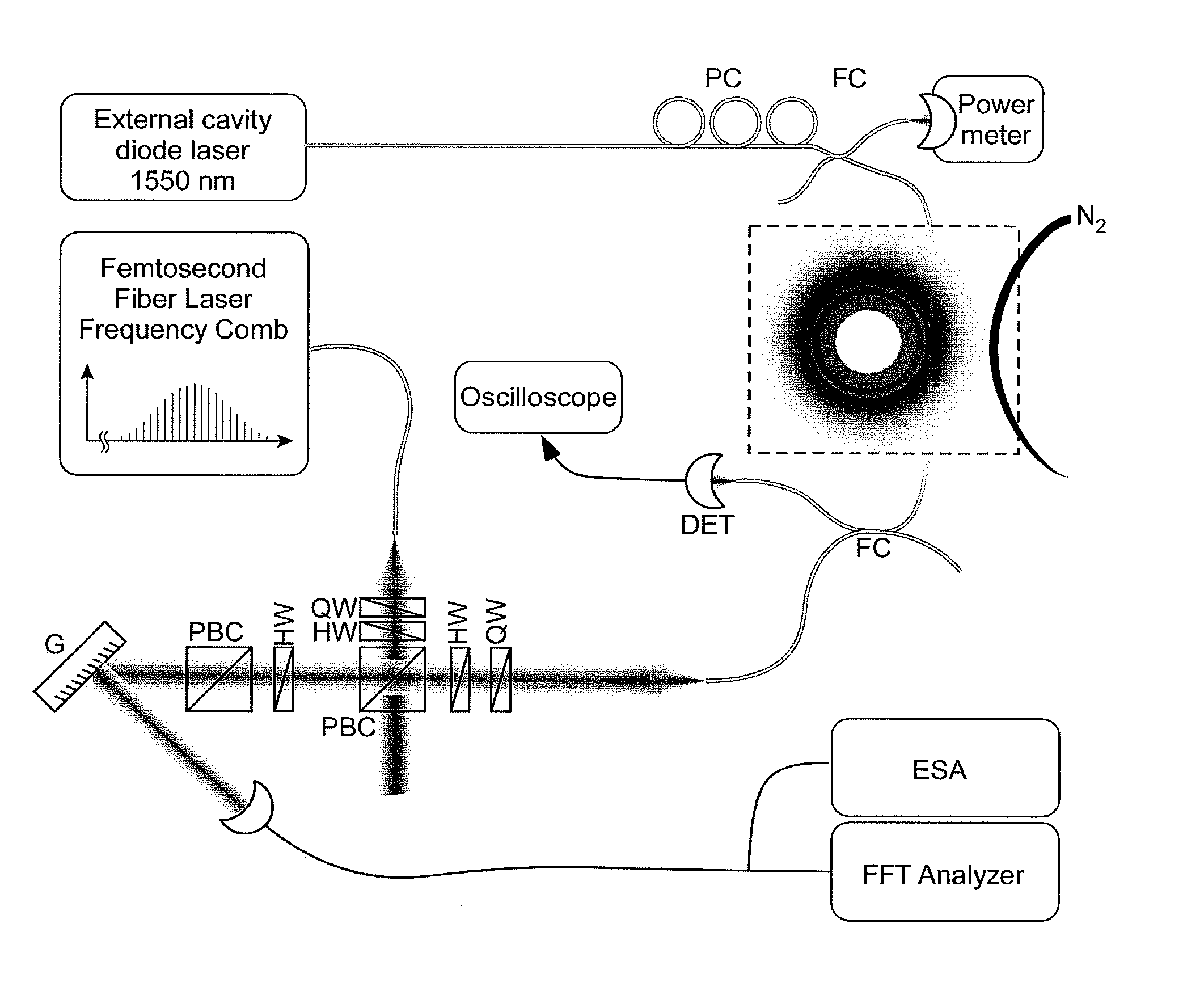
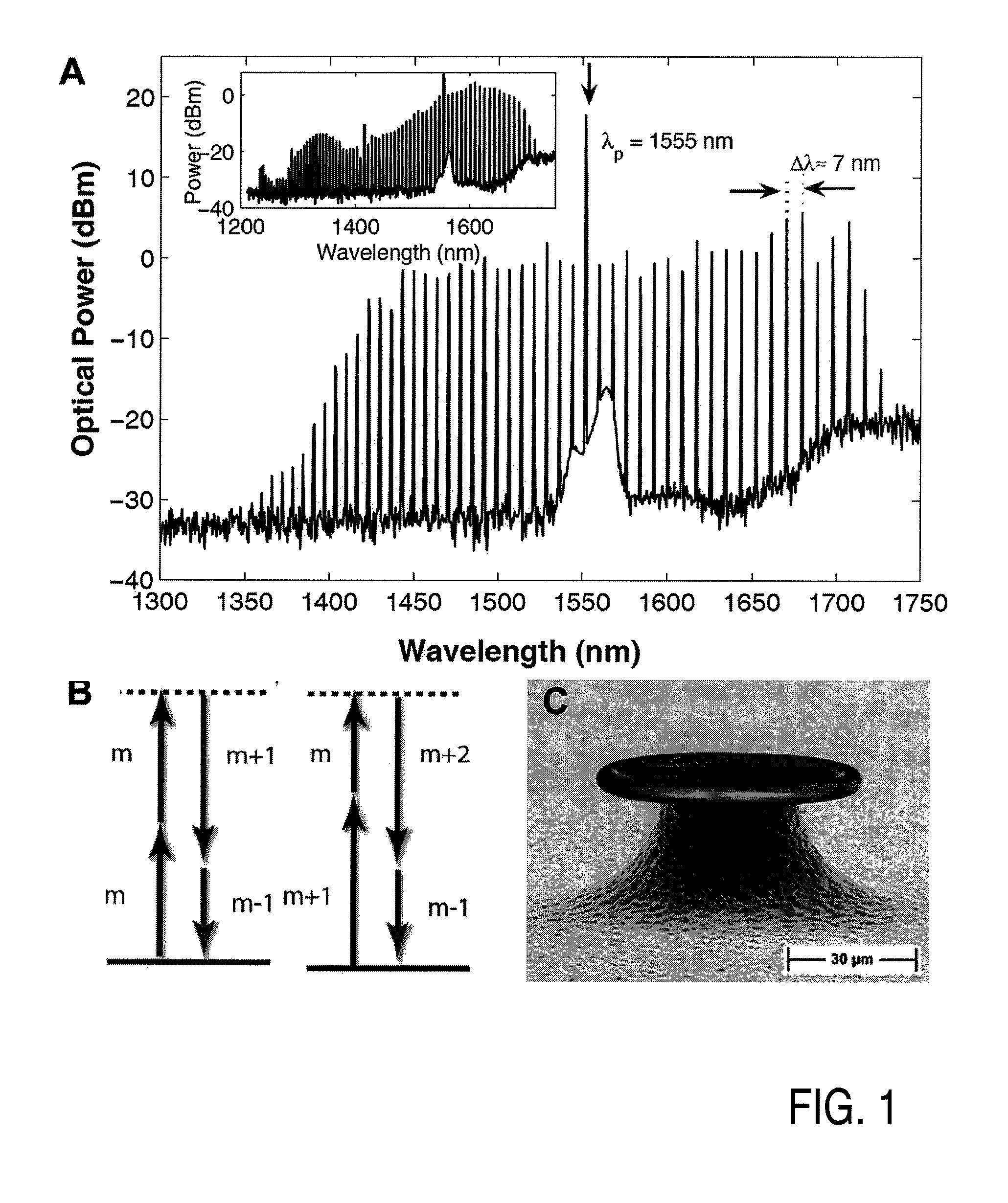
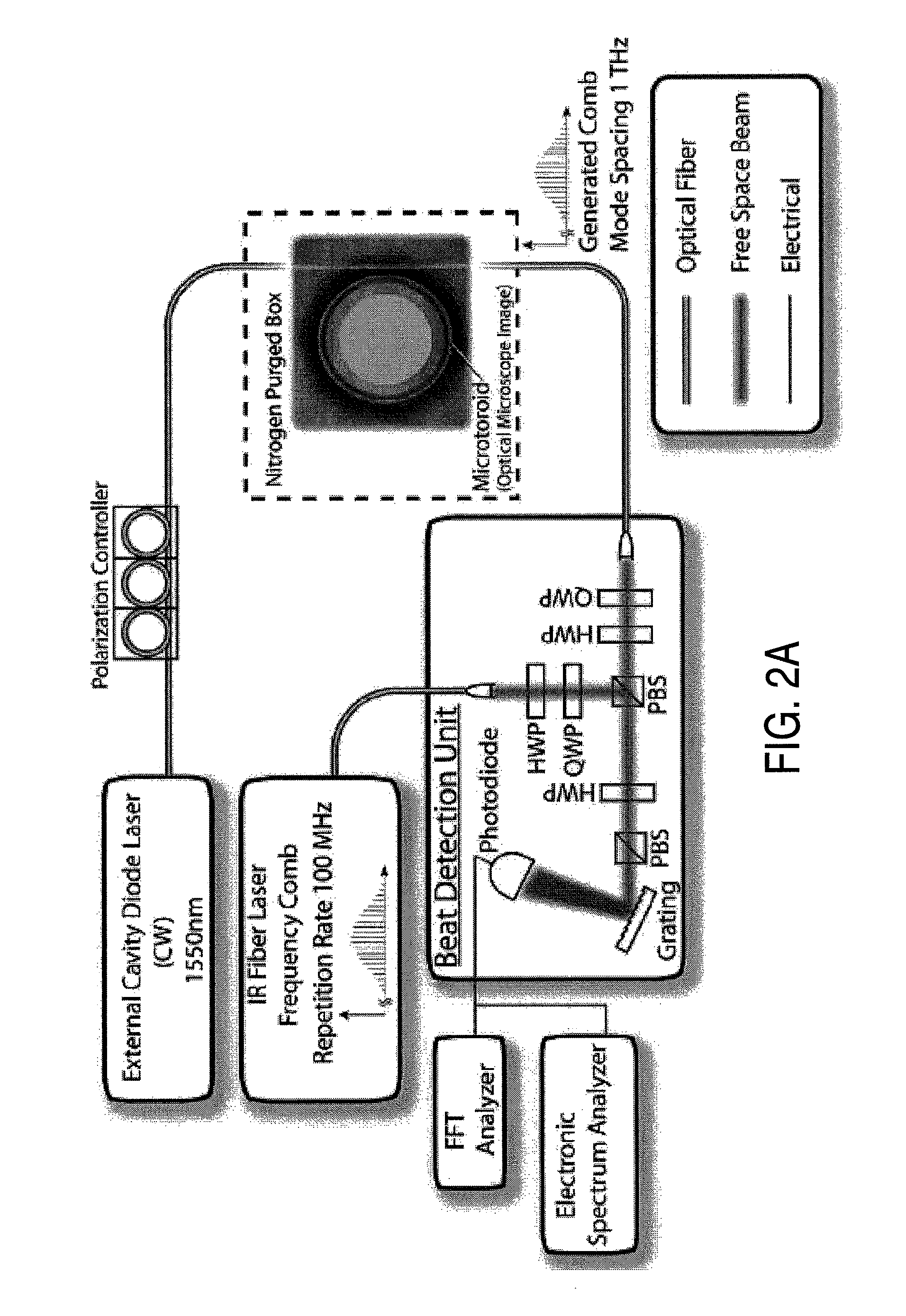
- A monolithic optical frequency comb generator is developed, comprising a pump laser, a dielectric micro-resonator with third-order nonlinearity, and a waveguide that resonantly couples the laser light to the micro-resonator, exceeding the cascaded parametric oscillation threshold to generate multiple frequency sidebands, forming a frequency comb through cascaded parametric generation and four-wave mixing.

Materials Science Advancements for Microcomb Fabrication
The advancement of materials science has been pivotal in the evolution of microcomb fabrication, particularly when considering the interplay between dispersion and nonlinearity. Recent developments in material platforms have significantly enhanced the performance capabilities of microcombs by offering improved control over these critical parameters.
Silicon nitride (Si3N4) has emerged as a leading material for microcomb applications due to its wide transparency window, high refractive index, and negligible two-photon absorption in the telecommunications band. The material's high Kerr nonlinearity coefficient (approximately 2.4 × 10^-19 m²/W) enables efficient nonlinear processes at relatively low power levels. Moreover, recent breakthroughs in Si3N4 fabrication techniques have reduced propagation losses to below 1 dB/m, representing a significant milestone for high-Q resonator development.
Aluminum nitride (AlN) presents another promising material platform, offering both Kerr nonlinearity and piezoelectric properties. This dual functionality enables novel approaches to dispersion engineering through electromechanical tuning mechanisms. The crystalline structure of AlN contributes to its exceptional thermal stability, making it suitable for applications requiring operation across wide temperature ranges.
Lithium niobate on insulator (LNOI) has gained considerable attention for its extraordinary electro-optic properties combined with strong χ(2) and χ(3) nonlinearities. The development of thin-film LNOI has revolutionized the field by allowing for tight optical confinement while maintaining low propagation losses. This material platform offers unprecedented flexibility in dispersion engineering through both geometric and electro-optic approaches.
Diamond-based photonic structures represent the frontier of material research for microcomb applications. With its ultrahigh thermal conductivity (approximately 2000 W/m·K) and wide bandgap, diamond enables operation at high optical powers without thermal instabilities. Recent advances in diamond thin-film growth and nanofabrication have made this exotic material increasingly accessible for integrated photonics applications.
Hybrid material systems combining different material layers have demonstrated remarkable capabilities in tailoring both dispersion and nonlinearity independently. For instance, heterogeneous integration of III-V materials with silicon nitride allows for incorporating active gain media within passive high-Q resonators, enabling new operational regimes for microcombs.
The development of novel deposition techniques, including atomic layer deposition and plasma-enhanced chemical vapor deposition with precise stoichiometry control, has enabled the fabrication of ultra-smooth surfaces with roughness below 0.2 nm. This advancement directly translates to reduced scattering losses and higher Q-factors, which are essential for lowering the power threshold for comb generation while maintaining coherent operation.
Silicon nitride (Si3N4) has emerged as a leading material for microcomb applications due to its wide transparency window, high refractive index, and negligible two-photon absorption in the telecommunications band. The material's high Kerr nonlinearity coefficient (approximately 2.4 × 10^-19 m²/W) enables efficient nonlinear processes at relatively low power levels. Moreover, recent breakthroughs in Si3N4 fabrication techniques have reduced propagation losses to below 1 dB/m, representing a significant milestone for high-Q resonator development.
Aluminum nitride (AlN) presents another promising material platform, offering both Kerr nonlinearity and piezoelectric properties. This dual functionality enables novel approaches to dispersion engineering through electromechanical tuning mechanisms. The crystalline structure of AlN contributes to its exceptional thermal stability, making it suitable for applications requiring operation across wide temperature ranges.
Lithium niobate on insulator (LNOI) has gained considerable attention for its extraordinary electro-optic properties combined with strong χ(2) and χ(3) nonlinearities. The development of thin-film LNOI has revolutionized the field by allowing for tight optical confinement while maintaining low propagation losses. This material platform offers unprecedented flexibility in dispersion engineering through both geometric and electro-optic approaches.
Diamond-based photonic structures represent the frontier of material research for microcomb applications. With its ultrahigh thermal conductivity (approximately 2000 W/m·K) and wide bandgap, diamond enables operation at high optical powers without thermal instabilities. Recent advances in diamond thin-film growth and nanofabrication have made this exotic material increasingly accessible for integrated photonics applications.
Hybrid material systems combining different material layers have demonstrated remarkable capabilities in tailoring both dispersion and nonlinearity independently. For instance, heterogeneous integration of III-V materials with silicon nitride allows for incorporating active gain media within passive high-Q resonators, enabling new operational regimes for microcombs.
The development of novel deposition techniques, including atomic layer deposition and plasma-enhanced chemical vapor deposition with precise stoichiometry control, has enabled the fabrication of ultra-smooth surfaces with roughness below 0.2 nm. This advancement directly translates to reduced scattering losses and higher Q-factors, which are essential for lowering the power threshold for comb generation while maintaining coherent operation.
Integration Strategies for Practical Microcomb Devices
The integration of microcombs into practical devices represents a critical step in transitioning this technology from laboratory demonstrations to commercial applications. Successful integration strategies must address the complex interplay between dispersion and nonlinearity while considering manufacturing scalability, reliability, and system-level compatibility.
Photonic integrated circuit (PIC) platforms offer the most promising pathway for practical microcomb devices. Silicon nitride (Si3N4) has emerged as a leading material platform due to its CMOS compatibility, low optical loss, and ability to engineer both dispersion and nonlinearity parameters simultaneously. Recent advances in thin-film lithium niobate and aluminum nitride also show potential for specialized applications requiring electro-optic functionality alongside comb generation.
Hybrid integration approaches are gaining traction, where optimized components are fabricated separately and then combined. For example, high-Q resonators can be fabricated in specialized processes while pump lasers and detectors are integrated using established semiconductor manufacturing techniques. This modular approach allows each component to be optimized independently while maintaining the critical dispersion-nonlinearity balance required for stable comb operation.
Packaging considerations present significant challenges, particularly thermal management and mechanical stability. Temperature fluctuations can dramatically alter the dispersion profile of microresonators, disrupting phase-matching conditions necessary for comb formation. Advanced thermal compensation techniques, including active temperature control and athermal design approaches, are being developed to maintain stable operation across varying environmental conditions.
Electrical integration for pump control and comb stabilization represents another crucial aspect. Feedback systems that monitor and adjust pump parameters in real-time can compensate for environmental variations and maintain the desired comb state. These control systems must be miniaturized and integrated alongside the photonic components to create fully functional devices.
Manufacturing scalability remains a significant hurdle. Current fabrication techniques often require high-precision processes that are difficult to transfer to high-volume production. Emerging approaches using standard semiconductor manufacturing equipment show promise for overcoming this limitation, though challenges in maintaining precise control over dispersion and nonlinearity parameters at scale persist.
System-level integration considerations extend beyond the microcomb itself to include interfaces with existing technologies. Standardized optical and electrical interfaces, along with appropriate signal processing capabilities, are essential for practical deployment in telecommunications, sensing, and computing applications.
Photonic integrated circuit (PIC) platforms offer the most promising pathway for practical microcomb devices. Silicon nitride (Si3N4) has emerged as a leading material platform due to its CMOS compatibility, low optical loss, and ability to engineer both dispersion and nonlinearity parameters simultaneously. Recent advances in thin-film lithium niobate and aluminum nitride also show potential for specialized applications requiring electro-optic functionality alongside comb generation.
Hybrid integration approaches are gaining traction, where optimized components are fabricated separately and then combined. For example, high-Q resonators can be fabricated in specialized processes while pump lasers and detectors are integrated using established semiconductor manufacturing techniques. This modular approach allows each component to be optimized independently while maintaining the critical dispersion-nonlinearity balance required for stable comb operation.
Packaging considerations present significant challenges, particularly thermal management and mechanical stability. Temperature fluctuations can dramatically alter the dispersion profile of microresonators, disrupting phase-matching conditions necessary for comb formation. Advanced thermal compensation techniques, including active temperature control and athermal design approaches, are being developed to maintain stable operation across varying environmental conditions.
Electrical integration for pump control and comb stabilization represents another crucial aspect. Feedback systems that monitor and adjust pump parameters in real-time can compensate for environmental variations and maintain the desired comb state. These control systems must be miniaturized and integrated alongside the photonic components to create fully functional devices.
Manufacturing scalability remains a significant hurdle. Current fabrication techniques often require high-precision processes that are difficult to transfer to high-volume production. Emerging approaches using standard semiconductor manufacturing equipment show promise for overcoming this limitation, though challenges in maintaining precise control over dispersion and nonlinearity parameters at scale persist.
System-level integration considerations extend beyond the microcomb itself to include interfaces with existing technologies. Standardized optical and electrical interfaces, along with appropriate signal processing capabilities, are essential for practical deployment in telecommunications, sensing, and computing applications.
Unlock deeper insights with Patsnap Eureka Quick Research — get a full tech report to explore trends and direct your research. Try now!
Generate Your Research Report Instantly with AI Agent
Supercharge your innovation with Patsnap Eureka AI Agent Platform!