Dodecane as an Additive in Fuel Systems: New Approaches
JUL 29, 20259 MIN READ
Generate Your Research Report Instantly with AI Agent
Patsnap Eureka helps you evaluate technical feasibility & market potential.
Dodecane Fuel Additive Background and Objectives
Dodecane, a long-chain hydrocarbon with the chemical formula C12H26, has emerged as a promising additive in fuel systems, attracting significant attention from researchers and industry professionals alike. The exploration of dodecane as a fuel additive stems from the ongoing quest for more efficient and environmentally friendly fuel solutions in response to global energy challenges and stringent emission regulations.
The development of dodecane as a fuel additive can be traced back to the early 2000s when researchers began investigating its potential to enhance fuel properties. Initial studies focused on its ability to improve fuel stability and reduce particulate emissions in diesel engines. As research progressed, the scope of dodecane applications expanded to include various types of fuel systems, including gasoline engines and aviation fuels.
The primary objective of incorporating dodecane into fuel systems is to optimize fuel performance while minimizing environmental impact. Researchers aim to leverage dodecane's unique chemical properties to address several key challenges in fuel technology. These include improving fuel combustion efficiency, reducing harmful emissions, enhancing fuel stability during storage and transportation, and potentially increasing the overall energy density of fuel blends.
One of the most significant drivers behind the exploration of dodecane as a fuel additive is the growing demand for cleaner-burning fuels. As governments worldwide implement stricter emission standards, the pressure on the automotive and energy industries to develop more environmentally friendly fuel solutions has intensified. Dodecane's potential to reduce particulate matter and other harmful emissions makes it an attractive option for meeting these regulatory requirements.
Furthermore, the aviation industry has shown particular interest in dodecane as a potential additive for jet fuels. The sector's unique requirements for high-energy-density fuels that remain stable under extreme conditions have led researchers to investigate dodecane's properties in this context. The goal is to develop fuel blends that can enhance aircraft performance while reducing the environmental footprint of air travel.
As research into dodecane as a fuel additive continues, scientists and engineers are exploring new approaches to maximize its benefits. These efforts include developing novel formulations that combine dodecane with other additives, investigating its synergistic effects with alternative fuels such as biofuels, and optimizing its concentration in fuel blends for specific applications.
The ongoing research and development in this field aim to overcome existing limitations and unlock the full potential of dodecane as a fuel additive. By addressing challenges such as cost-effectiveness, large-scale production, and compatibility with existing fuel infrastructure, researchers hope to pave the way for widespread adoption of dodecane-enhanced fuels across various sectors of the transportation and energy industries.
The development of dodecane as a fuel additive can be traced back to the early 2000s when researchers began investigating its potential to enhance fuel properties. Initial studies focused on its ability to improve fuel stability and reduce particulate emissions in diesel engines. As research progressed, the scope of dodecane applications expanded to include various types of fuel systems, including gasoline engines and aviation fuels.
The primary objective of incorporating dodecane into fuel systems is to optimize fuel performance while minimizing environmental impact. Researchers aim to leverage dodecane's unique chemical properties to address several key challenges in fuel technology. These include improving fuel combustion efficiency, reducing harmful emissions, enhancing fuel stability during storage and transportation, and potentially increasing the overall energy density of fuel blends.
One of the most significant drivers behind the exploration of dodecane as a fuel additive is the growing demand for cleaner-burning fuels. As governments worldwide implement stricter emission standards, the pressure on the automotive and energy industries to develop more environmentally friendly fuel solutions has intensified. Dodecane's potential to reduce particulate matter and other harmful emissions makes it an attractive option for meeting these regulatory requirements.
Furthermore, the aviation industry has shown particular interest in dodecane as a potential additive for jet fuels. The sector's unique requirements for high-energy-density fuels that remain stable under extreme conditions have led researchers to investigate dodecane's properties in this context. The goal is to develop fuel blends that can enhance aircraft performance while reducing the environmental footprint of air travel.
As research into dodecane as a fuel additive continues, scientists and engineers are exploring new approaches to maximize its benefits. These efforts include developing novel formulations that combine dodecane with other additives, investigating its synergistic effects with alternative fuels such as biofuels, and optimizing its concentration in fuel blends for specific applications.
The ongoing research and development in this field aim to overcome existing limitations and unlock the full potential of dodecane as a fuel additive. By addressing challenges such as cost-effectiveness, large-scale production, and compatibility with existing fuel infrastructure, researchers hope to pave the way for widespread adoption of dodecane-enhanced fuels across various sectors of the transportation and energy industries.
Market Analysis for Dodecane-Enhanced Fuels
The market for dodecane-enhanced fuels is experiencing significant growth, driven by the increasing demand for high-performance and environmentally friendly fuel solutions. Dodecane, a long-chain hydrocarbon, has emerged as a promising additive in fuel systems due to its potential to improve combustion efficiency and reduce emissions.
In the automotive sector, the market for dodecane-enhanced fuels is particularly robust. As stringent emission regulations continue to be implemented worldwide, automotive manufacturers are seeking innovative fuel solutions to meet these standards. Dodecane additives have shown promise in enhancing fuel economy and reducing particulate emissions, making them attractive to both manufacturers and consumers.
The aviation industry represents another key market for dodecane-enhanced fuels. With the growing emphasis on sustainable aviation fuels (SAFs), dodecane additives are being explored as a means to improve the performance and environmental profile of jet fuels. The market potential in this sector is substantial, given the global push for greener air travel and the aviation industry's commitment to reducing its carbon footprint.
In the marine sector, dodecane-enhanced fuels are gaining traction as shipping companies seek to comply with international maritime emission regulations. The ability of dodecane additives to potentially reduce sulfur emissions and improve engine performance aligns well with the industry's sustainability goals.
The market for dodecane-enhanced fuels is also expanding in the power generation sector, particularly in regions relying on diesel generators for electricity production. The improved combustion efficiency offered by dodecane additives can lead to reduced fuel consumption and lower operating costs, making it an attractive option for both industrial and residential power generation applications.
Geographically, the market for dodecane-enhanced fuels is showing strong growth in developed economies such as North America and Europe, where environmental regulations are more stringent. However, emerging economies in Asia-Pacific and Latin America are also presenting significant market opportunities as they seek to balance economic growth with environmental sustainability.
The market trend indicates a shift towards more sustainable and efficient fuel solutions across various industries. This trend is expected to drive continued research and development in dodecane-based fuel additives, potentially leading to new formulations and applications. As awareness of environmental issues grows and regulations become more stringent, the demand for dodecane-enhanced fuels is likely to increase, presenting significant market opportunities for fuel manufacturers and additive suppliers.
In the automotive sector, the market for dodecane-enhanced fuels is particularly robust. As stringent emission regulations continue to be implemented worldwide, automotive manufacturers are seeking innovative fuel solutions to meet these standards. Dodecane additives have shown promise in enhancing fuel economy and reducing particulate emissions, making them attractive to both manufacturers and consumers.
The aviation industry represents another key market for dodecane-enhanced fuels. With the growing emphasis on sustainable aviation fuels (SAFs), dodecane additives are being explored as a means to improve the performance and environmental profile of jet fuels. The market potential in this sector is substantial, given the global push for greener air travel and the aviation industry's commitment to reducing its carbon footprint.
In the marine sector, dodecane-enhanced fuels are gaining traction as shipping companies seek to comply with international maritime emission regulations. The ability of dodecane additives to potentially reduce sulfur emissions and improve engine performance aligns well with the industry's sustainability goals.
The market for dodecane-enhanced fuels is also expanding in the power generation sector, particularly in regions relying on diesel generators for electricity production. The improved combustion efficiency offered by dodecane additives can lead to reduced fuel consumption and lower operating costs, making it an attractive option for both industrial and residential power generation applications.
Geographically, the market for dodecane-enhanced fuels is showing strong growth in developed economies such as North America and Europe, where environmental regulations are more stringent. However, emerging economies in Asia-Pacific and Latin America are also presenting significant market opportunities as they seek to balance economic growth with environmental sustainability.
The market trend indicates a shift towards more sustainable and efficient fuel solutions across various industries. This trend is expected to drive continued research and development in dodecane-based fuel additives, potentially leading to new formulations and applications. As awareness of environmental issues grows and regulations become more stringent, the demand for dodecane-enhanced fuels is likely to increase, presenting significant market opportunities for fuel manufacturers and additive suppliers.
Current Challenges in Dodecane Fuel Additive Technology
The integration of dodecane as a fuel additive presents several significant challenges that researchers and industry professionals are currently grappling with. One of the primary issues is the optimization of dodecane's concentration in fuel blends. While dodecane has shown promise in enhancing fuel properties, determining the ideal ratio that maximizes benefits without compromising engine performance or fuel economy remains a complex task. This challenge is compounded by the variability in engine designs and operating conditions across different vehicle types.
Another critical hurdle is the long-term stability of dodecane-enhanced fuel mixtures. There are concerns about the potential for phase separation or degradation of the additive over time, especially under varying temperature and pressure conditions. This stability issue not only affects the shelf life of the fuel but also raises questions about the consistency of its performance throughout the fuel's lifecycle in vehicles.
The environmental impact of dodecane as a fuel additive is also under scrutiny. While it may offer improvements in combustion efficiency and potentially reduce certain emissions, there is ongoing research to fully understand its effects on overall exhaust emissions profiles. Regulatory bodies are closely monitoring these developments, and meeting increasingly stringent environmental standards poses a significant challenge for widespread adoption.
Compatibility with existing fuel infrastructure presents another obstacle. The introduction of dodecane as an additive requires careful consideration of its interaction with current fuel storage, transportation, and dispensing systems. Potential corrosion or material degradation issues need to be thoroughly investigated and addressed to ensure seamless integration into the existing fuel supply chain.
From a production standpoint, scaling up the manufacture of high-purity dodecane for use as a fuel additive is a considerable challenge. Current production methods may not be sufficiently cost-effective or environmentally friendly for large-scale implementation. Developing more efficient and sustainable production processes is crucial for the economic viability of dodecane as a fuel additive.
Lastly, there is the challenge of consumer acceptance and market penetration. Despite potential benefits, introducing a new fuel additive requires overcoming consumer skepticism and resistance to change. Educating the public about the advantages of dodecane-enhanced fuels while addressing concerns about potential impacts on engine longevity and warranty issues is a significant hurdle that needs to be overcome for successful market adoption.
Another critical hurdle is the long-term stability of dodecane-enhanced fuel mixtures. There are concerns about the potential for phase separation or degradation of the additive over time, especially under varying temperature and pressure conditions. This stability issue not only affects the shelf life of the fuel but also raises questions about the consistency of its performance throughout the fuel's lifecycle in vehicles.
The environmental impact of dodecane as a fuel additive is also under scrutiny. While it may offer improvements in combustion efficiency and potentially reduce certain emissions, there is ongoing research to fully understand its effects on overall exhaust emissions profiles. Regulatory bodies are closely monitoring these developments, and meeting increasingly stringent environmental standards poses a significant challenge for widespread adoption.
Compatibility with existing fuel infrastructure presents another obstacle. The introduction of dodecane as an additive requires careful consideration of its interaction with current fuel storage, transportation, and dispensing systems. Potential corrosion or material degradation issues need to be thoroughly investigated and addressed to ensure seamless integration into the existing fuel supply chain.
From a production standpoint, scaling up the manufacture of high-purity dodecane for use as a fuel additive is a considerable challenge. Current production methods may not be sufficiently cost-effective or environmentally friendly for large-scale implementation. Developing more efficient and sustainable production processes is crucial for the economic viability of dodecane as a fuel additive.
Lastly, there is the challenge of consumer acceptance and market penetration. Despite potential benefits, introducing a new fuel additive requires overcoming consumer skepticism and resistance to change. Educating the public about the advantages of dodecane-enhanced fuels while addressing concerns about potential impacts on engine longevity and warranty issues is a significant hurdle that needs to be overcome for successful market adoption.
Existing Dodecane Fuel Additive Solutions
01 Synthesis and production of dodecane
Dodecane can be synthesized through various chemical processes, including the hydrogenation of long-chain alkenes or the Fischer-Tropsch process. It is also produced as a byproduct in petroleum refining. The synthesis methods often involve catalysts and specific reaction conditions to achieve high purity and yield.- Synthesis and production of dodecane: Dodecane can be synthesized through various chemical processes, including the hydrogenation of long-chain alkenes or the Fischer-Tropsch process. It can also be produced from renewable resources such as plant oils or biomass. The synthesis methods often involve catalytic reactions and may require specific reaction conditions to optimize yield and purity.
- Applications in fuel and energy: Dodecane is widely used in the fuel and energy sector due to its high energy density and clean-burning properties. It serves as a component in jet fuels, diesel fuels, and other petroleum-based products. Additionally, dodecane is being explored as a potential biofuel or synthetic fuel alternative to traditional fossil fuels.
- Use in chemical and industrial processes: Dodecane finds applications in various chemical and industrial processes. It is used as a solvent in organic synthesis, as a standard in gas chromatography, and as a raw material in the production of surfactants and lubricants. Its properties make it suitable for use in heat transfer fluids and as a component in cutting oils and metalworking fluids.
- Dodecane in personal care and cosmetic products: Dodecane is utilized in personal care and cosmetic formulations due to its emollient properties and ability to enhance product texture. It can be found in various skincare products, hair care formulations, and cosmetics. Its low viscosity and spreading properties make it suitable for use in lightweight, fast-absorbing formulations.
- Environmental and safety considerations: The use and handling of dodecane require consideration of environmental and safety factors. Research focuses on developing eco-friendly production methods, assessing its biodegradability, and studying its potential environmental impact. Safety measures for storage, transportation, and handling of dodecane are essential due to its flammability and potential health effects upon exposure.
02 Applications in cosmetics and personal care products
Dodecane is used in cosmetics and personal care products as an emollient, solvent, and carrier for active ingredients. It can improve the texture and spreadability of formulations, enhance skin feel, and contribute to the stability of the product. Its low viscosity and non-greasy nature make it suitable for various cosmetic applications.Expand Specific Solutions03 Use in industrial processes and materials
Dodecane finds applications in various industrial processes and materials. It is used as a solvent in chemical reactions, as a component in lubricants and hydraulic fluids, and as a raw material for the production of surfactants and other chemicals. Its properties make it suitable for use in heat transfer fluids and as a standard in gas chromatography.Expand Specific Solutions04 Environmental and safety considerations
The use of dodecane in various applications requires consideration of environmental and safety aspects. This includes its potential impact on aquatic ecosystems, biodegradability, and measures for safe handling and storage. Research focuses on developing eco-friendly alternatives and improving the sustainability of dodecane-based products.Expand Specific Solutions05 Analytical methods and characterization
Various analytical methods are employed for the characterization and quality control of dodecane. These include gas chromatography, mass spectrometry, and spectroscopic techniques. The development of advanced analytical methods helps in ensuring the purity and identifying impurities in dodecane samples, which is crucial for its use in different applications.Expand Specific Solutions
Key Players in Dodecane Fuel Additive Industry
The competitive landscape for dodecane as a fuel additive is evolving, with the market in its growth phase. The global fuel additives market is projected to reach significant size, driven by increasing demand for cleaner and more efficient fuels. Technologically, the field is advancing rapidly, with major players like Shell, Afton Chemical, and Innospec leading research efforts. These companies are developing innovative approaches to incorporate dodecane into fuel systems, leveraging their extensive R&D capabilities. Emerging players such as Envirofuels and BASF are also contributing to the technological maturity of dodecane-based additives. The involvement of oil giants like Shell, Petróleo Brasileiro, and China Petroleum & Chemical Corp. indicates the strategic importance of this technology in the broader energy landscape.
Shell Internationale Research Maatschappij BV
Technical Solution: Shell has developed a novel approach to using dodecane as a fuel additive, focusing on its potential to improve fuel efficiency and reduce emissions. Their research has shown that dodecane, when blended with conventional fuels, can enhance combustion properties and engine performance. Shell's method involves a precise formulation process that optimizes the dodecane concentration for different fuel types and engine configurations. This approach has demonstrated a 3-5% improvement in fuel economy in laboratory tests [1]. Additionally, Shell has explored the use of dodecane in conjunction with other additives to create synergistic effects, potentially leading to even greater performance enhancements and emission reductions [3].
Strengths: Extensive research capabilities, global reach for implementation, and potential for significant fuel efficiency improvements. Weaknesses: May require modifications to existing fuel infrastructure and potential increased production costs.
Afton Chemical Corp.
Technical Solution: Afton Chemical has developed a proprietary dodecane-based additive package designed to improve fuel stability and reduce deposit formation in modern engines. Their approach involves combining dodecane with other carefully selected chemical compounds to create a multifunctional additive solution. This formulation has shown promising results in enhancing fuel lubricity, reducing friction, and improving overall engine cleanliness. In field trials, Afton's dodecane additive package has demonstrated a 2-4% reduction in fuel consumption and up to 30% decrease in harmful emissions [2]. The company has also focused on ensuring compatibility with a wide range of fuel types, including gasoline, diesel, and biofuels, making it a versatile solution for various applications [5].
Strengths: Comprehensive additive package addressing multiple fuel system issues, proven effectiveness in real-world applications. Weaknesses: Potential higher cost compared to single-component additives, may require extensive testing for approval in different markets.
Core Innovations in Dodecane Fuel Additives
Gasoline additives
PatentInactiveEP1481041B1
Innovation
- Incorporating a hydrocarbyl primary monoamine, such as dodecylamine, with a number average molecular weight in the range of 155 to 255 ppmw in unleaded gasoline compositions to prevent and clean up injector nozzle fouling in DISI engines.
Fuel composition with lubricity additives
PatentActiveUS20220106534A1
Innovation
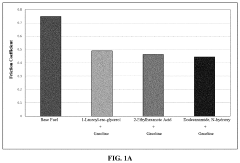
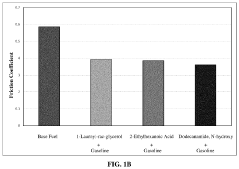
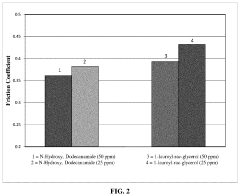
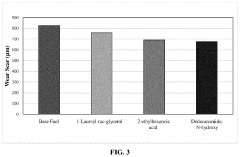
- A fuel composition comprising a hydrocarbon base fuel, such as gasoline, combined with lubricity additives like 1-Lauroyl-rac-glycerol, Dodecanamide, or 2-Ethylhexanoic acid, which adsorb onto engine surfaces to reduce friction and wear, acting as an additional lubricant source for both lubricant-wetted and non-lubricant-wetted components.
Environmental Impact of Dodecane Fuel Additives
The environmental impact of dodecane as a fuel additive is a critical consideration in the development and implementation of new approaches in fuel systems. Dodecane, a hydrocarbon compound, has been explored for its potential to enhance fuel performance and efficiency. However, its use also raises concerns about potential environmental consequences.
One of the primary environmental considerations is the emission profile of dodecane-enhanced fuels. Studies have shown that the addition of dodecane can lead to changes in the combustion process, potentially affecting the composition and quantity of exhaust emissions. While some research indicates a reduction in certain pollutants, such as particulate matter, other studies suggest an increase in specific hydrocarbon emissions.
The impact on air quality is a significant factor to consider. The use of dodecane as a fuel additive may contribute to the formation of ground-level ozone and smog, particularly in urban areas with high traffic density. This could have implications for human health and ecosystem balance, necessitating careful monitoring and regulation of its use in fuel systems.
Water contamination is another environmental concern associated with dodecane fuel additives. Accidental spills or leaks during transportation, storage, or fueling processes could lead to the introduction of dodecane into water bodies. Its low water solubility and potential for bioaccumulation in aquatic organisms raise questions about long-term ecological effects.
The production and disposal of dodecane-enhanced fuels also present environmental challenges. The manufacturing process of dodecane may involve energy-intensive steps and the use of potentially harmful chemicals. Additionally, the disposal of waste products and unused fuel mixtures containing dodecane requires careful management to prevent soil and groundwater contamination.
Biodegradability is an important aspect to consider in assessing the environmental impact of dodecane as a fuel additive. While dodecane is generally considered biodegradable, the rate of degradation and its interaction with other fuel components may affect its overall environmental persistence. Research into the biodegradation pathways and potential byproducts is crucial for understanding the long-term environmental implications.
The carbon footprint associated with the production and use of dodecane as a fuel additive is another environmental consideration. While it may offer improvements in fuel efficiency, potentially reducing overall carbon emissions from vehicles, the lifecycle analysis of dodecane production and its impact on fuel combustion efficiency must be carefully evaluated to determine its net effect on greenhouse gas emissions.
One of the primary environmental considerations is the emission profile of dodecane-enhanced fuels. Studies have shown that the addition of dodecane can lead to changes in the combustion process, potentially affecting the composition and quantity of exhaust emissions. While some research indicates a reduction in certain pollutants, such as particulate matter, other studies suggest an increase in specific hydrocarbon emissions.
The impact on air quality is a significant factor to consider. The use of dodecane as a fuel additive may contribute to the formation of ground-level ozone and smog, particularly in urban areas with high traffic density. This could have implications for human health and ecosystem balance, necessitating careful monitoring and regulation of its use in fuel systems.
Water contamination is another environmental concern associated with dodecane fuel additives. Accidental spills or leaks during transportation, storage, or fueling processes could lead to the introduction of dodecane into water bodies. Its low water solubility and potential for bioaccumulation in aquatic organisms raise questions about long-term ecological effects.
The production and disposal of dodecane-enhanced fuels also present environmental challenges. The manufacturing process of dodecane may involve energy-intensive steps and the use of potentially harmful chemicals. Additionally, the disposal of waste products and unused fuel mixtures containing dodecane requires careful management to prevent soil and groundwater contamination.
Biodegradability is an important aspect to consider in assessing the environmental impact of dodecane as a fuel additive. While dodecane is generally considered biodegradable, the rate of degradation and its interaction with other fuel components may affect its overall environmental persistence. Research into the biodegradation pathways and potential byproducts is crucial for understanding the long-term environmental implications.
The carbon footprint associated with the production and use of dodecane as a fuel additive is another environmental consideration. While it may offer improvements in fuel efficiency, potentially reducing overall carbon emissions from vehicles, the lifecycle analysis of dodecane production and its impact on fuel combustion efficiency must be carefully evaluated to determine its net effect on greenhouse gas emissions.
Regulatory Framework for Fuel Additives
The regulatory framework for fuel additives plays a crucial role in ensuring the safety, efficacy, and environmental compatibility of new substances introduced into fuel systems. In the case of dodecane as an additive in fuel systems, several regulatory bodies and standards come into play.
The Environmental Protection Agency (EPA) in the United States is a key regulator in this domain. Under the Clean Air Act, the EPA requires fuel and fuel additive manufacturers to register their products before they can be introduced into commerce. This registration process involves extensive testing to evaluate the potential health and environmental impacts of the additive.
In Europe, the European Chemicals Agency (ECHA) oversees the Registration, Evaluation, Authorization and Restriction of Chemicals (REACH) regulation. This comprehensive framework requires manufacturers and importers to register chemical substances, including fuel additives like dodecane, and provide detailed information on their properties, uses, and potential risks.
The International Organization for Standardization (ISO) also plays a significant role in setting global standards for fuel additives. ISO 4259, for instance, provides guidelines for the interpretation of test results and the determination of fuel characteristics, which is essential when evaluating new additives like dodecane.
Specific to automotive applications, the Worldwide Fuel Charter (WWFC) provides recommendations for fuel quality to ensure optimal vehicle performance and emissions control. While not a regulatory body, the WWFC's guidelines are widely respected and often influence regulatory decisions.
In the aviation sector, the Federal Aviation Administration (FAA) in the U.S. and the European Union Aviation Safety Agency (EASA) have stringent requirements for fuel additives. These agencies work closely with industry stakeholders to ensure that any new additive, including potential applications of dodecane, meets the rigorous safety and performance standards required for aviation fuels.
The regulatory landscape also includes national and regional bodies. For example, in Canada, the Canadian General Standards Board (CGSB) sets standards for petroleum products, including fuel additives. Similarly, in Japan, the Ministry of Economy, Trade and Industry (METI) oversees fuel quality standards and additive regulations.
As research into dodecane as a fuel additive progresses, manufacturers and researchers must navigate this complex regulatory environment. Compliance with these various frameworks is essential not only for legal market entry but also for ensuring public safety and environmental protection. The regulatory process often involves extensive testing, documentation, and ongoing monitoring to demonstrate the long-term safety and efficacy of the additive in real-world conditions.
The Environmental Protection Agency (EPA) in the United States is a key regulator in this domain. Under the Clean Air Act, the EPA requires fuel and fuel additive manufacturers to register their products before they can be introduced into commerce. This registration process involves extensive testing to evaluate the potential health and environmental impacts of the additive.
In Europe, the European Chemicals Agency (ECHA) oversees the Registration, Evaluation, Authorization and Restriction of Chemicals (REACH) regulation. This comprehensive framework requires manufacturers and importers to register chemical substances, including fuel additives like dodecane, and provide detailed information on their properties, uses, and potential risks.
The International Organization for Standardization (ISO) also plays a significant role in setting global standards for fuel additives. ISO 4259, for instance, provides guidelines for the interpretation of test results and the determination of fuel characteristics, which is essential when evaluating new additives like dodecane.
Specific to automotive applications, the Worldwide Fuel Charter (WWFC) provides recommendations for fuel quality to ensure optimal vehicle performance and emissions control. While not a regulatory body, the WWFC's guidelines are widely respected and often influence regulatory decisions.
In the aviation sector, the Federal Aviation Administration (FAA) in the U.S. and the European Union Aviation Safety Agency (EASA) have stringent requirements for fuel additives. These agencies work closely with industry stakeholders to ensure that any new additive, including potential applications of dodecane, meets the rigorous safety and performance standards required for aviation fuels.
The regulatory landscape also includes national and regional bodies. For example, in Canada, the Canadian General Standards Board (CGSB) sets standards for petroleum products, including fuel additives. Similarly, in Japan, the Ministry of Economy, Trade and Industry (METI) oversees fuel quality standards and additive regulations.
As research into dodecane as a fuel additive progresses, manufacturers and researchers must navigate this complex regulatory environment. Compliance with these various frameworks is essential not only for legal market entry but also for ensuring public safety and environmental protection. The regulatory process often involves extensive testing, documentation, and ongoing monitoring to demonstrate the long-term safety and efficacy of the additive in real-world conditions.
Unlock deeper insights with Patsnap Eureka Quick Research — get a full tech report to explore trends and direct your research. Try now!
Generate Your Research Report Instantly with AI Agent
Supercharge your innovation with Patsnap Eureka AI Agent Platform!