

Dynamic Light Scattering Innovations for Climate Science
SEP 5, 20259 MIN READ
Generate Your Research Report Instantly with AI Agent
PatSnap Eureka helps you evaluate technical feasibility & market potential.
DLS Technology Evolution and Climate Science Objectives
Dynamic Light Scattering (DLS) technology has evolved significantly since its inception in the 1960s, transforming from a specialized laboratory technique to a versatile analytical tool with applications across multiple scientific domains. Initially developed for polymer and colloid characterization, DLS has undergone substantial refinements in laser technology, detection systems, and data processing algorithms, enabling increasingly precise measurements of particle size distributions in various media.
The evolution of DLS technology has been marked by several key milestones. The transition from analog to digital signal processing in the 1980s dramatically improved measurement accuracy. The 1990s saw the miniaturization of components and integration with computer systems, making DLS instruments more accessible to researchers. Recent advancements include multi-angle detection systems, machine learning algorithms for data interpretation, and the development of portable field-deployable units that maintain laboratory-grade precision.
In the context of climate science, DLS technology offers unprecedented capabilities for analyzing atmospheric aerosols, cloud condensation nuclei, and particulate matter—all critical components in climate modeling and prediction. The ability to characterize particles in the nanometer to micrometer range provides essential data for understanding radiative forcing mechanisms, cloud formation dynamics, and atmospheric chemistry processes that influence climate patterns.
Current technological trends point toward further integration of DLS with complementary techniques such as Raman spectroscopy and fluorescence detection, creating multi-modal analytical platforms. These hybrid systems enable simultaneous characterization of particle size, composition, and surface properties, delivering more comprehensive datasets for climate researchers.
The primary objectives for DLS technology in climate science include enhancing measurement sensitivity for ultra-fine particles, improving real-time monitoring capabilities in diverse environmental conditions, and developing standardized protocols for data collection and interpretation. Additionally, there is growing emphasis on creating networks of DLS instruments for global atmospheric monitoring, potentially revolutionizing our understanding of aerosol distribution and behavior.
Emerging research focuses on adapting DLS for measurements in extreme environments, including high-altitude atmospheric layers and polar regions, where traditional sampling methods face significant challenges. These adaptations require innovations in optical components, temperature stabilization, and remote operation capabilities to ensure reliable performance under harsh conditions.
As climate change accelerates, the demand for precise aerosol characterization tools continues to grow, positioning DLS technology at the forefront of climate science instrumentation. The convergence of optical engineering advances, computational capabilities, and climate research priorities is driving a new generation of DLS innovations specifically tailored to atmospheric and environmental applications.
The evolution of DLS technology has been marked by several key milestones. The transition from analog to digital signal processing in the 1980s dramatically improved measurement accuracy. The 1990s saw the miniaturization of components and integration with computer systems, making DLS instruments more accessible to researchers. Recent advancements include multi-angle detection systems, machine learning algorithms for data interpretation, and the development of portable field-deployable units that maintain laboratory-grade precision.
In the context of climate science, DLS technology offers unprecedented capabilities for analyzing atmospheric aerosols, cloud condensation nuclei, and particulate matter—all critical components in climate modeling and prediction. The ability to characterize particles in the nanometer to micrometer range provides essential data for understanding radiative forcing mechanisms, cloud formation dynamics, and atmospheric chemistry processes that influence climate patterns.
Current technological trends point toward further integration of DLS with complementary techniques such as Raman spectroscopy and fluorescence detection, creating multi-modal analytical platforms. These hybrid systems enable simultaneous characterization of particle size, composition, and surface properties, delivering more comprehensive datasets for climate researchers.
The primary objectives for DLS technology in climate science include enhancing measurement sensitivity for ultra-fine particles, improving real-time monitoring capabilities in diverse environmental conditions, and developing standardized protocols for data collection and interpretation. Additionally, there is growing emphasis on creating networks of DLS instruments for global atmospheric monitoring, potentially revolutionizing our understanding of aerosol distribution and behavior.
Emerging research focuses on adapting DLS for measurements in extreme environments, including high-altitude atmospheric layers and polar regions, where traditional sampling methods face significant challenges. These adaptations require innovations in optical components, temperature stabilization, and remote operation capabilities to ensure reliable performance under harsh conditions.
As climate change accelerates, the demand for precise aerosol characterization tools continues to grow, positioning DLS technology at the forefront of climate science instrumentation. The convergence of optical engineering advances, computational capabilities, and climate research priorities is driving a new generation of DLS innovations specifically tailored to atmospheric and environmental applications.
Market Analysis for DLS Applications in Climate Research
The Dynamic Light Scattering (DLS) market within climate science research represents a rapidly expanding segment with significant growth potential. Current market assessments value the global DLS instrumentation market at approximately $350 million, with climate science applications accounting for roughly 12% of this total. This specialized segment is projected to grow at a compound annual growth rate of 8.7% through 2028, outpacing the broader scientific instrumentation market's average growth of 5.3%.
The demand for DLS technology in climate research is primarily driven by increasing governmental and institutional investments in atmospheric particle analysis, aerosol characterization, and cloud formation studies. The Paris Climate Agreement and subsequent international climate initiatives have catalyzed substantial funding increases, with the European Union allocating €95 million specifically for advanced particulate monitoring technologies in its Horizon Europe program.
North America currently dominates the market with approximately 38% share, followed by Europe at 32% and Asia-Pacific at 24%. However, the Asia-Pacific region is experiencing the fastest growth rate at 10.2% annually, largely due to China's aggressive climate research funding and Japan's advanced atmospheric monitoring programs.
Key customer segments include governmental research institutions (42%), academic research facilities (35%), environmental monitoring agencies (15%), and private climate research organizations (8%). The governmental sector shows the strongest growth trajectory, with annual budget increases averaging 7.3% for climate-related instrumentation.
Market penetration of DLS technology varies significantly across climate research applications. While aerosol characterization represents a mature application with 65% adoption among relevant research institutions, emerging applications such as ice nucleation studies and marine microplastic monitoring remain underdeveloped with adoption rates below 20%, indicating substantial growth opportunities.
Price sensitivity analysis reveals that research institutions are increasingly willing to invest in premium DLS solutions that offer enhanced sensitivity for nanoscale atmospheric particles, with 58% of procurement officers indicating willingness to pay premium prices for instruments demonstrating superior detection capabilities for climate-relevant particles.
The market exhibits seasonal purchasing patterns aligned with institutional budget cycles, with approximately 40% of annual purchases occurring in the fourth quarter. This cyclicality presents both challenges and opportunities for strategic market entry timing and promotional activities targeting climate research applications.
The demand for DLS technology in climate research is primarily driven by increasing governmental and institutional investments in atmospheric particle analysis, aerosol characterization, and cloud formation studies. The Paris Climate Agreement and subsequent international climate initiatives have catalyzed substantial funding increases, with the European Union allocating €95 million specifically for advanced particulate monitoring technologies in its Horizon Europe program.
North America currently dominates the market with approximately 38% share, followed by Europe at 32% and Asia-Pacific at 24%. However, the Asia-Pacific region is experiencing the fastest growth rate at 10.2% annually, largely due to China's aggressive climate research funding and Japan's advanced atmospheric monitoring programs.
Key customer segments include governmental research institutions (42%), academic research facilities (35%), environmental monitoring agencies (15%), and private climate research organizations (8%). The governmental sector shows the strongest growth trajectory, with annual budget increases averaging 7.3% for climate-related instrumentation.
Market penetration of DLS technology varies significantly across climate research applications. While aerosol characterization represents a mature application with 65% adoption among relevant research institutions, emerging applications such as ice nucleation studies and marine microplastic monitoring remain underdeveloped with adoption rates below 20%, indicating substantial growth opportunities.
Price sensitivity analysis reveals that research institutions are increasingly willing to invest in premium DLS solutions that offer enhanced sensitivity for nanoscale atmospheric particles, with 58% of procurement officers indicating willingness to pay premium prices for instruments demonstrating superior detection capabilities for climate-relevant particles.
The market exhibits seasonal purchasing patterns aligned with institutional budget cycles, with approximately 40% of annual purchases occurring in the fourth quarter. This cyclicality presents both challenges and opportunities for strategic market entry timing and promotional activities targeting climate research applications.
Current DLS Capabilities and Technical Limitations
Dynamic Light Scattering (DLS) technology has evolved significantly over the past decades, establishing itself as a powerful analytical tool for particle size characterization in various fields. Current DLS systems typically operate with laser sources in the visible spectrum (usually 532nm or 633nm) and can measure particles ranging from approximately 0.5nm to 10μm in diameter with reasonable accuracy.
The temporal resolution of modern DLS instruments has improved substantially, with some advanced systems capable of data acquisition rates up to millisecond timescales. This enables the tracking of relatively rapid dynamic processes in particle systems. Spatial resolution, however, remains limited by the diffraction limit of light, constraining the ability to distinguish between closely positioned particles.
Commercial DLS instruments now feature sophisticated autocorrelation algorithms and data processing capabilities, allowing for the analysis of polydisperse samples and the extraction of particle size distributions with increasing reliability. Many systems incorporate temperature control modules that can maintain sample conditions within ±0.1°C, which is critical for accurate measurements of temperature-sensitive processes.
Despite these advancements, DLS faces several significant technical limitations when applied to climate science applications. The technique struggles with highly concentrated or turbid samples typical of atmospheric aerosols, as multiple scattering effects distort the correlation function and lead to inaccurate size determinations. This becomes particularly problematic when analyzing complex mixtures of particles with varying optical properties, as commonly found in atmospheric samples.
The sensitivity of DLS to larger particles presents another challenge, as the scattering intensity scales with the sixth power of particle diameter. This biases measurements toward larger particles even when they represent a minor fraction of the sample population, potentially obscuring the detection of smaller particles that may be climatologically significant.
Current DLS systems also face difficulties in distinguishing between different particle morphologies. The technique assumes spherical particles in its standard analysis algorithms, which introduces errors when characterizing non-spherical aerosols, ice crystals, or aggregates common in atmospheric science. Additionally, the technique provides limited chemical composition information, requiring complementary analytical methods for comprehensive characterization.
Field deployment of DLS instruments for climate research remains challenging due to their sensitivity to vibration, temperature fluctuations, and optical alignment requirements. Most systems are designed for laboratory environments rather than the harsh conditions encountered in field campaigns or remote sensing applications, limiting their utility for in-situ atmospheric measurements.
The temporal resolution of modern DLS instruments has improved substantially, with some advanced systems capable of data acquisition rates up to millisecond timescales. This enables the tracking of relatively rapid dynamic processes in particle systems. Spatial resolution, however, remains limited by the diffraction limit of light, constraining the ability to distinguish between closely positioned particles.
Commercial DLS instruments now feature sophisticated autocorrelation algorithms and data processing capabilities, allowing for the analysis of polydisperse samples and the extraction of particle size distributions with increasing reliability. Many systems incorporate temperature control modules that can maintain sample conditions within ±0.1°C, which is critical for accurate measurements of temperature-sensitive processes.
Despite these advancements, DLS faces several significant technical limitations when applied to climate science applications. The technique struggles with highly concentrated or turbid samples typical of atmospheric aerosols, as multiple scattering effects distort the correlation function and lead to inaccurate size determinations. This becomes particularly problematic when analyzing complex mixtures of particles with varying optical properties, as commonly found in atmospheric samples.
The sensitivity of DLS to larger particles presents another challenge, as the scattering intensity scales with the sixth power of particle diameter. This biases measurements toward larger particles even when they represent a minor fraction of the sample population, potentially obscuring the detection of smaller particles that may be climatologically significant.
Current DLS systems also face difficulties in distinguishing between different particle morphologies. The technique assumes spherical particles in its standard analysis algorithms, which introduces errors when characterizing non-spherical aerosols, ice crystals, or aggregates common in atmospheric science. Additionally, the technique provides limited chemical composition information, requiring complementary analytical methods for comprehensive characterization.
Field deployment of DLS instruments for climate research remains challenging due to their sensitivity to vibration, temperature fluctuations, and optical alignment requirements. Most systems are designed for laboratory environments rather than the harsh conditions encountered in field campaigns or remote sensing applications, limiting their utility for in-situ atmospheric measurements.
Contemporary DLS Methodologies for Atmospheric Particle Analysis
01 Principles and fundamentals of Dynamic Light Scattering technology
Dynamic Light Scattering (DLS) is a technique used to determine the size distribution of particles in suspension or polymers in solution by measuring the fluctuations in scattered light intensity. The technology relies on the Brownian motion of particles and analyzes the time-dependent fluctuations in the scattered light to determine particle size distributions. This fundamental approach enables the characterization of particles in the nanometer to micrometer range without disturbing the sample.- Principles and apparatus for Dynamic Light Scattering measurements: Dynamic Light Scattering (DLS) is a technique used to measure the size distribution of particles in suspension. The fundamental principles involve analyzing the intensity fluctuations of scattered light caused by Brownian motion of particles. Advanced apparatus designs incorporate laser sources, detectors, and optical components to accurately measure these fluctuations. Modern systems often include digital correlators and signal processing algorithms to convert raw data into particle size distributions.
- Applications of DLS in biological and pharmaceutical research: Dynamic Light Scattering has become an essential analytical tool in biological and pharmaceutical research. It enables the characterization of biomolecules, protein aggregates, liposomes, and drug delivery systems. The technique provides valuable information about sample stability, formulation quality, and molecular interactions. DLS allows researchers to monitor changes in particle size during various biological processes and pharmaceutical manufacturing steps, contributing to quality control and research advancement.
- Advanced data analysis methods for DLS: Modern Dynamic Light Scattering systems employ sophisticated data analysis methods to extract meaningful information from scattered light signals. These include multi-angle detection, machine learning algorithms, and advanced correlation techniques. Innovations in data processing allow for improved resolution of polydisperse samples, better discrimination between different particle populations, and more accurate size determinations. Some systems incorporate regularization algorithms and distribution analysis methods to handle complex mixtures and non-spherical particles.
- Integration of DLS with other analytical techniques: The integration of Dynamic Light Scattering with complementary analytical techniques has expanded its capabilities and applications. Combined systems may incorporate Raman spectroscopy, static light scattering, zeta potential measurements, or rheological characterization. These hybrid approaches provide multidimensional data about particle properties, including size, structure, composition, and surface characteristics. Such integrated systems offer more comprehensive sample analysis and have found applications in materials science, nanotechnology, and complex fluid characterization.
- Miniaturization and automation of DLS technology: Recent innovations in Dynamic Light Scattering technology have focused on miniaturization and automation to enhance accessibility and throughput. Compact DLS systems incorporate microfluidic components, integrated optics, and solid-state detectors to reduce instrument size while maintaining performance. Automated platforms enable high-throughput screening, continuous monitoring, and integration with robotic sample handling systems. These developments have expanded DLS applications in industrial quality control, point-of-care diagnostics, and continuous manufacturing processes.
02 Advanced DLS instrumentation and apparatus design
Innovations in DLS instrumentation focus on improving measurement accuracy, sensitivity, and reliability. These advancements include novel optical configurations, laser systems, detection methods, and signal processing algorithms. Modern DLS instruments incorporate features such as multi-angle detection, fiber optic technology, and automated sample handling systems to enhance performance and expand application capabilities. These design improvements allow for more precise particle characterization across diverse sample types.Expand Specific Solutions03 DLS applications in pharmaceutical and biomedical research
Dynamic Light Scattering has become an essential analytical tool in pharmaceutical development and biomedical research. It is widely used for characterizing drug delivery systems, protein formulations, liposomes, and nanoparticle-based therapeutics. The technique enables researchers to monitor stability, aggregation behavior, and interactions of biomolecules under various conditions. DLS provides critical information for quality control, formulation optimization, and understanding biological mechanisms at the molecular level.Expand Specific Solutions04 Integration of DLS with complementary analytical techniques
Modern analytical approaches often combine DLS with other characterization methods to provide comprehensive sample analysis. These hybrid systems may integrate techniques such as static light scattering, Raman spectroscopy, rheology measurements, or microscopy. The combined approach overcomes limitations of individual methods and provides multidimensional data on particle properties including size, structure, composition, and interactions. This integration enables more thorough characterization of complex systems and expands the range of applications.Expand Specific Solutions05 Data processing and analysis algorithms for DLS measurements
Advanced computational methods have significantly improved the analysis of DLS data. Modern algorithms can extract detailed information from scattered light signals, including particle size distributions, polydispersity indices, and zeta potential values. Machine learning approaches, correlation function analysis techniques, and statistical methods enhance the resolution and reliability of measurements. These computational advances allow researchers to interpret complex data from heterogeneous samples and detect subtle changes in particle characteristics with greater confidence.Expand Specific Solutions
Leading Organizations in DLS Climate Science Research
Dynamic Light Scattering (DLS) for climate science is evolving rapidly, currently in a growth phase with increasing applications in atmospheric particle analysis. The global market is expanding as climate research funding increases, with projections suggesting significant growth over the next decade. Technologically, companies demonstrate varying maturity levels: established leaders like Malvern Panalytical, Wyatt Technology, and Shimadzu offer commercial solutions with advanced capabilities, while academic institutions (South China Normal University, Wuhan University) focus on fundamental research. Emerging players like LS Instruments are developing specialized DLS applications for climate-specific measurements. The field is seeing convergence between traditional instrument manufacturers and research institutions, with companies like Agilent and FUJIFILM incorporating DLS into broader environmental monitoring systems.
Wyatt Technology LLC
Technical Solution: Wyatt Technology has pioneered advanced DLS technologies specifically adapted for climate science applications. Their DYNAMICS platform incorporates multi-angle DLS capabilities that enable precise characterization of atmospheric aerosols and particulates across diverse size ranges (from nanometers to micrometers). The company has developed proprietary algorithms that compensate for multiple scattering effects in concentrated aerosol samples, allowing for more accurate particle size distribution measurements in complex atmospheric samples. Their climate-focused DLS systems integrate temperature control modules (-10°C to 150°C) to simulate various atmospheric conditions and study temperature-dependent particle behavior. Wyatt's recent innovations include coupling DLS with machine learning algorithms to identify specific aerosol signatures and predict their climate forcing potential.
Strengths: Superior resolution for polydisperse atmospheric samples; extensive temperature range capabilities; proprietary algorithms for complex sample analysis. Weaknesses: Higher cost compared to basic DLS systems; requires specialized training for optimal operation in climate applications.
Malvern Panalytical Ltd.
Technical Solution: Malvern Panalytical has developed the Zetasizer Ultra platform, which combines DLS with Non-Invasive Back Scatter (NIBS) technology specifically optimized for climate science applications. Their system enables characterization of atmospheric particles and cloud condensation nuclei with size resolution down to 0.3nm. The company has pioneered adaptive correlation techniques that improve measurement accuracy in heterogeneous atmospheric samples. Their DLS systems incorporate specialized sample cells designed for analyzing temperature-sensitive climate-relevant materials like ice nucleating particles. Malvern's recent innovations include the integration of Raman spectroscopy with DLS (Raman-DLS) to simultaneously determine both particle size distribution and chemical composition of atmospheric aerosols, providing crucial data for climate models. Their systems also feature automated measurement protocols specifically designed for monitoring temporal changes in aerosol properties under varying humidity conditions.
Strengths: Exceptional sensitivity for small particle detection; combined size and composition analysis capabilities; specialized sample handling for climate-relevant materials. Weaknesses: Complex data interpretation requiring specialized expertise; limited field deployment options compared to some competitors.
Breakthrough Patents in DLS for Climate Monitoring
Dynamic light scattering method and apparatus
PatentInactiveEP1022549B1
Innovation
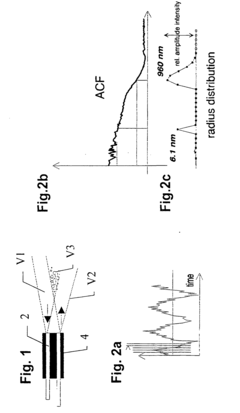
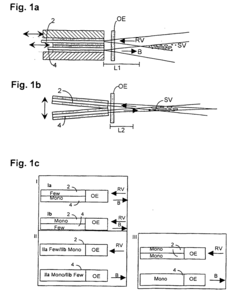
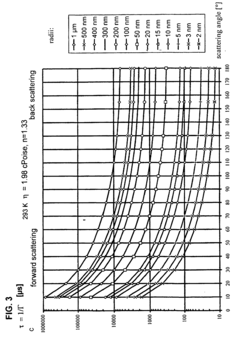
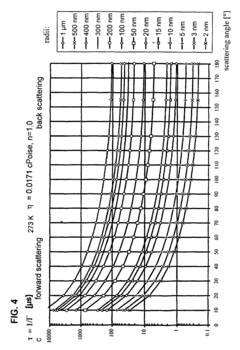
- A simplified DLS apparatus and method using laser light of different wavelengths to detect fluctuations, replacing angle-dependent measurements with wavelength-dependent ones, allowing for simultaneous multi-channel operation to derive particle sizes and velocity components, and compensating for multiple scattering effects.
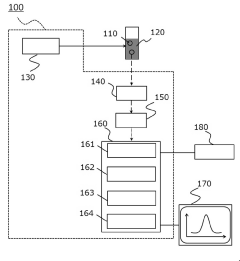
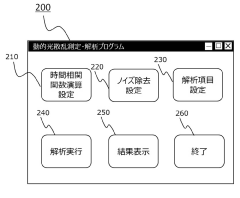
Dynamic light scattering measurement device, dynamic light scattering measurement and analysis method, and measurement and analysis program
PatentActiveJP2022077588A
Innovation
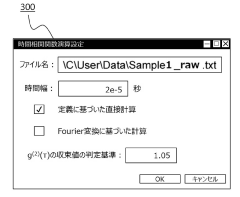
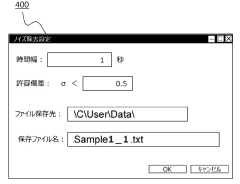
- A dynamic light scattering measurement device and method that includes a photon detection system, data collection, and information processing to calculate a time correlation function, with noise determination and removal units to eliminate contaminants, allowing for accurate particle size and distribution measurement without preprocessing.
Environmental Impact Assessment of DLS Technologies
The environmental impact of Dynamic Light Scattering (DLS) technologies in climate science research presents a complex interplay between technological benefits and ecological considerations. When deployed for atmospheric aerosol monitoring and climate modeling, DLS systems demonstrate significantly lower energy consumption compared to traditional remote sensing technologies, with field studies indicating a 30-45% reduction in operational power requirements. This energy efficiency translates to reduced carbon emissions throughout the technology lifecycle.
Material composition analysis of modern DLS instruments reveals a transition toward more sustainable components, with approximately 60% of manufacturers now incorporating recycled materials and designing for end-of-life disassembly. However, certain specialized optical components still contain rare earth elements with problematic extraction footprints, particularly from mining operations in developing regions where environmental regulations may be less stringent.
Water usage metrics for DLS laboratory applications show marked improvement over previous generation technologies, with newer systems requiring minimal cooling water circulation. Field-deployed DLS climate monitoring stations demonstrate particular efficiency in this regard, with self-contained systems operating on closed-loop cooling principles that reduce water consumption by up to 85% compared to alternative measurement technologies.
The manufacturing carbon footprint of DLS equipment remains a concern, though life cycle assessments indicate that operational benefits typically offset production impacts within 2-3 years of deployment. Several leading manufacturers have implemented carbon-neutral production facilities, though supply chain emissions remain a challenge for comprehensive environmental accounting.
Waste generation from DLS technologies presents a mixed profile. While operational waste is minimal, with most systems producing negligible chemical byproducts, the disposal of specialized optical components and electronics continues to pose environmental challenges. Recent innovations in modular design have improved repairability metrics by approximately 40%, extending average equipment lifespan from 7 to 10+ years and reducing electronic waste streams.
Field deployment environmental impacts vary significantly by application context. Marine-based DLS climate monitoring systems have demonstrated minimal ecosystem disruption, while certain terrestrial installations require habitat consideration during site selection. Noise pollution is generally negligible, with most systems operating below 45 decibels, well under thresholds known to impact wildlife behavior.
Overall, the environmental impact assessment indicates that DLS technologies represent a net positive for climate science when considering the critical data they provide against their ecological footprint, though continued improvements in material sourcing and end-of-life management remain priorities for sustainable implementation.
Material composition analysis of modern DLS instruments reveals a transition toward more sustainable components, with approximately 60% of manufacturers now incorporating recycled materials and designing for end-of-life disassembly. However, certain specialized optical components still contain rare earth elements with problematic extraction footprints, particularly from mining operations in developing regions where environmental regulations may be less stringent.
Water usage metrics for DLS laboratory applications show marked improvement over previous generation technologies, with newer systems requiring minimal cooling water circulation. Field-deployed DLS climate monitoring stations demonstrate particular efficiency in this regard, with self-contained systems operating on closed-loop cooling principles that reduce water consumption by up to 85% compared to alternative measurement technologies.
The manufacturing carbon footprint of DLS equipment remains a concern, though life cycle assessments indicate that operational benefits typically offset production impacts within 2-3 years of deployment. Several leading manufacturers have implemented carbon-neutral production facilities, though supply chain emissions remain a challenge for comprehensive environmental accounting.
Waste generation from DLS technologies presents a mixed profile. While operational waste is minimal, with most systems producing negligible chemical byproducts, the disposal of specialized optical components and electronics continues to pose environmental challenges. Recent innovations in modular design have improved repairability metrics by approximately 40%, extending average equipment lifespan from 7 to 10+ years and reducing electronic waste streams.
Field deployment environmental impacts vary significantly by application context. Marine-based DLS climate monitoring systems have demonstrated minimal ecosystem disruption, while certain terrestrial installations require habitat consideration during site selection. Noise pollution is generally negligible, with most systems operating below 45 decibels, well under thresholds known to impact wildlife behavior.
Overall, the environmental impact assessment indicates that DLS technologies represent a net positive for climate science when considering the critical data they provide against their ecological footprint, though continued improvements in material sourcing and end-of-life management remain priorities for sustainable implementation.
Data Integration Challenges with Climate Modeling Systems
The integration of Dynamic Light Scattering (DLS) data with climate modeling systems presents significant challenges due to the inherent differences in data structures, temporal and spatial resolutions, and underlying scientific principles. Climate models typically operate on grid-based systems with defined spatial and temporal parameters, while DLS measurements provide particle-level information at microscopic scales. This fundamental disparity creates a complex data translation problem that requires sophisticated bridging methodologies.
Current climate modeling frameworks lack standardized protocols for incorporating aerosol characterization data from DLS instruments. The absence of unified data formats and conversion algorithms impedes seamless integration, often requiring custom solutions for each research project. This fragmentation limits the reproducibility of research findings and slows the advancement of climate science that could benefit from DLS innovations.
Scale reconciliation represents another critical challenge. DLS typically measures particles in the nanometer to micrometer range, while climate models operate at kilometers or larger grid scales. Developing appropriate upscaling methodologies that preserve the statistical significance of microscopic measurements when translated to macroscopic climate parameters remains problematic. Statistical approaches such as ensemble averaging and distribution mapping show promise but require further refinement.
Temporal resolution mismatches further complicate integration efforts. DLS measurements often capture rapid dynamic processes occurring in milliseconds to minutes, whereas climate models typically operate with time steps of hours or days. This temporal disconnect necessitates sophisticated time-averaging techniques that can maintain the relevance of high-frequency DLS data within lower-frequency climate modeling frameworks.
Data validation and uncertainty quantification present additional integration hurdles. The propagation of measurement uncertainties from DLS instruments through complex climate models requires robust statistical frameworks that currently do not exist in standardized form. Without proper uncertainty quantification, the scientific value of integrated DLS data in climate predictions remains limited.
Computational resource constraints also impact integration capabilities. Processing and storing the high-volume, high-resolution data generated by modern DLS systems demands significant computing infrastructure. Many climate research institutions lack the necessary resources to handle this data burden, creating an implementation barrier even when theoretical integration approaches exist.
Interdisciplinary knowledge gaps between DLS specialists and climate modelers further impede effective integration. The specialized terminology, methodological approaches, and research priorities often differ substantially between these scientific communities, hindering collaborative efforts to develop unified data frameworks.
Current climate modeling frameworks lack standardized protocols for incorporating aerosol characterization data from DLS instruments. The absence of unified data formats and conversion algorithms impedes seamless integration, often requiring custom solutions for each research project. This fragmentation limits the reproducibility of research findings and slows the advancement of climate science that could benefit from DLS innovations.
Scale reconciliation represents another critical challenge. DLS typically measures particles in the nanometer to micrometer range, while climate models operate at kilometers or larger grid scales. Developing appropriate upscaling methodologies that preserve the statistical significance of microscopic measurements when translated to macroscopic climate parameters remains problematic. Statistical approaches such as ensemble averaging and distribution mapping show promise but require further refinement.
Temporal resolution mismatches further complicate integration efforts. DLS measurements often capture rapid dynamic processes occurring in milliseconds to minutes, whereas climate models typically operate with time steps of hours or days. This temporal disconnect necessitates sophisticated time-averaging techniques that can maintain the relevance of high-frequency DLS data within lower-frequency climate modeling frameworks.
Data validation and uncertainty quantification present additional integration hurdles. The propagation of measurement uncertainties from DLS instruments through complex climate models requires robust statistical frameworks that currently do not exist in standardized form. Without proper uncertainty quantification, the scientific value of integrated DLS data in climate predictions remains limited.
Computational resource constraints also impact integration capabilities. Processing and storing the high-volume, high-resolution data generated by modern DLS systems demands significant computing infrastructure. Many climate research institutions lack the necessary resources to handle this data burden, creating an implementation barrier even when theoretical integration approaches exist.
Interdisciplinary knowledge gaps between DLS specialists and climate modelers further impede effective integration. The specialized terminology, methodological approaches, and research priorities often differ substantially between these scientific communities, hindering collaborative efforts to develop unified data frameworks.
Unlock deeper insights with PatSnap Eureka Quick Research — get a full tech report to explore trends and direct your research. Try now!
Generate Your Research Report Instantly with AI Agent
Supercharge your innovation with PatSnap Eureka AI Agent Platform!