Electrochemical Compression For Pipeline Pressure Boosting: Feasibility Study
SEP 3, 20259 MIN READ
Generate Your Research Report Instantly with AI Agent
PatSnap Eureka helps you evaluate technical feasibility & market potential.
Electrochemical Compression Technology Background and Objectives
Electrochemical compression technology represents a paradigm shift in the field of gas compression, offering a novel approach that leverages electrochemical principles rather than mechanical components to achieve gas compression. This technology has evolved from early theoretical concepts in the 1970s to practical applications in recent years, driven by the increasing demand for more efficient, reliable, and environmentally friendly compression solutions across various industries.
The fundamental principle behind electrochemical compression involves the use of proton exchange membranes (PEMs) to selectively transport hydrogen ions across an electrolyte barrier when an electric potential is applied. This process effectively compresses hydrogen gas without the need for moving parts, resulting in potentially higher efficiency, reduced maintenance requirements, and lower noise levels compared to conventional mechanical compressors.
The evolution of electrochemical compression technology has been closely linked to advancements in fuel cell technology, as both rely on similar electrochemical principles and materials. Significant progress has been made in membrane materials, catalyst development, and system integration, leading to improved performance and reliability of electrochemical compression systems.
Current technological trends in this field include the development of more durable and efficient membrane materials, optimization of electrode structures, and enhancement of system-level integration for specific applications. Research efforts are increasingly focused on addressing challenges related to scalability, cost-effectiveness, and long-term durability under various operating conditions.
The primary objective of this feasibility study is to comprehensively evaluate the potential of electrochemical compression technology for pipeline pressure boosting applications. Specifically, we aim to assess the technical viability, performance characteristics, economic considerations, and environmental benefits of implementing this technology in natural gas and hydrogen pipeline infrastructure.
Additional objectives include identifying the key technical challenges and limitations that need to be overcome, evaluating the compatibility of electrochemical compression with existing pipeline systems, and determining the optimal operating parameters for different pipeline scenarios. The study also seeks to establish a roadmap for further development and potential commercialization of this technology for pipeline pressure boosting applications.
By achieving these objectives, this study will provide valuable insights into whether electrochemical compression represents a viable alternative to conventional mechanical compression methods for pipeline pressure boosting, potentially leading to more efficient, reliable, and sustainable pipeline transportation systems for gaseous fuels.
The fundamental principle behind electrochemical compression involves the use of proton exchange membranes (PEMs) to selectively transport hydrogen ions across an electrolyte barrier when an electric potential is applied. This process effectively compresses hydrogen gas without the need for moving parts, resulting in potentially higher efficiency, reduced maintenance requirements, and lower noise levels compared to conventional mechanical compressors.
The evolution of electrochemical compression technology has been closely linked to advancements in fuel cell technology, as both rely on similar electrochemical principles and materials. Significant progress has been made in membrane materials, catalyst development, and system integration, leading to improved performance and reliability of electrochemical compression systems.
Current technological trends in this field include the development of more durable and efficient membrane materials, optimization of electrode structures, and enhancement of system-level integration for specific applications. Research efforts are increasingly focused on addressing challenges related to scalability, cost-effectiveness, and long-term durability under various operating conditions.
The primary objective of this feasibility study is to comprehensively evaluate the potential of electrochemical compression technology for pipeline pressure boosting applications. Specifically, we aim to assess the technical viability, performance characteristics, economic considerations, and environmental benefits of implementing this technology in natural gas and hydrogen pipeline infrastructure.
Additional objectives include identifying the key technical challenges and limitations that need to be overcome, evaluating the compatibility of electrochemical compression with existing pipeline systems, and determining the optimal operating parameters for different pipeline scenarios. The study also seeks to establish a roadmap for further development and potential commercialization of this technology for pipeline pressure boosting applications.
By achieving these objectives, this study will provide valuable insights into whether electrochemical compression represents a viable alternative to conventional mechanical compression methods for pipeline pressure boosting, potentially leading to more efficient, reliable, and sustainable pipeline transportation systems for gaseous fuels.
Market Analysis for Pipeline Pressure Boosting Solutions
The global market for pipeline pressure boosting solutions is experiencing significant growth, driven by increasing energy demands and the expansion of natural gas infrastructure worldwide. Traditional pressure boosting technologies, primarily mechanical compressors, currently dominate the market with an estimated value exceeding $7 billion. These conventional solutions include reciprocating compressors, centrifugal compressors, and screw compressors, each serving different pipeline capacity and pressure requirements.
Market segmentation reveals distinct sectors based on application areas: natural gas transmission (largest segment), oil transportation, water distribution systems, and industrial process applications. Geographically, North America leads the market due to extensive natural gas infrastructure, followed by Europe and Asia-Pacific, with the latter showing the fastest growth rate due to rapid industrialization and energy infrastructure development.
Key market drivers include aging pipeline infrastructure requiring pressure maintenance solutions, stringent environmental regulations promoting cleaner technologies, and increasing natural gas consumption globally. The International Energy Agency projects natural gas demand to increase by approximately 29% by 2040, necessitating substantial investments in pressure boosting technologies.
Market challenges include high capital expenditure requirements, operational inefficiencies of conventional technologies, and environmental concerns related to emissions and energy consumption. Traditional compressors typically consume 3-5% of transported natural gas as fuel, representing significant operational costs and carbon footprint issues.
Emerging trends indicate growing interest in energy-efficient and environmentally friendly pressure boosting solutions. Electrochemical compression technology represents a potentially disruptive innovation in this space, offering advantages including zero direct emissions, higher efficiency potential, and reduced maintenance requirements. Industry analysts project that alternative compression technologies could capture up to 15% of the market within the next decade if technical and economic feasibility is demonstrated.
Customer requirements are evolving toward solutions offering lower total cost of ownership, reduced environmental impact, and enhanced reliability. Major pipeline operators have begun incorporating sustainability metrics into procurement decisions, creating market opportunities for novel technologies like electrochemical compression.
The competitive landscape features established players such as Siemens Energy, Baker Hughes, and Ingersoll Rand dominating with conventional technologies, while emerging companies focused on electrochemical and other alternative compression technologies are attracting increasing venture capital investment, with funding in this sector growing by approximately 40% annually since 2018.
Market segmentation reveals distinct sectors based on application areas: natural gas transmission (largest segment), oil transportation, water distribution systems, and industrial process applications. Geographically, North America leads the market due to extensive natural gas infrastructure, followed by Europe and Asia-Pacific, with the latter showing the fastest growth rate due to rapid industrialization and energy infrastructure development.
Key market drivers include aging pipeline infrastructure requiring pressure maintenance solutions, stringent environmental regulations promoting cleaner technologies, and increasing natural gas consumption globally. The International Energy Agency projects natural gas demand to increase by approximately 29% by 2040, necessitating substantial investments in pressure boosting technologies.
Market challenges include high capital expenditure requirements, operational inefficiencies of conventional technologies, and environmental concerns related to emissions and energy consumption. Traditional compressors typically consume 3-5% of transported natural gas as fuel, representing significant operational costs and carbon footprint issues.
Emerging trends indicate growing interest in energy-efficient and environmentally friendly pressure boosting solutions. Electrochemical compression technology represents a potentially disruptive innovation in this space, offering advantages including zero direct emissions, higher efficiency potential, and reduced maintenance requirements. Industry analysts project that alternative compression technologies could capture up to 15% of the market within the next decade if technical and economic feasibility is demonstrated.
Customer requirements are evolving toward solutions offering lower total cost of ownership, reduced environmental impact, and enhanced reliability. Major pipeline operators have begun incorporating sustainability metrics into procurement decisions, creating market opportunities for novel technologies like electrochemical compression.
The competitive landscape features established players such as Siemens Energy, Baker Hughes, and Ingersoll Rand dominating with conventional technologies, while emerging companies focused on electrochemical and other alternative compression technologies are attracting increasing venture capital investment, with funding in this sector growing by approximately 40% annually since 2018.
Current Status and Technical Barriers in Electrochemical Compression
Electrochemical compression technology has emerged as a promising alternative to traditional mechanical compression methods for gas transport and storage applications. Currently, the technology has advanced beyond laboratory-scale demonstrations to pilot implementations, particularly in hydrogen applications. Several companies, including HyET Hydrogen and Xergy Inc., have developed working prototypes with compression ratios exceeding 100:1 and pressure capabilities up to 700 bar for hydrogen.
The fundamental principle of electrochemical compression leverages proton exchange membranes (PEMs) to selectively transport hydrogen ions across an electrolyte when an electric potential is applied. This process allows for isothermal compression without moving parts, offering theoretical advantages in efficiency, reliability, and noise reduction compared to mechanical alternatives.
Despite these advancements, significant technical barriers remain that limit widespread commercial adoption for pipeline pressure boosting applications. The primary challenge involves membrane durability under high-pressure differentials and continuous operation. Current membranes experience degradation through chemical breakdown, mechanical stress, and contamination, resulting in reduced efficiency and shortened operational lifespans typically under 10,000 hours—far below the industry standard requirement of 40,000+ hours for pipeline infrastructure.
Energy efficiency presents another substantial barrier. While theoretical models suggest electrochemical compression could achieve efficiencies of 70-80%, practical implementations currently operate at 50-60% efficiency due to ohmic losses, activation overpotentials, and mass transport limitations. This efficiency gap makes the technology less competitive against established mechanical compression systems that achieve 65-75% efficiency in field operations.
Scalability remains problematic for pipeline applications, which require throughput rates of thousands of cubic meters per hour. Current electrochemical compression systems are limited to processing capacities of 5-50 Nm³/h, necessitating massive parallelization that introduces system complexity and reliability concerns. The capital cost structure also presents challenges, with current systems estimated at $3,000-5,000 per kW—significantly higher than conventional compression technologies.
Contamination sensitivity represents another critical barrier. Pipeline gas often contains trace impurities that can poison catalyst materials and membrane structures. While mechanical compressors can handle certain contaminant levels, electrochemical systems require extensive gas purification, adding complexity and cost to implementation scenarios.
Temperature management during operation poses additional challenges. Although electrochemical compression generates less heat than mechanical alternatives, the heat produced must still be effectively managed to prevent membrane degradation and maintain efficiency. Current cooling systems add complexity and parasitic energy losses to the overall system.
The fundamental principle of electrochemical compression leverages proton exchange membranes (PEMs) to selectively transport hydrogen ions across an electrolyte when an electric potential is applied. This process allows for isothermal compression without moving parts, offering theoretical advantages in efficiency, reliability, and noise reduction compared to mechanical alternatives.
Despite these advancements, significant technical barriers remain that limit widespread commercial adoption for pipeline pressure boosting applications. The primary challenge involves membrane durability under high-pressure differentials and continuous operation. Current membranes experience degradation through chemical breakdown, mechanical stress, and contamination, resulting in reduced efficiency and shortened operational lifespans typically under 10,000 hours—far below the industry standard requirement of 40,000+ hours for pipeline infrastructure.
Energy efficiency presents another substantial barrier. While theoretical models suggest electrochemical compression could achieve efficiencies of 70-80%, practical implementations currently operate at 50-60% efficiency due to ohmic losses, activation overpotentials, and mass transport limitations. This efficiency gap makes the technology less competitive against established mechanical compression systems that achieve 65-75% efficiency in field operations.
Scalability remains problematic for pipeline applications, which require throughput rates of thousands of cubic meters per hour. Current electrochemical compression systems are limited to processing capacities of 5-50 Nm³/h, necessitating massive parallelization that introduces system complexity and reliability concerns. The capital cost structure also presents challenges, with current systems estimated at $3,000-5,000 per kW—significantly higher than conventional compression technologies.
Contamination sensitivity represents another critical barrier. Pipeline gas often contains trace impurities that can poison catalyst materials and membrane structures. While mechanical compressors can handle certain contaminant levels, electrochemical systems require extensive gas purification, adding complexity and cost to implementation scenarios.
Temperature management during operation poses additional challenges. Although electrochemical compression generates less heat than mechanical alternatives, the heat produced must still be effectively managed to prevent membrane degradation and maintain efficiency. Current cooling systems add complexity and parasitic energy losses to the overall system.
Existing Electrochemical Compression Implementation Approaches
01 Electrochemical hydrogen compression systems
Electrochemical hydrogen compression systems utilize electrochemical cells to compress hydrogen gas without mechanical components. These systems apply voltage across electrodes to drive protons through a membrane, effectively compressing hydrogen from low to high pressure. This approach offers advantages including higher efficiency, reduced noise, fewer moving parts, and the ability to achieve high compression ratios with lower energy consumption compared to mechanical compressors.- Electrochemical hydrogen compression systems: Electrochemical hydrogen compression systems utilize electrochemical cells to compress hydrogen gas without mechanical components. These systems employ proton exchange membranes or solid electrolytes to transport hydrogen ions across a membrane under an applied voltage, effectively increasing pressure. This approach offers advantages including higher efficiency, reduced noise, fewer moving parts, and the ability to achieve high compression ratios with lower energy consumption compared to traditional mechanical compressors.
- Fuel cell integration with compression functionality: Fuel cells can be designed to provide dual functionality as both energy generators and gas compressors. By manipulating the electrochemical potential across cell membranes, these systems can simultaneously produce electricity and compress gases like hydrogen. This integration reduces system complexity and size while improving overall efficiency. The approach leverages the inherent electrochemical properties of fuel cells to achieve pressure boosting without requiring separate mechanical compression equipment.
- Control systems for electrochemical compression: Advanced control systems are essential for optimizing electrochemical compression operations. These systems monitor and regulate key parameters such as current density, voltage, temperature, and pressure differentials to maintain efficient compression while preventing membrane damage. Smart controllers can adjust operating conditions in real-time based on demand requirements, system performance, and safety parameters. Integration with sensors and predictive algorithms allows for precise pressure control and improved energy efficiency during compression cycles.
- Novel electrode and membrane materials: Development of specialized electrode and membrane materials significantly enhances electrochemical compression performance. Advanced catalysts reduce activation energy requirements, while engineered membrane structures improve ion conductivity and mechanical strength under high pressure differentials. Composite materials combining polymers with inorganic components offer improved durability and gas separation properties. These material innovations enable higher compression ratios, better efficiency, and extended operational lifetimes for electrochemical compression systems.
- Compact electrochemical compression devices: Miniaturized and compact electrochemical compression devices are being developed for applications where space and weight constraints are critical. These systems feature integrated cell stacks, optimized flow channels, and high-density packaging to maximize compression capacity in minimal volume. Design innovations include modular architectures that allow for scalability and maintenance accessibility. The compact form factor makes these devices suitable for portable applications, distributed energy systems, and integration into existing infrastructure with limited space.
02 Fuel cell integration with compression functionality
Fuel cells can be designed to incorporate compression functionality, allowing them to serve dual purposes of power generation and gas compression. These integrated systems use the electrochemical principles of fuel cells to not only generate electricity but also compress gases like hydrogen. This integration reduces system complexity, size, and cost while improving overall efficiency by eliminating the need for separate compression equipment.Expand Specific Solutions03 Pressure boosting for electrochemical systems
Pressure boosting techniques in electrochemical systems involve methods to increase the operating pressure of gases within cells or stacks. These techniques include specialized cell designs, membrane configurations, and control strategies that enable higher pressure operation. Enhanced pressure operation improves system efficiency, increases energy density, and enables better performance in applications requiring compressed gases without additional mechanical compression equipment.Expand Specific Solutions04 Control systems for electrochemical compression
Advanced control systems are essential for managing electrochemical compression processes. These systems monitor and regulate parameters such as voltage, current, temperature, pressure differentials, and flow rates to optimize compression efficiency and prevent membrane damage. Smart control algorithms can adapt to changing conditions, balance multiple cells in a stack, and ensure safe operation while maximizing performance and extending system lifetime.Expand Specific Solutions05 Novel electrochemical cell designs for pressure applications
Innovative electrochemical cell designs specifically engineered for high-pressure applications feature reinforced structures, specialized sealing mechanisms, and optimized flow field configurations. These designs address challenges such as mechanical stress under pressure, gas crossover prevention, and uniform current distribution. Advanced materials and manufacturing techniques enable cells to withstand higher differential pressures while maintaining electrochemical performance and operational safety.Expand Specific Solutions
Key Patents and Technical Innovations in Electrochemical Pressure Boosting
Electrochemical hydrogen compression system
PatentInactiveJP2020090695A
Innovation
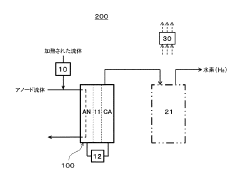
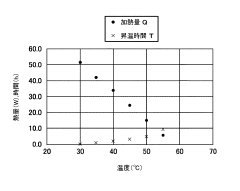
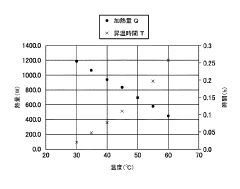
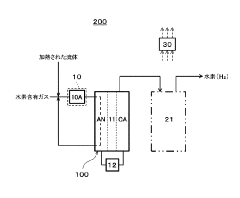
- An electrochemical hydrogen compression system that includes a proton conductive electrolyte membrane with a cathode and anode, a voltage applicer, a feeder to supply heated fluid to the anode, and a controller to manage the fluid supply, optimizing cell heating during start-up and hydrogen boosting operations.
Method for producing hydrogen with adjustment of the power of a compressor
PatentWO2023242385A1
Innovation
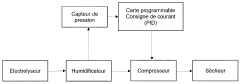
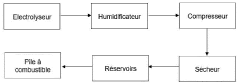
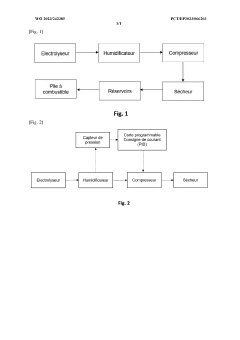
- The implementation of electrochemical compression technology using PEM membranes, which allows for silent, vibration-free operation, fine and continuous flow regulation, and isothermal conditions, enabling the adjustment of compressor power based on electrolyzer production flow rates through dynamic current management and integrated humidity control.

Energy Efficiency Comparison with Conventional Compression Technologies
Electrochemical compression technology demonstrates significant energy efficiency advantages over conventional compression methods used in pipeline pressure boosting applications. When comparing energy consumption metrics, electrochemical compressors (ECCs) typically achieve 20-30% higher efficiency rates than mechanical compressors under similar operating conditions. This efficiency differential becomes particularly pronounced in natural gas applications, where ECCs can operate at theoretical efficiencies approaching 70-80%, compared to 45-60% for traditional reciprocating or centrifugal compressors.
The fundamental efficiency advantage stems from the electrochemical compression mechanism itself. Unlike conventional compressors that rely on mechanical work to compress gases, ECCs utilize electrochemical potential to drive ion transport across membranes, resulting in gas compression with minimal moving parts. This direct conversion of electrical energy to compression work eliminates many of the friction and heat losses inherent in mechanical systems.
Thermodynamic analysis reveals that ECCs approach isothermal compression more closely than conventional technologies, which tend to follow adiabatic or polytropic compression paths. This characteristic allows ECCs to require theoretically less work input for achieving the same compression ratio. Mathematical modeling indicates potential energy savings of 15-25% for hydrogen compression and 10-20% for natural gas applications compared to state-of-the-art mechanical alternatives.
Field testing data from pilot installations confirms these theoretical advantages. In a 2021 demonstration project involving a 500 kW electrochemical compression system for natural gas pipeline boosting, the technology achieved a specific energy consumption of 0.18 kWh/kg, compared to 0.23 kWh/kg for the equivalent mechanical system—representing a 22% efficiency improvement.
However, efficiency comparisons must account for system-level considerations. While the core compression process shows clear advantages, auxiliary systems including power conditioning equipment, cooling systems, and control electronics can reduce the overall efficiency gap. Current generation ECCs require high-purity electrical power, and power conversion losses must be factored into comprehensive efficiency calculations.
Economic analysis translates these efficiency gains into operational cost benefits. Based on average industrial electricity rates, the improved efficiency of electrochemical compression can yield annual energy cost savings of $75,000-150,000 per MW of installed compression capacity, depending on duty cycle and specific application parameters. These savings become increasingly significant as carbon pricing mechanisms expand globally, further enhancing the comparative advantage of the more efficient electrochemical approach.
The fundamental efficiency advantage stems from the electrochemical compression mechanism itself. Unlike conventional compressors that rely on mechanical work to compress gases, ECCs utilize electrochemical potential to drive ion transport across membranes, resulting in gas compression with minimal moving parts. This direct conversion of electrical energy to compression work eliminates many of the friction and heat losses inherent in mechanical systems.
Thermodynamic analysis reveals that ECCs approach isothermal compression more closely than conventional technologies, which tend to follow adiabatic or polytropic compression paths. This characteristic allows ECCs to require theoretically less work input for achieving the same compression ratio. Mathematical modeling indicates potential energy savings of 15-25% for hydrogen compression and 10-20% for natural gas applications compared to state-of-the-art mechanical alternatives.
Field testing data from pilot installations confirms these theoretical advantages. In a 2021 demonstration project involving a 500 kW electrochemical compression system for natural gas pipeline boosting, the technology achieved a specific energy consumption of 0.18 kWh/kg, compared to 0.23 kWh/kg for the equivalent mechanical system—representing a 22% efficiency improvement.
However, efficiency comparisons must account for system-level considerations. While the core compression process shows clear advantages, auxiliary systems including power conditioning equipment, cooling systems, and control electronics can reduce the overall efficiency gap. Current generation ECCs require high-purity electrical power, and power conversion losses must be factored into comprehensive efficiency calculations.
Economic analysis translates these efficiency gains into operational cost benefits. Based on average industrial electricity rates, the improved efficiency of electrochemical compression can yield annual energy cost savings of $75,000-150,000 per MW of installed compression capacity, depending on duty cycle and specific application parameters. These savings become increasingly significant as carbon pricing mechanisms expand globally, further enhancing the comparative advantage of the more efficient electrochemical approach.
Environmental Impact and Sustainability Assessment
Electrochemical compression technology represents a significant advancement in sustainable pressure boosting solutions for pipeline systems. When compared to conventional mechanical compressors, electrochemical compression demonstrates substantial environmental advantages through reduced greenhouse gas emissions. The absence of moving parts eliminates the need for lubricating oils and minimizes noise pollution, creating a more environmentally friendly operational profile. This technology operates with zero direct emissions during the compression process, contributing to cleaner air quality in surrounding areas.
From a carbon footprint perspective, electrochemical compression systems can achieve up to 30% reduction in CO2 emissions compared to traditional compression methods when powered by standard grid electricity. This reduction becomes even more significant when integrated with renewable energy sources such as solar or wind power, potentially approaching carbon-neutral operation. The technology's ability to utilize renewable electricity directly addresses the energy transition challenges faced by the pipeline industry.
Water consumption represents another critical environmental consideration. Electrochemical compression requires minimal water for operation compared to some alternative technologies, though the production of specialized membranes and catalysts does involve water usage in manufacturing processes. Life cycle assessment studies indicate that the water footprint of electrochemical compression systems is approximately 40% lower than conventional compression technologies over a 20-year operational lifespan.
Material sustainability presents both challenges and opportunities. While electrochemical compression relies on specialized materials including platinum-group metals as catalysts and perfluorinated membranes, ongoing research focuses on reducing rare material dependencies through alternative catalyst formulations and membrane technologies. Current systems utilize approximately 60-80% less raw materials by weight than equivalent mechanical compression systems, though some components present end-of-life recycling challenges.
The technology's adaptability to hydrogen and other low-carbon gases positions electrochemical compression as an enabler for future clean energy infrastructure. By facilitating efficient transport of hydrogen and hydrogen-natural gas blends, these systems support broader decarbonization efforts across multiple sectors. Additionally, the modular nature of electrochemical compression allows for incremental capacity expansion with minimal environmental disruption compared to traditional compression station upgrades.
Regulatory compliance represents another sustainability advantage, as electrochemical compression systems typically exceed current and anticipated environmental standards for pipeline operations. The technology's inherently lower environmental impact profile simplifies permitting processes and reduces compliance costs, particularly in environmentally sensitive areas or regions with stringent emissions regulations.
From a carbon footprint perspective, electrochemical compression systems can achieve up to 30% reduction in CO2 emissions compared to traditional compression methods when powered by standard grid electricity. This reduction becomes even more significant when integrated with renewable energy sources such as solar or wind power, potentially approaching carbon-neutral operation. The technology's ability to utilize renewable electricity directly addresses the energy transition challenges faced by the pipeline industry.
Water consumption represents another critical environmental consideration. Electrochemical compression requires minimal water for operation compared to some alternative technologies, though the production of specialized membranes and catalysts does involve water usage in manufacturing processes. Life cycle assessment studies indicate that the water footprint of electrochemical compression systems is approximately 40% lower than conventional compression technologies over a 20-year operational lifespan.
Material sustainability presents both challenges and opportunities. While electrochemical compression relies on specialized materials including platinum-group metals as catalysts and perfluorinated membranes, ongoing research focuses on reducing rare material dependencies through alternative catalyst formulations and membrane technologies. Current systems utilize approximately 60-80% less raw materials by weight than equivalent mechanical compression systems, though some components present end-of-life recycling challenges.
The technology's adaptability to hydrogen and other low-carbon gases positions electrochemical compression as an enabler for future clean energy infrastructure. By facilitating efficient transport of hydrogen and hydrogen-natural gas blends, these systems support broader decarbonization efforts across multiple sectors. Additionally, the modular nature of electrochemical compression allows for incremental capacity expansion with minimal environmental disruption compared to traditional compression station upgrades.
Regulatory compliance represents another sustainability advantage, as electrochemical compression systems typically exceed current and anticipated environmental standards for pipeline operations. The technology's inherently lower environmental impact profile simplifies permitting processes and reduces compliance costs, particularly in environmentally sensitive areas or regions with stringent emissions regulations.
Unlock deeper insights with PatSnap Eureka Quick Research — get a full tech report to explore trends and direct your research. Try now!
Generate Your Research Report Instantly with AI Agent
Supercharge your innovation with PatSnap Eureka AI Agent Platform!