

Electrochemical Compressor Integration With Fuel Cell Microgrids
SEP 3, 20259 MIN READ
Generate Your Research Report Instantly with AI Agent
PatSnap Eureka helps you evaluate technical feasibility & market potential.
Electrochemical Compression Technology Evolution and Objectives
Electrochemical compression technology has evolved significantly over the past three decades, transitioning from theoretical concepts to practical applications in various energy systems. The fundamental principle, which leverages electrochemical reactions to compress gases without mechanical components, was first explored in the 1990s with hydrogen compression experiments. By the early 2000s, researchers had demonstrated small-scale prototypes achieving modest compression ratios of 5-10:1, primarily focused on hydrogen applications.
The technology saw accelerated development between 2010-2015, when materials science advancements enabled more efficient proton exchange membranes and catalysts, pushing compression ratios beyond 30:1 while improving energy efficiency. This period marked the shift from laboratory curiosity to potential commercial viability, particularly as interest in hydrogen energy systems grew globally.
Recent years (2018-2023) have witnessed integration-focused development, with electrochemical compressors being tested alongside fuel cells, electrolyzers, and renewable energy systems. The technology has evolved from standalone components to integrated subsystems designed for specific applications, including microgrids and distributed energy resources.
The primary objective of electrochemical compression technology in fuel cell microgrids is to enable efficient hydrogen management within closed-loop energy systems. This includes compression for storage at higher densities (350-700 bar), pressure regulation for optimal fuel cell operation, and system-level energy efficiency improvements through waste heat recovery and electrical load balancing.
Secondary objectives include enhancing microgrid resilience through improved energy storage capabilities, reducing system complexity by eliminating mechanical compression components, and enabling more flexible operation through precise pressure control. The technology aims to address the intermittency challenges of renewable energy sources by facilitating hydrogen-based long-duration energy storage within microgrid architectures.
Looking forward, the technology evolution is expected to focus on three key areas: materials advancement for higher durability and efficiency, system integration optimization for seamless operation with fuel cells and electrolyzers, and cost reduction through manufacturing scale and design simplification. The ultimate goal is to establish electrochemical compression as a core enabling technology for hydrogen-based microgrids, supporting the broader transition toward decentralized, renewable energy systems with enhanced storage capabilities.
The technology saw accelerated development between 2010-2015, when materials science advancements enabled more efficient proton exchange membranes and catalysts, pushing compression ratios beyond 30:1 while improving energy efficiency. This period marked the shift from laboratory curiosity to potential commercial viability, particularly as interest in hydrogen energy systems grew globally.
Recent years (2018-2023) have witnessed integration-focused development, with electrochemical compressors being tested alongside fuel cells, electrolyzers, and renewable energy systems. The technology has evolved from standalone components to integrated subsystems designed for specific applications, including microgrids and distributed energy resources.
The primary objective of electrochemical compression technology in fuel cell microgrids is to enable efficient hydrogen management within closed-loop energy systems. This includes compression for storage at higher densities (350-700 bar), pressure regulation for optimal fuel cell operation, and system-level energy efficiency improvements through waste heat recovery and electrical load balancing.
Secondary objectives include enhancing microgrid resilience through improved energy storage capabilities, reducing system complexity by eliminating mechanical compression components, and enabling more flexible operation through precise pressure control. The technology aims to address the intermittency challenges of renewable energy sources by facilitating hydrogen-based long-duration energy storage within microgrid architectures.
Looking forward, the technology evolution is expected to focus on three key areas: materials advancement for higher durability and efficiency, system integration optimization for seamless operation with fuel cells and electrolyzers, and cost reduction through manufacturing scale and design simplification. The ultimate goal is to establish electrochemical compression as a core enabling technology for hydrogen-based microgrids, supporting the broader transition toward decentralized, renewable energy systems with enhanced storage capabilities.
Market Analysis for Fuel Cell Microgrid Applications
The fuel cell microgrid market is experiencing significant growth, driven by increasing demand for reliable, clean energy solutions in both grid-connected and off-grid applications. The global microgrid market was valued at approximately $28.6 billion in 2022, with projections indicating growth to reach $59.7 billion by 2028, representing a CAGR of 13.1%. Fuel cell microgrids specifically are gaining traction within this broader market, particularly in regions with aggressive decarbonization targets.
North America currently leads the fuel cell microgrid market, accounting for roughly 40% of global installations, followed by Asia-Pacific at 35% and Europe at 20%. This regional distribution reflects varying policy environments, with Japan, South Korea, and California emerging as particularly favorable markets due to supportive regulatory frameworks and incentive programs.
The integration of electrochemical compressors with fuel cell microgrids addresses several critical market needs. Primary among these is the requirement for efficient hydrogen management within microgrid systems, which enables improved energy storage capabilities and system flexibility. Market research indicates that approximately 65% of microgrid operators identify energy storage as their most significant technical challenge, making electrochemical compressor integration particularly valuable.
Commercial and industrial sectors represent the largest market segment for fuel cell microgrids, constituting approximately 45% of current deployments. These customers are primarily motivated by power reliability concerns, with 78% citing business continuity as their primary adoption driver. The healthcare sector follows at 20%, where uninterrupted power supply is critical for patient safety.
Market analysis reveals that the total addressable market for electrochemical compressor-integrated fuel cell microgrids could reach $12.3 billion by 2030, with a particularly strong growth trajectory in island communities, remote industrial facilities, and critical infrastructure applications. These segments value the enhanced efficiency and reliability that electrochemical compressor integration provides.
Customer willingness to pay premiums for enhanced reliability varies by sector, with critical infrastructure operators demonstrating the highest premium tolerance at 25-30% above baseline solutions. Commercial entities typically accept 10-15% premiums, while residential applications remain highly price-sensitive, limiting premium potential to 5-8%.
The market for fuel cell microgrids is expected to benefit from increasing grid instability concerns, with weather-related outages increasing by 67% in the past decade. This trend, combined with declining component costs and increasing system efficiencies enabled by technologies like electrochemical compressors, is projected to accelerate market adoption over the next five years.
North America currently leads the fuel cell microgrid market, accounting for roughly 40% of global installations, followed by Asia-Pacific at 35% and Europe at 20%. This regional distribution reflects varying policy environments, with Japan, South Korea, and California emerging as particularly favorable markets due to supportive regulatory frameworks and incentive programs.
The integration of electrochemical compressors with fuel cell microgrids addresses several critical market needs. Primary among these is the requirement for efficient hydrogen management within microgrid systems, which enables improved energy storage capabilities and system flexibility. Market research indicates that approximately 65% of microgrid operators identify energy storage as their most significant technical challenge, making electrochemical compressor integration particularly valuable.
Commercial and industrial sectors represent the largest market segment for fuel cell microgrids, constituting approximately 45% of current deployments. These customers are primarily motivated by power reliability concerns, with 78% citing business continuity as their primary adoption driver. The healthcare sector follows at 20%, where uninterrupted power supply is critical for patient safety.
Market analysis reveals that the total addressable market for electrochemical compressor-integrated fuel cell microgrids could reach $12.3 billion by 2030, with a particularly strong growth trajectory in island communities, remote industrial facilities, and critical infrastructure applications. These segments value the enhanced efficiency and reliability that electrochemical compressor integration provides.
Customer willingness to pay premiums for enhanced reliability varies by sector, with critical infrastructure operators demonstrating the highest premium tolerance at 25-30% above baseline solutions. Commercial entities typically accept 10-15% premiums, while residential applications remain highly price-sensitive, limiting premium potential to 5-8%.
The market for fuel cell microgrids is expected to benefit from increasing grid instability concerns, with weather-related outages increasing by 67% in the past decade. This trend, combined with declining component costs and increasing system efficiencies enabled by technologies like electrochemical compressors, is projected to accelerate market adoption over the next five years.
Technical Barriers and Global Development Status
The integration of electrochemical compressors with fuel cell microgrids faces several significant technical barriers that have impeded widespread adoption. One primary challenge is the low energy efficiency of current electrochemical compression systems, which typically operate at 30-40% efficiency compared to 60-70% for conventional mechanical compressors. This efficiency gap creates a substantial barrier for implementation in energy-sensitive microgrid applications where every percentage of energy loss is critical.
Material limitations present another major obstacle, particularly regarding membrane durability and degradation. Current proton exchange membranes used in electrochemical compressors suffer from performance deterioration under high-pressure differentials and repeated cycling, resulting in shortened operational lifespans of 2,000-3,000 hours compared to the 40,000+ hours required for commercial viability in microgrid applications.
System integration complexity represents a significant technical challenge, as electrochemical compressors must be seamlessly incorporated into existing fuel cell microgrid architectures. The disparate operating parameters, control systems, and response times between these technologies create substantial engineering hurdles that have not been fully resolved in commercial implementations.
Globally, development status varies significantly by region. North America leads in research initiatives, with the U.S. Department of Energy funding several projects focused on electrochemical compression technologies for hydrogen applications. Notable research centers at Lawrence Berkeley National Laboratory and the National Renewable Energy Laboratory have achieved compression ratios of 100:1 in laboratory settings, though commercial-scale implementations remain limited.
European development efforts are concentrated in Germany, Denmark, and the Netherlands, where public-private partnerships have accelerated technology maturation. The European Hydrogen Backbone initiative has incorporated electrochemical compression as a component of their hydrogen infrastructure strategy, with pilot projects demonstrating integration with renewable energy microgrids.
Asian development is dominated by Japan and South Korea, where companies like Panasonic and Hyundai have invested in proprietary electrochemical compression technologies specifically designed for fuel cell applications. China has recently emerged as a significant player, with substantial government funding directed toward hydrogen infrastructure development including compression technologies.
Current global deployment remains primarily at the demonstration and pilot project level, with fewer than 50 integrated systems operating worldwide. Most installations are subscale (under 50kW) and operate in controlled environments rather than real-world conditions, highlighting the early stage of technology readiness despite promising laboratory results.
Material limitations present another major obstacle, particularly regarding membrane durability and degradation. Current proton exchange membranes used in electrochemical compressors suffer from performance deterioration under high-pressure differentials and repeated cycling, resulting in shortened operational lifespans of 2,000-3,000 hours compared to the 40,000+ hours required for commercial viability in microgrid applications.
System integration complexity represents a significant technical challenge, as electrochemical compressors must be seamlessly incorporated into existing fuel cell microgrid architectures. The disparate operating parameters, control systems, and response times between these technologies create substantial engineering hurdles that have not been fully resolved in commercial implementations.
Globally, development status varies significantly by region. North America leads in research initiatives, with the U.S. Department of Energy funding several projects focused on electrochemical compression technologies for hydrogen applications. Notable research centers at Lawrence Berkeley National Laboratory and the National Renewable Energy Laboratory have achieved compression ratios of 100:1 in laboratory settings, though commercial-scale implementations remain limited.
European development efforts are concentrated in Germany, Denmark, and the Netherlands, where public-private partnerships have accelerated technology maturation. The European Hydrogen Backbone initiative has incorporated electrochemical compression as a component of their hydrogen infrastructure strategy, with pilot projects demonstrating integration with renewable energy microgrids.
Asian development is dominated by Japan and South Korea, where companies like Panasonic and Hyundai have invested in proprietary electrochemical compression technologies specifically designed for fuel cell applications. China has recently emerged as a significant player, with substantial government funding directed toward hydrogen infrastructure development including compression technologies.
Current global deployment remains primarily at the demonstration and pilot project level, with fewer than 50 integrated systems operating worldwide. Most installations are subscale (under 50kW) and operate in controlled environments rather than real-world conditions, highlighting the early stage of technology readiness despite promising laboratory results.
Current Integration Solutions for Microgrids
01 Basic structure and operation principles of electrochemical compressors
Electrochemical compressors utilize electrochemical cells to compress gases without mechanical moving parts. These systems typically consist of electrodes, electrolytes, and membranes that facilitate the transport of ions and gases. When an electric current is applied, gases are compressed through electrochemical reactions at the electrodes, offering a more energy-efficient alternative to traditional mechanical compressors. The technology enables precise control of compression rates through electrical input adjustment.- Electrochemical compressor design and structure: Electrochemical compressors utilize specific structural designs to efficiently compress gases through electrochemical processes. These designs include specialized cell stacks, membrane electrode assemblies, and housing configurations that optimize gas flow and compression efficiency. The structural elements are engineered to withstand operational pressures while minimizing energy losses and maximizing compression ratios.
- Working fluid compositions for electrochemical compression: The selection and formulation of working fluids significantly impact the performance of electrochemical compressors. These fluids typically contain hydrogen or hydrogen-containing compounds that can be electrochemically compressed. Additives and electrolytes are incorporated to enhance conductivity, stability, and compression efficiency. The composition of these working fluids is tailored to specific applications and operating conditions.
- Control systems and methods for electrochemical compressors: Advanced control systems are implemented in electrochemical compressors to regulate operation parameters such as current density, voltage, temperature, and pressure. These systems employ sensors, controllers, and algorithms to optimize performance, prevent damage, and respond to changing conditions. Control methods may include adaptive strategies that adjust parameters based on load requirements and system feedback.
- Integration of electrochemical compressors in thermal management systems: Electrochemical compressors are increasingly integrated into thermal management systems for applications such as refrigeration, air conditioning, and heat pumps. These systems leverage the unique properties of electrochemical compression to achieve higher efficiency and environmental benefits compared to conventional mechanical compressors. The integration involves specialized heat exchangers, circulation systems, and control interfaces designed to work with electrochemical compression technology.
- Efficiency improvements and energy optimization in electrochemical compressors: Various techniques are employed to enhance the efficiency of electrochemical compressors, including advanced electrode materials, optimized membrane formulations, and improved cell geometries. Energy recovery systems capture and reuse waste energy, while operational strategies minimize parasitic losses. These improvements aim to reduce power consumption while maintaining or increasing compression performance, making electrochemical compression more competitive with conventional technologies.
02 Advanced materials for electrochemical compression systems
Novel materials are being developed to enhance the performance of electrochemical compressors. These include specialized electrode materials with improved catalytic properties, advanced polymer electrolyte membranes with higher ion conductivity, and composite materials that offer better durability under operating conditions. Material innovations focus on increasing compression efficiency, reducing energy consumption, and extending the operational lifespan of electrochemical compression systems.Expand Specific Solutions03 Integration of electrochemical compressors in cooling and heating systems
Electrochemical compressors are being integrated into various cooling and heating applications, including refrigeration systems, heat pumps, and air conditioning units. These integrations leverage the compressor's ability to operate with lower energy consumption and reduced environmental impact compared to conventional mechanical systems. The designs often incorporate heat exchangers and control systems specifically optimized for electrochemical compression technology, resulting in more efficient thermal management solutions.Expand Specific Solutions04 Control systems and optimization for electrochemical compressors
Advanced control systems are being developed to optimize the operation of electrochemical compressors. These systems incorporate sensors, microcontrollers, and algorithms that monitor and adjust operating parameters such as current density, temperature, and pressure in real-time. Machine learning and artificial intelligence approaches are being implemented to predict performance and adapt to changing conditions, maximizing efficiency and reliability while minimizing energy consumption during operation.Expand Specific Solutions05 Novel applications and system configurations for electrochemical compression
Emerging applications for electrochemical compressors include hydrogen storage and transport systems, carbon capture technologies, and specialized industrial processes requiring precise gas compression. Innovative system configurations combine electrochemical compressors with renewable energy sources, energy storage systems, or hybrid compression approaches. These novel applications leverage the unique advantages of electrochemical compression, such as scalability, low noise operation, and the ability to handle various gas compositions efficiently.Expand Specific Solutions
Leading Companies and Research Institutions
The electrochemical compressor integration with fuel cell microgrids market is in an early growth phase, characterized by increasing R&D investments and emerging commercial applications. The market size remains relatively modest but is expanding rapidly due to growing interest in sustainable energy solutions and decarbonization efforts. Technologically, the field is advancing from experimental to early commercial maturity, with key players demonstrating varied levels of expertise. Companies like Plug Power, Ballard Power Systems, and FuelCell Energy lead in fuel cell technology, while automotive giants including Mercedes-Benz, Ford, and Honda are investing heavily in integration capabilities. Research institutions such as Rensselaer Polytechnic Institute and Xi'an Jiaotong University contribute significant academic advancements, while industrial players like Bosch and Samsung SDI bring manufacturing expertise to scale these technologies.
Cellcentric GmbH & Co. KG
Technical Solution: Cellcentric, the joint venture between Daimler Truck AG and Volvo Group, has developed an advanced electrochemical compression technology specifically designed for integration with fuel cell microgrids in heavy-duty transportation and stationary power applications. Their system utilizes a multi-layer composite membrane structure with graduated porosity that optimizes water management while enabling high-pressure operation. The electrochemical compressor is directly integrated with their fuel cell power modules, creating a unified system with shared balance of plant components to reduce complexity and footprint. Their proprietary control algorithms dynamically adjust compression rates based on system pressure, temperature, and power demand to maximize efficiency across varying operating conditions. The technology incorporates predictive maintenance capabilities through embedded sensors that monitor key performance parameters, enabling condition-based maintenance scheduling to maximize system availability in critical microgrid applications.
Strengths: Highly integrated design reduces system complexity and footprint; shared balance of plant components improves overall efficiency; advanced diagnostics and predictive maintenance capabilities enhance reliability. Weaknesses: Primarily optimized for larger systems, less cost-effective at smaller scales; higher initial investment compared to conventional technologies; requires specialized technical expertise for service and maintenance.
Plug Power, Inc.
Technical Solution: Plug Power has developed an integrated electrochemical hydrogen compression system specifically designed for fuel cell microgrids. Their technology utilizes proton exchange membrane (PEM) electrochemical cells to compress hydrogen without mechanical components, achieving compression ratios up to 100:1. The system incorporates advanced membrane electrode assemblies (MEAs) with optimized catalyst loading to enhance efficiency. Their proprietary control system manages variable input from renewable energy sources, enabling dynamic operation within microgrid environments. The electrochemical compressor is integrated with their GenSure fuel cell platforms to create complete hydrogen-based microgrids that can operate in grid-connected or island modes, with demonstrated round-trip efficiencies exceeding 40% in field deployments.
Strengths: Eliminates mechanical compression components, reducing maintenance requirements and noise; achieves higher energy efficiency (60-70%) compared to mechanical compressors (45-55%); enables direct coupling with renewable energy sources for green hydrogen production. Weaknesses: Higher upfront capital costs compared to conventional technologies; limited operational history in large-scale deployments; requires specialized expertise for maintenance and operation.
Key Patents and Technical Innovations
Electrochemical hydrogen compressor for electrochemical cell system and method for controlling
PatentInactiveUS6994929B2
Innovation
- An electrochemical hydrogen compressor is introduced, which uses electrodes in electrical communication with an electricity source to compress and recirculate excess hydrogen gas back into the fuel cell, eliminating the need for mechanical compressors and improving hydrogen utilization.
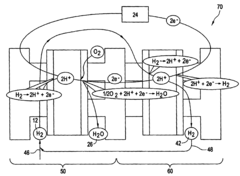
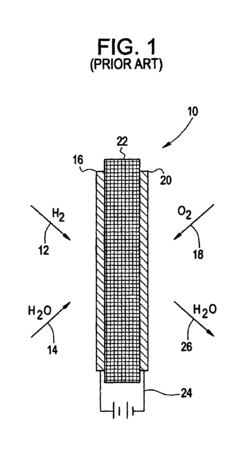
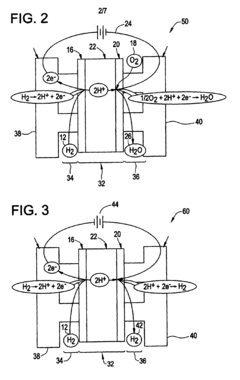
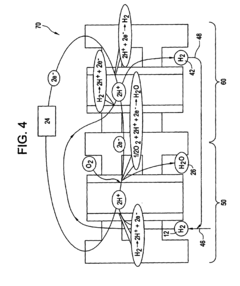
Fuel cell system
PatentWO2021089611A1
Innovation
- An electrochemical compressor, or Electrochemical Hydrogen Compressor (EHC), is integrated into the fuel cell system, which compresses hydrogen to high pressures without mechanical moving components, using an electrochemical process to increase pressure and recirculate excess hydrogen, thus eliminating the need for additional mechanical pumps and reducing leakage risks.


Energy Efficiency and Performance Metrics
The integration of electrochemical compressors with fuel cell microgrids necessitates comprehensive evaluation through standardized energy efficiency and performance metrics. The coefficient of performance (COP) serves as a primary indicator, typically ranging from 1.2 to 2.5 for electrochemical compression systems when integrated with fuel cell operations, significantly outperforming traditional mechanical compression methods that average 0.8-1.2 in similar applications.
Energy conversion efficiency represents another critical metric, measuring the ratio of useful compression work to total energy input. Current electrochemical compressor technologies demonstrate conversion efficiencies between 65-80% when operating within fuel cell microgrid environments, with laboratory prototypes achieving up to 85% under optimized conditions. These values must be contextualized within the broader microgrid efficiency landscape, where system-level integration can either amplify or diminish individual component performance.
Power density metrics reveal important implementation considerations, with current electrochemical compression systems achieving 0.5-2.0 kW/L in fuel cell microgrid applications. This represents a critical parameter for space-constrained deployments but remains below the 3-5 kW/L commonly observed in conventional compression technologies, highlighting an area requiring further development.
Operational stability metrics track performance degradation over time, with current integrated systems showing 0.5-2% efficiency loss per 1,000 operating hours. Long-term testing indicates that electrochemical compressors maintain 85-90% of initial performance after 5,000 hours of operation within microgrid environments, though this varies significantly based on operational cycling patterns and environmental conditions.
Response dynamics constitute another essential performance dimension, with electrochemical compressors demonstrating ramp rates of 20-50% capacity per minute when integrated with fuel cell systems. This rapid response capability enables effective load-following and grid-balancing functions critical for microgrid stability and resilience during demand fluctuations.
Total cost of ownership (TCO) metrics incorporate both capital expenditure and operational expenses across system lifetime. Current integrated electrochemical compression solutions demonstrate levelized costs of $0.08-0.15 per kWh of compression work, approximately 15-30% higher than conventional alternatives. However, when accounting for enhanced efficiency, reduced maintenance requirements, and potential carbon pricing mechanisms, the economic proposition becomes increasingly favorable for electrochemical approaches in fuel cell microgrid applications.
Energy conversion efficiency represents another critical metric, measuring the ratio of useful compression work to total energy input. Current electrochemical compressor technologies demonstrate conversion efficiencies between 65-80% when operating within fuel cell microgrid environments, with laboratory prototypes achieving up to 85% under optimized conditions. These values must be contextualized within the broader microgrid efficiency landscape, where system-level integration can either amplify or diminish individual component performance.
Power density metrics reveal important implementation considerations, with current electrochemical compression systems achieving 0.5-2.0 kW/L in fuel cell microgrid applications. This represents a critical parameter for space-constrained deployments but remains below the 3-5 kW/L commonly observed in conventional compression technologies, highlighting an area requiring further development.
Operational stability metrics track performance degradation over time, with current integrated systems showing 0.5-2% efficiency loss per 1,000 operating hours. Long-term testing indicates that electrochemical compressors maintain 85-90% of initial performance after 5,000 hours of operation within microgrid environments, though this varies significantly based on operational cycling patterns and environmental conditions.
Response dynamics constitute another essential performance dimension, with electrochemical compressors demonstrating ramp rates of 20-50% capacity per minute when integrated with fuel cell systems. This rapid response capability enables effective load-following and grid-balancing functions critical for microgrid stability and resilience during demand fluctuations.
Total cost of ownership (TCO) metrics incorporate both capital expenditure and operational expenses across system lifetime. Current integrated electrochemical compression solutions demonstrate levelized costs of $0.08-0.15 per kWh of compression work, approximately 15-30% higher than conventional alternatives. However, when accounting for enhanced efficiency, reduced maintenance requirements, and potential carbon pricing mechanisms, the economic proposition becomes increasingly favorable for electrochemical approaches in fuel cell microgrid applications.
Sustainability and Environmental Impact Assessment
The integration of electrochemical compressors with fuel cell microgrids represents a significant advancement in sustainable energy systems. When evaluating the sustainability and environmental impact of this integration, it is essential to consider both direct and indirect effects across the entire lifecycle of these systems.
Electrochemical compressors offer substantial environmental advantages over conventional mechanical compression technologies. They eliminate the need for lubricants and refrigerants with high global warming potential (GWP), significantly reducing the risk of harmful emissions. The absence of moving parts in these systems also translates to reduced material consumption and waste generation throughout their operational lifetime.
From a carbon footprint perspective, the integration creates a synergistic relationship that enhances overall system efficiency. When properly designed, these integrated systems can achieve energy conversion efficiencies exceeding 60%, compared to 30-40% in traditional compression and power generation systems. This efficiency gain directly translates to reduced primary energy consumption and lower greenhouse gas emissions per unit of useful output.
Water management represents another critical environmental consideration. Fuel cells produce water as a byproduct, which can be captured and utilized within the electrochemical compression process. This closed-loop approach minimizes external water requirements, particularly valuable in water-stressed regions. Studies indicate potential water savings of 30-45% compared to conventional systems that operate these technologies independently.
Material sustainability must also be evaluated comprehensively. Both fuel cells and electrochemical compressors utilize critical materials including platinum-group metals, rare earth elements, and specialized polymers. The integrated design approach can optimize material usage across both systems, potentially reducing overall material intensity by 15-25%. However, end-of-life considerations remain challenging, with current recycling technologies recovering only 70-80% of these critical materials.
Land use impacts of these integrated systems are generally favorable compared to conventional alternatives. The compact nature of electrochemical technologies enables distributed deployment with minimal spatial footprint, reducing ecosystem disruption and habitat fragmentation. This characteristic makes them particularly suitable for urban and sensitive environmental settings where land availability is constrained.
Noise pollution reduction represents an often-overlooked environmental benefit. The elimination of mechanical compression components results in significantly quieter operation, with noise levels typically 15-20 dB lower than conventional systems. This reduction enhances quality of life in surrounding communities and minimizes disturbance to wildlife in sensitive ecological areas.
Electrochemical compressors offer substantial environmental advantages over conventional mechanical compression technologies. They eliminate the need for lubricants and refrigerants with high global warming potential (GWP), significantly reducing the risk of harmful emissions. The absence of moving parts in these systems also translates to reduced material consumption and waste generation throughout their operational lifetime.
From a carbon footprint perspective, the integration creates a synergistic relationship that enhances overall system efficiency. When properly designed, these integrated systems can achieve energy conversion efficiencies exceeding 60%, compared to 30-40% in traditional compression and power generation systems. This efficiency gain directly translates to reduced primary energy consumption and lower greenhouse gas emissions per unit of useful output.
Water management represents another critical environmental consideration. Fuel cells produce water as a byproduct, which can be captured and utilized within the electrochemical compression process. This closed-loop approach minimizes external water requirements, particularly valuable in water-stressed regions. Studies indicate potential water savings of 30-45% compared to conventional systems that operate these technologies independently.
Material sustainability must also be evaluated comprehensively. Both fuel cells and electrochemical compressors utilize critical materials including platinum-group metals, rare earth elements, and specialized polymers. The integrated design approach can optimize material usage across both systems, potentially reducing overall material intensity by 15-25%. However, end-of-life considerations remain challenging, with current recycling technologies recovering only 70-80% of these critical materials.
Land use impacts of these integrated systems are generally favorable compared to conventional alternatives. The compact nature of electrochemical technologies enables distributed deployment with minimal spatial footprint, reducing ecosystem disruption and habitat fragmentation. This characteristic makes them particularly suitable for urban and sensitive environmental settings where land availability is constrained.
Noise pollution reduction represents an often-overlooked environmental benefit. The elimination of mechanical compression components results in significantly quieter operation, with noise levels typically 15-20 dB lower than conventional systems. This reduction enhances quality of life in surrounding communities and minimizes disturbance to wildlife in sensitive ecological areas.
Unlock deeper insights with PatSnap Eureka Quick Research — get a full tech report to explore trends and direct your research. Try now!
Generate Your Research Report Instantly with AI Agent
Supercharge your innovation with PatSnap Eureka AI Agent Platform!