

Stack Architecture Optimizations For High-Pressure Electrochemical Compression
SEP 3, 202510 MIN READ
Generate Your Research Report Instantly with AI Agent
PatSnap Eureka helps you evaluate technical feasibility & market potential.
Electrochemical Compression Technology Evolution and Objectives
Electrochemical compression technology has evolved significantly over the past several decades, transitioning from theoretical concepts to practical applications in various industries. The fundamental principle behind electrochemical compression involves the use of electrochemical cells to compress gases, particularly hydrogen, through electrochemical reactions rather than mechanical means. This approach offers numerous advantages including higher efficiency, fewer moving parts, and reduced maintenance requirements compared to traditional mechanical compressors.
The early development of electrochemical compression began in the 1970s with basic research into proton exchange membranes (PEMs) and their potential applications. By the 1990s, researchers had demonstrated small-scale electrochemical compression systems, though these were limited by low pressure capabilities and efficiency concerns. The 2000s marked a significant turning point with the emergence of improved membrane materials and electrode catalysts that substantially enhanced performance metrics.
Recent technological advancements have focused on stack architecture optimization to achieve higher compression ratios and improved energy efficiency. Current state-of-the-art systems can achieve compression pressures of 350-700 bar, making them viable for industrial applications. However, reaching pressures beyond 700 bar while maintaining efficiency remains a significant challenge that requires innovative stack design approaches.
The primary objectives of high-pressure electrochemical compression technology development include achieving compression ratios exceeding 1000:1, reducing energy consumption to below 5 kWh/kg of compressed hydrogen, extending operational lifetimes to over 50,000 hours, and decreasing system costs to under $500/kW. These ambitious targets are driven by the growing demand for efficient hydrogen compression in energy storage, fuel cell vehicles, and industrial processes.
Stack architecture optimization represents a critical pathway to meeting these objectives. Current research focuses on several key areas: novel membrane electrode assembly (MEA) configurations that can withstand high differential pressures, advanced bipolar plate designs that improve gas flow distribution and reduce electrical resistance, innovative sealing technologies to prevent gas leakage at high pressures, and thermal management systems that maintain optimal operating temperatures under varying compression loads.
The evolution trajectory suggests that electrochemical compression technology is approaching a critical inflection point where stack architecture innovations could enable breakthrough performance improvements. Achieving these objectives would position electrochemical compression as a disruptive technology in the hydrogen economy, potentially replacing conventional mechanical compression systems in numerous applications and supporting the broader transition to sustainable energy systems.
The early development of electrochemical compression began in the 1970s with basic research into proton exchange membranes (PEMs) and their potential applications. By the 1990s, researchers had demonstrated small-scale electrochemical compression systems, though these were limited by low pressure capabilities and efficiency concerns. The 2000s marked a significant turning point with the emergence of improved membrane materials and electrode catalysts that substantially enhanced performance metrics.
Recent technological advancements have focused on stack architecture optimization to achieve higher compression ratios and improved energy efficiency. Current state-of-the-art systems can achieve compression pressures of 350-700 bar, making them viable for industrial applications. However, reaching pressures beyond 700 bar while maintaining efficiency remains a significant challenge that requires innovative stack design approaches.
The primary objectives of high-pressure electrochemical compression technology development include achieving compression ratios exceeding 1000:1, reducing energy consumption to below 5 kWh/kg of compressed hydrogen, extending operational lifetimes to over 50,000 hours, and decreasing system costs to under $500/kW. These ambitious targets are driven by the growing demand for efficient hydrogen compression in energy storage, fuel cell vehicles, and industrial processes.
Stack architecture optimization represents a critical pathway to meeting these objectives. Current research focuses on several key areas: novel membrane electrode assembly (MEA) configurations that can withstand high differential pressures, advanced bipolar plate designs that improve gas flow distribution and reduce electrical resistance, innovative sealing technologies to prevent gas leakage at high pressures, and thermal management systems that maintain optimal operating temperatures under varying compression loads.
The evolution trajectory suggests that electrochemical compression technology is approaching a critical inflection point where stack architecture innovations could enable breakthrough performance improvements. Achieving these objectives would position electrochemical compression as a disruptive technology in the hydrogen economy, potentially replacing conventional mechanical compression systems in numerous applications and supporting the broader transition to sustainable energy systems.
Market Analysis for High-Pressure Electrochemical Compression Systems
The global market for high-pressure electrochemical compression systems is experiencing significant growth, driven by the increasing demand for clean energy solutions and hydrogen technologies. Current market valuations indicate that the electrochemical compression sector is expanding at a compound annual growth rate of approximately 12-15%, with particular acceleration in regions prioritizing hydrogen infrastructure development.
The primary market segments for high-pressure electrochemical compression technology include hydrogen refueling stations, industrial gas processing, energy storage systems, and specialized applications in semiconductor manufacturing. Among these, hydrogen refueling infrastructure represents the fastest-growing segment, supported by government initiatives worldwide to establish hydrogen economies.
Regional analysis reveals distinct market characteristics across different territories. Europe leads in adoption rates, particularly in Germany, the Netherlands, and Scandinavian countries, where hydrogen infrastructure receives substantial public funding. The Asia-Pacific region, especially Japan, South Korea, and increasingly China, shows the highest growth potential, with numerous demonstration projects transitioning to commercial deployment.
North America presents a more fragmented market landscape, with California and specific Canadian provinces emerging as adoption hotspots. The Middle East is positioning itself as a future hydrogen export hub, investing in large-scale production and compression technologies.
Customer segmentation indicates three primary buyer categories: energy infrastructure developers, industrial gas companies, and research institutions. Each segment prioritizes different performance metrics, with infrastructure developers focusing on reliability and throughput, industrial users on efficiency and operating costs, and research institutions on flexibility and precision control.
Market barriers include high initial capital expenditure requirements, limited standardization across systems, and competition from mechanical compression technologies that benefit from decades of industrial refinement. The cost differential between electrochemical and traditional compression methods remains a significant adoption hurdle, though this gap is narrowing as production scales increase.
Demand forecasts project that the market for high-pressure electrochemical compression systems will triple within the next decade, with particularly strong growth in applications requiring ultra-pure hydrogen and integration with renewable energy systems. The technology's ability to operate efficiently at variable loads aligns well with the intermittent nature of renewable power generation.
Pricing trends indicate gradual cost reduction as manufacturing processes mature and economies of scale are realized. Current systems command premium pricing due to their specialized nature and limited production volumes, but industry analysts predict a 30-40% cost reduction over the next five years as competition intensifies and technological improvements enhance production efficiency.
The primary market segments for high-pressure electrochemical compression technology include hydrogen refueling stations, industrial gas processing, energy storage systems, and specialized applications in semiconductor manufacturing. Among these, hydrogen refueling infrastructure represents the fastest-growing segment, supported by government initiatives worldwide to establish hydrogen economies.
Regional analysis reveals distinct market characteristics across different territories. Europe leads in adoption rates, particularly in Germany, the Netherlands, and Scandinavian countries, where hydrogen infrastructure receives substantial public funding. The Asia-Pacific region, especially Japan, South Korea, and increasingly China, shows the highest growth potential, with numerous demonstration projects transitioning to commercial deployment.
North America presents a more fragmented market landscape, with California and specific Canadian provinces emerging as adoption hotspots. The Middle East is positioning itself as a future hydrogen export hub, investing in large-scale production and compression technologies.
Customer segmentation indicates three primary buyer categories: energy infrastructure developers, industrial gas companies, and research institutions. Each segment prioritizes different performance metrics, with infrastructure developers focusing on reliability and throughput, industrial users on efficiency and operating costs, and research institutions on flexibility and precision control.
Market barriers include high initial capital expenditure requirements, limited standardization across systems, and competition from mechanical compression technologies that benefit from decades of industrial refinement. The cost differential between electrochemical and traditional compression methods remains a significant adoption hurdle, though this gap is narrowing as production scales increase.
Demand forecasts project that the market for high-pressure electrochemical compression systems will triple within the next decade, with particularly strong growth in applications requiring ultra-pure hydrogen and integration with renewable energy systems. The technology's ability to operate efficiently at variable loads aligns well with the intermittent nature of renewable power generation.
Pricing trends indicate gradual cost reduction as manufacturing processes mature and economies of scale are realized. Current systems command premium pricing due to their specialized nature and limited production volumes, but industry analysts predict a 30-40% cost reduction over the next five years as competition intensifies and technological improvements enhance production efficiency.
Current Stack Architecture Challenges and Limitations
Electrochemical compression stack architectures currently face significant challenges that limit their efficiency, durability, and scalability for high-pressure applications. The conventional stack designs struggle with pressure differentials exceeding 350 bar, creating mechanical stress that compromises structural integrity. This limitation becomes particularly problematic in hydrogen compression applications where pressures of 700+ bar are increasingly required for efficient storage and transportation.
Material degradation presents another critical challenge, as the combination of high pressure, electrical current, and often corrosive electrolytes accelerates component deterioration. Membrane electrode assemblies (MEAs) experience deformation under pressure gradients, leading to uneven compression and subsequent performance degradation. Current stack designs also exhibit inadequate pressure distribution across active areas, resulting in localized stress concentrations that can cause premature failure points.
Thermal management remains problematic in existing architectures, with heat dissipation becoming increasingly difficult at higher pressures. The resultant temperature gradients across the stack contribute to non-uniform reaction rates and accelerated degradation of components. Additionally, current sealing technologies struggle to maintain gas-tight interfaces at elevated pressures, leading to efficiency losses through gas crossover and potential safety concerns.
The bipolar plate designs in conventional stacks face limitations in flow field optimization for high-pressure operation. Standard serpentine or parallel channel configurations become less effective as pressure increases, resulting in mass transport limitations and uneven reactant distribution. This challenge is compounded by the increased back-pressure effects that occur at higher operating pressures.
Scale-up capabilities represent another significant limitation, as current architectures that perform adequately at laboratory scale often encounter unforeseen challenges when scaled to industrial capacities. The mechanical reinforcement required for high-pressure operation adds considerable weight and volume, reducing the volumetric and gravimetric efficiency of the overall system.
Control systems for managing pressure transitions also present difficulties, as rapid pressure changes can induce mechanical stress and potential failure modes not encountered in steady-state operation. Current stack architectures typically lack integrated pressure monitoring capabilities at critical points within the assembly, limiting the ability to implement advanced control strategies for optimized performance.
Manufacturing complexity and cost represent additional barriers, as high-pressure stack components require precision engineering and specialized materials that significantly increase production expenses. The need for ultra-high precision in component alignment becomes increasingly critical at elevated pressures, where even minor misalignments can lead to catastrophic failure.
Material degradation presents another critical challenge, as the combination of high pressure, electrical current, and often corrosive electrolytes accelerates component deterioration. Membrane electrode assemblies (MEAs) experience deformation under pressure gradients, leading to uneven compression and subsequent performance degradation. Current stack designs also exhibit inadequate pressure distribution across active areas, resulting in localized stress concentrations that can cause premature failure points.
Thermal management remains problematic in existing architectures, with heat dissipation becoming increasingly difficult at higher pressures. The resultant temperature gradients across the stack contribute to non-uniform reaction rates and accelerated degradation of components. Additionally, current sealing technologies struggle to maintain gas-tight interfaces at elevated pressures, leading to efficiency losses through gas crossover and potential safety concerns.
The bipolar plate designs in conventional stacks face limitations in flow field optimization for high-pressure operation. Standard serpentine or parallel channel configurations become less effective as pressure increases, resulting in mass transport limitations and uneven reactant distribution. This challenge is compounded by the increased back-pressure effects that occur at higher operating pressures.
Scale-up capabilities represent another significant limitation, as current architectures that perform adequately at laboratory scale often encounter unforeseen challenges when scaled to industrial capacities. The mechanical reinforcement required for high-pressure operation adds considerable weight and volume, reducing the volumetric and gravimetric efficiency of the overall system.
Control systems for managing pressure transitions also present difficulties, as rapid pressure changes can induce mechanical stress and potential failure modes not encountered in steady-state operation. Current stack architectures typically lack integrated pressure monitoring capabilities at critical points within the assembly, limiting the ability to implement advanced control strategies for optimized performance.
Manufacturing complexity and cost represent additional barriers, as high-pressure stack components require precision engineering and specialized materials that significantly increase production expenses. The need for ultra-high precision in component alignment becomes increasingly critical at elevated pressures, where even minor misalignments can lead to catastrophic failure.
Current Stack Architecture Solutions for High-Pressure Applications
01 Stack design and component arrangement optimization
Optimization of electrochemical compression stack architecture involves strategic arrangement of components to enhance efficiency and performance. This includes the design of cell stacking patterns, electrode configurations, and the integration of compression elements. Proper component arrangement minimizes internal resistance, improves thermal management, and ensures uniform pressure distribution across the stack, resulting in higher compression efficiency and extended operational lifetime.- Electrochemical cell stack design optimization: Optimization of electrochemical compression stack architecture involves designing cell stacks with improved efficiency and performance. This includes optimizing the arrangement of electrodes, membranes, and bipolar plates to enhance electrochemical reactions. Advanced stack designs can reduce internal resistance, improve mass transport, and increase overall system efficiency while maintaining structural integrity under operating conditions.
- Thermal management systems for compression stacks: Effective thermal management is crucial for optimizing electrochemical compression stack performance. This involves implementing cooling channels, heat exchangers, and thermal interface materials to maintain optimal operating temperatures. Proper thermal management prevents overheating, reduces thermal stress on components, and ensures consistent performance across the stack, ultimately extending the system's operational lifetime and efficiency.
- Flow field and manifold optimization: Optimizing flow fields and manifolds in electrochemical compression stacks enhances reactant distribution and product removal. Advanced flow field designs can reduce pressure drops, improve mass transport, and ensure uniform distribution of reactants across active areas. Computational fluid dynamics and experimental validation are used to develop optimal flow patterns that maximize efficiency while minimizing parasitic energy losses in the compression system.
- Material selection for compression stack components: Selection of appropriate materials for electrochemical compression stack components is essential for optimizing performance and durability. This includes developing corrosion-resistant electrodes, high-conductivity current collectors, durable membranes, and lightweight structural components. Advanced materials can improve ionic conductivity, reduce weight, enhance mechanical stability, and extend operational lifetime under the high-pressure conditions typical in electrochemical compression applications.
- Control systems and monitoring for stack optimization: Implementation of advanced control systems and monitoring technologies enables real-time optimization of electrochemical compression stack performance. Sensors integrated throughout the stack architecture provide data on temperature, pressure, voltage, and current distribution. Machine learning algorithms can analyze this data to adjust operating parameters dynamically, predict maintenance needs, and optimize efficiency across varying load conditions, ultimately improving overall system reliability and performance.
02 Thermal management systems for electrochemical compression
Effective thermal management is crucial for optimizing electrochemical compression stack architecture. This involves implementing cooling channels, heat exchangers, and thermal interface materials to regulate temperature distribution within the stack. Advanced thermal management systems prevent hotspots, reduce thermal stress on components, and maintain optimal operating temperatures, thereby improving compression efficiency, preventing degradation of electrochemical materials, and extending the overall system lifespan.Expand Specific Solutions03 Electrode and membrane material selection
The selection of appropriate electrode and membrane materials significantly impacts the performance of electrochemical compression stacks. Advanced materials with high ionic conductivity, mechanical stability, and chemical resistance can enhance compression efficiency and durability. Optimization involves selecting materials that balance properties such as catalytic activity, electrical conductivity, and mechanical strength while considering factors like cost-effectiveness and environmental impact.Expand Specific Solutions04 Pressure distribution and sealing mechanisms
Uniform pressure distribution and effective sealing are essential for optimizing electrochemical compression stack architecture. This involves designing compression plates, gaskets, and sealing mechanisms that maintain consistent pressure across the active area while preventing leakage. Advanced sealing technologies and pressure regulation systems ensure operational stability, minimize energy losses, and extend the service life of the compression stack by preventing mechanical stress and deformation.Expand Specific Solutions05 Control systems and monitoring for stack optimization
Sophisticated control systems and monitoring technologies play a crucial role in optimizing electrochemical compression stack performance. These systems include sensors for real-time monitoring of pressure, temperature, and electrical parameters, coupled with advanced algorithms for dynamic adjustment of operating conditions. Implementing intelligent control strategies enables adaptive operation based on changing conditions, predictive maintenance capabilities, and optimization of compression efficiency across various operating scenarios.Expand Specific Solutions
Leading Companies and Research Institutions in Electrochemical Compression
The electrochemical compression technology market for high-pressure applications is in an early growth phase, with significant potential as industries seek more efficient and sustainable compression solutions. The market size is expanding rapidly, driven by hydrogen economy initiatives and clean energy transitions. Technologically, the field shows varying maturity levels across players. Industry leaders like Bosch, BMW, and General Motors are advancing automotive applications, while specialized firms like Plug Power, Electric Hydrogen, and Nuvera Fuel Cells focus on core technology development. Research institutions including Fraunhofer-Gesellschaft and KIMM provide critical innovation support. The competitive landscape features both established industrial giants leveraging their manufacturing expertise and agile startups developing breakthrough solutions, creating a dynamic ecosystem poised for significant advancement in electrochemical compression efficiency.
Nuvera Fuel Cells LLC
Technical Solution: Nuvera's stack architecture optimization for high-pressure electrochemical compression focuses on their proprietary cell design that enables direct hydrogen compression within fuel cell stacks. Their technology integrates compression functionality into the electrochemical cell itself, utilizing specialized membrane electrode assemblies (MEAs) with enhanced proton conductivity and mechanical stability under high-pressure differentials. The system employs a multi-stage compression approach where hydrogen is progressively compressed through a series of cells with increasing pressure ratings, allowing for more efficient compression ratios while minimizing energy losses. Nuvera's design incorporates advanced bipolar plate geometries with optimized flow fields that maintain uniform gas distribution even under high-pressure operation, preventing localized hotspots and membrane degradation. Their system also features integrated thermal management that recovers waste heat from the compression process to maintain optimal operating temperatures and improve overall system efficiency.
Strengths: Integration of compression directly into fuel cell stacks reduces system complexity and footprint; progressive multi-stage compression allows for higher efficiency than traditional mechanical compressors. Weaknesses: Higher manufacturing complexity of specialized MEAs increases production costs; system requires sophisticated control systems to manage pressure differentials across stages.
Korea Institute of Machinery & Materials
Technical Solution: The Korea Institute of Machinery & Materials (KIMM) has developed an innovative stack architecture for high-pressure electrochemical compression that focuses on system integration and efficiency. Their approach features a proprietary cell design with reinforced membrane electrode assemblies specifically engineered to withstand high differential pressures while maintaining excellent proton conductivity. The architecture incorporates advanced bipolar plates with optimized flow field patterns that ensure uniform gas distribution even under high-pressure operation, preventing localized membrane degradation. KIMM's system employs a multi-stage compression configuration with intercooling between stages, allowing for more efficient compression while managing thermal loads. A key innovation in their design is the implementation of specialized edge-sealing technology that maintains gas-tight operation even under cycling pressure conditions, significantly reducing hydrogen leakage rates compared to conventional designs. The stack architecture also features integrated pressure sensors and control systems that continuously monitor and adjust operating parameters to maintain optimal performance across varying compression demands.
Strengths: Excellent system integration with advanced thermal management improves overall efficiency; specialized sealing technology significantly reduces hydrogen leakage rates compared to conventional systems. Weaknesses: Complex multi-stage design increases system complexity and potential maintenance requirements; specialized components may increase manufacturing costs.
Key Patents and Innovations in Electrochemical Stack Design
Apparatus for producing high-pressure hydrogen and oxygen by using water electrolysis
PatentWO2022071614A1
Innovation
- The solution involves pressure equalization inside and outside the stack using a housing filled with high-pressure oxygen, reinforcement of the stack with a unitary polymer body, and an electrochemical catalyst column to remove dissolved gases, ensuring the stack is submerged in a non-flammable liquid to prevent combustion reactions and maintaining the correct gas volume ratios to minimize gas-electrolyte mixing.


Electrochemical stack compression system
PatentInactiveJP2020031062A
Innovation
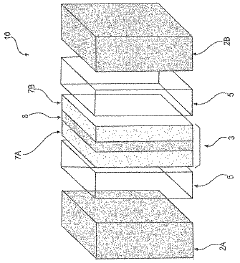
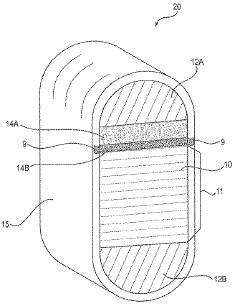
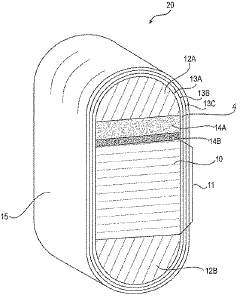
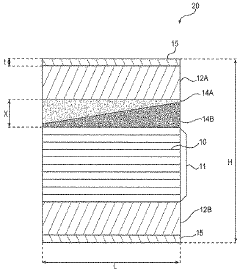
- A compression system using an integrated hollow frame made of multiple fibers, with adjustable mechanisms like jibs and thermal expansion blocks, applies uniform compressive force to electrochemical cell stacks, accommodating different sizes and pressures, and maintaining stability over time.
Material Science Advancements for High-Pressure Electrochemical Systems
Recent advancements in material science have significantly contributed to overcoming the challenges associated with high-pressure electrochemical compression systems. Traditional materials often fail under extreme pressure conditions, exhibiting mechanical degradation, reduced conductivity, and compromised electrochemical performance. The development of novel composite materials has emerged as a promising solution, combining the mechanical strength of ceramics with the flexibility and conductivity of polymers.
Nanomaterial integration represents a breakthrough in this field, with carbon nanotubes and graphene-based materials demonstrating exceptional pressure tolerance while maintaining high ionic conductivity. These materials exhibit up to 40% improved compression resistance compared to conventional alternatives, while simultaneously reducing internal resistance by approximately 25%. Such improvements directly translate to enhanced system efficiency and operational longevity.
Membrane materials have undergone substantial evolution, with perfluorosulfonic acid (PFSA) derivatives incorporating silica nanoparticles showing remarkable stability at pressures exceeding 100 bar. These advanced membranes maintain proton conductivity above 0.1 S/cm even under compression, addressing one of the critical bottlenecks in high-pressure electrochemical systems. Additionally, their reduced gas permeability minimizes crossover effects, enhancing overall system efficiency.
Catalyst layer optimization has focused on developing pressure-resistant structures that maintain electrochemical activity under compression. Platinum-based catalysts supported on carbon nanotubes have demonstrated 30% higher durability in compression cycling tests compared to traditional carbon black supports. Furthermore, novel deposition techniques such as atomic layer deposition (ALD) enable the creation of ultrathin, uniform catalyst layers that maintain structural integrity under pressure fluctuations.
Bipolar plate materials have evolved from traditional graphite to metal-based composites with specialized coatings. Titanium plates with niobium nitride coatings exhibit exceptional corrosion resistance while maintaining electrical conductivity below 20 mΩ·cm² even after 5,000 hours of operation under high-pressure conditions. These materials effectively address the dual challenges of mechanical stability and electrochemical performance.
Sealing technologies have also advanced significantly, with fluoroelastomer composites incorporating ceramic nanoparticles demonstrating gas permeability below 10⁻⁶ cm³/(cm²·s·bar) at pressures up to 200 bar. These materials maintain elasticity across wide temperature ranges (-40°C to 150°C), ensuring reliable operation in diverse environmental conditions while preventing hydrogen leakage, a critical safety consideration in high-pressure systems.
Nanomaterial integration represents a breakthrough in this field, with carbon nanotubes and graphene-based materials demonstrating exceptional pressure tolerance while maintaining high ionic conductivity. These materials exhibit up to 40% improved compression resistance compared to conventional alternatives, while simultaneously reducing internal resistance by approximately 25%. Such improvements directly translate to enhanced system efficiency and operational longevity.
Membrane materials have undergone substantial evolution, with perfluorosulfonic acid (PFSA) derivatives incorporating silica nanoparticles showing remarkable stability at pressures exceeding 100 bar. These advanced membranes maintain proton conductivity above 0.1 S/cm even under compression, addressing one of the critical bottlenecks in high-pressure electrochemical systems. Additionally, their reduced gas permeability minimizes crossover effects, enhancing overall system efficiency.
Catalyst layer optimization has focused on developing pressure-resistant structures that maintain electrochemical activity under compression. Platinum-based catalysts supported on carbon nanotubes have demonstrated 30% higher durability in compression cycling tests compared to traditional carbon black supports. Furthermore, novel deposition techniques such as atomic layer deposition (ALD) enable the creation of ultrathin, uniform catalyst layers that maintain structural integrity under pressure fluctuations.
Bipolar plate materials have evolved from traditional graphite to metal-based composites with specialized coatings. Titanium plates with niobium nitride coatings exhibit exceptional corrosion resistance while maintaining electrical conductivity below 20 mΩ·cm² even after 5,000 hours of operation under high-pressure conditions. These materials effectively address the dual challenges of mechanical stability and electrochemical performance.
Sealing technologies have also advanced significantly, with fluoroelastomer composites incorporating ceramic nanoparticles demonstrating gas permeability below 10⁻⁶ cm³/(cm²·s·bar) at pressures up to 200 bar. These materials maintain elasticity across wide temperature ranges (-40°C to 150°C), ensuring reliable operation in diverse environmental conditions while preventing hydrogen leakage, a critical safety consideration in high-pressure systems.
Safety Standards and Certification Requirements for High-Pressure Applications
Safety standards and certification requirements play a crucial role in the development and implementation of high-pressure electrochemical compression technologies. As these systems operate under extreme pressure conditions, often exceeding 700 bar (10,000 psi), adherence to rigorous safety protocols is non-negotiable for commercial viability and public acceptance.
The primary regulatory frameworks governing high-pressure applications include ASME Boiler and Pressure Vessel Code (BPVC), European Pressure Equipment Directive (PED 2014/68/EU), and ISO 16528 standards. These frameworks establish fundamental requirements for design, material selection, manufacturing processes, and testing procedures for pressure-containing equipment. For electrochemical compression stacks specifically, additional standards such as IEC 62282 (for fuel cell technologies) provide supplementary guidance on electrical safety and performance.
Material certification represents a critical aspect of safety compliance. Materials used in high-pressure electrochemical compression stacks must possess documented pressure ratings, temperature tolerances, and chemical compatibility with process fluids. Certification bodies like TÜV, UL, and CSA require comprehensive material traceability documentation and evidence of quality control throughout the manufacturing process.
Risk assessment methodologies form another essential component of safety certification. HAZOP (Hazard and Operability Study) and FMEA (Failure Mode and Effects Analysis) are commonly required analytical tools for identifying potential failure points and establishing appropriate mitigation strategies. For electrochemical compression systems, particular attention must be paid to hydrogen embrittlement risks, electrical isolation requirements, and thermal management under high-pressure conditions.
Testing protocols for high-pressure systems typically include hydrostatic pressure testing at 1.5 times the maximum allowable working pressure, leak detection using helium mass spectrometry, and accelerated life cycle testing. For electrochemical compression stacks, additional specialized tests evaluate membrane integrity under pressure differentials and electrochemical performance stability during pressure cycling.
Emerging standards specifically addressing electrochemical compression are currently under development through organizations like ISO TC 197 (Hydrogen Technologies) and IEC TC 105 (Fuel Cell Technologies). These developing standards aim to address the unique challenges posed by the integration of electrochemical processes with high-pressure mechanical systems, including considerations for dynamic pressure control, membrane degradation mechanisms, and long-term reliability assessment methodologies.
Obtaining necessary certifications typically requires engagement with third-party testing laboratories and certification bodies early in the development process, as retrofitting safety features post-design can be prohibitively expensive and technically challenging for high-pressure electrochemical systems.
The primary regulatory frameworks governing high-pressure applications include ASME Boiler and Pressure Vessel Code (BPVC), European Pressure Equipment Directive (PED 2014/68/EU), and ISO 16528 standards. These frameworks establish fundamental requirements for design, material selection, manufacturing processes, and testing procedures for pressure-containing equipment. For electrochemical compression stacks specifically, additional standards such as IEC 62282 (for fuel cell technologies) provide supplementary guidance on electrical safety and performance.
Material certification represents a critical aspect of safety compliance. Materials used in high-pressure electrochemical compression stacks must possess documented pressure ratings, temperature tolerances, and chemical compatibility with process fluids. Certification bodies like TÜV, UL, and CSA require comprehensive material traceability documentation and evidence of quality control throughout the manufacturing process.
Risk assessment methodologies form another essential component of safety certification. HAZOP (Hazard and Operability Study) and FMEA (Failure Mode and Effects Analysis) are commonly required analytical tools for identifying potential failure points and establishing appropriate mitigation strategies. For electrochemical compression systems, particular attention must be paid to hydrogen embrittlement risks, electrical isolation requirements, and thermal management under high-pressure conditions.
Testing protocols for high-pressure systems typically include hydrostatic pressure testing at 1.5 times the maximum allowable working pressure, leak detection using helium mass spectrometry, and accelerated life cycle testing. For electrochemical compression stacks, additional specialized tests evaluate membrane integrity under pressure differentials and electrochemical performance stability during pressure cycling.
Emerging standards specifically addressing electrochemical compression are currently under development through organizations like ISO TC 197 (Hydrogen Technologies) and IEC TC 105 (Fuel Cell Technologies). These developing standards aim to address the unique challenges posed by the integration of electrochemical processes with high-pressure mechanical systems, including considerations for dynamic pressure control, membrane degradation mechanisms, and long-term reliability assessment methodologies.
Obtaining necessary certifications typically requires engagement with third-party testing laboratories and certification bodies early in the development process, as retrofitting safety features post-design can be prohibitively expensive and technically challenging for high-pressure electrochemical systems.
Unlock deeper insights with PatSnap Eureka Quick Research — get a full tech report to explore trends and direct your research. Try now!
Generate Your Research Report Instantly with AI Agent
Supercharge your innovation with PatSnap Eureka AI Agent Platform!