

Electrochemical Compressor Stack Degradation Mechanisms And Mitigation
SEP 3, 202510 MIN READ
Generate Your Research Report Instantly with AI Agent
PatSnap Eureka helps you evaluate technical feasibility & market potential.
Electrochemical Compressor Technology Evolution and Objectives
Electrochemical compressors represent a significant advancement in compression technology, offering a promising alternative to traditional mechanical compressors. The evolution of this technology began in the late 1970s with initial conceptual designs, but significant practical development only emerged in the early 2000s when concerns about energy efficiency and environmental impact gained prominence. The fundamental principle leverages electrochemical processes to compress gases, particularly hydrogen, without moving parts, resulting in potentially higher efficiency and reliability.
The technology has evolved through several distinct phases. The first generation (2000-2010) focused on proof-of-concept designs with limited capacity and efficiency. These early systems demonstrated the feasibility of electrochemical compression but suffered from significant degradation issues and limited operational lifespans. The second generation (2010-2015) introduced improved membrane materials and electrode designs, enhancing durability and compression ratios while reducing energy consumption.
Current third-generation systems (2015-present) have achieved substantial improvements in stack design, incorporating advanced materials science breakthroughs and optimized electrochemical interfaces. These developments have addressed many early limitations, though stack degradation remains a persistent challenge requiring further innovation. The integration of computational modeling and real-time monitoring systems has enabled more precise control of operational parameters, significantly extending service life.
The primary objectives in electrochemical compressor development center on addressing several critical challenges. First, enhancing long-term durability by mitigating degradation mechanisms in the electrochemical stack, which currently limit commercial viability. Second, improving energy efficiency to exceed conventional mechanical compression technologies across a wider range of operating conditions. Third, scaling the technology to accommodate industrial applications while maintaining performance metrics.
Additional objectives include reducing system complexity and manufacturing costs to enable broader market adoption. Current research focuses on novel membrane materials with enhanced proton conductivity and mechanical stability, catalyst designs with improved resistance to poisoning, and system architectures that minimize parasitic losses. The development of standardized testing protocols and accelerated aging methodologies also represents a crucial objective for accurate performance prediction and quality assurance.
The technology trajectory aims toward fully integrated systems capable of efficient operation across variable conditions with minimal maintenance requirements. Future developments will likely incorporate advanced materials such as graphene-enhanced membranes, self-healing interfaces, and intelligent control systems utilizing machine learning algorithms to predict and prevent degradation events before they occur.
The technology has evolved through several distinct phases. The first generation (2000-2010) focused on proof-of-concept designs with limited capacity and efficiency. These early systems demonstrated the feasibility of electrochemical compression but suffered from significant degradation issues and limited operational lifespans. The second generation (2010-2015) introduced improved membrane materials and electrode designs, enhancing durability and compression ratios while reducing energy consumption.
Current third-generation systems (2015-present) have achieved substantial improvements in stack design, incorporating advanced materials science breakthroughs and optimized electrochemical interfaces. These developments have addressed many early limitations, though stack degradation remains a persistent challenge requiring further innovation. The integration of computational modeling and real-time monitoring systems has enabled more precise control of operational parameters, significantly extending service life.
The primary objectives in electrochemical compressor development center on addressing several critical challenges. First, enhancing long-term durability by mitigating degradation mechanisms in the electrochemical stack, which currently limit commercial viability. Second, improving energy efficiency to exceed conventional mechanical compression technologies across a wider range of operating conditions. Third, scaling the technology to accommodate industrial applications while maintaining performance metrics.
Additional objectives include reducing system complexity and manufacturing costs to enable broader market adoption. Current research focuses on novel membrane materials with enhanced proton conductivity and mechanical stability, catalyst designs with improved resistance to poisoning, and system architectures that minimize parasitic losses. The development of standardized testing protocols and accelerated aging methodologies also represents a crucial objective for accurate performance prediction and quality assurance.
The technology trajectory aims toward fully integrated systems capable of efficient operation across variable conditions with minimal maintenance requirements. Future developments will likely incorporate advanced materials such as graphene-enhanced membranes, self-healing interfaces, and intelligent control systems utilizing machine learning algorithms to predict and prevent degradation events before they occur.
Market Analysis for Electrochemical Compression Applications
The electrochemical compression market is experiencing significant growth driven by increasing demand for clean energy technologies and sustainable industrial processes. Current market valuations indicate the global electrochemical compression sector reached approximately $320 million in 2022, with projections suggesting a compound annual growth rate of 9.7% through 2030. This growth trajectory is primarily fueled by applications in hydrogen refueling stations, renewable energy storage systems, and industrial gas processing.
Hydrogen energy infrastructure represents the largest market segment, accounting for roughly 45% of current electrochemical compression applications. With over 700 hydrogen refueling stations operational globally and ambitious expansion plans in Europe, Asia, and North America, this segment is expected to maintain dominance through the next decade. The critical advantage of electrochemical compressors in this space is their ability to provide contamination-free compression essential for fuel cell applications.
The renewable energy storage sector presents the fastest-growing application area, with a projected 14.2% annual growth rate. Grid-scale energy storage projects increasingly incorporate hydrogen as a long-duration storage medium, with electrochemical compression offering higher efficiency compared to mechanical alternatives. Several utility-scale demonstration projects in Germany, Australia, and Japan have validated these efficiency gains, reporting 15-20% energy savings over conventional compression technologies.
Industrial gas processing applications constitute approximately 30% of the current market, with notable adoption in semiconductor manufacturing, pharmaceutical production, and specialty chemicals. These industries value the oil-free operation and precise pressure control capabilities of electrochemical systems, despite their currently higher capital costs compared to traditional compressors.
Market barriers include high initial investment requirements, limited awareness of the technology's benefits, and concerns about long-term reliability—particularly regarding stack degradation issues. The average cost premium for electrochemical compression systems remains 30-40% above conventional technologies, though this gap is narrowing as production scales increase and manufacturing processes mature.
Regional analysis shows Asia-Pacific leading market adoption with 38% share, followed by Europe (32%) and North America (25%). China's aggressive hydrogen infrastructure development and Japan's commitment to a hydrogen economy are driving significant investments in the region, while European demand is bolstered by stringent carbon reduction policies and renewable energy integration requirements.
Hydrogen energy infrastructure represents the largest market segment, accounting for roughly 45% of current electrochemical compression applications. With over 700 hydrogen refueling stations operational globally and ambitious expansion plans in Europe, Asia, and North America, this segment is expected to maintain dominance through the next decade. The critical advantage of electrochemical compressors in this space is their ability to provide contamination-free compression essential for fuel cell applications.
The renewable energy storage sector presents the fastest-growing application area, with a projected 14.2% annual growth rate. Grid-scale energy storage projects increasingly incorporate hydrogen as a long-duration storage medium, with electrochemical compression offering higher efficiency compared to mechanical alternatives. Several utility-scale demonstration projects in Germany, Australia, and Japan have validated these efficiency gains, reporting 15-20% energy savings over conventional compression technologies.
Industrial gas processing applications constitute approximately 30% of the current market, with notable adoption in semiconductor manufacturing, pharmaceutical production, and specialty chemicals. These industries value the oil-free operation and precise pressure control capabilities of electrochemical systems, despite their currently higher capital costs compared to traditional compressors.
Market barriers include high initial investment requirements, limited awareness of the technology's benefits, and concerns about long-term reliability—particularly regarding stack degradation issues. The average cost premium for electrochemical compression systems remains 30-40% above conventional technologies, though this gap is narrowing as production scales increase and manufacturing processes mature.
Regional analysis shows Asia-Pacific leading market adoption with 38% share, followed by Europe (32%) and North America (25%). China's aggressive hydrogen infrastructure development and Japan's commitment to a hydrogen economy are driving significant investments in the region, while European demand is bolstered by stringent carbon reduction policies and renewable energy integration requirements.
Current Challenges in Stack Degradation
Electrochemical compressor stack degradation presents significant challenges that impede the widespread adoption and long-term reliability of this promising technology. The primary degradation mechanisms stem from both chemical and mechanical factors that interact in complex ways during operation. Membrane degradation remains one of the most critical issues, with chemical attack from reactive species generated during operation causing gradual thinning and eventual failure of the polymer electrolyte membranes. This degradation accelerates particularly under high current density operations and temperature fluctuations, leading to reduced proton conductivity and increased gas crossover.
Catalyst layer degradation constitutes another major challenge, with platinum and other noble metal catalysts suffering from dissolution, agglomeration, and poisoning effects. The electrochemical environment, especially during start-stop cycles, creates conditions conducive to catalyst particle growth and surface area reduction. Studies have shown up to 40% loss in electrochemically active surface area after extended operation periods, directly impacting compression efficiency and capacity.
Bipolar plate corrosion presents persistent reliability concerns, particularly in metallic plates where protective coatings may deteriorate over time. The resulting oxide formation increases contact resistance at interfaces, creating localized hot spots and uneven current distribution that exacerbate other degradation mechanisms. Even with advanced coating technologies, achieving the target 40,000-hour durability remains challenging under real-world operating conditions.
Water management issues significantly contribute to stack degradation through several pathways. Insufficient hydration leads to membrane drying and increased ohmic resistance, while excessive water accumulation causes flooding that blocks gas transport pathways. This delicate balance becomes increasingly difficult to maintain as systems scale up and operate under variable load conditions, with each imbalance event potentially causing irreversible damage to stack components.
Mechanical stress-induced degradation occurs through repeated thermal cycling, pressure differentials, and assembly compression forces. These stresses manifest as membrane creep, delamination between layers, and contact loss at critical interfaces. The cumulative effect reduces active area utilization and creates preferential pathways for gas leakage, ultimately compromising both efficiency and safety.
Contamination from external sources or system components represents an often underestimated degradation factor. Airborne particulates, lubricants from auxiliary components, and leached materials from system piping can all introduce impurities that poison catalysts, block flow channels, or alter membrane properties. Even trace contaminants at parts-per-million levels can accumulate over time to cause significant performance decline.
These multifaceted degradation mechanisms create substantial barriers to achieving the reliability, efficiency, and cost targets necessary for commercial viability of electrochemical compression technology. Addressing these challenges requires integrated approaches that consider material innovations, system design improvements, and advanced operational strategies.
Catalyst layer degradation constitutes another major challenge, with platinum and other noble metal catalysts suffering from dissolution, agglomeration, and poisoning effects. The electrochemical environment, especially during start-stop cycles, creates conditions conducive to catalyst particle growth and surface area reduction. Studies have shown up to 40% loss in electrochemically active surface area after extended operation periods, directly impacting compression efficiency and capacity.
Bipolar plate corrosion presents persistent reliability concerns, particularly in metallic plates where protective coatings may deteriorate over time. The resulting oxide formation increases contact resistance at interfaces, creating localized hot spots and uneven current distribution that exacerbate other degradation mechanisms. Even with advanced coating technologies, achieving the target 40,000-hour durability remains challenging under real-world operating conditions.
Water management issues significantly contribute to stack degradation through several pathways. Insufficient hydration leads to membrane drying and increased ohmic resistance, while excessive water accumulation causes flooding that blocks gas transport pathways. This delicate balance becomes increasingly difficult to maintain as systems scale up and operate under variable load conditions, with each imbalance event potentially causing irreversible damage to stack components.
Mechanical stress-induced degradation occurs through repeated thermal cycling, pressure differentials, and assembly compression forces. These stresses manifest as membrane creep, delamination between layers, and contact loss at critical interfaces. The cumulative effect reduces active area utilization and creates preferential pathways for gas leakage, ultimately compromising both efficiency and safety.
Contamination from external sources or system components represents an often underestimated degradation factor. Airborne particulates, lubricants from auxiliary components, and leached materials from system piping can all introduce impurities that poison catalysts, block flow channels, or alter membrane properties. Even trace contaminants at parts-per-million levels can accumulate over time to cause significant performance decline.
These multifaceted degradation mechanisms create substantial barriers to achieving the reliability, efficiency, and cost targets necessary for commercial viability of electrochemical compression technology. Addressing these challenges requires integrated approaches that consider material innovations, system design improvements, and advanced operational strategies.
Existing Degradation Mitigation Strategies
01 Degradation mechanisms in electrochemical compressor stacks
Electrochemical compressor stacks can degrade through various mechanisms including electrode corrosion, membrane fouling, and catalyst poisoning. These degradation processes are often accelerated by operating conditions such as high current densities, temperature fluctuations, and exposure to contaminants. Understanding these mechanisms is crucial for developing strategies to mitigate degradation and extend the operational lifetime of electrochemical compressor systems.- Degradation mechanisms in electrochemical compressor stacks: Electrochemical compressor stacks can degrade through various mechanisms including membrane fouling, catalyst poisoning, and electrode corrosion. These degradation processes can be accelerated by operating conditions such as high current densities, temperature fluctuations, and impurities in the working fluid. Understanding these mechanisms is crucial for developing strategies to mitigate degradation and extend the operational lifetime of electrochemical compressor systems.
- Monitoring and diagnostic techniques for stack degradation: Advanced monitoring and diagnostic techniques are essential for detecting early signs of degradation in electrochemical compressor stacks. These include electrochemical impedance spectroscopy, voltage monitoring, pressure differential measurements, and real-time performance analysis. Implementing these techniques allows for timely intervention before catastrophic failure occurs, optimizing maintenance schedules and reducing downtime of electrochemical compression systems.
- Materials and coatings to prevent stack degradation: Innovative materials and protective coatings can significantly reduce degradation in electrochemical compressor stacks. These include corrosion-resistant electrode materials, advanced membrane formulations with enhanced chemical stability, and specialized coatings that prevent catalyst poisoning. The selection of appropriate materials based on the specific operating conditions and working fluids can substantially extend the service life of electrochemical compressor components.
- System design optimization to minimize degradation: Optimizing the design of electrochemical compressor systems can minimize degradation effects. This includes improved flow field designs to ensure uniform distribution of reactants, thermal management systems to prevent temperature-induced degradation, and pressure balancing mechanisms to reduce mechanical stress on components. Strategic system architecture can also incorporate redundancy and modular designs that allow for easier maintenance and component replacement when degradation occurs.
- Regeneration and recovery strategies for degraded stacks: Various regeneration and recovery strategies can be employed to restore performance in degraded electrochemical compressor stacks. These include in-situ cleaning procedures, polarity reversal techniques to remove contaminants, controlled exposure to specific chemical agents that can dissolve deposits, and thermal regeneration processes. Implementing these strategies at appropriate intervals can extend the operational lifetime of electrochemical compressor systems and reduce the frequency of complete stack replacements.
02 Monitoring and diagnostic techniques for stack degradation
Advanced monitoring and diagnostic techniques are essential for detecting early signs of electrochemical compressor stack degradation. These include electrochemical impedance spectroscopy, voltage monitoring, pressure differential measurements, and real-time performance analysis. Implementing these techniques allows for timely intervention before catastrophic failure occurs, reducing maintenance costs and improving system reliability.Expand Specific Solutions03 Materials and coatings to prevent degradation
Innovative materials and protective coatings can significantly reduce degradation in electrochemical compressor stacks. These include corrosion-resistant electrode materials, advanced polymer membranes with enhanced chemical stability, and specialized catalyst formulations that resist poisoning. Applying protective coatings to critical components can also create barriers against degradative processes, extending the operational lifetime of the stack.Expand Specific Solutions04 System design optimization to minimize degradation
Optimizing the design of electrochemical compressor systems can minimize degradation effects. This includes improved flow field designs to ensure uniform distribution of reactants, thermal management systems to prevent temperature-induced degradation, and pressure balancing mechanisms to reduce mechanical stress on components. Strategic placement of sensors and control systems also enables adaptive operation that responds to changing conditions before degradation accelerates.Expand Specific Solutions05 Regeneration and maintenance protocols
Implementing effective regeneration and maintenance protocols can reverse or mitigate degradation in electrochemical compressor stacks. These include periodic polarity reversal to remove deposits, flushing procedures to eliminate contaminants, and controlled shutdown and startup sequences to prevent thermal and mechanical stress. Regular preventive maintenance schedules based on operating hours or performance metrics can significantly extend stack lifetime and maintain efficiency.Expand Specific Solutions
Industry Leaders in Electrochemical Compression Technology
The electrochemical compressor stack degradation market is currently in an early growth phase, characterized by increasing research focus and emerging commercial applications. The market size remains relatively modest but is expanding as hydrogen technologies gain traction in clean energy transitions. From a technical maturity perspective, this field presents varying levels of development across key players. Companies like Bloom Energy and Toshiba Energy Systems have established significant expertise in electrochemical systems, while semiconductor industry leaders including Applied Materials, Lam Research, and TSMC bring advanced materials science capabilities. Research institutions such as CEA and Korea Institute of Machinery & Materials contribute fundamental scientific advancements. Automotive and energy corporations including Robert Bosch, TotalEnergies, and Panasonic are investing in this technology to support their long-term electrification strategies, indicating growing cross-industry recognition of electrochemical compression's potential in sustainable energy applications.
Bloom Energy Corp.
Technical Solution: Bloom Energy has developed innovative approaches to electrochemical compressor stack degradation mitigation leveraging their extensive experience with solid oxide fuel cell technology. Their system incorporates specialized ceramic-based electrodes with exceptional thermal stability and resistance to chemical degradation under high-pressure operation. The company employs proprietary sealing technologies that maintain gas separation integrity over thousands of pressure cycles while accommodating thermal expansion differences between stack components. Bloom's approach features advanced interconnect materials with protective coatings that prevent chromium poisoning and other contamination mechanisms that accelerate electrode degradation. Their systems incorporate sophisticated thermal management strategies that minimize thermal gradients across the stack during operation and transient conditions, preventing mechanical stress that leads to cracking and delamination. Additionally, Bloom Energy has implemented predictive maintenance algorithms that analyze performance data to identify early indicators of degradation, enabling proactive intervention before efficiency losses become significant. The company's electrochemical compressors benefit from their modular architecture that allows for selective replacement of degraded components rather than entire systems.
Strengths: Deep expertise in high-temperature electrochemical systems with proven long-duration reliability in field deployments; vertical integration allowing control of critical component manufacturing. Weaknesses: Primary focus on solid oxide technology which operates at higher temperatures than polymer-based systems, potentially limiting some applications; solutions optimized for stationary power generation rather than mobility applications.
Commissariat à l´énergie atomique et aux énergies Alternatives
Technical Solution: The French Alternative Energies and Atomic Energy Commission (CEA) has developed sophisticated electrochemical compressor technology addressing degradation through a multi-faceted scientific approach. Their research has yielded novel composite membrane materials incorporating fluorinated polymers with nanoscale ceramic reinforcements that demonstrate exceptional resistance to mechanical deformation under high differential pressure conditions. CEA's technology employs gradient catalyst layers with optimized platinum group metal distribution that minimizes degradation while maintaining high activity. Their systems feature advanced bipolar plates with specialized flow field geometries designed through computational fluid dynamics modeling to ensure uniform reactant distribution and prevent localized starvation that accelerates degradation. The organization has pioneered accelerated stress testing protocols that simulate years of operational degradation in compressed timeframes, allowing for rapid iteration and validation of mitigation strategies. Additionally, CEA has developed non-destructive characterization techniques including in-situ impedance spectroscopy that enables real-time monitoring of degradation processes at the molecular level.
Strengths: World-class fundamental research capabilities with extensive materials science expertise; strong public-private partnership model enabling technology transfer to industry partners. Weaknesses: As a research organization rather than commercial entity, technologies may require additional development for commercial deployment; solutions may prioritize performance over cost considerations in some cases.
Critical Patents and Research on Stack Longevity
Degradation protection for electrochemical cells and stacks
PatentWO2025038822A1
Innovation
- The implementation of a controller that manages the operation of electrochemical cells and stacks by switching between an operating state for hydrogen generation and a shielding state, where a non-faradaic voltage is applied to prevent depolarization and discharge, thereby reducing degradation.


SOEC stack with fuel flow from periphery towards centre
PatentWO2022199935A1
Innovation
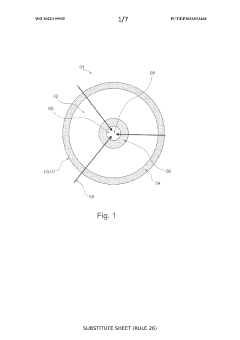
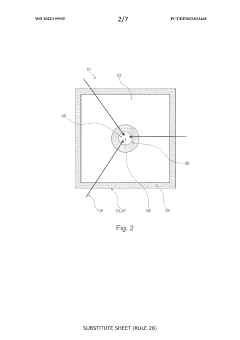
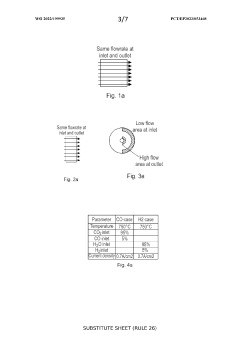
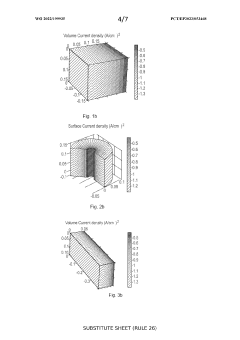
- The design features a solid oxide electrolysis cell stack with a fuel flow direction from the periphery towards the center, increasing the fuel inlet active cell area and decreasing it towards the outlet, thereby reducing maximum current density and degradation while maintaining production rate, using an external fuel inlet manifold to minimize pressure drop and ensure even gas distribution.
Material Science Advancements for Electrochemical Stacks
Recent advancements in material science have significantly contributed to improving the durability and performance of electrochemical compressor stacks. The development of novel membrane materials with enhanced proton conductivity and mechanical stability has been a key focus area. Perfluorosulfonic acid (PFSA) membranes, traditionally used in these systems, are now being modified with inorganic fillers such as silica, titanium dioxide, and zirconium phosphate to improve their water retention capabilities and reduce degradation under varying humidity conditions.
Electrode materials have also undergone substantial improvements, with researchers developing carbon-supported catalysts that demonstrate greater resistance to dissolution and agglomeration. Platinum-alloy catalysts, particularly those incorporating transition metals like cobalt, nickel, and iron, have shown promising results in maintaining activity while reducing the platinum loading, thereby addressing both performance and cost concerns in electrochemical compressor stacks.
Bipolar plate materials have evolved from traditional graphite to more robust alternatives such as coated stainless steel and composite materials. These newer materials offer improved corrosion resistance and electrical conductivity while maintaining the necessary mechanical properties. Surface treatments and coatings, including titanium nitride and graphene-based materials, have been applied to further enhance conductivity and reduce interfacial contact resistance.
Sealing materials have seen innovation through the development of reinforced elastomers and composite gaskets that maintain their properties under the harsh operating conditions of electrochemical compressors. These materials demonstrate improved chemical stability against the aggressive environment while providing consistent compression set resistance over extended operational periods.
Advances in manufacturing techniques have complemented these material developments. Techniques such as electrospinning for membrane fabrication, pulse electrodeposition for catalyst layer formation, and advanced molding processes for bipolar plates have enabled more precise control over material microstructure and properties, leading to components with enhanced durability and performance characteristics.
Computational materials science has accelerated the discovery and optimization of new materials for electrochemical stacks. Machine learning algorithms combined with density functional theory calculations are being employed to predict material properties and degradation mechanisms, allowing researchers to screen potential candidates more efficiently before experimental validation.
The integration of self-healing materials represents another frontier in addressing degradation issues. Polymers with intrinsic self-healing capabilities or those incorporating microcapsules with healing agents are being explored to automatically repair microcracks and other damage that occurs during operation, potentially extending the service life of electrochemical compressor stacks significantly.
Electrode materials have also undergone substantial improvements, with researchers developing carbon-supported catalysts that demonstrate greater resistance to dissolution and agglomeration. Platinum-alloy catalysts, particularly those incorporating transition metals like cobalt, nickel, and iron, have shown promising results in maintaining activity while reducing the platinum loading, thereby addressing both performance and cost concerns in electrochemical compressor stacks.
Bipolar plate materials have evolved from traditional graphite to more robust alternatives such as coated stainless steel and composite materials. These newer materials offer improved corrosion resistance and electrical conductivity while maintaining the necessary mechanical properties. Surface treatments and coatings, including titanium nitride and graphene-based materials, have been applied to further enhance conductivity and reduce interfacial contact resistance.
Sealing materials have seen innovation through the development of reinforced elastomers and composite gaskets that maintain their properties under the harsh operating conditions of electrochemical compressors. These materials demonstrate improved chemical stability against the aggressive environment while providing consistent compression set resistance over extended operational periods.
Advances in manufacturing techniques have complemented these material developments. Techniques such as electrospinning for membrane fabrication, pulse electrodeposition for catalyst layer formation, and advanced molding processes for bipolar plates have enabled more precise control over material microstructure and properties, leading to components with enhanced durability and performance characteristics.
Computational materials science has accelerated the discovery and optimization of new materials for electrochemical stacks. Machine learning algorithms combined with density functional theory calculations are being employed to predict material properties and degradation mechanisms, allowing researchers to screen potential candidates more efficiently before experimental validation.
The integration of self-healing materials represents another frontier in addressing degradation issues. Polymers with intrinsic self-healing capabilities or those incorporating microcapsules with healing agents are being explored to automatically repair microcracks and other damage that occurs during operation, potentially extending the service life of electrochemical compressor stacks significantly.
Environmental Impact and Sustainability Considerations
Electrochemical compressors represent a significant advancement in sustainable cooling and compression technologies, offering potential environmental benefits over traditional mechanical systems. The environmental impact of these systems is closely tied to their degradation mechanisms and the effectiveness of mitigation strategies. When electrochemical compressor stacks degrade prematurely, this necessitates more frequent replacement, increasing material consumption and waste generation throughout the product lifecycle.
The primary environmental advantage of electrochemical compressors lies in their elimination of harmful refrigerants with high global warming potential (GWP). Unlike conventional vapor compression systems that rely on hydrofluorocarbons (HFCs) or hydrochlorofluorocarbons (HCFCs), electrochemical systems typically use hydrogen or other environmentally benign working fluids. This transition aligns with global environmental regulations such as the Kigali Amendment to the Montreal Protocol, which mandates the phase-down of high-GWP refrigerants.
Energy efficiency considerations are equally critical when assessing environmental impact. While electrochemical compressors demonstrate promising theoretical efficiency, degradation mechanisms can significantly reduce operational efficiency over time. This efficiency loss translates directly to increased energy consumption and associated carbon emissions. Research indicates that maintaining optimal membrane hydration and preventing catalyst poisoning can preserve efficiency, thereby minimizing the carbon footprint during operation.
Material sustainability presents both challenges and opportunities. Current electrochemical stack designs often incorporate precious metals like platinum as catalysts, raising concerns about resource scarcity and extraction impacts. Degradation mitigation strategies that extend stack lifetime effectively reduce the consumption rate of these critical materials. Additionally, emerging research into alternative catalysts using earth-abundant materials shows promise for reducing dependence on scarce resources while maintaining performance.
End-of-life considerations for electrochemical compressor components require attention as market adoption increases. The composite nature of membrane electrode assemblies presents recycling challenges, as separation of valuable materials often involves energy-intensive processes. Developing design-for-disassembly approaches and establishing specialized recycling infrastructure will be essential to closing the material loop and minimizing waste.
Water management within electrochemical systems also carries environmental implications. Systems requiring pure water for operation may increase water consumption in water-stressed regions. Implementing closed-loop water recovery systems and optimizing membrane hydration strategies can minimize this impact while simultaneously addressing a key degradation mechanism.
The primary environmental advantage of electrochemical compressors lies in their elimination of harmful refrigerants with high global warming potential (GWP). Unlike conventional vapor compression systems that rely on hydrofluorocarbons (HFCs) or hydrochlorofluorocarbons (HCFCs), electrochemical systems typically use hydrogen or other environmentally benign working fluids. This transition aligns with global environmental regulations such as the Kigali Amendment to the Montreal Protocol, which mandates the phase-down of high-GWP refrigerants.
Energy efficiency considerations are equally critical when assessing environmental impact. While electrochemical compressors demonstrate promising theoretical efficiency, degradation mechanisms can significantly reduce operational efficiency over time. This efficiency loss translates directly to increased energy consumption and associated carbon emissions. Research indicates that maintaining optimal membrane hydration and preventing catalyst poisoning can preserve efficiency, thereby minimizing the carbon footprint during operation.
Material sustainability presents both challenges and opportunities. Current electrochemical stack designs often incorporate precious metals like platinum as catalysts, raising concerns about resource scarcity and extraction impacts. Degradation mitigation strategies that extend stack lifetime effectively reduce the consumption rate of these critical materials. Additionally, emerging research into alternative catalysts using earth-abundant materials shows promise for reducing dependence on scarce resources while maintaining performance.
End-of-life considerations for electrochemical compressor components require attention as market adoption increases. The composite nature of membrane electrode assemblies presents recycling challenges, as separation of valuable materials often involves energy-intensive processes. Developing design-for-disassembly approaches and establishing specialized recycling infrastructure will be essential to closing the material loop and minimizing waste.
Water management within electrochemical systems also carries environmental implications. Systems requiring pure water for operation may increase water consumption in water-stressed regions. Implementing closed-loop water recovery systems and optimizing membrane hydration strategies can minimize this impact while simultaneously addressing a key degradation mechanism.
Unlock deeper insights with PatSnap Eureka Quick Research — get a full tech report to explore trends and direct your research. Try now!
Generate Your Research Report Instantly with AI Agent
Supercharge your innovation with PatSnap Eureka AI Agent Platform!