

Enhancing B58 Engine Performance with Advanced Throttle Bodies
AUG 12, 20259 MIN READ
Generate Your Research Report Instantly with AI Agent
PatSnap Eureka helps you evaluate technical feasibility & market potential.
B58 Engine Evolution
The B58 engine, developed by BMW, has undergone significant evolution since its introduction in 2015. This inline-six turbocharged engine has become a cornerstone of BMW's powertrain strategy, finding its way into various models across the BMW and Toyota lineups. The engine's development has been driven by the need for increased performance, improved fuel efficiency, and reduced emissions.
Initially introduced with a 3.0-liter displacement, the B58 engine has seen several iterations and improvements over the years. The first generation, known as B58B30M0, produced between 322 and 382 horsepower, depending on the application. This version set the foundation for future developments, showcasing BMW's commitment to combining power with efficiency.
As emissions regulations tightened globally, BMW engineers focused on enhancing the B58's performance while simultaneously reducing its environmental impact. This led to the introduction of the B58B30O1 variant in 2019, which incorporated more advanced fuel injection systems and improved turbocharger designs. These updates resulted in power outputs ranging from 335 to 382 horsepower, demonstrating BMW's ability to extract more performance from the same basic architecture.
The most recent evolution of the B58 engine, the B58B30O2, represents a significant leap forward in terms of both performance and efficiency. Introduced in 2022, this version features a host of improvements, including a redesigned intake system, updated turbocharger, and enhanced cooling capabilities. These modifications have pushed the engine's output to new heights, with some applications producing up to 455 horsepower.
Throughout its evolution, the B58 engine has maintained its core characteristics of smooth power delivery and impressive torque output. BMW's continuous refinement of the engine has focused on improving throttle response, reducing turbo lag, and enhancing overall drivability. These efforts have been particularly evident in the engine's application in high-performance models, where immediate throttle response is crucial.
The B58's evolution has also seen advancements in materials and manufacturing processes. BMW has incorporated lightweight components and more efficient production techniques to reduce the engine's overall weight and improve its thermal efficiency. These changes have contributed to the engine's ability to meet increasingly stringent emissions standards while delivering enhanced performance.
As the automotive industry shifts towards electrification, the B58 engine's evolution has included the integration of mild hybrid technology in some applications. This addition has further improved fuel efficiency and reduced emissions, showcasing BMW's strategy to bridge the gap between traditional internal combustion engines and fully electric powertrains.
Initially introduced with a 3.0-liter displacement, the B58 engine has seen several iterations and improvements over the years. The first generation, known as B58B30M0, produced between 322 and 382 horsepower, depending on the application. This version set the foundation for future developments, showcasing BMW's commitment to combining power with efficiency.
As emissions regulations tightened globally, BMW engineers focused on enhancing the B58's performance while simultaneously reducing its environmental impact. This led to the introduction of the B58B30O1 variant in 2019, which incorporated more advanced fuel injection systems and improved turbocharger designs. These updates resulted in power outputs ranging from 335 to 382 horsepower, demonstrating BMW's ability to extract more performance from the same basic architecture.
The most recent evolution of the B58 engine, the B58B30O2, represents a significant leap forward in terms of both performance and efficiency. Introduced in 2022, this version features a host of improvements, including a redesigned intake system, updated turbocharger, and enhanced cooling capabilities. These modifications have pushed the engine's output to new heights, with some applications producing up to 455 horsepower.
Throughout its evolution, the B58 engine has maintained its core characteristics of smooth power delivery and impressive torque output. BMW's continuous refinement of the engine has focused on improving throttle response, reducing turbo lag, and enhancing overall drivability. These efforts have been particularly evident in the engine's application in high-performance models, where immediate throttle response is crucial.
The B58's evolution has also seen advancements in materials and manufacturing processes. BMW has incorporated lightweight components and more efficient production techniques to reduce the engine's overall weight and improve its thermal efficiency. These changes have contributed to the engine's ability to meet increasingly stringent emissions standards while delivering enhanced performance.
As the automotive industry shifts towards electrification, the B58 engine's evolution has included the integration of mild hybrid technology in some applications. This addition has further improved fuel efficiency and reduced emissions, showcasing BMW's strategy to bridge the gap between traditional internal combustion engines and fully electric powertrains.
Market Demand Analysis
The market demand for advanced throttle bodies to enhance B58 engine performance has been steadily growing in recent years. This trend is driven by automotive enthusiasts and performance-oriented consumers seeking to maximize the potential of their vehicles equipped with the BMW B58 engine.
The B58 engine, known for its robust design and tuning potential, has become a popular choice among car manufacturers and aftermarket tuners. As a result, there is a significant market for performance upgrades, with advanced throttle bodies being a key component in achieving improved engine output and responsiveness.
The automotive aftermarket industry has witnessed a surge in demand for B58 engine upgrades, particularly in regions with a strong car culture and performance-oriented consumer base. North America, Europe, and parts of Asia have shown considerable interest in these advanced throttle body solutions.
Performance-oriented vehicle owners are increasingly seeking ways to unlock additional horsepower and torque from their B58-equipped vehicles. Advanced throttle bodies offer a relatively cost-effective and straightforward method to achieve noticeable performance gains without extensive engine modifications.
The market for B58 engine upgrades is not limited to individual consumers. Tuning shops, performance garages, and specialized automotive businesses have also contributed to the growing demand for advanced throttle bodies. These businesses cater to customers looking for professional installation and comprehensive performance packages.
Racing and motorsport applications have further fueled the demand for high-performance throttle bodies. Competitive drivers and teams utilizing B58-powered vehicles in various racing series are constantly seeking ways to gain an edge, making advanced throttle bodies an attractive option for extracting maximum performance.
The increasing popularity of track days and amateur racing events has also contributed to the market growth. Enthusiasts participating in these activities often seek to enhance their vehicles' performance, creating a steady demand for advanced throttle body solutions.
As environmental regulations become more stringent, there is a growing interest in performance upgrades that can improve engine efficiency alongside power output. Advanced throttle bodies that offer better airflow management and improved fuel economy are likely to see increased demand in the coming years.
The market for B58 engine performance upgrades, including advanced throttle bodies, is expected to continue its growth trajectory. Factors such as the ongoing production of B58-equipped vehicles, the engine's popularity among tuners, and the constant pursuit of performance improvements by enthusiasts all contribute to a positive market outlook for the foreseeable future.
The B58 engine, known for its robust design and tuning potential, has become a popular choice among car manufacturers and aftermarket tuners. As a result, there is a significant market for performance upgrades, with advanced throttle bodies being a key component in achieving improved engine output and responsiveness.
The automotive aftermarket industry has witnessed a surge in demand for B58 engine upgrades, particularly in regions with a strong car culture and performance-oriented consumer base. North America, Europe, and parts of Asia have shown considerable interest in these advanced throttle body solutions.
Performance-oriented vehicle owners are increasingly seeking ways to unlock additional horsepower and torque from their B58-equipped vehicles. Advanced throttle bodies offer a relatively cost-effective and straightforward method to achieve noticeable performance gains without extensive engine modifications.
The market for B58 engine upgrades is not limited to individual consumers. Tuning shops, performance garages, and specialized automotive businesses have also contributed to the growing demand for advanced throttle bodies. These businesses cater to customers looking for professional installation and comprehensive performance packages.
Racing and motorsport applications have further fueled the demand for high-performance throttle bodies. Competitive drivers and teams utilizing B58-powered vehicles in various racing series are constantly seeking ways to gain an edge, making advanced throttle bodies an attractive option for extracting maximum performance.
The increasing popularity of track days and amateur racing events has also contributed to the market growth. Enthusiasts participating in these activities often seek to enhance their vehicles' performance, creating a steady demand for advanced throttle body solutions.
As environmental regulations become more stringent, there is a growing interest in performance upgrades that can improve engine efficiency alongside power output. Advanced throttle bodies that offer better airflow management and improved fuel economy are likely to see increased demand in the coming years.
The market for B58 engine performance upgrades, including advanced throttle bodies, is expected to continue its growth trajectory. Factors such as the ongoing production of B58-equipped vehicles, the engine's popularity among tuners, and the constant pursuit of performance improvements by enthusiasts all contribute to a positive market outlook for the foreseeable future.
Current Challenges
The B58 engine, renowned for its robust performance, faces several challenges in its quest for enhanced output through advanced throttle bodies. One primary obstacle is the delicate balance between increased airflow and maintaining optimal fuel mixture ratios. As throttle bodies are enlarged to allow more air into the engine, the fuel injection system must be recalibrated to match the increased air volume, a process that requires precise tuning and sophisticated engine management systems.
Another significant challenge lies in the thermal management of the engine. With increased airflow and potential for higher power output, the B58 engine may experience elevated operating temperatures. This necessitates improved cooling solutions, which can be complex to implement without compromising the engine's compact design or adding substantial weight to the vehicle.
The integration of advanced throttle bodies also presents challenges in terms of compatibility with existing engine components. The B58's stock intake manifold, sensors, and electronic control units may require modifications or upgrades to fully capitalize on the benefits of enhanced throttle bodies. This interdependency of components adds layers of complexity to the performance enhancement process.
Furthermore, maintaining drivability and emissions compliance while increasing performance is a critical challenge. Advanced throttle bodies can potentially alter the engine's behavior across its entire RPM range, necessitating careful calibration to ensure smooth power delivery and adherence to increasingly stringent emissions standards.
The durability and longevity of engine components under increased stress is another concern. Higher airflow and potential boost pressures can accelerate wear on internal engine parts, requiring engineers to reevaluate material choices and design tolerances to maintain reliability.
Lastly, the cost-effectiveness of implementing advanced throttle bodies presents a challenge for both manufacturers and aftermarket tuners. Balancing the performance gains against the investment in research, development, and production of these components is crucial for market viability.
Addressing these challenges requires a multifaceted approach, combining advanced engineering techniques, materials science, and sophisticated electronic control strategies. As the automotive industry continues to push the boundaries of internal combustion engine performance, overcoming these obstacles will be key to unlocking the full potential of the B58 engine with advanced throttle bodies.
Another significant challenge lies in the thermal management of the engine. With increased airflow and potential for higher power output, the B58 engine may experience elevated operating temperatures. This necessitates improved cooling solutions, which can be complex to implement without compromising the engine's compact design or adding substantial weight to the vehicle.
The integration of advanced throttle bodies also presents challenges in terms of compatibility with existing engine components. The B58's stock intake manifold, sensors, and electronic control units may require modifications or upgrades to fully capitalize on the benefits of enhanced throttle bodies. This interdependency of components adds layers of complexity to the performance enhancement process.
Furthermore, maintaining drivability and emissions compliance while increasing performance is a critical challenge. Advanced throttle bodies can potentially alter the engine's behavior across its entire RPM range, necessitating careful calibration to ensure smooth power delivery and adherence to increasingly stringent emissions standards.
The durability and longevity of engine components under increased stress is another concern. Higher airflow and potential boost pressures can accelerate wear on internal engine parts, requiring engineers to reevaluate material choices and design tolerances to maintain reliability.
Lastly, the cost-effectiveness of implementing advanced throttle bodies presents a challenge for both manufacturers and aftermarket tuners. Balancing the performance gains against the investment in research, development, and production of these components is crucial for market viability.
Addressing these challenges requires a multifaceted approach, combining advanced engineering techniques, materials science, and sophisticated electronic control strategies. As the automotive industry continues to push the boundaries of internal combustion engine performance, overcoming these obstacles will be key to unlocking the full potential of the B58 engine with advanced throttle bodies.
Existing Solutions
01 Engine control and optimization
Advanced control systems and algorithms are used to optimize B58 engine performance. These systems monitor various parameters and adjust engine settings in real-time to enhance power output, fuel efficiency, and overall performance. Techniques include adaptive learning, predictive modeling, and intelligent control strategies.- Engine control and optimization: Advanced control systems and algorithms are used to optimize B58 engine performance. These systems monitor various parameters and adjust engine settings in real-time to enhance power output, fuel efficiency, and overall performance. Techniques include adaptive engine mapping, variable valve timing, and intelligent boost control.
- Turbocharging and boost management: The B58 engine employs sophisticated turbocharging technology to increase power output. This includes advanced boost management systems, variable geometry turbochargers, and intercooling solutions. These components work together to optimize air intake, reduce turbo lag, and enhance overall engine efficiency.
- Fuel injection and combustion optimization: High-precision fuel injection systems are utilized in the B58 engine to improve combustion efficiency and power output. This includes direct injection technology, multiple injection events per cycle, and advanced fuel pressure management. These systems contribute to better fuel atomization, more complete combustion, and reduced emissions.
- Thermal management and cooling systems: Effective thermal management is crucial for maintaining optimal B58 engine performance. Advanced cooling systems, including precision coolant flow control, integrated exhaust manifolds, and innovative heat exchanger designs, help regulate engine temperature and improve overall efficiency and longevity.
- Performance monitoring and diagnostics: Sophisticated monitoring and diagnostic systems are employed to ensure peak B58 engine performance. These include real-time sensor networks, advanced data analysis algorithms, and predictive maintenance capabilities. Such systems help identify potential issues early, optimize performance parameters, and maintain engine efficiency over time.
02 Turbocharging and boost pressure management
The B58 engine employs sophisticated turbocharging systems to increase power output. This includes advanced boost pressure management, variable geometry turbochargers, and electronic wastegate control. These technologies work together to optimize air intake, reduce turbo lag, and enhance overall engine performance across different operating conditions.Expand Specific Solutions03 Fuel injection and combustion optimization
High-precision fuel injection systems are utilized in the B58 engine to improve combustion efficiency and power output. This includes direct injection technology, multiple injection events per cycle, and advanced fuel mapping strategies. These systems work in conjunction with sophisticated engine management software to optimize fuel delivery and combustion processes.Expand Specific Solutions04 Thermal management and cooling systems
Effective thermal management is crucial for maintaining optimal B58 engine performance. Advanced cooling systems, including precision coolant flow control, integrated exhaust manifolds, and intelligent temperature management, help maintain ideal operating temperatures. This contributes to improved efficiency, reduced wear, and enhanced overall engine performance.Expand Specific Solutions05 Performance monitoring and diagnostics
Sophisticated onboard diagnostics and performance monitoring systems are integrated into the B58 engine. These systems continuously analyze engine parameters, detect potential issues, and provide real-time feedback for performance optimization. Advanced sensors and data analysis techniques are employed to ensure peak engine performance and early detection of any anomalies.Expand Specific Solutions
Key Industry Players
The market for advanced throttle bodies to enhance B58 engine performance is in a growth phase, with increasing demand driven by automotive enthusiasts and performance-oriented manufacturers. The global market size for aftermarket engine components is expanding, reflecting a growing interest in vehicle customization and performance upgrades. Technologically, the field is moderately mature, with established players like Holley Group and Keihin Corp. leading innovation. However, there's room for advancement, particularly in electronic throttle control and integration with engine management systems. Major automotive manufacturers such as Ford, Toyota, and BMW (through their B58 engine) are also actively developing proprietary technologies, indicating a competitive and evolving landscape.
Ford Global Technologies LLC
Technical Solution: Ford has developed a cutting-edge throttle body system that can be adapted to enhance the B58 engine's performance. Their design incorporates a twin-butterfly valve configuration, allowing for more nuanced airflow control across different load conditions. Ford's throttle body utilizes advanced composite materials for the valve plates, reducing inertia and improving response times. The system features Ford's patented Electronic Throttle Control (ETC) technology, which uses predictive algorithms to anticipate driver inputs and optimize throttle positioning[10]. Additionally, Ford has implemented a novel thermal management system that maintains optimal operating temperatures for consistent performance. The throttle body also incorporates active noise cancellation technology to reduce intake noise and improve NVH characteristics[11].
Strengths: Twin-butterfly design for precise control, advanced materials for improved response, and innovative features like predictive algorithms and active noise cancellation. Weaknesses: Potential compatibility issues with non-Ford ECUs and may require specialized calibration tools for optimal setup.
Toyota Motor Corp.
Technical Solution: Toyota has developed a sophisticated throttle body system for high-performance applications, which can be adapted to enhance the B58 engine. Their design incorporates a dual-bore configuration with independent actuators for each throttle plate, allowing for more precise air management across the engine's RPM range. Toyota's system utilizes advanced carbon fiber components to reduce weight and improve throttle response times. The throttle body is integrated with Toyota's D-4S direct and port fuel injection system, enabling dynamic switching between injection methods for optimal fuel atomization and combustion efficiency[6]. Additionally, Toyota has implemented a self-cleaning mechanism that uses high-frequency vibrations to prevent carbon buildup, ensuring consistent performance over time[8].
Strengths: Innovative dual-bore design, lightweight construction, and integration with advanced fuel injection systems. Weaknesses: Complexity may lead to higher manufacturing costs and potential compatibility issues with non-Toyota engine management systems.
Core Innovations
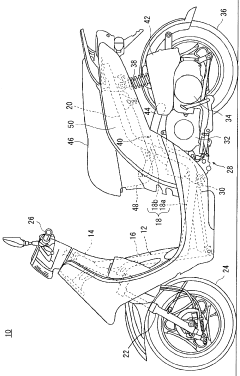
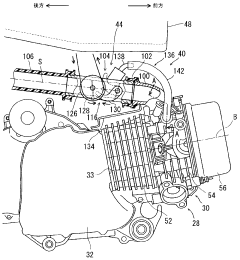
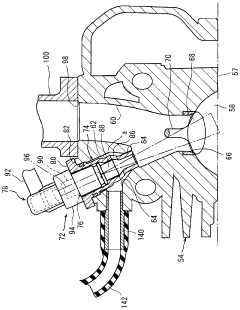
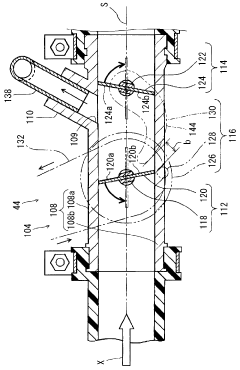
Throttle body and powered two-wheeled vehicle provided therewith
PatentWO2010113981A1
Innovation
- A throttle body design featuring butterfly-type first and second throttle valves with a tubular portion, through hole, and branch pipe to improve intake air flow between the valves, ensuring efficient air introduction into an auxiliary passage, which enhances fuel atomization and efficiency.
Emissions Regulations
Emissions regulations play a crucial role in shaping the development and implementation of advanced throttle bodies for enhancing B58 engine performance. These regulations, established by governmental bodies worldwide, aim to reduce harmful emissions from vehicles and promote environmental sustainability. As automotive manufacturers strive to improve engine performance, they must simultaneously adhere to increasingly stringent emissions standards.
In recent years, emissions regulations have become more stringent, particularly in developed countries. The European Union's Euro 6 standards, implemented in 2014, set strict limits on nitrogen oxides (NOx), carbon monoxide (CO), and particulate matter emissions. Similarly, the United States Environmental Protection Agency (EPA) has established Tier 3 standards, which require significant reductions in emissions across various vehicle categories.
These regulations have a direct impact on the design and functionality of throttle bodies for the B58 engine. Advanced throttle bodies must not only enhance performance but also contribute to reducing emissions. This dual objective has led to the development of innovative technologies such as electronic throttle control systems and variable geometry throttle bodies.
Electronic throttle control systems, also known as drive-by-wire technology, allow for precise control of air intake, optimizing fuel efficiency and reducing emissions. These systems can adjust throttle response based on various parameters, including engine load, speed, and environmental conditions, ensuring optimal performance while maintaining compliance with emissions standards.
Variable geometry throttle bodies represent another advancement in emissions control. These systems can alter the shape and size of the throttle opening, allowing for better airflow management across different engine operating conditions. By optimizing air-fuel mixture ratios, variable geometry throttle bodies can significantly reduce emissions without compromising engine performance.
Manufacturers developing advanced throttle bodies for the B58 engine must also consider the impact of emissions regulations on testing and certification processes. Rigorous emissions testing procedures, such as the Worldwide Harmonized Light Vehicles Test Procedure (WLTP), require vehicles to demonstrate compliance under various driving conditions. This necessitates the development of throttle bodies that can maintain optimal performance and emissions control across a wide range of scenarios.
Furthermore, emissions regulations have spurred research into materials and coatings that can enhance the durability and efficiency of throttle bodies. Advanced materials with low friction properties and corrosion resistance can contribute to reduced emissions by minimizing wear and maintaining consistent performance over time.
As emissions regulations continue to evolve, the development of advanced throttle bodies for the B58 engine must remain adaptable. Future regulations may focus on reducing greenhouse gas emissions, particularly carbon dioxide (CO2), which could further influence throttle body design and functionality. Manufacturers must anticipate these changes and invest in research and development to ensure their throttle bodies remain compliant while delivering enhanced engine performance.
In recent years, emissions regulations have become more stringent, particularly in developed countries. The European Union's Euro 6 standards, implemented in 2014, set strict limits on nitrogen oxides (NOx), carbon monoxide (CO), and particulate matter emissions. Similarly, the United States Environmental Protection Agency (EPA) has established Tier 3 standards, which require significant reductions in emissions across various vehicle categories.
These regulations have a direct impact on the design and functionality of throttle bodies for the B58 engine. Advanced throttle bodies must not only enhance performance but also contribute to reducing emissions. This dual objective has led to the development of innovative technologies such as electronic throttle control systems and variable geometry throttle bodies.
Electronic throttle control systems, also known as drive-by-wire technology, allow for precise control of air intake, optimizing fuel efficiency and reducing emissions. These systems can adjust throttle response based on various parameters, including engine load, speed, and environmental conditions, ensuring optimal performance while maintaining compliance with emissions standards.
Variable geometry throttle bodies represent another advancement in emissions control. These systems can alter the shape and size of the throttle opening, allowing for better airflow management across different engine operating conditions. By optimizing air-fuel mixture ratios, variable geometry throttle bodies can significantly reduce emissions without compromising engine performance.
Manufacturers developing advanced throttle bodies for the B58 engine must also consider the impact of emissions regulations on testing and certification processes. Rigorous emissions testing procedures, such as the Worldwide Harmonized Light Vehicles Test Procedure (WLTP), require vehicles to demonstrate compliance under various driving conditions. This necessitates the development of throttle bodies that can maintain optimal performance and emissions control across a wide range of scenarios.
Furthermore, emissions regulations have spurred research into materials and coatings that can enhance the durability and efficiency of throttle bodies. Advanced materials with low friction properties and corrosion resistance can contribute to reduced emissions by minimizing wear and maintaining consistent performance over time.
As emissions regulations continue to evolve, the development of advanced throttle bodies for the B58 engine must remain adaptable. Future regulations may focus on reducing greenhouse gas emissions, particularly carbon dioxide (CO2), which could further influence throttle body design and functionality. Manufacturers must anticipate these changes and invest in research and development to ensure their throttle bodies remain compliant while delivering enhanced engine performance.
Performance Testing
Performance testing is a critical aspect of enhancing the B58 engine's performance with advanced throttle bodies. This process involves rigorous evaluation of various parameters to quantify the improvements achieved through the implementation of new throttle body designs.
The testing methodology typically begins with establishing a baseline performance using the stock throttle body. This involves measuring key metrics such as horsepower, torque, throttle response, and fuel efficiency across different engine speeds and load conditions. Dynamometer testing is often employed to obtain accurate and repeatable results, allowing for precise comparison between stock and upgraded configurations.
Once the baseline is established, the advanced throttle body is installed, and the same suite of tests is conducted. This allows for a direct comparison of performance gains. Particular attention is paid to improvements in airflow, which is a critical factor in enhancing engine performance. Advanced throttle bodies are designed to optimize airflow into the engine, potentially leading to increased power output and improved throttle response.
In addition to power and torque measurements, throttle response testing is crucial. This involves assessing the engine's ability to react quickly to throttle inputs, which can significantly impact the driving experience. Sophisticated data logging equipment is used to capture precise timing information, measuring the delay between throttle input and engine response.
Fuel efficiency testing is another important component, as advanced throttle bodies may impact the air-fuel mixture. This testing involves measuring fuel consumption under various driving conditions and comparing it to the baseline data. Any improvements in fuel efficiency can provide additional value to the upgrade beyond pure performance gains.
Temperature monitoring during performance testing is essential, as changes in airflow can affect engine operating temperatures. Thermal imaging and strategically placed sensors are used to track temperature changes in key components, ensuring that the advanced throttle body does not introduce any thermal management issues.
Durability testing is also conducted to ensure that the advanced throttle body can withstand prolonged use under high-performance conditions. This may involve extended dyno runs or real-world driving tests to simulate long-term usage scenarios.
Finally, emissions testing is performed to verify that the enhanced performance does not come at the cost of increased pollutant output. This is particularly important for maintaining compliance with environmental regulations and ensuring that the upgrade does not compromise the vehicle's emissions control systems.
The results of these comprehensive performance tests are meticulously analyzed and documented, providing a clear picture of the benefits and any potential trade-offs associated with implementing advanced throttle bodies on the B58 engine. This data is invaluable for both engineers and end-users in making informed decisions about performance upgrades.
The testing methodology typically begins with establishing a baseline performance using the stock throttle body. This involves measuring key metrics such as horsepower, torque, throttle response, and fuel efficiency across different engine speeds and load conditions. Dynamometer testing is often employed to obtain accurate and repeatable results, allowing for precise comparison between stock and upgraded configurations.
Once the baseline is established, the advanced throttle body is installed, and the same suite of tests is conducted. This allows for a direct comparison of performance gains. Particular attention is paid to improvements in airflow, which is a critical factor in enhancing engine performance. Advanced throttle bodies are designed to optimize airflow into the engine, potentially leading to increased power output and improved throttle response.
In addition to power and torque measurements, throttle response testing is crucial. This involves assessing the engine's ability to react quickly to throttle inputs, which can significantly impact the driving experience. Sophisticated data logging equipment is used to capture precise timing information, measuring the delay between throttle input and engine response.
Fuel efficiency testing is another important component, as advanced throttle bodies may impact the air-fuel mixture. This testing involves measuring fuel consumption under various driving conditions and comparing it to the baseline data. Any improvements in fuel efficiency can provide additional value to the upgrade beyond pure performance gains.
Temperature monitoring during performance testing is essential, as changes in airflow can affect engine operating temperatures. Thermal imaging and strategically placed sensors are used to track temperature changes in key components, ensuring that the advanced throttle body does not introduce any thermal management issues.
Durability testing is also conducted to ensure that the advanced throttle body can withstand prolonged use under high-performance conditions. This may involve extended dyno runs or real-world driving tests to simulate long-term usage scenarios.
Finally, emissions testing is performed to verify that the enhanced performance does not come at the cost of increased pollutant output. This is particularly important for maintaining compliance with environmental regulations and ensuring that the upgrade does not compromise the vehicle's emissions control systems.
The results of these comprehensive performance tests are meticulously analyzed and documented, providing a clear picture of the benefits and any potential trade-offs associated with implementing advanced throttle bodies on the B58 engine. This data is invaluable for both engineers and end-users in making informed decisions about performance upgrades.
Unlock deeper insights with PatSnap Eureka Quick Research — get a full tech report to explore trends and direct your research. Try now!
Generate Your Research Report Instantly with AI Agent
Supercharge your innovation with PatSnap Eureka AI Agent Platform!