

Exploring scalable manufacturing with silicon photonics processes.
JUL 17, 20259 MIN READ
Generate Your Research Report Instantly with AI Agent
PatSnap Eureka helps you evaluate technical feasibility & market potential.
Silicon Photonics Evolution and Objectives
Silicon photonics has emerged as a transformative technology in the field of integrated optics, offering the potential for high-speed, low-power, and cost-effective optical communication systems. The evolution of silicon photonics can be traced back to the late 1980s when researchers first explored the possibility of using silicon as a platform for photonic devices. Since then, the field has witnessed remarkable progress, driven by advancements in fabrication techniques and the increasing demand for high-bandwidth communication systems.
The primary objective of silicon photonics is to leverage the well-established semiconductor manufacturing infrastructure to produce photonic integrated circuits (PICs) that can seamlessly integrate with electronic components. This integration aims to overcome the limitations of traditional electronic interconnects, particularly in terms of bandwidth and power consumption. By utilizing silicon as the primary material, researchers and engineers seek to create scalable and cost-effective solutions for a wide range of applications, including data centers, telecommunications, and high-performance computing.
One of the key milestones in the evolution of silicon photonics was the development of efficient silicon-based modulators and photodetectors in the early 2000s. These components are essential for converting electrical signals to optical signals and vice versa, enabling the integration of photonic and electronic circuits on a single chip. Subsequent advancements focused on improving the performance and reliability of these devices, as well as developing novel components such as waveguides, multiplexers, and on-chip lasers.
The current technological landscape of silicon photonics is characterized by a push towards higher levels of integration and functionality. Researchers are exploring advanced manufacturing techniques, such as 3D integration and wafer-scale bonding, to create more complex and compact photonic circuits. Additionally, there is a growing emphasis on developing new materials and structures to enhance the performance of silicon photonic devices, including the incorporation of III-V materials for efficient light emission and detection.
Looking ahead, the objectives of silicon photonics research and development are multifaceted. One primary goal is to achieve seamless integration of photonic and electronic components at the chip level, enabling the creation of high-performance, energy-efficient systems for next-generation computing and communication applications. Another important objective is to improve the scalability and yield of silicon photonic manufacturing processes, making the technology more accessible and cost-effective for widespread adoption.
Furthermore, researchers are exploring novel applications of silicon photonics beyond traditional communication systems. These include sensing and imaging technologies, quantum computing, and neuromorphic computing, where the unique properties of photonic circuits can offer significant advantages over conventional electronic approaches. As the field continues to evolve, the overarching goal remains to harness the full potential of silicon photonics to address the growing demands for high-speed, low-power, and scalable solutions in an increasingly interconnected world.
The primary objective of silicon photonics is to leverage the well-established semiconductor manufacturing infrastructure to produce photonic integrated circuits (PICs) that can seamlessly integrate with electronic components. This integration aims to overcome the limitations of traditional electronic interconnects, particularly in terms of bandwidth and power consumption. By utilizing silicon as the primary material, researchers and engineers seek to create scalable and cost-effective solutions for a wide range of applications, including data centers, telecommunications, and high-performance computing.
One of the key milestones in the evolution of silicon photonics was the development of efficient silicon-based modulators and photodetectors in the early 2000s. These components are essential for converting electrical signals to optical signals and vice versa, enabling the integration of photonic and electronic circuits on a single chip. Subsequent advancements focused on improving the performance and reliability of these devices, as well as developing novel components such as waveguides, multiplexers, and on-chip lasers.
The current technological landscape of silicon photonics is characterized by a push towards higher levels of integration and functionality. Researchers are exploring advanced manufacturing techniques, such as 3D integration and wafer-scale bonding, to create more complex and compact photonic circuits. Additionally, there is a growing emphasis on developing new materials and structures to enhance the performance of silicon photonic devices, including the incorporation of III-V materials for efficient light emission and detection.
Looking ahead, the objectives of silicon photonics research and development are multifaceted. One primary goal is to achieve seamless integration of photonic and electronic components at the chip level, enabling the creation of high-performance, energy-efficient systems for next-generation computing and communication applications. Another important objective is to improve the scalability and yield of silicon photonic manufacturing processes, making the technology more accessible and cost-effective for widespread adoption.
Furthermore, researchers are exploring novel applications of silicon photonics beyond traditional communication systems. These include sensing and imaging technologies, quantum computing, and neuromorphic computing, where the unique properties of photonic circuits can offer significant advantages over conventional electronic approaches. As the field continues to evolve, the overarching goal remains to harness the full potential of silicon photonics to address the growing demands for high-speed, low-power, and scalable solutions in an increasingly interconnected world.
Market Demand Analysis for Silicon Photonics
The market demand for silicon photonics has been experiencing significant growth in recent years, driven by the increasing need for high-speed data transmission and processing in various industries. As data centers and telecommunications networks continue to expand, the demand for faster, more energy-efficient, and compact optical communication solutions has surged. Silicon photonics offers a promising solution to these challenges, integrating optical and electronic components on a single chip.
The global silicon photonics market is projected to grow substantially over the next decade. This growth is primarily fueled by the rising adoption of cloud computing, 5G networks, and the Internet of Things (IoT). Data centers, in particular, are a key driver of demand for silicon photonics, as they require ever-increasing bandwidth and lower power consumption to handle the exponential growth in data traffic.
Telecommunications is another major sector contributing to the market demand for silicon photonics. As network operators upgrade their infrastructure to support 5G and beyond, there is a growing need for high-speed, low-latency optical communication components. Silicon photonics offers advantages in terms of size, power efficiency, and cost-effectiveness compared to traditional optical technologies.
The automotive industry is emerging as a potential growth area for silicon photonics. Advanced driver-assistance systems (ADAS) and autonomous vehicles require high-bandwidth, low-latency communication between various sensors and processing units. Silicon photonics can provide the necessary performance improvements to support these applications.
In the healthcare sector, there is increasing interest in silicon photonics for applications such as biosensing and medical imaging. The ability to integrate multiple optical functions on a single chip offers potential for more compact and cost-effective diagnostic tools.
Despite the growing demand, there are challenges that need to be addressed to fully realize the potential of silicon photonics. Manufacturing scalability remains a key issue, as the production processes for silicon photonics devices are complex and require high precision. Improving yield rates and reducing production costs are crucial factors in meeting the increasing market demand.
Standardization is another area that requires attention. As the silicon photonics ecosystem expands, there is a need for industry-wide standards to ensure interoperability and facilitate wider adoption across different applications and industries.
In conclusion, the market demand for silicon photonics is robust and expected to continue growing across multiple sectors. However, addressing manufacturing challenges and establishing industry standards will be critical in meeting this demand and unlocking the full potential of silicon photonics technology.
The global silicon photonics market is projected to grow substantially over the next decade. This growth is primarily fueled by the rising adoption of cloud computing, 5G networks, and the Internet of Things (IoT). Data centers, in particular, are a key driver of demand for silicon photonics, as they require ever-increasing bandwidth and lower power consumption to handle the exponential growth in data traffic.
Telecommunications is another major sector contributing to the market demand for silicon photonics. As network operators upgrade their infrastructure to support 5G and beyond, there is a growing need for high-speed, low-latency optical communication components. Silicon photonics offers advantages in terms of size, power efficiency, and cost-effectiveness compared to traditional optical technologies.
The automotive industry is emerging as a potential growth area for silicon photonics. Advanced driver-assistance systems (ADAS) and autonomous vehicles require high-bandwidth, low-latency communication between various sensors and processing units. Silicon photonics can provide the necessary performance improvements to support these applications.
In the healthcare sector, there is increasing interest in silicon photonics for applications such as biosensing and medical imaging. The ability to integrate multiple optical functions on a single chip offers potential for more compact and cost-effective diagnostic tools.
Despite the growing demand, there are challenges that need to be addressed to fully realize the potential of silicon photonics. Manufacturing scalability remains a key issue, as the production processes for silicon photonics devices are complex and require high precision. Improving yield rates and reducing production costs are crucial factors in meeting the increasing market demand.
Standardization is another area that requires attention. As the silicon photonics ecosystem expands, there is a need for industry-wide standards to ensure interoperability and facilitate wider adoption across different applications and industries.
In conclusion, the market demand for silicon photonics is robust and expected to continue growing across multiple sectors. However, addressing manufacturing challenges and establishing industry standards will be critical in meeting this demand and unlocking the full potential of silicon photonics technology.
Current Challenges in Silicon Photonics Manufacturing
Silicon photonics manufacturing faces several significant challenges that hinder its widespread adoption and scalability. One of the primary obstacles is the complexity of integrating optical components with electronic circuits on a single chip. This integration requires precise alignment and coupling between photonic and electronic elements, which is difficult to achieve consistently in large-scale production.
The fabrication process for silicon photonics devices demands extremely high precision and cleanliness standards. Even minor imperfections or contamination can significantly impact device performance. Achieving and maintaining these standards across large-scale manufacturing processes presents a considerable challenge, often resulting in lower yields and increased production costs.
Another critical challenge is the development of efficient and reliable packaging solutions for silicon photonics devices. Packaging must protect delicate optical components while allowing for precise fiber coupling and thermal management. Current packaging techniques are often labor-intensive and not well-suited for high-volume production, creating a bottleneck in the manufacturing process.
The lack of standardization in silicon photonics manufacturing processes and design tools also poses a significant hurdle. Unlike the well-established ecosystem for electronic integrated circuits, silicon photonics lacks a unified set of design rules and process parameters. This absence of standardization makes it difficult for different manufacturers to collaborate and for the industry to achieve economies of scale.
Thermal management is another crucial challenge in silicon photonics manufacturing. Optical components are sensitive to temperature variations, which can affect their performance and reliability. Developing effective cooling solutions that can be integrated into compact photonic devices while maintaining manufacturing scalability remains a complex task.
The availability of specialized testing and characterization equipment for silicon photonics devices is limited, making it challenging to perform rapid and accurate quality control in a high-volume manufacturing environment. This limitation can lead to increased production times and costs, as well as potential reliability issues in final products.
Lastly, the silicon photonics industry faces a shortage of skilled personnel with expertise in both optics and semiconductor manufacturing. This talent gap makes it difficult for companies to scale up their production capabilities and innovate in manufacturing processes. Addressing this challenge requires significant investment in education and training programs to develop a workforce capable of advancing silicon photonics manufacturing technologies.
The fabrication process for silicon photonics devices demands extremely high precision and cleanliness standards. Even minor imperfections or contamination can significantly impact device performance. Achieving and maintaining these standards across large-scale manufacturing processes presents a considerable challenge, often resulting in lower yields and increased production costs.
Another critical challenge is the development of efficient and reliable packaging solutions for silicon photonics devices. Packaging must protect delicate optical components while allowing for precise fiber coupling and thermal management. Current packaging techniques are often labor-intensive and not well-suited for high-volume production, creating a bottleneck in the manufacturing process.
The lack of standardization in silicon photonics manufacturing processes and design tools also poses a significant hurdle. Unlike the well-established ecosystem for electronic integrated circuits, silicon photonics lacks a unified set of design rules and process parameters. This absence of standardization makes it difficult for different manufacturers to collaborate and for the industry to achieve economies of scale.
Thermal management is another crucial challenge in silicon photonics manufacturing. Optical components are sensitive to temperature variations, which can affect their performance and reliability. Developing effective cooling solutions that can be integrated into compact photonic devices while maintaining manufacturing scalability remains a complex task.
The availability of specialized testing and characterization equipment for silicon photonics devices is limited, making it challenging to perform rapid and accurate quality control in a high-volume manufacturing environment. This limitation can lead to increased production times and costs, as well as potential reliability issues in final products.
Lastly, the silicon photonics industry faces a shortage of skilled personnel with expertise in both optics and semiconductor manufacturing. This talent gap makes it difficult for companies to scale up their production capabilities and innovate in manufacturing processes. Addressing this challenge requires significant investment in education and training programs to develop a workforce capable of advancing silicon photonics manufacturing technologies.
Scalable Manufacturing Techniques for Silicon Photonics
01 Scalable fabrication techniques for silicon photonics
Advanced manufacturing processes are being developed to enhance the scalability of silicon photonics production. These techniques include improved lithography methods, wafer-scale integration, and automated assembly processes. Such advancements allow for higher throughput and cost-effective production of silicon photonic devices and circuits.- Scalable fabrication techniques for silicon photonics: Advanced manufacturing processes are being developed to enhance the scalability of silicon photonics production. These techniques include improved lithography methods, wafer-scale integration, and automated assembly processes. Such advancements aim to increase throughput, reduce costs, and maintain high quality in large-scale production of silicon photonic devices.
- Integration of silicon photonics with CMOS technology: Efforts are being made to seamlessly integrate silicon photonics with existing CMOS technology. This integration allows for the scalable production of hybrid electro-optical systems on a single chip. The process involves developing compatible materials and fabrication techniques that can be implemented in standard CMOS foundries, enabling mass production of integrated photonic-electronic devices.
- Novel materials for enhancing silicon photonics scalability: Research is focused on developing and incorporating new materials to improve the performance and scalability of silicon photonic devices. These materials include III-V semiconductors, 2D materials, and novel alloys that can be integrated with silicon to enhance light emission, detection, and modulation capabilities. The use of these materials aims to overcome some of the limitations of pure silicon in photonic applications.
- Modular and reconfigurable silicon photonic systems: Scalability in silicon photonics is being addressed through the development of modular and reconfigurable photonic systems. This approach involves creating standardized photonic building blocks that can be easily combined and reconfigured to create complex systems. The modularity allows for easier scaling of photonic circuits and enables more flexible and adaptable photonic systems.
- Automated design and optimization tools for silicon photonics: To improve the scalability of silicon photonics design processes, automated design and optimization tools are being developed. These tools use machine learning algorithms and advanced simulation techniques to rapidly design and optimize complex photonic circuits. By automating much of the design process, these tools enable faster iteration and scaling of silicon photonic devices and systems.
02 Integration of silicon photonics with CMOS technology
Efforts are being made to seamlessly integrate silicon photonics with existing CMOS technology. This integration enables the production of hybrid electro-optical systems on a single chip, leveraging the mature CMOS fabrication infrastructure. The approach enhances scalability by allowing for high-volume manufacturing of integrated photonic-electronic devices.Expand Specific Solutions03 Novel materials and structures for improved scalability
Researchers are exploring new materials and device structures to enhance the scalability of silicon photonics. This includes the development of novel waveguide designs, the use of alternative materials for specific components, and the implementation of 3D integration techniques. These innovations aim to improve device performance and manufacturing efficiency.Expand Specific Solutions04 Automated design and simulation tools
The development of sophisticated design and simulation tools is crucial for scaling silicon photonics processes. These tools enable rapid prototyping, optimization of device layouts, and prediction of system performance. By streamlining the design process, these automated tools contribute to faster development cycles and improved scalability in production.Expand Specific Solutions05 Packaging and testing solutions for large-scale production
Advancements in packaging and testing technologies are essential for scaling silicon photonics production. This includes the development of automated fiber alignment techniques, standardized packaging platforms, and high-throughput testing methodologies. These solutions address key challenges in the mass production and quality assurance of silicon photonic devices.Expand Specific Solutions
Key Players in Silicon Photonics Industry
The field of scalable manufacturing with silicon photonics processes is in a growth phase, with increasing market potential driven by demand for high-speed data transmission and integrated photonic solutions. The global silicon photonics market is projected to expand significantly in the coming years, reflecting the technology's growing importance. Key players like Intel, GlobalFoundries, and TSMC are investing heavily in silicon photonics, leveraging their semiconductor expertise to advance the technology. Universities and research institutions, such as MIT and Zhejiang University, are also contributing to technological advancements. While the technology is maturing, challenges in integration and manufacturing scalability remain, indicating opportunities for further innovation and market development.
Taiwan Semiconductor Manufacturing Co., Ltd.
Technical Solution: TSMC has developed advanced silicon photonics processes for scalable manufacturing. Their approach integrates photonic components with CMOS technology on 300mm wafers, enabling high-volume production. TSMC's process includes low-loss waveguides, high-speed modulators, and efficient photodetectors. They have achieved integration densities of over 10,000 optical components per square centimeter[1]. TSMC's silicon photonics platform supports data rates up to 100 Gbps per channel, with plans to scale to 400 Gbps and beyond[2]. The company has also developed specialized packaging solutions for optical I/O, facilitating easier integration with electronic systems.
Strengths: Industry-leading manufacturing capabilities, high integration density, and established ecosystem. Weaknesses: High initial investment costs and potential for overcapacity in a nascent market.
Intel Corp.
Technical Solution: Intel's silicon photonics technology focuses on scalable manufacturing for data center interconnects. Their process integrates lasers, modulators, and detectors on a single chip using standard CMOS fabrication techniques. Intel has demonstrated 400 Gbps transceivers using their silicon photonics platform[3]. Their manufacturing approach includes wafer-scale testing and automated assembly, enabling high-volume production. Intel's silicon photonics chips feature integrated laser sources, which eliminates the need for external laser alignment[4]. The company has also developed advanced packaging techniques, such as their EMIB (Embedded Multi-die Interconnect Bridge) technology, to facilitate the integration of photonic and electronic components.
Strengths: Vertical integration from design to manufacturing, established presence in data center market. Weaknesses: Limited focus on applications outside data centers, potential for competition from specialized photonics companies.
Innovative Approaches in Silicon Photonics Fabrication
CVD-free, scalable processes for the production of silicon micro- and nanostructures
PatentActiveUS9299778B2
Innovation
- A method involving a silicon substrate with an etch layer and optional intermediate layers, where a pattern is created using a mask with template bands and exposed to light to form silicon tubes through chemical differentiation and development, followed by wet or dry etching to transfer the pattern into the substrate, enabling the scalable production of silicon tubes with controlled dimensions.


Photonic wire bonding methods and processes for the advanced packaging of photonic devices and systems
PatentPendingUS20250154053A1
Innovation
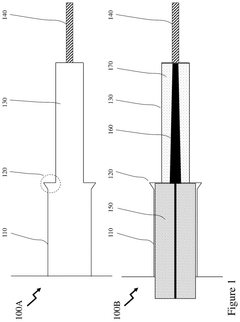
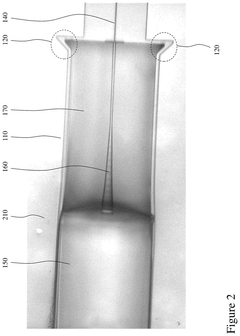
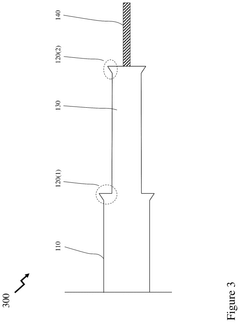
- The development of photonic wire bonds and photonic wire bonding techniques for packaging discrete integrated optical components, allowing for the formation of optical waveguides that can be directly connected or connected via special structures between optical fibers and integrated optical waveguides, thereby enabling low-cost, low-loss optical interconnections.

Supply Chain Considerations for Silicon Photonics
The supply chain for silicon photonics manufacturing is a complex ecosystem that requires careful consideration and management. As the industry moves towards scalable manufacturing processes, several key factors come into play. Firstly, the availability and quality of raw materials are crucial. High-purity silicon wafers, specialized dopants, and photoresist materials must be sourced reliably to ensure consistent production quality.
Secondly, the manufacturing equipment supply chain is equally important. Silicon photonics requires specialized tools for processes such as lithography, etching, and deposition. These tools are often highly sophisticated and expensive, necessitating strong relationships with equipment suppliers and careful planning for maintenance and upgrades.
Thirdly, packaging and integration present unique challenges in the silicon photonics supply chain. The need for precise alignment of optical components and the integration of electronic and photonic elements require specialized packaging solutions. This often involves collaborations with packaging houses or the development of in-house capabilities.
Furthermore, testing and quality control throughout the supply chain are critical. The sensitive nature of photonic devices demands rigorous testing at various stages of production. This requires investment in advanced testing equipment and the development of standardized testing protocols.
Lastly, the global nature of the silicon photonics industry means that supply chain management must account for international logistics, trade regulations, and potential geopolitical risks. Diversifying suppliers and considering local manufacturing options can help mitigate these risks and ensure a more resilient supply chain.
As the industry scales up, vertical integration and strategic partnerships will likely play an increasingly important role. Companies may seek to control more aspects of their supply chain to ensure quality, reduce costs, and protect intellectual property. This could lead to consolidation within the industry and the emergence of dominant players controlling key parts of the supply chain.
Secondly, the manufacturing equipment supply chain is equally important. Silicon photonics requires specialized tools for processes such as lithography, etching, and deposition. These tools are often highly sophisticated and expensive, necessitating strong relationships with equipment suppliers and careful planning for maintenance and upgrades.
Thirdly, packaging and integration present unique challenges in the silicon photonics supply chain. The need for precise alignment of optical components and the integration of electronic and photonic elements require specialized packaging solutions. This often involves collaborations with packaging houses or the development of in-house capabilities.
Furthermore, testing and quality control throughout the supply chain are critical. The sensitive nature of photonic devices demands rigorous testing at various stages of production. This requires investment in advanced testing equipment and the development of standardized testing protocols.
Lastly, the global nature of the silicon photonics industry means that supply chain management must account for international logistics, trade regulations, and potential geopolitical risks. Diversifying suppliers and considering local manufacturing options can help mitigate these risks and ensure a more resilient supply chain.
As the industry scales up, vertical integration and strategic partnerships will likely play an increasingly important role. Companies may seek to control more aspects of their supply chain to ensure quality, reduce costs, and protect intellectual property. This could lead to consolidation within the industry and the emergence of dominant players controlling key parts of the supply chain.
Environmental Impact of Silicon Photonics Production
The environmental impact of silicon photonics production is a critical consideration as the technology scales up for widespread adoption. The manufacturing process of silicon photonics devices involves several stages that can potentially affect the environment. One of the primary concerns is the use of hazardous materials in the fabrication process. Chemicals such as hydrofluoric acid, sulfuric acid, and various solvents are commonly used in the etching and cleaning steps of silicon wafer processing. These substances require careful handling and disposal to prevent environmental contamination.
Energy consumption is another significant factor in the environmental footprint of silicon photonics production. The fabrication of these devices often requires cleanroom environments with stringent temperature and humidity controls, which are energy-intensive to maintain. Additionally, the lithography and etching processes used in silicon photonics manufacturing consume substantial amounts of electricity, contributing to the overall energy demand of the industry.
Water usage is also a notable environmental concern in silicon photonics production. The manufacturing process requires large volumes of ultra-pure water for cleaning and rinsing steps. The purification and treatment of this water, as well as the management of wastewater, present challenges in terms of resource conservation and pollution prevention.
The production of silicon photonics devices generates various types of waste, including chemical byproducts, used substrates, and packaging materials. Proper waste management and recycling strategies are essential to minimize the environmental impact of these materials. Some manufacturers are exploring innovative recycling techniques for silicon wafers and other valuable components to reduce waste and conserve resources.
As the silicon photonics industry grows, there is an increasing focus on developing more sustainable manufacturing practices. This includes the adoption of green chemistry principles, which aim to reduce or eliminate the use and generation of hazardous substances. Some companies are investing in closed-loop systems that recycle and reuse materials within the production process, thereby reducing waste and resource consumption.
The environmental impact of silicon photonics production extends beyond the manufacturing stage to include the entire lifecycle of the devices. Considerations such as energy efficiency during operation, durability, and end-of-life disposal or recycling are becoming increasingly important in assessing the overall environmental footprint of silicon photonics technologies.
Energy consumption is another significant factor in the environmental footprint of silicon photonics production. The fabrication of these devices often requires cleanroom environments with stringent temperature and humidity controls, which are energy-intensive to maintain. Additionally, the lithography and etching processes used in silicon photonics manufacturing consume substantial amounts of electricity, contributing to the overall energy demand of the industry.
Water usage is also a notable environmental concern in silicon photonics production. The manufacturing process requires large volumes of ultra-pure water for cleaning and rinsing steps. The purification and treatment of this water, as well as the management of wastewater, present challenges in terms of resource conservation and pollution prevention.
The production of silicon photonics devices generates various types of waste, including chemical byproducts, used substrates, and packaging materials. Proper waste management and recycling strategies are essential to minimize the environmental impact of these materials. Some manufacturers are exploring innovative recycling techniques for silicon wafers and other valuable components to reduce waste and conserve resources.
As the silicon photonics industry grows, there is an increasing focus on developing more sustainable manufacturing practices. This includes the adoption of green chemistry principles, which aim to reduce or eliminate the use and generation of hazardous substances. Some companies are investing in closed-loop systems that recycle and reuse materials within the production process, thereby reducing waste and resource consumption.
The environmental impact of silicon photonics production extends beyond the manufacturing stage to include the entire lifecycle of the devices. Considerations such as energy efficiency during operation, durability, and end-of-life disposal or recycling are becoming increasingly important in assessing the overall environmental footprint of silicon photonics technologies.
Unlock deeper insights with PatSnap Eureka Quick Research — get a full tech report to explore trends and direct your research. Try now!
Generate Your Research Report Instantly with AI Agent
Supercharge your innovation with PatSnap Eureka AI Agent Platform!