

How To Implement Advanced Atomic Force Microscopy Techniques — Methods
SEP 19, 20259 MIN READ
Generate Your Research Report Instantly with AI Agent
PatSnap Eureka helps you evaluate technical feasibility & market potential.
AFM Technology Background and Objectives
Atomic Force Microscopy (AFM) has evolved significantly since its invention in 1986 by Gerd Binnig, Calvin Quate, and Christoph Gerber. This revolutionary scanning probe microscopy technique has transformed our ability to visualize and manipulate matter at the nanoscale. Initially developed as an extension of Scanning Tunneling Microscopy (STM), AFM overcame STM's limitation of requiring conductive samples by measuring forces between a sharp probe and sample surface, enabling imaging of virtually any material in various environments.
The evolution of AFM technology has been marked by continuous improvements in resolution, speed, and functionality. Early AFM systems operated primarily in contact mode, where the probe maintained constant contact with the sample surface. Subsequent innovations introduced tapping mode (intermittent contact) and non-contact modes, significantly reducing sample damage and expanding applications to soft biological materials. Recent decades have witnessed the development of multimodal and advanced AFM techniques that simultaneously capture topographical, mechanical, electrical, magnetic, and thermal properties.
Current state-of-the-art AFM systems incorporate high-speed scanning capabilities, automated operation, and integration with complementary analytical techniques. The resolution has improved from nanometer to sub-angstrom levels, allowing visualization of individual atoms and molecules. Modern AFM instruments also feature enhanced force sensitivity, reaching the piconewton range, crucial for studying biomolecular interactions and single-molecule mechanics.
The primary objective of advanced AFM implementation is to maximize the technique's capabilities while overcoming inherent limitations. These objectives include achieving higher spatial and temporal resolution, minimizing artifacts, enhancing measurement reproducibility, and expanding the range of measurable properties. Additionally, there is a growing emphasis on developing user-friendly interfaces and automated workflows to make advanced AFM techniques accessible to non-specialists.
Another critical goal is the integration of AFM with other analytical methods, creating comprehensive characterization platforms. This includes combining AFM with optical microscopy, Raman spectroscopy, infrared spectroscopy, and electron microscopy to provide correlative multi-dimensional information about samples. Such integration aims to bridge the gap between nanoscale structural information and functional properties.
The future trajectory of AFM technology is directed toward real-time imaging of dynamic processes, enhanced chemical specificity through functionalized probes, and improved quantitative analysis of nanomechanical properties. Emerging objectives include the development of artificial intelligence and machine learning algorithms for AFM data acquisition, processing, and interpretation, potentially revolutionizing how researchers interact with these sophisticated instruments and extract meaningful information from complex datasets.
The evolution of AFM technology has been marked by continuous improvements in resolution, speed, and functionality. Early AFM systems operated primarily in contact mode, where the probe maintained constant contact with the sample surface. Subsequent innovations introduced tapping mode (intermittent contact) and non-contact modes, significantly reducing sample damage and expanding applications to soft biological materials. Recent decades have witnessed the development of multimodal and advanced AFM techniques that simultaneously capture topographical, mechanical, electrical, magnetic, and thermal properties.
Current state-of-the-art AFM systems incorporate high-speed scanning capabilities, automated operation, and integration with complementary analytical techniques. The resolution has improved from nanometer to sub-angstrom levels, allowing visualization of individual atoms and molecules. Modern AFM instruments also feature enhanced force sensitivity, reaching the piconewton range, crucial for studying biomolecular interactions and single-molecule mechanics.
The primary objective of advanced AFM implementation is to maximize the technique's capabilities while overcoming inherent limitations. These objectives include achieving higher spatial and temporal resolution, minimizing artifacts, enhancing measurement reproducibility, and expanding the range of measurable properties. Additionally, there is a growing emphasis on developing user-friendly interfaces and automated workflows to make advanced AFM techniques accessible to non-specialists.
Another critical goal is the integration of AFM with other analytical methods, creating comprehensive characterization platforms. This includes combining AFM with optical microscopy, Raman spectroscopy, infrared spectroscopy, and electron microscopy to provide correlative multi-dimensional information about samples. Such integration aims to bridge the gap between nanoscale structural information and functional properties.
The future trajectory of AFM technology is directed toward real-time imaging of dynamic processes, enhanced chemical specificity through functionalized probes, and improved quantitative analysis of nanomechanical properties. Emerging objectives include the development of artificial intelligence and machine learning algorithms for AFM data acquisition, processing, and interpretation, potentially revolutionizing how researchers interact with these sophisticated instruments and extract meaningful information from complex datasets.
Market Applications and Demand Analysis
The global market for Atomic Force Microscopy (AFM) has witnessed substantial growth, driven primarily by increasing demand for nanoscale imaging and characterization across multiple industries. The current market valuation exceeds $500 million and is projected to grow at a compound annual growth rate of approximately 6-7% through 2028, reflecting the expanding applications of advanced AFM techniques.
The semiconductor industry represents the largest market segment for advanced AFM methods, accounting for nearly 30% of total demand. As semiconductor manufacturers continue to push toward smaller node sizes and 3D architectures, the need for high-precision metrology tools capable of sub-nanometer resolution has intensified. Advanced AFM techniques such as conductive AFM and scanning capacitance microscopy have become essential for failure analysis and quality control in semiconductor fabrication.
Materials science research constitutes another significant market segment, where AFM techniques are extensively utilized for characterizing novel materials including 2D materials, polymers, and composites. The growing focus on materials for energy storage, particularly battery technologies, has created substantial demand for techniques like electrochemical AFM and force spectroscopy to analyze surface properties and mechanical characteristics at the nanoscale.
The life sciences sector demonstrates the fastest growth rate for AFM applications, expanding at approximately 8-9% annually. Advanced techniques such as high-speed AFM and single-molecule force spectroscopy have revolutionized biological research by enabling real-time visualization of biomolecular interactions and cellular processes. Pharmaceutical companies increasingly rely on AFM for drug development and formulation studies, particularly for analyzing protein aggregation and stability.
Regional analysis reveals that North America currently dominates the AFM market with approximately 35% share, followed closely by Europe and Asia-Pacific. However, the Asia-Pacific region is experiencing the most rapid growth, driven by expanding semiconductor manufacturing capabilities in countries like Taiwan, South Korea, and China, along with increasing research investments.
End-user segmentation shows academic and research institutions remain the primary consumers of advanced AFM systems, accounting for approximately 45% of the market. However, industrial applications are growing more rapidly as manufacturing processes increasingly require nanoscale precision and quality control. This shift is driving demand for more automated, user-friendly AFM systems that can be integrated into production environments rather than being limited to specialized research laboratories.
The semiconductor industry represents the largest market segment for advanced AFM methods, accounting for nearly 30% of total demand. As semiconductor manufacturers continue to push toward smaller node sizes and 3D architectures, the need for high-precision metrology tools capable of sub-nanometer resolution has intensified. Advanced AFM techniques such as conductive AFM and scanning capacitance microscopy have become essential for failure analysis and quality control in semiconductor fabrication.
Materials science research constitutes another significant market segment, where AFM techniques are extensively utilized for characterizing novel materials including 2D materials, polymers, and composites. The growing focus on materials for energy storage, particularly battery technologies, has created substantial demand for techniques like electrochemical AFM and force spectroscopy to analyze surface properties and mechanical characteristics at the nanoscale.
The life sciences sector demonstrates the fastest growth rate for AFM applications, expanding at approximately 8-9% annually. Advanced techniques such as high-speed AFM and single-molecule force spectroscopy have revolutionized biological research by enabling real-time visualization of biomolecular interactions and cellular processes. Pharmaceutical companies increasingly rely on AFM for drug development and formulation studies, particularly for analyzing protein aggregation and stability.
Regional analysis reveals that North America currently dominates the AFM market with approximately 35% share, followed closely by Europe and Asia-Pacific. However, the Asia-Pacific region is experiencing the most rapid growth, driven by expanding semiconductor manufacturing capabilities in countries like Taiwan, South Korea, and China, along with increasing research investments.
End-user segmentation shows academic and research institutions remain the primary consumers of advanced AFM systems, accounting for approximately 45% of the market. However, industrial applications are growing more rapidly as manufacturing processes increasingly require nanoscale precision and quality control. This shift is driving demand for more automated, user-friendly AFM systems that can be integrated into production environments rather than being limited to specialized research laboratories.
Current AFM Techniques and Challenges
Atomic Force Microscopy (AFM) has evolved significantly since its invention in 1986, with current techniques offering unprecedented resolution for surface characterization at the nanoscale. Contemporary AFM methodologies can be categorized into several operational modes, each with distinct advantages and limitations. Contact mode, the original AFM technique, provides high-resolution topographical imaging but often damages delicate samples due to lateral forces between the tip and sample.
Tapping mode (also known as intermittent contact or AC mode) has emerged as a preferred alternative, reducing sample damage by oscillating the cantilever near its resonant frequency and only intermittently contacting the surface. This technique significantly reduces lateral forces while maintaining resolution, making it suitable for biological samples and soft materials.
Non-contact AFM represents another advancement, where the cantilever oscillates above the sample without making contact, detecting changes in frequency or amplitude due to attractive forces. While this method minimizes sample disturbance, it typically offers lower resolution than contact modes and requires more sophisticated control systems.
Peak Force Tapping, a relatively recent innovation, controls the maximum force applied to the sample during each tap, enabling simultaneous acquisition of multiple material properties including adhesion, modulus, and deformation alongside topography. This technique has revolutionized mechanical property mapping at the nanoscale.
Despite these advances, significant challenges persist in AFM implementation. Tip-sample interactions remain complex and can introduce artifacts, particularly when imaging heterogeneous surfaces. The quality of AFM probes significantly impacts resolution and reproducibility, with tip wear and contamination presenting ongoing challenges during extended imaging sessions.
Environmental factors also pose considerable difficulties, as temperature fluctuations, acoustic vibrations, and electromagnetic interference can degrade image quality. High-resolution imaging often requires controlled environments, limiting in-situ applications in dynamic or fluid systems.
Speed limitations represent another substantial challenge, with conventional AFM typically requiring minutes to hours for high-resolution imaging, making it unsuitable for capturing rapid dynamic processes. Recent developments in high-speed AFM have improved scan rates, but often at the expense of force control or imaging area.
Quantitative data interpretation presents additional complexity, as converting AFM measurements into absolute physical properties requires sophisticated models and calibration procedures. This becomes particularly challenging when analyzing heterogeneous or anisotropic materials with complex mechanical behaviors.
Integration with complementary techniques remains limited, with challenges in correlating AFM data with information from other analytical methods. Advances in correlative microscopy are beginning to address this gap, but standardized workflows are still developing.
Tapping mode (also known as intermittent contact or AC mode) has emerged as a preferred alternative, reducing sample damage by oscillating the cantilever near its resonant frequency and only intermittently contacting the surface. This technique significantly reduces lateral forces while maintaining resolution, making it suitable for biological samples and soft materials.
Non-contact AFM represents another advancement, where the cantilever oscillates above the sample without making contact, detecting changes in frequency or amplitude due to attractive forces. While this method minimizes sample disturbance, it typically offers lower resolution than contact modes and requires more sophisticated control systems.
Peak Force Tapping, a relatively recent innovation, controls the maximum force applied to the sample during each tap, enabling simultaneous acquisition of multiple material properties including adhesion, modulus, and deformation alongside topography. This technique has revolutionized mechanical property mapping at the nanoscale.
Despite these advances, significant challenges persist in AFM implementation. Tip-sample interactions remain complex and can introduce artifacts, particularly when imaging heterogeneous surfaces. The quality of AFM probes significantly impacts resolution and reproducibility, with tip wear and contamination presenting ongoing challenges during extended imaging sessions.
Environmental factors also pose considerable difficulties, as temperature fluctuations, acoustic vibrations, and electromagnetic interference can degrade image quality. High-resolution imaging often requires controlled environments, limiting in-situ applications in dynamic or fluid systems.
Speed limitations represent another substantial challenge, with conventional AFM typically requiring minutes to hours for high-resolution imaging, making it unsuitable for capturing rapid dynamic processes. Recent developments in high-speed AFM have improved scan rates, but often at the expense of force control or imaging area.
Quantitative data interpretation presents additional complexity, as converting AFM measurements into absolute physical properties requires sophisticated models and calibration procedures. This becomes particularly challenging when analyzing heterogeneous or anisotropic materials with complex mechanical behaviors.
Integration with complementary techniques remains limited, with challenges in correlating AFM data with information from other analytical methods. Advances in correlative microscopy are beginning to address this gap, but standardized workflows are still developing.
State-of-the-Art AFM Implementation Approaches
01 High-resolution imaging and measurement techniques
Advanced AFM techniques enable high-resolution imaging and precise measurements at the nanoscale. These techniques include tapping mode, non-contact mode, and peak force tapping, which allow for detailed surface characterization with minimal sample damage. These methods can achieve atomic resolution and are capable of measuring various physical properties such as topography, elasticity, and adhesion simultaneously.- High-resolution imaging and measurement techniques: Advanced AFM techniques enable high-resolution imaging and precise measurements at the nanoscale. These techniques include tapping mode, non-contact mode, and peak force tapping, which allow for detailed surface characterization while minimizing sample damage. These methods can achieve atomic-level resolution for various materials including biological samples, semiconductors, and polymers, providing crucial information about surface topography and mechanical properties.
- Multimodal and functional AFM techniques: Multimodal AFM techniques combine traditional topographical imaging with simultaneous measurement of other physical properties. These advanced methods include Kelvin probe force microscopy (KPFM) for surface potential mapping, magnetic force microscopy (MFM) for magnetic domain imaging, and conductive AFM for electrical characterization. These techniques provide comprehensive material characterization by correlating structural features with functional properties at the nanoscale.
- AFM probe and cantilever innovations: Innovations in AFM probe and cantilever design have significantly enhanced measurement capabilities. Advanced probes include functionalized tips for chemical specificity, ultra-sharp tips for improved resolution, and specialized cantilevers with optimized spring constants. These developments enable more precise control of tip-sample interactions, reduced thermal drift, and improved sensitivity for detecting subtle surface features and forces.
- Environmental and in-situ AFM techniques: Environmental and in-situ AFM techniques allow for real-time observation of dynamic processes under controlled conditions. These include liquid-cell AFM for studying samples in their native environments, high-temperature AFM for thermal behavior analysis, and electrochemical AFM for investigating electrochemical reactions at interfaces. These methods enable researchers to monitor dynamic processes such as crystal growth, corrosion, and biological interactions as they occur.
- AFM data processing and automation: Advanced data processing and automation techniques have revolutionized AFM analysis capabilities. These include machine learning algorithms for image enhancement and feature recognition, automated tip calibration procedures, and high-throughput scanning methods. Software innovations enable real-time data processing, artifact removal, and quantitative analysis of large datasets, significantly improving measurement accuracy and experimental efficiency.
02 Multimodal and functional AFM techniques
Multimodal AFM techniques combine traditional topographical imaging with additional measurement capabilities to characterize functional properties of materials. These include Kelvin probe force microscopy (KPFM) for surface potential mapping, magnetic force microscopy (MFM) for magnetic domain imaging, and conductive AFM for electrical characterization. These techniques provide comprehensive material analysis by simultaneously measuring multiple physical properties at the nanoscale.Expand Specific Solutions03 AFM probe and cantilever innovations
Innovations in AFM probe and cantilever design have significantly enhanced measurement capabilities. Advanced probes include functionalized tips for chemical specificity, ultra-sharp tips for improved resolution, and specialized cantilevers with optimized spring constants. These developments enable more precise control of tip-sample interactions, reduced noise, and expanded application range for various sample types and measurement conditions.Expand Specific Solutions04 Environmental and in-situ AFM techniques
Environmental and in-situ AFM techniques allow for real-time observation of dynamic processes under controlled conditions. These include liquid-cell AFM for biological samples, high-temperature AFM for thermal studies, and electrochemical AFM for studying electrochemical reactions. These techniques enable researchers to observe nanoscale processes as they occur, providing insights into reaction mechanisms, biological interactions, and material transformations.Expand Specific Solutions05 AFM data processing and analysis methods
Advanced data processing and analysis methods enhance the information extracted from AFM measurements. These include machine learning algorithms for pattern recognition, automated feature detection, and multivariate statistical analysis. These computational approaches improve the accuracy of measurements, enable the processing of large datasets, and facilitate the extraction of quantitative information from complex AFM data, leading to more robust and reproducible results.Expand Specific Solutions
Leading AFM Instrument Manufacturers and Research Groups
The Atomic Force Microscopy (AFM) techniques market is currently in a growth phase, characterized by increasing adoption across research institutions and industrial applications. The global AFM market is estimated to reach approximately $750 million by 2025, with advanced techniques driving significant expansion. Leading research organizations like CNRS, CSIC, and TNO are pioneering methodological innovations, while commercial players including Leica Microsystems, IBM, and Samsung Electronics are advancing hardware capabilities. Universities such as Nankai, Zhejiang, and McGill contribute significantly to fundamental research. The technology maturity varies across applications, with established players like FEI Co. and Hitachi offering mature solutions for standard AFM, while specialized techniques for biological and semiconductor applications are still evolving through collaborations between academic institutions and industry leaders.
Leica Microsystems CMS GmbH
Technical Solution: Leica Microsystems has developed a sophisticated implementation approach for advanced AFM techniques focused on biological applications. Their methodology centers on integrating AFM with optical microscopy systems, particularly confocal and super-resolution platforms, enabling correlative imaging across multiple scales. Leica's implementation includes specialized sample preparation protocols optimized for maintaining biological specimen integrity during AFM measurements. Their systems incorporate temperature and environmental control chambers that maintain physiological conditions for live cell imaging, with precise regulation of CO2, humidity, and temperature parameters. Leica has pioneered the development of specialized cantilevers with bio-compatible coatings that minimize sample disruption during measurements of delicate biological structures[5]. Their AFM implementation features automated approach and engagement systems that prevent tip crashes and sample damage, critical for preserving expensive biological specimens and probes. Leica's data acquisition software incorporates drift correction algorithms that compensate for thermal and mechanical instabilities during long-duration measurements, essential for time-lapse studies of biological processes. Their systems include specialized force spectroscopy modes optimized for measuring biomolecular interactions with piconewton sensitivity.
Strengths: Exceptional integration with optical microscopy platforms; specialized biological sample handling capabilities; environmental control systems optimized for physiological conditions. Weaknesses: Less emphasis on ultimate resolution compared to physics-focused systems; higher operational complexity for biological applications; specialized consumables increase ongoing operational costs.
International Business Machines Corp.
Technical Solution: IBM has pioneered advanced AFM techniques through their development of the "qPlus sensor" technology, which enables atomic force microscopy with unprecedented precision and stability. Their implementation combines frequency modulation AFM with specialized cantilevers that maintain high Q factors even in liquid environments. IBM's approach incorporates machine learning algorithms to process and interpret complex AFM data, reducing noise and enhancing image resolution. Their proprietary tip functionalization methods allow for chemical specificity during measurements, enabling researchers to identify specific molecular interactions. IBM has also developed integrated systems that combine AFM with complementary techniques such as scanning tunneling microscopy (STM) and Kelvin probe force microscopy (KPFM), creating multi-modal imaging capabilities that provide comprehensive surface characterization at the atomic scale[1][3]. Their recent innovations include temperature-controlled AFM systems that maintain thermal stability to within 0.1°C, critical for high-resolution biological imaging.
Strengths: Exceptional precision at atomic scale resolution; integration with complementary techniques creates comprehensive analysis capabilities; advanced data processing algorithms enhance signal quality. Weaknesses: High implementation costs; requires specialized expertise to operate effectively; complex setup procedures limit accessibility for routine laboratory use.
Key AFM Patents and Technical Innovations
Advanced atomic force microscopy scanning for obtaining a true shape
PatentInactiveUS20130081159A1
Innovation
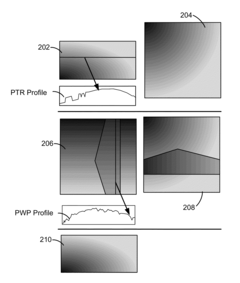
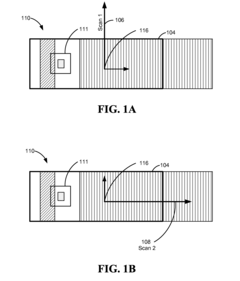
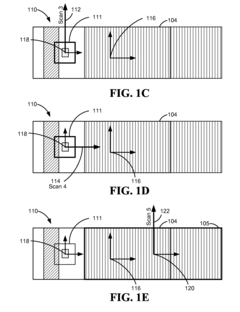
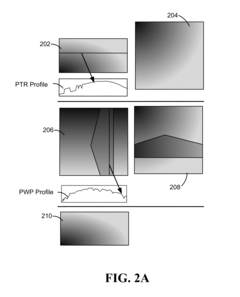
- The Advanced Pole tip recession and Perpendicular writer protrusion (APP) method involves performing multiple scans at different angles and positions, using image correction techniques such as true 3D image flattening and image subtraction to correct for scanner bow, system drift, and localized feature shape errors, ensuring accurate topography measurement.
Atomic force microscopy scanning methods
PatentInactiveUS6715346B2
Innovation
- A method involving surface survey scans to locate and map deep features, followed by controlled AFM tip movement in geometric patterns to minimize atomic force interactions, allowing precise depth measurement and extended tip life by avoiding sidewall contact and optimizing tip positioning.


Sample Preparation Protocols for Optimal AFM Results
Sample preparation is a critical determinant of success in atomic force microscopy (AFM) experiments. The quality of results obtained through advanced AFM techniques depends significantly on how specimens are prepared prior to imaging. Effective sample preparation begins with understanding the physical and chemical properties of the material being studied, as these characteristics will dictate the appropriate preparation methodology.
For biological samples, preservation of native structure is paramount. Fixation techniques using glutaraldehyde or formaldehyde can stabilize proteins and cellular structures while maintaining their morphological integrity. However, chemical fixation may introduce artifacts that could compromise data interpretation. Alternatively, rapid freezing methods such as plunge-freezing in liquid ethane or high-pressure freezing offer superior structural preservation by vitrifying samples without ice crystal formation.
Surface cleanliness represents another crucial factor in AFM sample preparation. Contaminants at the nanoscale can severely interfere with tip-sample interactions, leading to imaging artifacts and reduced resolution. Rigorous cleaning protocols involving sequential solvent washes, plasma cleaning, or UV-ozone treatment are commonly employed to ensure atomically clean surfaces prior to sample deposition.
Substrate selection must be carefully considered based on the specific AFM technique being implemented. For high-resolution imaging, atomically flat substrates such as mica, highly oriented pyrolytic graphite (HOPG), or single-crystal silicon are preferred. These materials provide minimal background noise and allow for clear visualization of nanoscale features. For specialized applications like conductive AFM, substrates with specific electrical properties may be required.
Sample immobilization techniques vary depending on the specimen type. For molecular studies, covalent attachment strategies using silanes or thiols can create stable linkages between biomolecules and substrates. Physical adsorption methods may be suitable for certain applications but can result in sample mobility during scanning. Polymer-based immobilization matrices offer an alternative approach for securing samples while maintaining their native conformation.
Environmental control during sample preparation and imaging is essential for obtaining reproducible results. Parameters such as temperature, humidity, and ambient gas composition can significantly impact sample stability and tip-sample interactions. Preparation under controlled atmospheric conditions or in liquid environments may be necessary for certain specimens to prevent degradation or structural alterations.
Optimization of sample concentration and deposition methods is often required to achieve ideal surface coverage. Techniques such as spin-coating, drop-casting, or Langmuir-Blodgett deposition can be employed depending on the sample characteristics and desired surface density. The goal is to achieve uniform distribution with appropriate spacing between individual features to facilitate accurate imaging and analysis.
For biological samples, preservation of native structure is paramount. Fixation techniques using glutaraldehyde or formaldehyde can stabilize proteins and cellular structures while maintaining their morphological integrity. However, chemical fixation may introduce artifacts that could compromise data interpretation. Alternatively, rapid freezing methods such as plunge-freezing in liquid ethane or high-pressure freezing offer superior structural preservation by vitrifying samples without ice crystal formation.
Surface cleanliness represents another crucial factor in AFM sample preparation. Contaminants at the nanoscale can severely interfere with tip-sample interactions, leading to imaging artifacts and reduced resolution. Rigorous cleaning protocols involving sequential solvent washes, plasma cleaning, or UV-ozone treatment are commonly employed to ensure atomically clean surfaces prior to sample deposition.
Substrate selection must be carefully considered based on the specific AFM technique being implemented. For high-resolution imaging, atomically flat substrates such as mica, highly oriented pyrolytic graphite (HOPG), or single-crystal silicon are preferred. These materials provide minimal background noise and allow for clear visualization of nanoscale features. For specialized applications like conductive AFM, substrates with specific electrical properties may be required.
Sample immobilization techniques vary depending on the specimen type. For molecular studies, covalent attachment strategies using silanes or thiols can create stable linkages between biomolecules and substrates. Physical adsorption methods may be suitable for certain applications but can result in sample mobility during scanning. Polymer-based immobilization matrices offer an alternative approach for securing samples while maintaining their native conformation.
Environmental control during sample preparation and imaging is essential for obtaining reproducible results. Parameters such as temperature, humidity, and ambient gas composition can significantly impact sample stability and tip-sample interactions. Preparation under controlled atmospheric conditions or in liquid environments may be necessary for certain specimens to prevent degradation or structural alterations.
Optimization of sample concentration and deposition methods is often required to achieve ideal surface coverage. Techniques such as spin-coating, drop-casting, or Langmuir-Blodgett deposition can be employed depending on the sample characteristics and desired surface density. The goal is to achieve uniform distribution with appropriate spacing between individual features to facilitate accurate imaging and analysis.
Data Processing and Image Analysis Methods
Data processing and image analysis represent critical components in advanced atomic force microscopy (AFM) implementations. Raw AFM data typically contains various artifacts, noise, and distortions that must be addressed through sophisticated processing algorithms to extract meaningful scientific information. Modern AFM systems generate enormous datasets that require efficient computational methods for proper interpretation and visualization.
The fundamental processing pipeline begins with noise filtering techniques, including Gaussian smoothing, wavelet transforms, and principal component analysis (PCA). These methods effectively reduce random fluctuations while preserving essential topographical features. For instance, wavelet-based denoising has demonstrated superior performance in preserving edge information compared to traditional Fourier-based approaches, particularly for high-resolution AFM images of biological samples.
Flattening and plane-fitting algorithms address the common issue of sample tilt and scanner bow artifacts. Polynomial fitting methods of varying orders are applied to each scan line or the entire image to remove background curvature. Advanced implementations utilize intelligent masking techniques to exclude features of interest during the flattening process, preventing artificial distortions of actual topographical elements.
Quantitative analysis tools extract specific metrics from processed images, including roughness parameters (Ra, Rq, Rz), feature dimensions, and statistical distributions of surface properties. Modern software packages incorporate automated feature recognition algorithms based on machine learning approaches, enabling rapid identification and measurement of nanostructures across large datasets.
Three-dimensional visualization techniques transform AFM data into intuitive representations through false-color mapping, illumination modeling, and perspective rendering. Recent developments in this area include interactive visualization tools that allow researchers to manipulate viewing angles and apply various rendering methods in real-time, enhancing the interpretation of complex surface structures.
Multimodal data fusion represents an emerging frontier, where AFM topographical data is correlated with simultaneously acquired mechanical, electrical, or chemical property maps. This correlation requires sophisticated registration algorithms and statistical methods to align datasets with nanometer precision, revealing relationships between structure and function at the nanoscale.
Open-source software platforms like Gwyddion and commercial packages such as NanoScope Analysis provide comprehensive toolsets for AFM data processing. The trend toward standardized data formats and processing protocols is improving reproducibility and enabling more effective collaboration in the AFM community, though challenges remain in establishing universal standards for advanced processing methodologies.
The fundamental processing pipeline begins with noise filtering techniques, including Gaussian smoothing, wavelet transforms, and principal component analysis (PCA). These methods effectively reduce random fluctuations while preserving essential topographical features. For instance, wavelet-based denoising has demonstrated superior performance in preserving edge information compared to traditional Fourier-based approaches, particularly for high-resolution AFM images of biological samples.
Flattening and plane-fitting algorithms address the common issue of sample tilt and scanner bow artifacts. Polynomial fitting methods of varying orders are applied to each scan line or the entire image to remove background curvature. Advanced implementations utilize intelligent masking techniques to exclude features of interest during the flattening process, preventing artificial distortions of actual topographical elements.
Quantitative analysis tools extract specific metrics from processed images, including roughness parameters (Ra, Rq, Rz), feature dimensions, and statistical distributions of surface properties. Modern software packages incorporate automated feature recognition algorithms based on machine learning approaches, enabling rapid identification and measurement of nanostructures across large datasets.
Three-dimensional visualization techniques transform AFM data into intuitive representations through false-color mapping, illumination modeling, and perspective rendering. Recent developments in this area include interactive visualization tools that allow researchers to manipulate viewing angles and apply various rendering methods in real-time, enhancing the interpretation of complex surface structures.
Multimodal data fusion represents an emerging frontier, where AFM topographical data is correlated with simultaneously acquired mechanical, electrical, or chemical property maps. This correlation requires sophisticated registration algorithms and statistical methods to align datasets with nanometer precision, revealing relationships between structure and function at the nanoscale.
Open-source software platforms like Gwyddion and commercial packages such as NanoScope Analysis provide comprehensive toolsets for AFM data processing. The trend toward standardized data formats and processing protocols is improving reproducibility and enabling more effective collaboration in the AFM community, though challenges remain in establishing universal standards for advanced processing methodologies.
Unlock deeper insights with PatSnap Eureka Quick Research — get a full tech report to explore trends and direct your research. Try now!
Generate Your Research Report Instantly with AI Agent
Supercharge your innovation with PatSnap Eureka AI Agent Platform!