

Validate Atomic Force Microscopy Instrument Calibration — Standards
SEP 19, 202510 MIN READ
Generate Your Research Report Instantly with AI Agent
PatSnap Eureka helps you evaluate technical feasibility & market potential.
AFM Calibration Background and Objectives
Atomic Force Microscopy (AFM) has evolved significantly since its invention in 1986 by Gerd Binnig, Calvin Quate, and Christoph Gerber. This revolutionary scanning probe microscopy technique has transformed our ability to visualize and manipulate matter at the nanoscale, offering unprecedented resolution down to the atomic level. The technology operates by measuring forces between a sharp probe and sample surface, enabling three-dimensional surface profiling with sub-nanometer precision.
The calibration of AFM instruments represents a critical aspect of ensuring measurement accuracy and reliability. As AFM applications have expanded across diverse fields including materials science, semiconductor manufacturing, biological research, and nanotechnology, the demand for standardized calibration protocols has intensified. Historically, calibration approaches were often laboratory-specific, leading to significant variations in measurement outcomes between different instruments and facilities.
International metrology organizations including NIST (USA), PTB (Germany), and BIPM (France) have progressively developed reference standards and protocols to address calibration challenges. The evolution of these standards reflects the increasing sophistication of AFM technology and its applications, moving from simple dimensional calibration to comprehensive performance validation across multiple measurement parameters.
The primary objective of AFM calibration standards is to establish traceability to the International System of Units (SI), ensuring that measurements are comparable across different instruments, laboratories, and time periods. This traceability is fundamental to scientific reproducibility and industrial quality control. Current calibration efforts focus on five critical parameters: lateral dimensions (x,y), vertical dimensions (z), force measurements, environmental conditions, and probe characterization.
Recent technological advancements have introduced new challenges in AFM calibration, particularly for high-speed AFM, multifrequency techniques, and quantitative nanomechanical mapping. These emerging applications require more sophisticated calibration approaches that account for dynamic behavior and complex tip-sample interactions. Additionally, the integration of AFM with complementary techniques such as Raman spectroscopy and infrared spectroscopy has created demand for multi-modal calibration standards.
The development trajectory for AFM calibration standards aims to address several key goals: improving measurement uncertainty to sub-nanometer levels, establishing robust calibration protocols for specialized AFM modes, developing in-situ calibration methods for real-time verification, and creating accessible calibration standards suitable for routine laboratory use. These objectives align with broader metrology initiatives focused on nanoscale measurement science and support the increasing industrial adoption of AFM technology in precision manufacturing and quality control applications.
The calibration of AFM instruments represents a critical aspect of ensuring measurement accuracy and reliability. As AFM applications have expanded across diverse fields including materials science, semiconductor manufacturing, biological research, and nanotechnology, the demand for standardized calibration protocols has intensified. Historically, calibration approaches were often laboratory-specific, leading to significant variations in measurement outcomes between different instruments and facilities.
International metrology organizations including NIST (USA), PTB (Germany), and BIPM (France) have progressively developed reference standards and protocols to address calibration challenges. The evolution of these standards reflects the increasing sophistication of AFM technology and its applications, moving from simple dimensional calibration to comprehensive performance validation across multiple measurement parameters.
The primary objective of AFM calibration standards is to establish traceability to the International System of Units (SI), ensuring that measurements are comparable across different instruments, laboratories, and time periods. This traceability is fundamental to scientific reproducibility and industrial quality control. Current calibration efforts focus on five critical parameters: lateral dimensions (x,y), vertical dimensions (z), force measurements, environmental conditions, and probe characterization.
Recent technological advancements have introduced new challenges in AFM calibration, particularly for high-speed AFM, multifrequency techniques, and quantitative nanomechanical mapping. These emerging applications require more sophisticated calibration approaches that account for dynamic behavior and complex tip-sample interactions. Additionally, the integration of AFM with complementary techniques such as Raman spectroscopy and infrared spectroscopy has created demand for multi-modal calibration standards.
The development trajectory for AFM calibration standards aims to address several key goals: improving measurement uncertainty to sub-nanometer levels, establishing robust calibration protocols for specialized AFM modes, developing in-situ calibration methods for real-time verification, and creating accessible calibration standards suitable for routine laboratory use. These objectives align with broader metrology initiatives focused on nanoscale measurement science and support the increasing industrial adoption of AFM technology in precision manufacturing and quality control applications.
Market Demand for Precision AFM Calibration
The global market for Atomic Force Microscopy (AFM) calibration standards has experienced significant growth in recent years, driven primarily by increasing demands for nanoscale precision across multiple industries. The current market size for AFM calibration standards is estimated at approximately $120 million annually, with projections indicating a compound annual growth rate of 7.8% through 2028.
The semiconductor industry represents the largest market segment, accounting for nearly 35% of the total demand. As semiconductor manufacturers continue to push the boundaries of miniaturization with sub-5nm process nodes, the need for ultra-precise AFM calibration has become critical. Even nanometer-scale deviations can result in significant yield losses, making reliable calibration standards essential for quality control and process optimization.
Materials science research institutions constitute the second-largest market segment at 28%. The growing focus on advanced materials development, including 2D materials, nanocomposites, and functional surfaces, has intensified the need for accurate topographical and mechanical property measurements at the nanoscale. Researchers require calibration standards that can validate measurements across diverse sample types and environmental conditions.
The life sciences sector has emerged as the fastest-growing segment with a 12.3% annual growth rate. Applications in cellular imaging, biomolecular interactions, and nanomedicine increasingly rely on AFM for quantitative measurements, driving demand for biologically relevant calibration standards that can function in liquid environments and physiological conditions.
Geographically, North America and Europe currently dominate the market with 38% and 32% market share respectively, primarily due to their established research infrastructure and semiconductor manufacturing bases. However, the Asia-Pacific region is experiencing the most rapid growth at 14.2% annually, fueled by expanding semiconductor fabrication facilities in Taiwan, South Korea, and China.
Customer surveys indicate that key purchasing factors include traceability to international standards (cited by 87% of respondents), long-term stability (82%), and versatility across different measurement modes (76%). There is particularly strong demand for calibration standards that can validate not only dimensional measurements but also mechanical properties such as elasticity, adhesion, and friction at the nanoscale.
Industry analysts have identified significant unmet needs in the market, particularly for standards that can function reliably under variable environmental conditions and for in-situ calibration during measurements. Additionally, there is growing demand for calibration standards specifically designed for high-speed AFM applications, where traditional calibration methods may introduce unacceptable delays in measurement workflows.
The semiconductor industry represents the largest market segment, accounting for nearly 35% of the total demand. As semiconductor manufacturers continue to push the boundaries of miniaturization with sub-5nm process nodes, the need for ultra-precise AFM calibration has become critical. Even nanometer-scale deviations can result in significant yield losses, making reliable calibration standards essential for quality control and process optimization.
Materials science research institutions constitute the second-largest market segment at 28%. The growing focus on advanced materials development, including 2D materials, nanocomposites, and functional surfaces, has intensified the need for accurate topographical and mechanical property measurements at the nanoscale. Researchers require calibration standards that can validate measurements across diverse sample types and environmental conditions.
The life sciences sector has emerged as the fastest-growing segment with a 12.3% annual growth rate. Applications in cellular imaging, biomolecular interactions, and nanomedicine increasingly rely on AFM for quantitative measurements, driving demand for biologically relevant calibration standards that can function in liquid environments and physiological conditions.
Geographically, North America and Europe currently dominate the market with 38% and 32% market share respectively, primarily due to their established research infrastructure and semiconductor manufacturing bases. However, the Asia-Pacific region is experiencing the most rapid growth at 14.2% annually, fueled by expanding semiconductor fabrication facilities in Taiwan, South Korea, and China.
Customer surveys indicate that key purchasing factors include traceability to international standards (cited by 87% of respondents), long-term stability (82%), and versatility across different measurement modes (76%). There is particularly strong demand for calibration standards that can validate not only dimensional measurements but also mechanical properties such as elasticity, adhesion, and friction at the nanoscale.
Industry analysts have identified significant unmet needs in the market, particularly for standards that can function reliably under variable environmental conditions and for in-situ calibration during measurements. Additionally, there is growing demand for calibration standards specifically designed for high-speed AFM applications, where traditional calibration methods may introduce unacceptable delays in measurement workflows.
Current Standards and Technical Challenges
The current landscape of Atomic Force Microscopy (AFM) calibration standards is characterized by a mix of established protocols and emerging methodologies. ISO and ASTM have developed several standards specifically addressing AFM calibration, including ISO 11775 for lateral calibration and ASTM E2530 for dimensional measurements. These standards provide foundational frameworks for ensuring measurement accuracy across different AFM instruments and laboratories.
Commercial calibration standards have become increasingly sophisticated, with manufacturers like Bruker, NT-MDT, and MikroMasch offering specialized calibration gratings with precisely defined step heights, pitches, and geometries. These standards typically feature silicon or silicon dioxide structures with certified dimensions traceable to national metrology institutes such as NIST (USA), PTB (Germany), and NPL (UK).
Despite these advancements, significant technical challenges persist in AFM calibration. Probe-sample interactions introduce complex nonlinearities that can affect measurement accuracy. Thermal drift remains a persistent issue, causing dimensional changes during measurement that can significantly impact calibration stability, particularly for high-precision applications requiring sub-nanometer accuracy.
Cross-laboratory reproducibility presents another major challenge, with studies showing measurement variations of 5-15% between different instruments and operators even when using identical calibration standards. This variability undermines the reliability of AFM measurements in critical applications such as semiconductor metrology and nanomaterial characterization.
Environmental factors including temperature fluctuations, humidity, and vibrations significantly impact calibration stability. While controlled laboratory environments can mitigate these effects, maintaining calibration in diverse operating conditions remains problematic, especially for industrial applications.
The Z-axis (vertical) calibration faces unique challenges compared to XY calibration, as it relies on different physical principles and is more susceptible to probe-sample interaction artifacts. Current standards often fail to adequately address the interdependence between lateral and vertical calibrations.
Material-dependent artifacts represent another significant challenge, as the same probe can interact differently with various sample materials, leading to apparent height variations that are not related to actual topography. This is particularly problematic when calibrating instruments intended for diverse material characterization.
Emerging applications in biological and soft matter imaging have highlighted limitations in existing calibration approaches, which were primarily developed for rigid materials. The viscoelastic properties of biological samples introduce additional complexities that current standards do not fully address.
The development of dynamic AFM modes has outpaced corresponding calibration standards, creating a gap between instrumental capabilities and validated calibration methodologies. This is especially evident in techniques like bimodal AFM and fast scanning modes where traditional calibration approaches may not be applicable.
Commercial calibration standards have become increasingly sophisticated, with manufacturers like Bruker, NT-MDT, and MikroMasch offering specialized calibration gratings with precisely defined step heights, pitches, and geometries. These standards typically feature silicon or silicon dioxide structures with certified dimensions traceable to national metrology institutes such as NIST (USA), PTB (Germany), and NPL (UK).
Despite these advancements, significant technical challenges persist in AFM calibration. Probe-sample interactions introduce complex nonlinearities that can affect measurement accuracy. Thermal drift remains a persistent issue, causing dimensional changes during measurement that can significantly impact calibration stability, particularly for high-precision applications requiring sub-nanometer accuracy.
Cross-laboratory reproducibility presents another major challenge, with studies showing measurement variations of 5-15% between different instruments and operators even when using identical calibration standards. This variability undermines the reliability of AFM measurements in critical applications such as semiconductor metrology and nanomaterial characterization.
Environmental factors including temperature fluctuations, humidity, and vibrations significantly impact calibration stability. While controlled laboratory environments can mitigate these effects, maintaining calibration in diverse operating conditions remains problematic, especially for industrial applications.
The Z-axis (vertical) calibration faces unique challenges compared to XY calibration, as it relies on different physical principles and is more susceptible to probe-sample interaction artifacts. Current standards often fail to adequately address the interdependence between lateral and vertical calibrations.
Material-dependent artifacts represent another significant challenge, as the same probe can interact differently with various sample materials, leading to apparent height variations that are not related to actual topography. This is particularly problematic when calibrating instruments intended for diverse material characterization.
Emerging applications in biological and soft matter imaging have highlighted limitations in existing calibration approaches, which were primarily developed for rigid materials. The viscoelastic properties of biological samples introduce additional complexities that current standards do not fully address.
The development of dynamic AFM modes has outpaced corresponding calibration standards, creating a gap between instrumental capabilities and validated calibration methodologies. This is especially evident in techniques like bimodal AFM and fast scanning modes where traditional calibration approaches may not be applicable.
Existing AFM Calibration Standard Solutions
01 Calibration standards for AFM dimensional measurements
Various calibration standards are used to ensure accurate dimensional measurements in atomic force microscopy. These standards include precisely manufactured gratings, step height standards, and nanostructured patterns with known dimensions. The calibration process involves measuring these standards to validate the instrument's performance in terms of lateral and vertical measurements, which is essential for obtaining reliable dimensional data across different scales.- Calibration standards for AFM dimensional measurements: Various calibration standards are used to ensure accurate dimensional measurements in atomic force microscopy. These standards include precisely manufactured gratings, step height standards, and nanostructured patterns with known dimensions. The calibration process involves measuring these standards to validate the instrument's performance in terms of lateral and vertical measurements, ensuring traceability to national measurement standards.
- Force calibration methods and standards: Force calibration is critical for quantitative AFM measurements. This involves calibrating the spring constant of cantilevers using reference materials or comparison methods. Techniques include thermal noise method, reference cantilever method, and using calibrated force standards. These methods ensure accurate force measurements during AFM operation, which is essential for applications requiring precise mechanical property characterization.
- Validation procedures for AFM performance: Comprehensive validation procedures are implemented to verify AFM instrument performance. These include measuring reference samples under standardized conditions, comparing results with certified values, and statistical analysis of measurement uncertainty. Validation protocols assess parameters such as resolution, noise level, drift, and measurement reproducibility to ensure the instrument meets specified performance criteria.
- Specialized calibration artifacts and reference materials: Specialized calibration artifacts are designed specifically for AFM validation. These include nanogrids, silicon step structures, colloidal gold particles, and precision-engineered surfaces with features at multiple length scales. These reference materials provide known geometries and dimensions for calibrating different aspects of AFM performance, including tip characterization and scanner linearity.
- Software and algorithms for calibration data analysis: Advanced software tools and algorithms are developed for analyzing calibration data and validating AFM measurements. These include automated calibration routines, statistical analysis packages, and uncertainty calculation methods. The software helps in processing raw calibration data, applying correction factors, and generating validation reports that document instrument performance against established standards.
02 Force calibration methods and standards
Force calibration is critical for quantitative AFM measurements, particularly in applications requiring precise force control. Calibration methods include the use of reference cantilevers with known spring constants, thermal noise analysis, and specialized force calibration standards. These approaches enable the validation of force measurements and ensure consistency across different experimental conditions, improving the reliability of mechanical property measurements at the nanoscale.Expand Specific Solutions03 Probe characterization and tip validation techniques
Techniques for characterizing AFM probes and validating tip geometry are essential for accurate measurements. These include using specialized tip characterizers, blind tip reconstruction algorithms, and reference samples with known geometries. Proper tip validation ensures that measurements are not affected by tip wear or contamination, which can significantly impact image quality and measurement accuracy in atomic force microscopy.Expand Specific Solutions04 Environmental and operational validation protocols
Validation protocols for AFM operation under various environmental conditions ensure measurement reliability. These protocols address factors such as temperature stability, vibration isolation, humidity control, and acoustic interference. Standardized procedures for validating AFM performance under different operational conditions help maintain measurement consistency and enable comparison of results across different instruments and laboratories.Expand Specific Solutions05 Traceability and reference material standards
Establishing traceability to international measurement standards is crucial for AFM calibration validation. This involves the use of certified reference materials and standards that are traceable to national metrology institutes. These reference materials provide a foundation for comparing measurements across different instruments and ensuring that calibration procedures meet internationally recognized standards, which is particularly important for regulated industries and research requiring high measurement confidence.Expand Specific Solutions
Leading Manufacturers and Research Institutions
The Atomic Force Microscopy (AFM) instrument calibration standards market is currently in a growth phase, characterized by increasing demand for nanoscale measurement precision across multiple industries. The global market size for AFM calibration standards is expanding steadily, driven by advancements in nanotechnology research and semiconductor manufacturing. From a technical maturity perspective, established research institutions like Centre National de la Recherche Scientifique and Korea Research Institute of Standards & Science lead in developing primary calibration standards, while commercial players such as Keysight Technologies and Texas Instruments focus on application-specific solutions. Academic institutions including Zhejiang University and Nankai University contribute significantly to research advancements. The competitive landscape shows a balanced distribution between government metrology institutes, specialized instrumentation companies, and semiconductor manufacturers like TSMC, reflecting the technology's cross-industry importance and ongoing evolution toward greater precision and reliability.
Centre National de la Recherche Scientifique
Technical Solution: CNRS has developed comprehensive AFM calibration standards based on their metrological expertise. Their approach includes silicon-based reference materials with precisely engineered step heights and lattice structures for three-dimensional calibration. They've pioneered the use of single-crystal materials with known lattice constants as absolute references for z-axis calibration, achieving sub-nanometer accuracy. CNRS has also developed specialized software algorithms that compensate for thermal drift and piezoelectric creep during calibration procedures. Their calibration methodology incorporates uncertainty analysis following the Guide to the Expression of Uncertainty in Measurement (GUM) principles, ensuring traceability to SI units through comparison with standards maintained by national metrology institutes.
Strengths: Exceptional metrological expertise, direct connection to international standards bodies, and comprehensive uncertainty analysis. Weaknesses: Their solutions may be more academically focused than commercially oriented, potentially limiting widespread industrial adoption.
Korea Research Institute of Standards & Science
Technical Solution: KRISS has developed advanced AFM calibration standards featuring precisely engineered silicon and quartz structures with certified dimensional properties. Their calibration methodology employs multi-parameter approaches that simultaneously address lateral and vertical calibration using single reference artifacts. KRISS has pioneered the development of three-dimensional calibration standards with nanoscale features arranged in regular arrays, allowing for comprehensive instrument validation. Their calibration protocols incorporate environmental monitoring and control systems to account for temperature, humidity, and vibration effects on measurement accuracy. KRISS maintains traceability to international standards through participation in international comparison studies and maintains close collaboration with other national metrology institutes worldwide.
Strengths: Direct authority as a national metrology institute, comprehensive calibration solutions, and strong international recognition. Weaknesses: Geographic focus may limit global accessibility of their calibration services and standards.
Critical Metrology Innovations for AFM
Caliber, method for manufacturing a caliber, and method for calibrating an atomic force microscope
PatentWO2025172655A1
Innovation
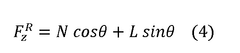
- A caliber for AFMs is developed with symmetrical, isotropic mechanical properties and identical friction coefficients, featuring grooves with equal and symmetrical angles, allowing for a simpler and more precise calibration process by reducing the number of unknowns to two, and enabling accurate determination of the conversion factor using a system of two equations.



Method for calibrating NANO measurement scale and standard material used therein
PatentPendingEP4016090A1
Innovation
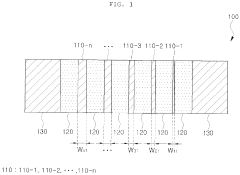
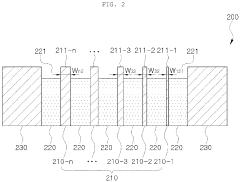
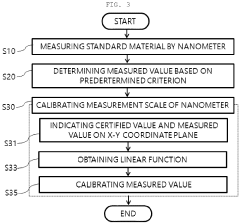
- A method involving a standard material with a series of nanostructures of certified values of different sizes, alternately stacked with intermediate layers, is used to calibrate the microscope measurement scale by measuring widths and determining deviations, allowing for linear fitting and calibration of measured values to align with certified values.
International Metrology Standards Compliance
Compliance with international metrology standards is essential for ensuring the reliability and global acceptance of Atomic Force Microscopy (AFM) calibration procedures. The International Organization for Standardization (ISO) has developed several standards specifically addressing dimensional measurements at the nanoscale, with ISO 11775 and ISO 11039 being particularly relevant for AFM calibration. These standards establish uniform methods for calibrating AFM instruments and validating measurement results, enabling consistent performance across different laboratories and geographical regions.
The International Bureau of Weights and Measures (BIPM) provides the foundation for these standards through the International System of Units (SI), particularly the definition of the meter. National metrology institutes worldwide, such as NIST (USA), PTB (Germany), and NPL (UK), maintain traceability chains that link AFM calibration standards to SI units. This traceability is crucial for ensuring that AFM measurements can be compared meaningfully across different instruments and facilities.
For AFM calibration, standards compliance typically involves three key dimensions: lateral (x-y) calibration, vertical (z) calibration, and force calibration. Each dimension requires specific reference materials and procedures that conform to international standards. For example, lateral calibration often utilizes calibration gratings with precisely defined pitch values traceable to national standards, while vertical calibration may employ step height standards certified by national metrology institutes.
The American Society for Testing and Materials (ASTM) has also developed standards relevant to AFM calibration, including ASTM E2530 for scanning probe microscopy. These standards complement ISO requirements and are widely adopted in industrial applications. Similarly, the European Committee for Standardization (CEN) has established regional standards that align with international frameworks while addressing specific European regulatory requirements.
Achieving compliance with these standards requires regular verification using certified reference materials (CRMs). These materials must themselves be traceable to national or international standards and accompanied by certificates detailing their measurement uncertainty. The documentation of calibration procedures, including uncertainty budgets and environmental conditions, is equally important for demonstrating standards compliance.
Recent developments in international standardization have focused on addressing emerging challenges in AFM calibration, such as measurements in non-ambient conditions and calibration of advanced AFM modes. Working groups within ISO Technical Committee 201 (Surface Chemical Analysis) and Technical Committee 229 (Nanotechnologies) are actively developing new standards to address these evolving requirements, ensuring that international metrology standards remain relevant for cutting-edge AFM applications.
The International Bureau of Weights and Measures (BIPM) provides the foundation for these standards through the International System of Units (SI), particularly the definition of the meter. National metrology institutes worldwide, such as NIST (USA), PTB (Germany), and NPL (UK), maintain traceability chains that link AFM calibration standards to SI units. This traceability is crucial for ensuring that AFM measurements can be compared meaningfully across different instruments and facilities.
For AFM calibration, standards compliance typically involves three key dimensions: lateral (x-y) calibration, vertical (z) calibration, and force calibration. Each dimension requires specific reference materials and procedures that conform to international standards. For example, lateral calibration often utilizes calibration gratings with precisely defined pitch values traceable to national standards, while vertical calibration may employ step height standards certified by national metrology institutes.
The American Society for Testing and Materials (ASTM) has also developed standards relevant to AFM calibration, including ASTM E2530 for scanning probe microscopy. These standards complement ISO requirements and are widely adopted in industrial applications. Similarly, the European Committee for Standardization (CEN) has established regional standards that align with international frameworks while addressing specific European regulatory requirements.
Achieving compliance with these standards requires regular verification using certified reference materials (CRMs). These materials must themselves be traceable to national or international standards and accompanied by certificates detailing their measurement uncertainty. The documentation of calibration procedures, including uncertainty budgets and environmental conditions, is equally important for demonstrating standards compliance.
Recent developments in international standardization have focused on addressing emerging challenges in AFM calibration, such as measurements in non-ambient conditions and calibration of advanced AFM modes. Working groups within ISO Technical Committee 201 (Surface Chemical Analysis) and Technical Committee 229 (Nanotechnologies) are actively developing new standards to address these evolving requirements, ensuring that international metrology standards remain relevant for cutting-edge AFM applications.
Uncertainty Analysis in AFM Measurements
Uncertainty analysis represents a critical component in the validation of Atomic Force Microscopy (AFM) instrument calibration. The inherent complexity of AFM measurements introduces multiple sources of uncertainty that must be systematically identified, quantified, and managed to ensure reliable data interpretation and reproducibility across different instruments and laboratories.
Primary uncertainty sources in AFM measurements include probe-related factors such as tip geometry variations, tip wear during scanning, and cantilever spring constant deviations. These factors can significantly impact measurement accuracy, particularly when characterizing nanoscale features where even minor tip imperfections can lead to substantial artifacts.
Environmental conditions constitute another significant uncertainty source. Temperature fluctuations can cause thermal drift in both the sample and instrument components, while humidity variations may alter sample-tip interactions, particularly for hydrophilic materials. Vibration interference, despite isolation systems, can introduce noise that affects measurement precision, especially at sub-nanometer resolutions.
Calibration standard uncertainties must also be considered. Reference materials used for calibration carry their own certified uncertainty values that propagate through the measurement chain. The traceability of these standards to national metrology institutes establishes the foundation for reliable uncertainty budgets in AFM measurements.
Instrument-specific uncertainties arise from scanner nonlinearities, hysteresis effects, and creep phenomena. These systematic errors can distort dimensional measurements if not properly characterized and compensated. Modern AFM systems incorporate closed-loop scanners to mitigate these effects, but residual uncertainties remain that must be quantified.
Statistical analysis methods play a crucial role in uncertainty evaluation. The Guide to the Expression of Uncertainty in Measurement (GUM) framework provides a standardized approach for combining various uncertainty components. This involves distinguishing between Type A uncertainties (evaluated by statistical methods) and Type B uncertainties (evaluated by other means, such as manufacturer specifications or prior knowledge).
Monte Carlo simulations offer a powerful complementary approach for complex uncertainty propagation scenarios in AFM measurements. This method is particularly valuable when dealing with non-linear measurement models or asymmetric probability distributions that challenge traditional analytical approaches to uncertainty calculation.
Establishing comprehensive uncertainty budgets for specific AFM measurement tasks enables meaningful comparisons between different measurement results and provides essential context for interpreting nanoscale dimensional data. This practice is increasingly important as AFM applications expand into quantitative metrology for semiconductor manufacturing, nanomaterial characterization, and biological structure analysis.
Primary uncertainty sources in AFM measurements include probe-related factors such as tip geometry variations, tip wear during scanning, and cantilever spring constant deviations. These factors can significantly impact measurement accuracy, particularly when characterizing nanoscale features where even minor tip imperfections can lead to substantial artifacts.
Environmental conditions constitute another significant uncertainty source. Temperature fluctuations can cause thermal drift in both the sample and instrument components, while humidity variations may alter sample-tip interactions, particularly for hydrophilic materials. Vibration interference, despite isolation systems, can introduce noise that affects measurement precision, especially at sub-nanometer resolutions.
Calibration standard uncertainties must also be considered. Reference materials used for calibration carry their own certified uncertainty values that propagate through the measurement chain. The traceability of these standards to national metrology institutes establishes the foundation for reliable uncertainty budgets in AFM measurements.
Instrument-specific uncertainties arise from scanner nonlinearities, hysteresis effects, and creep phenomena. These systematic errors can distort dimensional measurements if not properly characterized and compensated. Modern AFM systems incorporate closed-loop scanners to mitigate these effects, but residual uncertainties remain that must be quantified.
Statistical analysis methods play a crucial role in uncertainty evaluation. The Guide to the Expression of Uncertainty in Measurement (GUM) framework provides a standardized approach for combining various uncertainty components. This involves distinguishing between Type A uncertainties (evaluated by statistical methods) and Type B uncertainties (evaluated by other means, such as manufacturer specifications or prior knowledge).
Monte Carlo simulations offer a powerful complementary approach for complex uncertainty propagation scenarios in AFM measurements. This method is particularly valuable when dealing with non-linear measurement models or asymmetric probability distributions that challenge traditional analytical approaches to uncertainty calculation.
Establishing comprehensive uncertainty budgets for specific AFM measurement tasks enables meaningful comparisons between different measurement results and provides essential context for interpreting nanoscale dimensional data. This practice is increasingly important as AFM applications expand into quantitative metrology for semiconductor manufacturing, nanomaterial characterization, and biological structure analysis.
Unlock deeper insights with PatSnap Eureka Quick Research — get a full tech report to explore trends and direct your research. Try now!
Generate Your Research Report Instantly with AI Agent
Supercharge your innovation with PatSnap Eureka AI Agent Platform!