

Measure Atomic Force Microscopy Probe Dynamics — Criteria
SEP 19, 20259 MIN READ
Generate Your Research Report Instantly with AI Agent
PatSnap Eureka helps you evaluate technical feasibility & market potential.
AFM Probe Dynamics Background and Objectives
Atomic Force Microscopy (AFM) has evolved significantly since its invention in 1986 by Gerd Binnig, Calvin Quate, and Christoph Gerber. This revolutionary scanning probe microscopy technique has transformed our ability to visualize and manipulate matter at the nanoscale. The probe dynamics in AFM represent a critical aspect that determines the resolution, accuracy, and overall performance of the instrument.
The evolution of AFM probe technology has followed a trajectory from simple silicon or silicon nitride cantilevers to more sophisticated designs incorporating specialized coatings, functionalized tips, and even multi-probe arrays. Early AFM systems operated primarily in contact mode, where the probe maintained constant contact with the sample surface. This approach, while straightforward, often led to sample damage and probe wear.
Subsequent technological advancements introduced dynamic operating modes such as tapping mode (intermittent contact) and non-contact mode, which significantly reduced sample damage while enhancing resolution. These developments necessitated a deeper understanding of probe dynamics, including resonance frequency, quality factor, spring constant, and damping characteristics.
The current technological landscape demands increasingly precise control and measurement of AFM probe dynamics to address emerging challenges in nanotechnology, materials science, and biological research. Researchers require probes capable of operating in various environments (vacuum, air, liquid) while maintaining stability and measurement accuracy.
The primary objective of this technical research is to establish comprehensive criteria for measuring and evaluating AFM probe dynamics. These criteria will serve as standardized benchmarks for assessing probe performance across different operating conditions and applications. Specifically, we aim to develop quantitative metrics for evaluating dynamic response characteristics, including transient behavior, frequency response, and nonlinear effects.
Additionally, this research seeks to identify optimal probe designs and materials for specific applications, ranging from high-resolution imaging of biological samples to nanomechanical property measurements of advanced materials. By establishing these criteria, we intend to provide a framework that enables researchers and manufacturers to systematically improve probe performance and reliability.
Furthermore, this investigation aims to explore emerging technologies that could potentially revolutionize AFM probe dynamics, such as MEMS-based active probes, optomechanical sensing systems, and machine learning algorithms for real-time probe control and data interpretation. The ultimate goal is to push the boundaries of what is currently achievable with AFM technology, enabling new scientific discoveries and technological innovations at the nanoscale.
The evolution of AFM probe technology has followed a trajectory from simple silicon or silicon nitride cantilevers to more sophisticated designs incorporating specialized coatings, functionalized tips, and even multi-probe arrays. Early AFM systems operated primarily in contact mode, where the probe maintained constant contact with the sample surface. This approach, while straightforward, often led to sample damage and probe wear.
Subsequent technological advancements introduced dynamic operating modes such as tapping mode (intermittent contact) and non-contact mode, which significantly reduced sample damage while enhancing resolution. These developments necessitated a deeper understanding of probe dynamics, including resonance frequency, quality factor, spring constant, and damping characteristics.
The current technological landscape demands increasingly precise control and measurement of AFM probe dynamics to address emerging challenges in nanotechnology, materials science, and biological research. Researchers require probes capable of operating in various environments (vacuum, air, liquid) while maintaining stability and measurement accuracy.
The primary objective of this technical research is to establish comprehensive criteria for measuring and evaluating AFM probe dynamics. These criteria will serve as standardized benchmarks for assessing probe performance across different operating conditions and applications. Specifically, we aim to develop quantitative metrics for evaluating dynamic response characteristics, including transient behavior, frequency response, and nonlinear effects.
Additionally, this research seeks to identify optimal probe designs and materials for specific applications, ranging from high-resolution imaging of biological samples to nanomechanical property measurements of advanced materials. By establishing these criteria, we intend to provide a framework that enables researchers and manufacturers to systematically improve probe performance and reliability.
Furthermore, this investigation aims to explore emerging technologies that could potentially revolutionize AFM probe dynamics, such as MEMS-based active probes, optomechanical sensing systems, and machine learning algorithms for real-time probe control and data interpretation. The ultimate goal is to push the boundaries of what is currently achievable with AFM technology, enabling new scientific discoveries and technological innovations at the nanoscale.
Market Applications and Demand Analysis for AFM Technology
The Atomic Force Microscopy (AFM) market has experienced significant growth over the past decade, driven by increasing demand across multiple sectors. The global AFM market was valued at approximately 570 million USD in 2022 and is projected to reach 850 million USD by 2028, representing a compound annual growth rate of 6.9%. This growth trajectory underscores the expanding applications and rising demand for advanced AFM technologies.
The semiconductor industry remains the largest consumer of AFM technology, accounting for nearly 35% of the total market share. As semiconductor manufacturers continue to push the boundaries of miniaturization, the need for precise nanoscale measurement and characterization tools becomes increasingly critical. AFM systems capable of measuring probe dynamics with high accuracy are essential for quality control and process optimization in chip manufacturing.
Materials science research represents another significant market segment, comprising approximately 25% of AFM applications. Researchers in this field require sophisticated AFM probe dynamics measurement capabilities to investigate surface properties, mechanical behaviors, and atomic-scale interactions of novel materials. The growing focus on nanomaterials and advanced composites has further intensified demand for high-precision AFM systems.
The life sciences sector has emerged as the fastest-growing application area for AFM technology, with an annual growth rate exceeding 9%. Biological researchers utilize AFM for studying cellular structures, biomolecular interactions, and drug delivery mechanisms. The ability to measure probe dynamics accurately in liquid environments has become particularly valuable for applications in pharmaceutical development and medical diagnostics.
Industrial quality control applications represent approximately 15% of the AFM market. Manufacturing companies across various industries employ AFM for surface roughness analysis, defect detection, and dimensional verification. The demand for automated, high-throughput AFM systems with reliable probe dynamics measurement capabilities continues to rise in this sector.
Geographically, North America and Europe currently dominate the AFM market, collectively accounting for over 60% of global demand. However, the Asia-Pacific region is witnessing the fastest growth, driven by expanding semiconductor manufacturing, increasing research activities, and rising industrial applications in countries like China, Japan, and South Korea.
Customer requirements are evolving toward AFM systems with enhanced probe dynamics measurement capabilities, including higher speed, improved accuracy, and better reliability. End-users increasingly demand systems that can provide real-time feedback on probe behavior, automated calibration features, and compatibility with various sample environments. These market trends highlight the critical importance of advancing probe dynamics measurement criteria to meet evolving application needs.
The semiconductor industry remains the largest consumer of AFM technology, accounting for nearly 35% of the total market share. As semiconductor manufacturers continue to push the boundaries of miniaturization, the need for precise nanoscale measurement and characterization tools becomes increasingly critical. AFM systems capable of measuring probe dynamics with high accuracy are essential for quality control and process optimization in chip manufacturing.
Materials science research represents another significant market segment, comprising approximately 25% of AFM applications. Researchers in this field require sophisticated AFM probe dynamics measurement capabilities to investigate surface properties, mechanical behaviors, and atomic-scale interactions of novel materials. The growing focus on nanomaterials and advanced composites has further intensified demand for high-precision AFM systems.
The life sciences sector has emerged as the fastest-growing application area for AFM technology, with an annual growth rate exceeding 9%. Biological researchers utilize AFM for studying cellular structures, biomolecular interactions, and drug delivery mechanisms. The ability to measure probe dynamics accurately in liquid environments has become particularly valuable for applications in pharmaceutical development and medical diagnostics.
Industrial quality control applications represent approximately 15% of the AFM market. Manufacturing companies across various industries employ AFM for surface roughness analysis, defect detection, and dimensional verification. The demand for automated, high-throughput AFM systems with reliable probe dynamics measurement capabilities continues to rise in this sector.
Geographically, North America and Europe currently dominate the AFM market, collectively accounting for over 60% of global demand. However, the Asia-Pacific region is witnessing the fastest growth, driven by expanding semiconductor manufacturing, increasing research activities, and rising industrial applications in countries like China, Japan, and South Korea.
Customer requirements are evolving toward AFM systems with enhanced probe dynamics measurement capabilities, including higher speed, improved accuracy, and better reliability. End-users increasingly demand systems that can provide real-time feedback on probe behavior, automated calibration features, and compatibility with various sample environments. These market trends highlight the critical importance of advancing probe dynamics measurement criteria to meet evolving application needs.
Current Challenges in AFM Probe Dynamics Measurement
Despite significant advancements in Atomic Force Microscopy (AFM) technology, measuring probe dynamics accurately remains a complex challenge. Current AFM systems face several critical limitations that impede precise quantification of probe behavior, particularly in dynamic measurement modes. The fundamental challenge stems from the nanoscale nature of the probe-sample interactions, where even minor disturbances can significantly affect measurement accuracy.
Signal-to-noise ratio presents a persistent obstacle in AFM probe dynamics measurement. Environmental vibrations, thermal drift, and electronic noise contaminate the cantilever response signals, making it difficult to isolate true probe dynamics from background interference. This becomes particularly problematic when measuring soft biological samples or when operating in liquid environments where additional damping effects occur.
Calibration inconsistencies represent another significant hurdle. Current calibration methods often rely on simplified models that fail to account for the complex geometry of commercial AFM probes. The spring constant, resonance frequency, and quality factor—all critical parameters for dynamics measurement—show variations between nominally identical probes, sometimes exceeding 20%. This variability introduces systematic errors in quantitative measurements that are difficult to standardize across different instruments and laboratories.
The nonlinear behavior of cantilevers in the proximity of surfaces creates additional complications. As the probe approaches the sample, various force gradients (van der Waals, electrostatic, capillary forces) modify the effective spring constant and resonance properties of the cantilever. Current mathematical models struggle to fully capture these complex interactions, particularly in non-vacuum environments where additional damping mechanisms come into play.
High-speed imaging requirements further exacerbate measurement challenges. As researchers push toward faster scanning rates to capture dynamic biological processes or rapid material transformations, the probe's response time becomes a limiting factor. At high frequencies, the cantilever's behavior deviates from simple harmonic oscillator models, introducing artifacts that are difficult to distinguish from actual sample features.
Data processing limitations also contribute to measurement uncertainties. Real-time analysis of probe dynamics requires sophisticated algorithms capable of deconvoluting multiple force contributions. Current software solutions often employ simplifications that compromise accuracy for computational efficiency, particularly when dealing with viscoelastic materials where time-dependent forces are significant.
Multifrequency and multimodal AFM techniques, while offering enhanced information content, introduce additional complexity in probe dynamics interpretation. The interaction between different oscillation modes and the cross-coupling effects remain inadequately characterized in many measurement scenarios, leading to ambiguities in data interpretation and quantification of mechanical properties.
Signal-to-noise ratio presents a persistent obstacle in AFM probe dynamics measurement. Environmental vibrations, thermal drift, and electronic noise contaminate the cantilever response signals, making it difficult to isolate true probe dynamics from background interference. This becomes particularly problematic when measuring soft biological samples or when operating in liquid environments where additional damping effects occur.
Calibration inconsistencies represent another significant hurdle. Current calibration methods often rely on simplified models that fail to account for the complex geometry of commercial AFM probes. The spring constant, resonance frequency, and quality factor—all critical parameters for dynamics measurement—show variations between nominally identical probes, sometimes exceeding 20%. This variability introduces systematic errors in quantitative measurements that are difficult to standardize across different instruments and laboratories.
The nonlinear behavior of cantilevers in the proximity of surfaces creates additional complications. As the probe approaches the sample, various force gradients (van der Waals, electrostatic, capillary forces) modify the effective spring constant and resonance properties of the cantilever. Current mathematical models struggle to fully capture these complex interactions, particularly in non-vacuum environments where additional damping mechanisms come into play.
High-speed imaging requirements further exacerbate measurement challenges. As researchers push toward faster scanning rates to capture dynamic biological processes or rapid material transformations, the probe's response time becomes a limiting factor. At high frequencies, the cantilever's behavior deviates from simple harmonic oscillator models, introducing artifacts that are difficult to distinguish from actual sample features.
Data processing limitations also contribute to measurement uncertainties. Real-time analysis of probe dynamics requires sophisticated algorithms capable of deconvoluting multiple force contributions. Current software solutions often employ simplifications that compromise accuracy for computational efficiency, particularly when dealing with viscoelastic materials where time-dependent forces are significant.
Multifrequency and multimodal AFM techniques, while offering enhanced information content, introduce additional complexity in probe dynamics interpretation. The interaction between different oscillation modes and the cross-coupling effects remain inadequately characterized in many measurement scenarios, leading to ambiguities in data interpretation and quantification of mechanical properties.
State-of-the-Art AFM Probe Dynamics Measurement Solutions
01 Probe oscillation and frequency control
Atomic force microscopy (AFM) probe dynamics involve controlling the oscillation and frequency of the probe to achieve accurate measurements. This includes techniques for maintaining stable resonant frequencies, adjusting amplitude and phase of oscillations, and implementing feedback mechanisms to optimize probe-sample interactions. These methods enhance the sensitivity and resolution of AFM imaging while reducing noise and distortion in the measurements.- Probe oscillation and frequency control: Atomic force microscopy (AFM) probe dynamics involve controlling the oscillation and frequency of the probe to enhance measurement accuracy. This includes techniques for maintaining stable resonant frequencies, implementing frequency modulation, and managing probe oscillation amplitude. These methods help in reducing noise, improving sensitivity, and enabling more precise surface characterization across various scanning modes.
- Probe-sample interaction dynamics: The interaction between the AFM probe and sample surface is critical for accurate measurements. This includes managing tip-sample forces, controlling approach and retraction dynamics, and analyzing the mechanical response during contact. Advanced techniques monitor and adjust these interactions in real-time to prevent sample damage while maximizing resolution and measurement accuracy across different material types and environmental conditions.
- Multi-frequency and multi-modal probe operation: Multi-frequency and multi-modal probe operation techniques enable simultaneous measurement of multiple sample properties. These approaches involve exciting the probe at multiple frequencies or in different vibrational modes to extract complementary information about sample characteristics. This allows for more comprehensive analysis of mechanical, electrical, and chemical properties while reducing measurement time and increasing data acquisition efficiency.
- Environmental effects on probe dynamics: Environmental factors significantly impact AFM probe dynamics, requiring specialized techniques for operation in various conditions. This includes methods for managing probe behavior in liquid environments, vacuum conditions, or at different temperatures. Compensation algorithms and specialized probe designs help maintain measurement stability and accuracy despite environmental variations that would otherwise affect resonance characteristics and tip-sample interactions.
- Advanced probe design and materials: Innovations in probe design and materials significantly enhance AFM measurement capabilities. This includes development of specialized cantilever geometries, tip shapes, and coating materials to optimize mechanical properties and measurement sensitivity. Advanced materials and fabrication techniques produce probes with improved resonance characteristics, reduced thermal drift, and enhanced durability, enabling more precise measurements across diverse applications.
02 Multi-frequency and multi-modal AFM techniques
Advanced AFM probe dynamics incorporate multi-frequency and multi-modal techniques that allow simultaneous measurement of multiple sample properties. These approaches involve exciting the probe at multiple frequencies or in different vibrational modes to extract complementary information about sample characteristics. This enables researchers to obtain mechanical, electrical, and topographical data in a single scan, improving efficiency and providing more comprehensive sample analysis.Expand Specific Solutions03 High-speed and dynamic AFM imaging
Innovations in probe dynamics have enabled high-speed and dynamic AFM imaging capabilities. These developments focus on optimizing cantilever design, improving actuator response times, and implementing advanced control algorithms to capture rapid changes in sample properties. High-speed AFM allows for real-time observation of biological processes, chemical reactions, and other dynamic phenomena at the nanoscale with minimal invasiveness.Expand Specific Solutions04 Probe-sample interaction modeling and analysis
Understanding and modeling probe-sample interactions is crucial for interpreting AFM measurements accurately. This involves theoretical frameworks and computational methods to analyze the complex dynamics between the probe tip and sample surface, including adhesion forces, viscoelastic responses, and electrostatic interactions. Advanced modeling helps in extracting quantitative material properties and correcting for artifacts in AFM data.Expand Specific Solutions05 Environmental and condition-specific probe dynamics
AFM probe dynamics are significantly affected by environmental conditions such as temperature, humidity, and surrounding medium. Specialized techniques have been developed to maintain stable probe performance in various environments, including liquid, vacuum, and variable temperature conditions. These approaches enable AFM measurements in conditions that mimic natural biological environments or specific industrial processes, expanding the application range of atomic force microscopy.Expand Specific Solutions
Leading Manufacturers and Research Institutions in AFM Technology
Atomic Force Microscopy (AFM) probe dynamics measurement technology is currently in a growth phase, with increasing adoption across research and industrial applications. The market is expanding steadily, estimated to reach approximately $750 million by 2025, driven by demand for nanoscale imaging and metrology solutions. Technologically, the field shows varying maturity levels among key players. Leading companies like Bruker Nano and JPKinstruments demonstrate advanced capabilities in high-speed and precision measurements, while research institutions including CNRS, Institut Curie, and SINANO are pushing boundaries in probe dynamics characterization. Industrial players such as IBM, Samsung Electronics, and Veeco Instruments are integrating these technologies into broader semiconductor and materials science applications, focusing on practical implementation rather than fundamental research. Government laboratories like KRISS and NIST are establishing measurement standards crucial for industry-wide adoption.
Infinitesima Ltd.
Technical Solution: Infinitesima has developed the Rapid Probe Microscopy (RPM) technology, which represents a significant advancement in atomic force microscopy probe dynamics measurement. Their system utilizes a unique resonant scanner design that enables probe movement at frequencies up to 1 kHz, dramatically faster than conventional AFM systems. The technology incorporates proprietary optical detection methods that can track cantilever deflections with sub-angstrom precision at these high speeds. Infinitesima's approach includes advanced feedback algorithms that maintain consistent probe-sample interactions despite rapid scanning, with response times in the microsecond range. Their system features specialized probe designs optimized for high-frequency operation while maintaining measurement sensitivity, and incorporates real-time data processing capabilities that can analyze probe dynamics during measurement rather than post-acquisition.
Strengths: Revolutionary high-speed imaging capabilities (100-1000x faster than conventional AFM) while maintaining precise control of probe dynamics and excellent integration with semiconductor manufacturing workflows. Weaknesses: More specialized application focus primarily on semiconductor metrology rather than broader research applications and relatively higher system complexity requiring specialized maintenance.
Bruker Nano, Inc.
Technical Solution: Bruker Nano has developed PeakForce Tapping technology for atomic force microscopy probe dynamics measurement, which enables precise control of probe-sample interaction forces. Their system utilizes real-time force curve analysis at each pixel, allowing for direct force control and measurement of nanomechanical properties. The technology incorporates advanced algorithms that continuously monitor cantilever dynamics and adjust parameters to maintain consistent force application. Bruker's FastScan technology further enhances measurement capabilities by enabling high-speed imaging while maintaining precise probe dynamics control, with scanning rates up to 125 Hz compared to conventional 1-2 Hz rates. Their proprietary probe calibration methods ensure accurate quantification of tip-sample interactions across various operating environments.
Strengths: Industry-leading force sensitivity (piconewton range) and superior temporal resolution for dynamic measurements. Comprehensive software integration for real-time data analysis and visualization. Weaknesses: Higher cost compared to competitors and proprietary systems may limit customization options for specialized research applications.
Critical Patents and Research in AFM Probe Characterization
Atomic force microscope and interaction force measurement method using atomic force microscope
PatentInactiveUS20100071099A1
Innovation
- A frequency modulation atomic force microscope method that computes the difference between Δf curves obtained on a target atom and an atomic defect to isolate the short-range interaction force, allowing for measurement within a shorter range scale (up to 1 nm) and reducing the need for bias voltage compensation, thereby minimizing electrostatic influence and accelerating computational processes.
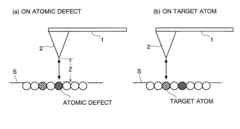
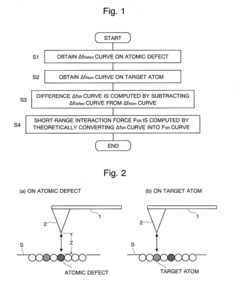
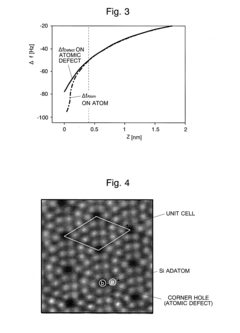
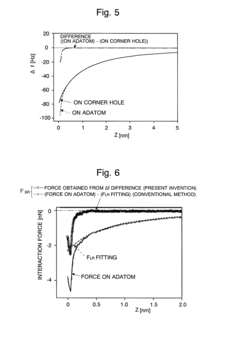
Measuring method for atomic force microscope
PatentActiveUS20170052210A1
Innovation
- The proposed method involves vibrating the probe in a circular motion using two oscillating units with a 90° phase difference, allowing for simultaneous detection and control of surface information, including position and slope, through a feed forward algorithm to modify the probe's movement path and minimize feedback control.


Calibration Standards and Metrology for AFM Probes
The development of reliable calibration standards for Atomic Force Microscopy (AFM) probes represents a critical foundation for accurate nanoscale measurements. Current calibration standards for AFM probes include silicon gratings with precisely defined pitch dimensions, typically ranging from 1-10 μm, which serve as reference structures for lateral calibration. For vertical calibration, step height standards made from materials such as silicon dioxide or highly ordered pyrolytic graphite (HOPG) provide known height references typically in the range of 5-100 nm. These standards must be traceable to international measurement standards to ensure global consistency in nanoscale measurements.
Metrology systems for AFM probe characterization have evolved significantly, incorporating laser Doppler vibrometry for direct measurement of cantilever dynamics and scanning electron microscopy (SEM) for precise dimensional analysis of tip geometry. Advanced optical interferometry techniques now allow for non-contact measurement of cantilever properties with sub-nanometer resolution. These systems enable quantification of key parameters including spring constant, resonant frequency, quality factor, and tip radius—all critical for understanding probe dynamics.
Uncertainty analysis in AFM probe calibration remains challenging due to multiple contributing factors. Thermal drift can introduce errors of 0.1-1 nm/min, while environmental vibrations may contribute uncertainties of 0.05-0.5 nm depending on isolation systems. Tip-sample interactions introduce non-linearities that complicate calibration, particularly in dynamic measurement modes. Statistical approaches using multiple measurements and reference standards have been developed to quantify these uncertainties, typically achieving expanded uncertainties (k=2) of 1-5% for spring constants and 3-8% for tip radius measurements.
International standardization efforts led by organizations such as ISO, ASTM, and NIST have established protocols for AFM probe calibration. ISO/TS 11308:2011 provides guidelines for cantilever spring constant calibration, while ASTM E2382 addresses scanning probe microscope tip characterization. These standards ensure measurement consistency across different laboratories and instruments, facilitating reliable data comparison in both research and industrial applications.
Recent innovations include self-calibrating AFM probes with integrated reference structures that enable in-situ calibration during measurements. Machine learning algorithms are being developed to automatically correct for probe wear and deformation during extended measurements. Additionally, quantum-based standards utilizing atomic-scale reference structures promise to provide absolute calibration references with unprecedented accuracy, potentially reducing measurement uncertainties by an order of magnitude compared to conventional standards.
Metrology systems for AFM probe characterization have evolved significantly, incorporating laser Doppler vibrometry for direct measurement of cantilever dynamics and scanning electron microscopy (SEM) for precise dimensional analysis of tip geometry. Advanced optical interferometry techniques now allow for non-contact measurement of cantilever properties with sub-nanometer resolution. These systems enable quantification of key parameters including spring constant, resonant frequency, quality factor, and tip radius—all critical for understanding probe dynamics.
Uncertainty analysis in AFM probe calibration remains challenging due to multiple contributing factors. Thermal drift can introduce errors of 0.1-1 nm/min, while environmental vibrations may contribute uncertainties of 0.05-0.5 nm depending on isolation systems. Tip-sample interactions introduce non-linearities that complicate calibration, particularly in dynamic measurement modes. Statistical approaches using multiple measurements and reference standards have been developed to quantify these uncertainties, typically achieving expanded uncertainties (k=2) of 1-5% for spring constants and 3-8% for tip radius measurements.
International standardization efforts led by organizations such as ISO, ASTM, and NIST have established protocols for AFM probe calibration. ISO/TS 11308:2011 provides guidelines for cantilever spring constant calibration, while ASTM E2382 addresses scanning probe microscope tip characterization. These standards ensure measurement consistency across different laboratories and instruments, facilitating reliable data comparison in both research and industrial applications.
Recent innovations include self-calibrating AFM probes with integrated reference structures that enable in-situ calibration during measurements. Machine learning algorithms are being developed to automatically correct for probe wear and deformation during extended measurements. Additionally, quantum-based standards utilizing atomic-scale reference structures promise to provide absolute calibration references with unprecedented accuracy, potentially reducing measurement uncertainties by an order of magnitude compared to conventional standards.
Nanoscale Precision Limitations and Quantum Effects
At the nanoscale, Atomic Force Microscopy (AFM) probe dynamics encounter fundamental physical limitations that significantly impact measurement precision. The Heisenberg uncertainty principle establishes an absolute theoretical limit to simultaneous position and momentum measurements, becoming particularly relevant when measuring quantum-scale objects. This inherent limitation means that as measurement precision increases for one parameter, uncertainty in the complementary parameter inevitably grows.
Thermal noise presents another significant challenge for AFM probe dynamics. At room temperature, thermal fluctuations cause random motion in cantilevers, creating a noise floor that limits detection sensitivity. Even with cooling techniques, complete elimination of thermal noise remains impossible due to quantum zero-point energy fluctuations that persist even at absolute zero temperature.
Quantum tunneling effects become prominent at nanoscale distances between the probe tip and sample surface. Electrons can tunnel through potential barriers that classical physics would deem impenetrable, creating measurement artifacts and affecting force calculations. This quantum mechanical behavior introduces non-linearities in the force-distance relationship that standard models may not adequately account for.
Surface forces at the nanoscale exhibit quantum mechanical characteristics that deviate from classical models. Van der Waals forces, casimir effects, and quantum electrodynamic interactions dominate at these scales, creating complex force landscapes that vary non-intuitively with distance. These quantum effects can mask or mimic the mechanical properties being measured, leading to potential misinterpretation of data.
The discrete nature of matter becomes significant at the atomic scale. The granularity of atoms and molecules means that forces are not continuous but quantized, leading to discontinuities in measurements. This discreteness fundamentally limits the smoothness of force curves and introduces inherent uncertainty in position measurements below the atomic spacing threshold.
Probe-sample interactions may also induce quantum state changes in the measured system. The observer effect becomes pronounced, where the act of measurement alters the quantum state of the system being observed. This creates a feedback loop where the measurement process itself introduces uncertainties that cannot be calibrated away through conventional means.
Advanced quantum metrology techniques, including squeezed states and quantum-enhanced sensing, represent emerging approaches to overcome some of these fundamental limitations. However, these techniques remain largely experimental and have not yet been fully integrated into commercial AFM systems, representing both a challenge and an opportunity for future development in nanoscale precision measurements.
Thermal noise presents another significant challenge for AFM probe dynamics. At room temperature, thermal fluctuations cause random motion in cantilevers, creating a noise floor that limits detection sensitivity. Even with cooling techniques, complete elimination of thermal noise remains impossible due to quantum zero-point energy fluctuations that persist even at absolute zero temperature.
Quantum tunneling effects become prominent at nanoscale distances between the probe tip and sample surface. Electrons can tunnel through potential barriers that classical physics would deem impenetrable, creating measurement artifacts and affecting force calculations. This quantum mechanical behavior introduces non-linearities in the force-distance relationship that standard models may not adequately account for.
Surface forces at the nanoscale exhibit quantum mechanical characteristics that deviate from classical models. Van der Waals forces, casimir effects, and quantum electrodynamic interactions dominate at these scales, creating complex force landscapes that vary non-intuitively with distance. These quantum effects can mask or mimic the mechanical properties being measured, leading to potential misinterpretation of data.
The discrete nature of matter becomes significant at the atomic scale. The granularity of atoms and molecules means that forces are not continuous but quantized, leading to discontinuities in measurements. This discreteness fundamentally limits the smoothness of force curves and introduces inherent uncertainty in position measurements below the atomic spacing threshold.
Probe-sample interactions may also induce quantum state changes in the measured system. The observer effect becomes pronounced, where the act of measurement alters the quantum state of the system being observed. This creates a feedback loop where the measurement process itself introduces uncertainties that cannot be calibrated away through conventional means.
Advanced quantum metrology techniques, including squeezed states and quantum-enhanced sensing, represent emerging approaches to overcome some of these fundamental limitations. However, these techniques remain largely experimental and have not yet been fully integrated into commercial AFM systems, representing both a challenge and an opportunity for future development in nanoscale precision measurements.
Unlock deeper insights with PatSnap Eureka Quick Research — get a full tech report to explore trends and direct your research. Try now!
Generate Your Research Report Instantly with AI Agent
Supercharge your innovation with PatSnap Eureka AI Agent Platform!