
ICP-MS Sensitivity vs Background Noise: Improving Detection
SEP 19, 20259 MIN READ
Generate Your Research Report Instantly with AI Agent
Patsnap Eureka helps you evaluate technical feasibility & market potential.
ICP-MS Technology Evolution and Sensitivity Goals
Inductively Coupled Plasma Mass Spectrometry (ICP-MS) has evolved significantly since its commercial introduction in the early 1980s. The technology emerged from the combination of inductively coupled plasma as an ion source with mass spectrometry as a detection method, revolutionizing trace element analysis. Early ICP-MS systems offered detection limits in the parts per billion (ppb) range, which was groundbreaking at the time but modest by today's standards.
Throughout the 1990s, technological advancements focused on improving ion transmission efficiency and reducing background interference. The introduction of collision/reaction cells in the late 1990s marked a pivotal development, allowing for the reduction of polyatomic interferences that had previously limited detection capabilities for certain elements. This innovation pushed detection limits into the parts per trillion (ppt) range for many elements.
The 2000s witnessed the integration of high-resolution mass analyzers, such as sector field instruments, enabling mass resolution sufficient to separate analyte ions from spectral interferences. Concurrently, improvements in sample introduction systems, including desolvation nebulizers and laser ablation techniques, expanded the application scope of ICP-MS across diverse sample matrices.
Recent technological trends have centered on enhancing sensitivity while simultaneously reducing background noise. Modern ICP-MS systems incorporate advanced ion optics, improved vacuum systems, and sophisticated detector technologies. Triple quadrupole ICP-MS, introduced in the 2010s, represents a significant advancement in interference management, allowing for MS/MS capabilities that effectively eliminate complex matrix interferences.
The current sensitivity goals in ICP-MS technology are driven by increasingly demanding analytical requirements across various fields. Environmental monitoring necessitates detection of ultra-trace contaminants in complex matrices, while biomedical applications require quantification of elements at physiologically relevant concentrations in limited sample volumes. Semiconductor manufacturing demands identification of contaminants at sub-ppt levels to ensure product integrity.
Looking forward, the technological trajectory aims to achieve sub-parts per quadrillion (ppq) detection limits while maintaining analytical robustness. This involves pushing the signal-to-noise ratio boundaries through innovations in plasma generation efficiency, ion extraction and focusing, and detector technology. Additionally, there is growing emphasis on developing systems with reduced matrix effects, improved isotope ratio precision, and enhanced multi-element capabilities.
The ultimate goal extends beyond mere sensitivity improvements to creating more accessible, reliable, and cost-effective analytical platforms that can operate with minimal maintenance requirements while delivering consistent performance across diverse analytical scenarios.
Throughout the 1990s, technological advancements focused on improving ion transmission efficiency and reducing background interference. The introduction of collision/reaction cells in the late 1990s marked a pivotal development, allowing for the reduction of polyatomic interferences that had previously limited detection capabilities for certain elements. This innovation pushed detection limits into the parts per trillion (ppt) range for many elements.
The 2000s witnessed the integration of high-resolution mass analyzers, such as sector field instruments, enabling mass resolution sufficient to separate analyte ions from spectral interferences. Concurrently, improvements in sample introduction systems, including desolvation nebulizers and laser ablation techniques, expanded the application scope of ICP-MS across diverse sample matrices.
Recent technological trends have centered on enhancing sensitivity while simultaneously reducing background noise. Modern ICP-MS systems incorporate advanced ion optics, improved vacuum systems, and sophisticated detector technologies. Triple quadrupole ICP-MS, introduced in the 2010s, represents a significant advancement in interference management, allowing for MS/MS capabilities that effectively eliminate complex matrix interferences.
The current sensitivity goals in ICP-MS technology are driven by increasingly demanding analytical requirements across various fields. Environmental monitoring necessitates detection of ultra-trace contaminants in complex matrices, while biomedical applications require quantification of elements at physiologically relevant concentrations in limited sample volumes. Semiconductor manufacturing demands identification of contaminants at sub-ppt levels to ensure product integrity.
Looking forward, the technological trajectory aims to achieve sub-parts per quadrillion (ppq) detection limits while maintaining analytical robustness. This involves pushing the signal-to-noise ratio boundaries through innovations in plasma generation efficiency, ion extraction and focusing, and detector technology. Additionally, there is growing emphasis on developing systems with reduced matrix effects, improved isotope ratio precision, and enhanced multi-element capabilities.
The ultimate goal extends beyond mere sensitivity improvements to creating more accessible, reliable, and cost-effective analytical platforms that can operate with minimal maintenance requirements while delivering consistent performance across diverse analytical scenarios.
Market Demand for High-Sensitivity Trace Element Analysis
The global market for high-sensitivity trace element analysis has experienced substantial growth over the past decade, driven primarily by increasing regulatory requirements and quality control standards across multiple industries. Environmental monitoring agencies worldwide have implemented stricter guidelines for heavy metal detection in soil, water, and air samples, creating a significant demand for advanced analytical technologies capable of detecting contaminants at increasingly lower concentrations.
Healthcare and clinical diagnostics represent another major market segment, where the ability to detect trace elements in biological samples has become crucial for disease diagnosis, treatment monitoring, and toxicology studies. The growing awareness of how trace elements impact human health has spurred research into biomarkers and personalized medicine approaches that rely on precise elemental analysis.
The pharmaceutical industry has emerged as a key driver for high-sensitivity analytical instruments, with stringent requirements for detecting metallic impurities in drug products. Following the implementation of ICH Q3D guidelines for elemental impurities, pharmaceutical manufacturers have significantly increased their analytical testing capabilities, creating substantial demand for instruments that can reliably detect elements at parts-per-trillion levels.
Food safety testing represents another rapidly expanding market segment, with regulatory bodies worldwide establishing lower maximum limits for toxic elements in food products. Consumer awareness regarding food contamination has further accelerated this trend, with food producers implementing comprehensive testing protocols to ensure product safety and maintain consumer trust.
Semiconductor and electronics manufacturing continues to demand ultra-trace elemental analysis capabilities, as impurities at even the lowest concentrations can significantly impact device performance. As miniaturization trends continue, the tolerance for contaminants decreases, driving demand for more sensitive analytical technologies.
Market research indicates that the global trace element analysis market was valued at approximately $3.4 billion in 2022, with projections suggesting a compound annual growth rate of 6.8% through 2028. ICP-MS technology accounts for roughly 35% of this market, with its share expected to increase due to its superior detection capabilities compared to alternative technologies.
Regional analysis shows North America and Europe currently dominating the market, though Asia-Pacific regions are experiencing the fastest growth rates, driven by expanding industrial bases, increasing environmental concerns, and strengthening regulatory frameworks in countries like China, India, and South Korea.
Healthcare and clinical diagnostics represent another major market segment, where the ability to detect trace elements in biological samples has become crucial for disease diagnosis, treatment monitoring, and toxicology studies. The growing awareness of how trace elements impact human health has spurred research into biomarkers and personalized medicine approaches that rely on precise elemental analysis.
The pharmaceutical industry has emerged as a key driver for high-sensitivity analytical instruments, with stringent requirements for detecting metallic impurities in drug products. Following the implementation of ICH Q3D guidelines for elemental impurities, pharmaceutical manufacturers have significantly increased their analytical testing capabilities, creating substantial demand for instruments that can reliably detect elements at parts-per-trillion levels.
Food safety testing represents another rapidly expanding market segment, with regulatory bodies worldwide establishing lower maximum limits for toxic elements in food products. Consumer awareness regarding food contamination has further accelerated this trend, with food producers implementing comprehensive testing protocols to ensure product safety and maintain consumer trust.
Semiconductor and electronics manufacturing continues to demand ultra-trace elemental analysis capabilities, as impurities at even the lowest concentrations can significantly impact device performance. As miniaturization trends continue, the tolerance for contaminants decreases, driving demand for more sensitive analytical technologies.
Market research indicates that the global trace element analysis market was valued at approximately $3.4 billion in 2022, with projections suggesting a compound annual growth rate of 6.8% through 2028. ICP-MS technology accounts for roughly 35% of this market, with its share expected to increase due to its superior detection capabilities compared to alternative technologies.
Regional analysis shows North America and Europe currently dominating the market, though Asia-Pacific regions are experiencing the fastest growth rates, driven by expanding industrial bases, increasing environmental concerns, and strengthening regulatory frameworks in countries like China, India, and South Korea.
Current Challenges in ICP-MS Background Noise Reduction
Despite significant advancements in ICP-MS technology, several persistent challenges continue to limit the technique's sensitivity and detection capabilities. The primary obstacle remains the management of background noise, which originates from multiple sources within the analytical system. Polyatomic interferences, formed when plasma gas elements combine with sample matrix components, create spectral overlaps that mask analyte signals, particularly problematic for elements like arsenic, selenium, and iron where argon-based polyatomic species interfere directly with detection.
Instrument-derived background noise presents another significant challenge. Electronic noise from detectors, especially at high gain settings necessary for trace analysis, contributes to elevated detection limits. The plasma source itself generates continuum background radiation that affects spectral baseline stability, while memory effects from previous samples create persistent background signals that compromise detection of ultra-trace elements.
Matrix-induced background effects remain particularly troublesome in complex sample analysis. High dissolved solid content in samples increases background through non-specific scattering and signal suppression mechanisms. Space-charge effects in the ion beam, especially pronounced when analyzing heavy elements in matrices containing lighter elements at high concentrations, distort ion transmission efficiency and contribute to background variability.
Current collision/reaction cell technologies, while effective, introduce their own challenges. The optimization of cell parameters often requires complex method development procedures specific to each analytical problem. Gas purity requirements add operational costs, while kinetic energy discrimination techniques sometimes sacrifice sensitivity for background reduction, creating a perpetual sensitivity-selectivity compromise.
The detector systems themselves face limitations in dynamic range capabilities. When analyzing samples containing both trace and major elements, detector saturation or non-linearity at high count rates compromises accurate quantification. Pulse/analog switching points introduce additional uncertainty in measurements spanning multiple concentration decades.
Time-dependent background variations present methodological challenges for long analytical sequences. Instrument drift necessitates frequent recalibration, while gradual component contamination leads to increasing background over extended operation periods. These temporal variations are particularly problematic in regulatory or forensic applications requiring consistent detection limits.
Emerging applications demanding ever-lower detection limits continue to push against these background limitations. Environmental monitoring of emerging contaminants, biomedical analysis of disease biomarkers, and semiconductor manufacturing quality control all require sub-ppt detection capabilities that test the fundamental limits of current background reduction strategies.
Instrument-derived background noise presents another significant challenge. Electronic noise from detectors, especially at high gain settings necessary for trace analysis, contributes to elevated detection limits. The plasma source itself generates continuum background radiation that affects spectral baseline stability, while memory effects from previous samples create persistent background signals that compromise detection of ultra-trace elements.
Matrix-induced background effects remain particularly troublesome in complex sample analysis. High dissolved solid content in samples increases background through non-specific scattering and signal suppression mechanisms. Space-charge effects in the ion beam, especially pronounced when analyzing heavy elements in matrices containing lighter elements at high concentrations, distort ion transmission efficiency and contribute to background variability.
Current collision/reaction cell technologies, while effective, introduce their own challenges. The optimization of cell parameters often requires complex method development procedures specific to each analytical problem. Gas purity requirements add operational costs, while kinetic energy discrimination techniques sometimes sacrifice sensitivity for background reduction, creating a perpetual sensitivity-selectivity compromise.
The detector systems themselves face limitations in dynamic range capabilities. When analyzing samples containing both trace and major elements, detector saturation or non-linearity at high count rates compromises accurate quantification. Pulse/analog switching points introduce additional uncertainty in measurements spanning multiple concentration decades.
Time-dependent background variations present methodological challenges for long analytical sequences. Instrument drift necessitates frequent recalibration, while gradual component contamination leads to increasing background over extended operation periods. These temporal variations are particularly problematic in regulatory or forensic applications requiring consistent detection limits.
Emerging applications demanding ever-lower detection limits continue to push against these background limitations. Environmental monitoring of emerging contaminants, biomedical analysis of disease biomarkers, and semiconductor manufacturing quality control all require sub-ppt detection capabilities that test the fundamental limits of current background reduction strategies.
Current Approaches to Signal-to-Noise Ratio Enhancement
01 Plasma source optimization for ICP-MS sensitivity
Optimizing the plasma source in ICP-MS systems can significantly improve sensitivity while reducing background noise. This includes adjustments to plasma temperature, gas flow rates, and RF power settings. Advanced plasma source designs incorporate improved ion extraction interfaces and specialized torch configurations that enhance ionization efficiency while minimizing matrix effects and polyatomic interferences. These optimizations result in lower detection limits and improved signal-to-noise ratios for trace element analysis.- Plasma source optimization for ICP-MS sensitivity: Optimizing the plasma source in ICP-MS systems can significantly improve sensitivity while reducing background noise. This includes adjustments to plasma power, gas flow rates, and torch design. Advanced plasma configurations enable more efficient ionization of sample elements, leading to enhanced detection limits. Proper plasma source optimization also helps minimize polyatomic interferences that contribute to background noise, resulting in improved signal-to-noise ratios for trace element analysis.
- Interface design and ion optics improvements: Innovations in interface design and ion optics significantly impact ICP-MS sensitivity and background noise reduction. Enhanced interface components, including sampler and skimmer cones with optimized geometries, improve ion transmission efficiency. Advanced ion optics systems with electrostatic lenses and ion guides help focus and transmit ions more effectively from the plasma to the mass analyzer while reducing background noise. These improvements allow for better discrimination between analyte ions and unwanted background species.
- Collision/reaction cell technology: Collision/reaction cell technology is crucial for reducing background noise in ICP-MS analysis. These cells, positioned between the ion optics and mass analyzer, use collision gases (like helium) or reaction gases (like hydrogen or ammonia) to eliminate polyatomic interferences through kinetic energy discrimination or chemical reactions. This technology significantly improves detection limits for elements affected by spectral interferences, enhancing overall sensitivity while maintaining low background levels for complex sample matrices.
- Sample introduction and preparation methods: Advanced sample introduction and preparation techniques play a vital role in enhancing ICP-MS sensitivity and reducing background noise. Innovations include high-efficiency nebulizers, desolvation systems, and specialized spray chambers that improve sample transport efficiency and reduce solvent load to the plasma. Pre-concentration methods, matrix separation techniques, and automated sample preparation systems help eliminate matrix components that contribute to background interference, resulting in cleaner spectra and lower detection limits.
- Signal processing and data analysis algorithms: Sophisticated signal processing and data analysis algorithms significantly improve ICP-MS sensitivity and background noise management. These include advanced baseline correction methods, peak integration algorithms, and statistical approaches for noise filtering. Machine learning and artificial intelligence techniques help distinguish true analyte signals from background noise. Time-resolved analysis and signal deconvolution methods further enhance detection capabilities by separating overlapping signals and identifying transient events, ultimately improving detection limits and quantification accuracy.
02 Ion optics and transmission improvements
Enhanced ion optics systems in ICP-MS instruments significantly improve sensitivity by maximizing ion transmission from the plasma to the detector. These improvements include optimized ion lens configurations, electrostatic focusing elements, and ion guide technologies that efficiently transport ions while filtering out unwanted species. Advanced designs incorporate multipole collision/reaction cells that can operate in various modes to reduce background noise from polyatomic interferences. These technologies collectively improve the instrument's ability to detect trace elements at ultra-low concentrations.Expand Specific Solutions03 Collision/reaction cell technology for interference reduction
Collision/reaction cell technologies are critical for reducing background noise in ICP-MS analysis. These cells, positioned between the ion optics and mass analyzer, use collision gases (like helium) or reaction gases (like hydrogen or ammonia) to eliminate polyatomic interferences through kinetic energy discrimination or chemical reactions. Advanced cell designs feature improved gas control systems, optimized cell geometries, and dynamic bandpass tuning capabilities that selectively remove interfering species while preserving analyte ions. This technology significantly improves detection limits for elements traditionally affected by spectral interferences.Expand Specific Solutions04 Mass analyzer and detector enhancements
Innovations in mass analyzer and detector technologies have substantially improved ICP-MS sensitivity and background characteristics. Advanced quadrupole designs with improved stability and resolution, time-of-flight analyzers with enhanced duty cycles, and high-resolution magnetic sector instruments enable better separation of analyte ions from interferences. Complementing these are next-generation detector systems featuring extended dynamic range, faster response times, and lower electronic noise. These improvements collectively enable detection of elements at sub-ppt levels while maintaining linearity across a wide concentration range.Expand Specific Solutions05 Sample introduction and preparation techniques
Advanced sample introduction systems significantly impact ICP-MS sensitivity and background noise. Innovations include high-efficiency nebulizers, temperature-controlled spray chambers, and desolvation systems that improve sample transport efficiency while reducing solvent load to the plasma. Specialized sample preparation techniques such as matrix separation, preconcentration methods, and automated dilution systems help minimize matrix effects and contamination. These approaches collectively reduce background interferences while enhancing analyte signals, resulting in improved detection limits and analytical precision for challenging sample types.Expand Specific Solutions
Leading Manufacturers and Research Institutions in ICP-MS
The ICP-MS sensitivity vs background noise landscape is currently in a mature growth phase, with an estimated market size of $1.2-1.5 billion and expanding at 7-8% annually. Leading analytical instrumentation companies like Agilent Technologies, PerkinElmer, and Thermo Fisher dominate with established product lines, while specialized players such as Kimia Analytics are driving innovation with patented torch technologies. Academic institutions including Sun Yat-Sen University and University of Wyoming contribute significant research advancements. The technology has reached commercial maturity but continues evolving toward higher sensitivity and lower detection limits, with recent innovations focusing on interference reduction, plasma stability improvements, and AI-enhanced signal processing. Competition is intensifying as Asian manufacturers like Hangzhou Puyu Technology enter the previously Western-dominated market.
Micromass UK Ltd.
Technical Solution: Micromass (now part of Waters Corporation) has pioneered innovative approaches to ICP-MS sensitivity enhancement through their patented collision cell technology. Their ICP-MS systems employ a hexapole collision cell with dynamic bandpass tuning that selectively transmits analyte ions while rejecting interfering species, resulting in background reduction of up to 99% for problematic masses. The company has developed specialized ion optics that incorporate a 90-degree reflecting device to separate ions from neutral particles and photons, dramatically reducing random background noise. Their instruments feature high-efficiency sample introduction systems with temperature-controlled spray chambers that improve sample transport efficiency by up to 40% compared to conventional designs. Micromass has also implemented advanced detector technology with extended dynamic range capabilities, allowing simultaneous measurement of major, minor, and trace elements across nine orders of magnitude without detector saturation issues that can contribute to background noise.
Strengths: Exceptional sensitivity for challenging matrices; superior interference removal through advanced collision cell technology; excellent stability for long analytical runs. Weaknesses: More complex operation requiring higher level of expertise; higher maintenance requirements for some components; slightly slower analysis times in certain high-precision modes.
Agilent Technologies, Inc.
Technical Solution: Agilent has developed advanced ICP-MS systems featuring their proprietary High Matrix Introduction (HMI) technology that significantly reduces matrix effects while maintaining sensitivity. Their ICP-MS instruments incorporate Octopole Reaction System (ORS) technology, which effectively removes polyatomic interferences through kinetic energy discrimination and collision/reaction mechanisms. Agilent's latest ICP-MS models utilize helium collision mode to reduce background noise by up to 99.99% for critical elements, while maintaining detection limits in the ppt range. The company has also implemented advanced signal processing algorithms that can distinguish between analyte signals and background noise based on temporal characteristics, improving signal-to-noise ratios by factors of 3-10 depending on the element. Additionally, Agilent's instruments feature improved ion optics designs with off-axis lens configurations that physically separate the ion beam from photons and neutral species, dramatically reducing random background noise.
Strengths: Industry-leading sensitivity with detection limits in the sub-ppt range for most elements; comprehensive interference management through multiple cell technologies; robust performance in complex matrices. Weaknesses: Higher acquisition and operating costs compared to some competitors; complex systems require more specialized training for operators; helium consumption can be significant in collision mode operation.
Key Innovations in Collision/Reaction Cell Technologies
Method and apparatus to increase sensitivity of inductively coupled plasma mass spectrometry
PatentPendingUS20250226199A1
Innovation
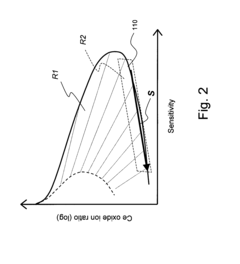
- Implementing time-varying RF and DC fields in the ion guide to selectively eject unwanted ions, reduce charge density, and enhance the transmission of desired ions by applying auxiliary excitation methods such as resolving DC potential, RF dipolar/quadrupolar fields, and segmenting the ion guide to separate and trap ions of interest.
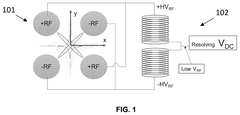
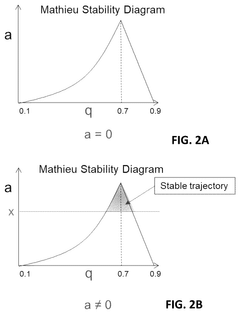
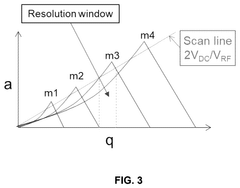
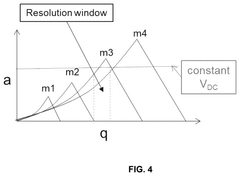
Inductively coupled plasma mass spectrometer
PatentActiveUS7671329B2
Innovation
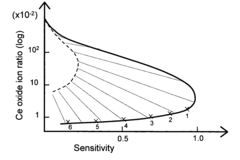
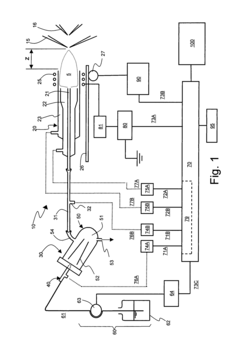
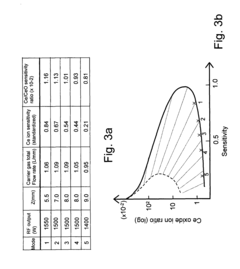
- An ICP-MS system with a control device that adjusts the amount of liquid drops, carrier gas flow rate, RF power output, and plasma torch position to optimize ion sensitivity, allowing for continuous analysis of samples with varying concentrations without additional dilution equipment or lengthy procedures, thereby maintaining high sensitivity and precision.
Environmental and Sample Preparation Considerations
Environmental factors and sample preparation methodologies significantly impact ICP-MS sensitivity and background noise levels. Laboratory conditions must be strictly controlled to minimize contamination sources. Temperature fluctuations can affect instrument stability, while humidity variations may introduce moisture-related interferences. Establishing a clean room environment with HEPA filtration systems and positive pressure differentials represents the gold standard for ultra-trace analysis, reducing airborne particulates that contribute to background signals.
Sample preparation constitutes a critical determinant of analytical success. Conventional acid digestion procedures using high-purity reagents (typically sub-boiling distilled acids) minimize reagent-derived contamination. The selection of appropriate digestion vessels—PTFE or quartz for trace metal analysis—prevents leaching of contaminants into samples. Closed-vessel microwave digestion systems offer advantages by reducing contamination risks and volatile analyte losses compared to open-vessel techniques.
Matrix effects represent a significant challenge in ICP-MS analysis. Complex matrices can suppress or enhance analyte signals, contributing to measurement inaccuracies. Implementation of matrix-matched calibration standards or internal standardization techniques helps compensate for these effects. The addition of collision/reaction cell technology further mitigates polyatomic interferences arising from sample matrices, improving detection capabilities for problematic elements like arsenic, selenium, and iron.
Ultra-purification protocols for reagents and diluents directly impact detection limits. Even trace impurities in water or acids can elevate background signals, masking analytes at ultra-trace concentrations. Double sub-boiling distillation of acids and production of 18.2 MΩ·cm water through multi-stage purification systems represent minimum requirements for ultra-trace analysis.
Sample introduction systems warrant careful consideration. Nebulizer selection affects sample transport efficiency and droplet size distribution, influencing sensitivity and stability. Low-flow nebulizers coupled with efficient spray chambers reduce matrix loading while maintaining sensitivity. Desolvating nebulizers dramatically decrease oxide formation and improve signal-to-background ratios by removing solvent before plasma introduction, though at the cost of increased maintenance requirements.
Pre-concentration techniques offer powerful approaches for challenging samples. Solid-phase extraction, co-precipitation, and chelation methods can selectively isolate analytes from complex matrices while simultaneously removing interfering components, effectively improving detection capabilities by orders of magnitude for specific applications.
Sample preparation constitutes a critical determinant of analytical success. Conventional acid digestion procedures using high-purity reagents (typically sub-boiling distilled acids) minimize reagent-derived contamination. The selection of appropriate digestion vessels—PTFE or quartz for trace metal analysis—prevents leaching of contaminants into samples. Closed-vessel microwave digestion systems offer advantages by reducing contamination risks and volatile analyte losses compared to open-vessel techniques.
Matrix effects represent a significant challenge in ICP-MS analysis. Complex matrices can suppress or enhance analyte signals, contributing to measurement inaccuracies. Implementation of matrix-matched calibration standards or internal standardization techniques helps compensate for these effects. The addition of collision/reaction cell technology further mitigates polyatomic interferences arising from sample matrices, improving detection capabilities for problematic elements like arsenic, selenium, and iron.
Ultra-purification protocols for reagents and diluents directly impact detection limits. Even trace impurities in water or acids can elevate background signals, masking analytes at ultra-trace concentrations. Double sub-boiling distillation of acids and production of 18.2 MΩ·cm water through multi-stage purification systems represent minimum requirements for ultra-trace analysis.
Sample introduction systems warrant careful consideration. Nebulizer selection affects sample transport efficiency and droplet size distribution, influencing sensitivity and stability. Low-flow nebulizers coupled with efficient spray chambers reduce matrix loading while maintaining sensitivity. Desolvating nebulizers dramatically decrease oxide formation and improve signal-to-background ratios by removing solvent before plasma introduction, though at the cost of increased maintenance requirements.
Pre-concentration techniques offer powerful approaches for challenging samples. Solid-phase extraction, co-precipitation, and chelation methods can selectively isolate analytes from complex matrices while simultaneously removing interfering components, effectively improving detection capabilities by orders of magnitude for specific applications.
Validation Methods for Enhanced Detection Limits
Validation of enhanced detection limits in ICP-MS requires rigorous methodological approaches to ensure that improvements in sensitivity versus background noise are scientifically sound and reproducible. The standard validation protocol begins with the determination of method detection limits (MDL) through repeated measurements of blank solutions and low concentration standards, typically following EPA Method 200.8 or similar guidelines.
Statistical validation forms the cornerstone of detection limit verification, employing tools such as signal-to-noise ratio calculations, standard deviation of the blank (σblank), and confidence interval assessments. The limit of detection (LOD) is commonly defined as 3σblank, while the limit of quantification (LOQ) is established at 10σblank, providing different thresholds for reliable analyte identification versus accurate quantification.
Inter-laboratory comparison studies represent another critical validation approach, where multiple facilities analyze identical samples to verify that sensitivity improvements are consistent across different instrumental setups and operator conditions. These collaborative trials help establish reproducibility parameters and identify potential sources of systematic error that might otherwise remain undetected in single-laboratory validations.
Matrix-matched certified reference materials (CRMs) play an essential role in validating enhanced detection capabilities across complex sample types. By analyzing CRMs with certified values near the claimed detection limits, researchers can verify method accuracy under real-world analytical conditions. This approach is particularly valuable when evaluating new collision/reaction cell technologies or novel sample introduction systems.
Recovery studies using spike addition methods provide complementary validation data, especially for challenging matrices where signal suppression or enhancement effects may occur. Standard addition techniques can further validate linearity at ultra-trace concentrations and help identify potential interferences that might compromise detection limit improvements.
Long-term stability testing represents the final validation component, monitoring detection performance over extended periods to ensure that sensitivity enhancements remain stable under routine laboratory conditions. This includes tracking quality control standards, instrument drift patterns, and background signal variations across multiple analytical batches and maintenance cycles.
Validation documentation should include comprehensive uncertainty budgets that quantify all contributing factors to measurement variability, providing a holistic assessment of the true detection capabilities. This approach aligns with modern metrology principles and ensures that claimed improvements in ICP-MS detection limits are both scientifically defensible and practically achievable in routine analytical applications.
Statistical validation forms the cornerstone of detection limit verification, employing tools such as signal-to-noise ratio calculations, standard deviation of the blank (σblank), and confidence interval assessments. The limit of detection (LOD) is commonly defined as 3σblank, while the limit of quantification (LOQ) is established at 10σblank, providing different thresholds for reliable analyte identification versus accurate quantification.
Inter-laboratory comparison studies represent another critical validation approach, where multiple facilities analyze identical samples to verify that sensitivity improvements are consistent across different instrumental setups and operator conditions. These collaborative trials help establish reproducibility parameters and identify potential sources of systematic error that might otherwise remain undetected in single-laboratory validations.
Matrix-matched certified reference materials (CRMs) play an essential role in validating enhanced detection capabilities across complex sample types. By analyzing CRMs with certified values near the claimed detection limits, researchers can verify method accuracy under real-world analytical conditions. This approach is particularly valuable when evaluating new collision/reaction cell technologies or novel sample introduction systems.
Recovery studies using spike addition methods provide complementary validation data, especially for challenging matrices where signal suppression or enhancement effects may occur. Standard addition techniques can further validate linearity at ultra-trace concentrations and help identify potential interferences that might compromise detection limit improvements.
Long-term stability testing represents the final validation component, monitoring detection performance over extended periods to ensure that sensitivity enhancements remain stable under routine laboratory conditions. This includes tracking quality control standards, instrument drift patterns, and background signal variations across multiple analytical batches and maintenance cycles.
Validation documentation should include comprehensive uncertainty budgets that quantify all contributing factors to measurement variability, providing a holistic assessment of the true detection capabilities. This approach aligns with modern metrology principles and ensures that claimed improvements in ICP-MS detection limits are both scientifically defensible and practically achievable in routine analytical applications.
Unlock deeper insights with Patsnap Eureka Quick Research — get a full tech report to explore trends and direct your research. Try now!
Generate Your Research Report Instantly with AI Agent
Supercharge your innovation with Patsnap Eureka AI Agent Platform!